Why Do Cats Knead? The Nursing Instinct That Never Grows Up
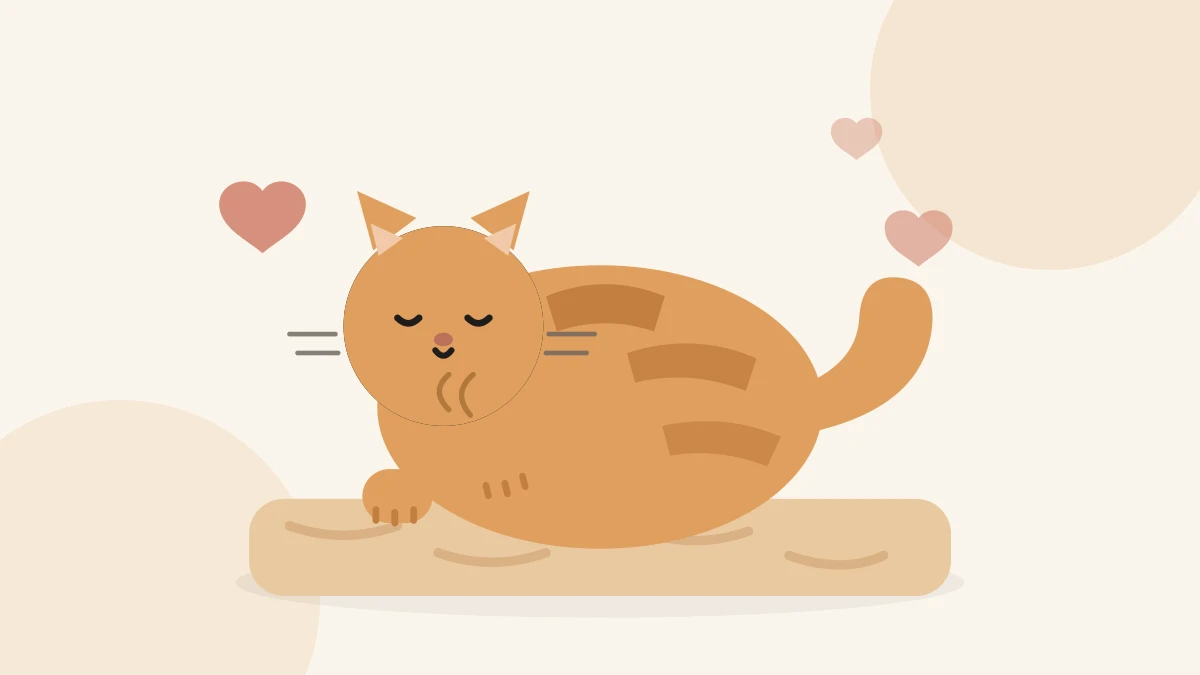
Your cat presses her front paws into a blanket — or your lap — in a slow, alternating rhythm, as if she were kneading dough. That is exactly why the behavior is called kneading, or affectionately, “making biscuits.” The short answer to why: kneading is a nursing behavior that never fully retires. Newborn kittens knead their mother’s belly to stimulate milk flow, and the motion stays wired to feelings of warmth, safety, and contentment for the rest of a cat’s life. Veterinary sources agree on the big picture: in almost every case, kneading is normal, healthy behavior — and when it happens on you, it is a compliment.
What kneading actually looks like
Before the why, the what. Kneading is a rhythmic, alternating push of the front paws against something soft: a blanket, a pillow, a cat bed, your stomach, your thigh. Some cats extend and retract their claws with each push; others keep them tucked in the whole time. Many cats purr while they knead, half-close their eyes, and drift into an expression somewhere between meditation and sleep.
The style varies enormously from cat to cat. Some knead several times a day, some almost never. Some only knead one particular blanket; others reserve the ritual for the exact moment you sit down. All of these variations are within the normal range. Whether and how much a cat kneads is not a health indicator by itself — what matters is whether the overall pattern of behavior changes, which we will get to below.
Where it starts: the milk tread
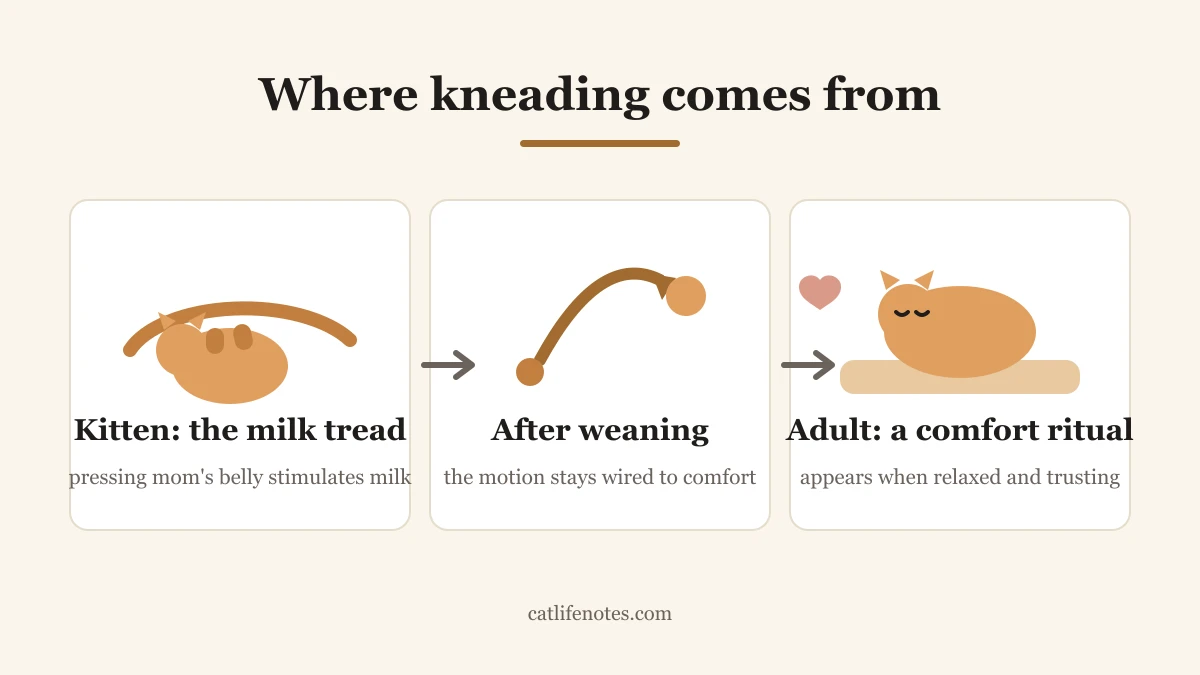
To understand an adult cat’s kneading, go back to her first weeks of life. WebMD’s veterinarian-reviewed article puts it plainly: “When a kitten is first born, they knead against the mother cat’s stomach to stimulate milk.” The motion is part of nursing itself — the rhythmic pressure of tiny paws helps the milk flow, and a kitten that kneads well eats well.
For a kitten, then, kneading is bundled together with food, warmth, the smell of her mother, and total safety. Weaning ends the milk, but not the motion. As PetMD explains, “many cats will continue to knead into adulthood to create a similar sense of calm and relaxation.” The most widely shared reading of the behavior follows directly: an adult cat kneading is a cat returning to the safest feeling she has ever known.
That is also what makes the lap-kneading cat such a compliment. In the words of Zoetis veterinarian Dr. Sam Gilbert: “When a cat kneads an object with a beating heart (namely you), it’s a big compliment!” Your cat has filed you in the same category as her mother — a safe place. It costs you some fabric and occasionally some skin, but it is trust, plainly expressed.
That comfort link also explains a few everyday observations. It is why kneading almost always targets soft surfaces — the texture is the closest thing to a mother cat’s belly. It is why the behavior so often arrives bundled with purring and half-closed eyes: the whole nursing-era relaxation package tends to switch on together. And it is why how much a cat kneads is simply individual — the ritual survives in different quantities in different cats. One popular explanation can be retired along the way: kneading is not a sign of leaving mom too early. WebMD notes that studies show many cats knead no matter how long they stayed with their mother, and Zoetis calls early separation a common misconception — nearly all cats knead, at all ages. Kneading is a souvenir each cat carries out of kittenhood in her own quantity — some bring a whole blanket’s worth, some just a trace.
Five reasons adult cats knead
The nursing instinct is the origin story, but veterinary sources describe several motivations layered on top of it. The first three below are consistently supported across sources; the last two each come with their own citation — and one of them is explicitly a theory.
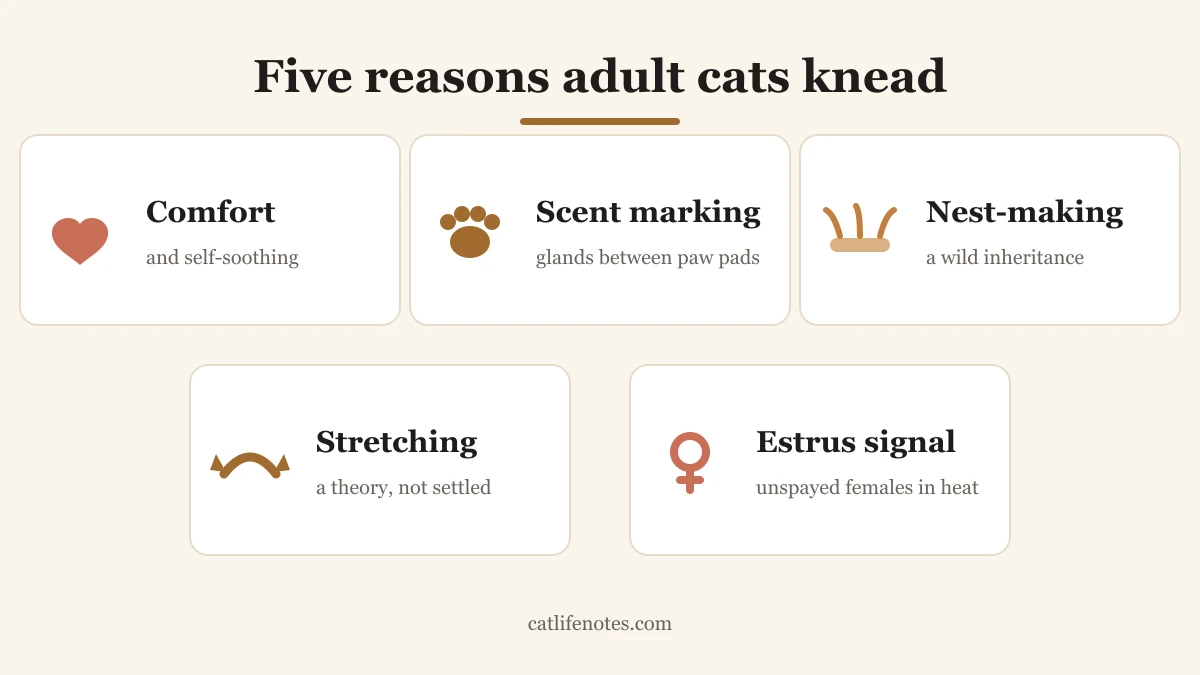
1. Comfort, contentment — and self-soothing. The classic scene: a fed, warm cat settling in for a nap, purring and kneading in rhythm. But the same motion also appears under stress. WebMD notes that cats may knead to unwind from anxiety and release bodily tension, and PetMD points out that excessive kneading can be an anxious cat’s attempt to soothe herself. One behavior, two directions: “I feel good,” and “I am making myself feel better.”
2. Scent marking: claiming you. Cats carry scent glands between their paw pads. PetMD explains that “when they knead an object or a person, their scent is deposited onto that surface.” Scent is one of the most important channels cats use to communicate — WebMD lists kneading alongside licking and spraying as ways cats mark territory. So when your cat kneads your lap, she is, in a quiet chemical way, broadcasting to the world: this human is taken.
3. Nest-making: an inheritance from the wild. PetMD notes that wild feline species will knead soft grasses and bedding material as they prepare a resting spot, and WebMD likewise describes wild cats kneading grass or dirt to make it more comfortable. A house cat giving her blanket a few determined rounds of kneading before curling up is very likely running the modern version of that ancient bed-making routine.
4. Stretching (a theory). Some experts suggest kneading doubles as a stretch, keeping the muscles of the forelegs and shoulders limber. PetMD is careful to label this one as something “some experts also theorize” — not settled science. Animal behavior has plenty of open questions; this site’s rule is to say so rather than dress a guess up as a fact.
5. Estrus signaling (unspayed females). Zoetis notes that females may use kneading when in heat, as one of the ways they signal availability to males. If you live with an unspayed female and see kneading in that context, it is part of her cycle, not a behavior problem.
When kneading deserves attention
Start with the baseline: PetMD’s answer to “should I worry about kneading?” is that it is “typically normal cat behavior you don’t need to worry about.”
What deserves attention is change, not the behavior itself. PetMD cautions that excessive kneading “can be a sign that your cat is uncomfortable or anxious,” and Zoetis recommends consulting a veterinarian if obsessive kneading appears suddenly. In practice, the situations worth a call to the vet look like this: a cat who rarely kneads suddenly kneading constantly; kneading that arrives together with changes in appetite, energy, or litter box habits; or compulsive, repetitive behavior that starts right after a big disruption at home — a move, a new pet, a new person.
And to be clear about what this article is: it explains behavior, it does not diagnose. If your cat’s behavior changes suddenly, the first stop is your veterinarian, not an article on the internet.
Living with a kneader
Kneading itself needs no correction. The only real problem it causes is mechanical: claws rhythmically pressed into your thigh hurt. The veterinary sources converge on the same short playbook:
- Never punish it. Kneading is instinctive. WebMD and Zoetis both say it outright: do not punish a kneading cat. Punishment will not switch off an instinct — it will only damage her trust in you.
- Assign a kneading blanket. WebMD suggests keeping a designated blanket, and sliding it between paws and lap when the biscuits start. Everyone wins.
- Keep the nails trimmed. PetMD and Zoetis both list regular nail trims as basic maintenance. Blunt claws turn kneading back into a massage.
- Redirect gently when it hurts. Zoetis recommends diverting an enthusiastic kneader with a toy or play instead of pushing her away. The principle: offer a better option, don’t block the instinct.
Notice what these four moves have in common: they adjust the environment, not the cat. Kneading exists because it means safety to her. Arrange the blanket and the claws so that her comfort stops costing you pain, and both of you keep what you came for. Try to train the instinct away instead, and you lose far more than a blanket — you switch off her clearest way of telling you she trusts you.
Do these four things and kneading goes back to being what it really is — a slightly ridiculous, completely endearing bedtime ritual from an animal that trusts you.
FAQ
Do cats knead their whole lives? Many do. Zoetis notes that nearly all cats knead, at all ages — what varies enormously is how often. PetMD’s framing is that kneading is typical, normal behavior, and a cat who rarely kneads is not a cat with a problem.
Why does my cat only knead on me and nobody else? Because safety is personal. As Zoetis puts it, a cat kneading “an object with a beating heart” is showing she feels safe and comforted with that specific person. She picked you. Take the compliment.
Kneading with claws out is painful — what can I do? Trim the nails and add a thick blanket; that solves most of it. For the rest, redirect with a toy or shift positions — but don’t punish, which is the one line every veterinary source draws.
My cat suddenly kneads constantly. Is that normal? A sudden, compulsive increase in kneading is worth attention. PetMD notes excessive kneading can reflect discomfort or anxiety, and Zoetis advises seeing a veterinarian when obsessive kneading appears suddenly — especially if appetite, energy, or other habits changed at the same time.
Should I stop my cat from kneading altogether? No. Kneading is an instinct carried over from nursing, and one of the clearest signals of trust a cat gives. The veterinary sources are unanimous against punishing it. Manage the inconvenient parts — claws, timing, location — with a designated blanket, nail trims, and gentle redirection, and leave the behavior itself alone.