How to Read a Cat Food Label: Complete Nutrition, Ingredients, and Claims
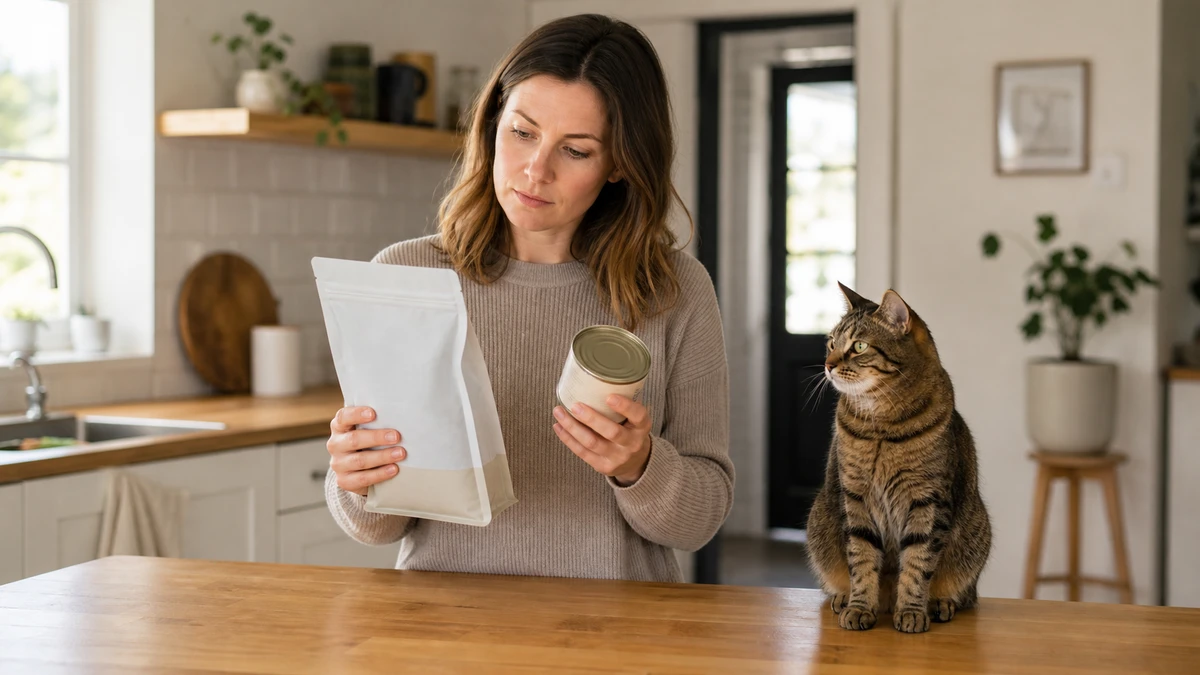
Read a cat-food label in this order: intended species and purpose, complete-versus-supplemental status, life stage, nutritional-adequacy basis, calories, nutrient analysis, ingredients, feeding directions, responsible company, and lot/date information. That sequence tells you much more than the front image, the first ingredient, or words such as “premium,” “natural,” and “grain-free.” Match the food to the cat first; compare products second.
Label law and vocabulary vary by market. The U.S., European Union, Taiwan, and other jurisdictions do not require identical panels or phrases. The regional examples below were checked in August 2026; use the regulator for the country where the product is sold when a legal detail matters.
A three-pass routine is faster than reading every word
Turn the package over instead of deciding from its front. Make three passes:
- Fit: Is it for cats, is it a complete daily food or a supplemental product, and does its life stage fit this cat?
- Amount: How many calories does it provide, what nutrients are declared, and what quantity does the feeding guide suggest as a starting point?
- Traceability: Who is responsible for it, how can that company answer questions, and where are the lot code, best-before or expiry date, and storage directions?
Only after those checks should you study the ingredient list and voluntary claims. This order prevents a colorful front panel or familiar ingredient name from outranking the information that establishes intended use.
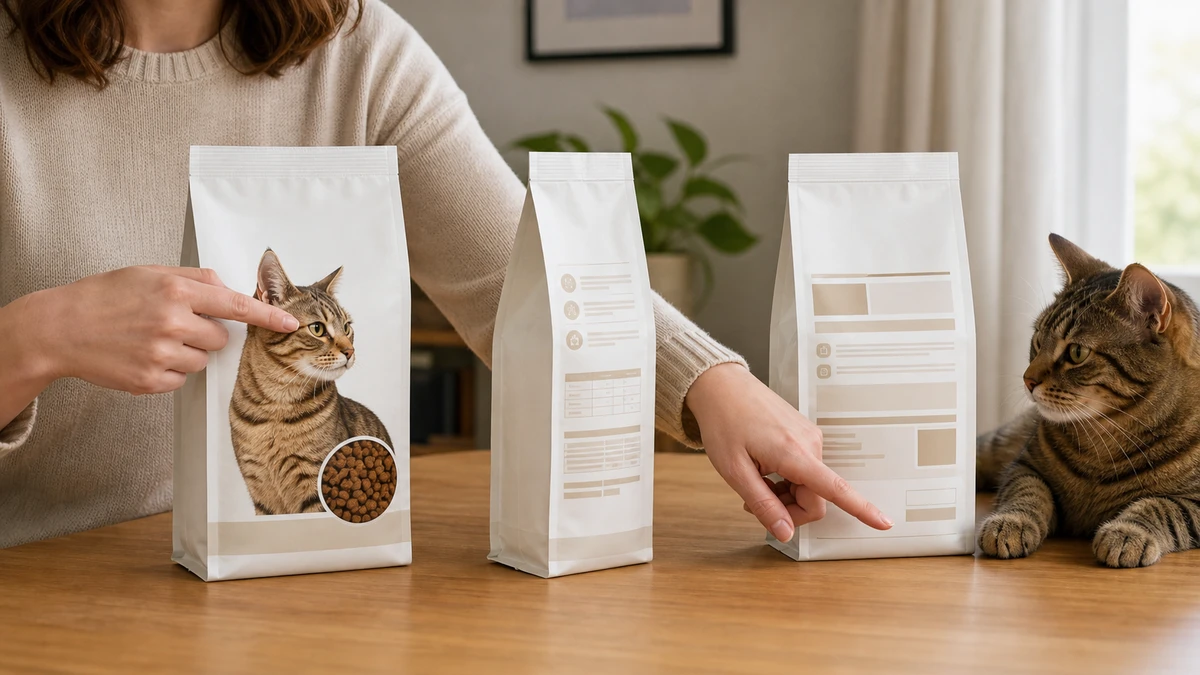
Eleven label fields worth finding
| Field | What to look for | Why it matters |
|---|---|---|
| 1. Product identity | Product name plus clear identification that it is food for cats | A cat picture alone is not the same as an intended-species statement |
| 2. Intended use | Complete and balanced, complete pet food, complementary food, supplemental or intermittent feeding, treat, topper, or mixer | Tells you whether it can serve as the sole diet |
| 3. Life stage | Growth, adult maintenance, gestation/lactation, all life stages, or the local equivalent | Nutrient needs are not identical across life stages |
| 4. Adequacy basis | A nutrient-profile formulation, feeding test, or the substantiation recognized in that market | Explains how a complete-nutrition claim was supported |
| 5. Calorie or energy content | kcal/kg and kcal per can, pouch, cup, piece, or gram when available | Lets you calculate the amount actually served |
| 6. Nutrient panel | U.S. guaranteed analysis, European analytical constituents, or the local nutrition declaration | Gives declared nutrient values, usually on an as-sold basis |
| 7. Ingredients/composition | Ingredients or feed materials, plus any separately declared additives | Shows what was used, but not the finished food’s total quality |
| 8. Feeding directions | Amount per body weight and time, preparation, and any special-use direction | Provides a starting quantity, not an individualized prescription |
| 9. Responsible company | Manufacturer, distributor, importer, guarantor, or responsible operator and contact route | Gives you someone to ask for typical analyses and quality information |
| 10. Net quantity | Weight, volume, or count | Needed for cost-per-day and portion calculations |
| 11. Traceability and storage | Lot/batch code, best-before or expiry information, and storage directions | Essential for freshness questions, complaints, and recalls |
Some details may be split between an outer carton and individual containers. Photograph every relevant panel before discarding packaging, especially when buying a multipack.
“Complete” and “complementary” answer the most important question
In the United States, a nutritional-adequacy statement that says a cat food is “complete and balanced” identifies the species and life stage it is meant to support. The FDA explains that this claim is commonly substantiated by meeting an AAFCO cat-food nutrient profile or by passing a feeding trial using AAFCO procedures. The statement may instead say the product is for intermittent or supplemental feeding only.
In the European framework, “complete pet food” supplies all daily nutrients when fed as directed, while “complementary pet food” is intended to be combined with something else or used in a limited role such as a treat. The wording differs, but the practical question is the same: Can this product provide the whole diet for this cat in its stated use?
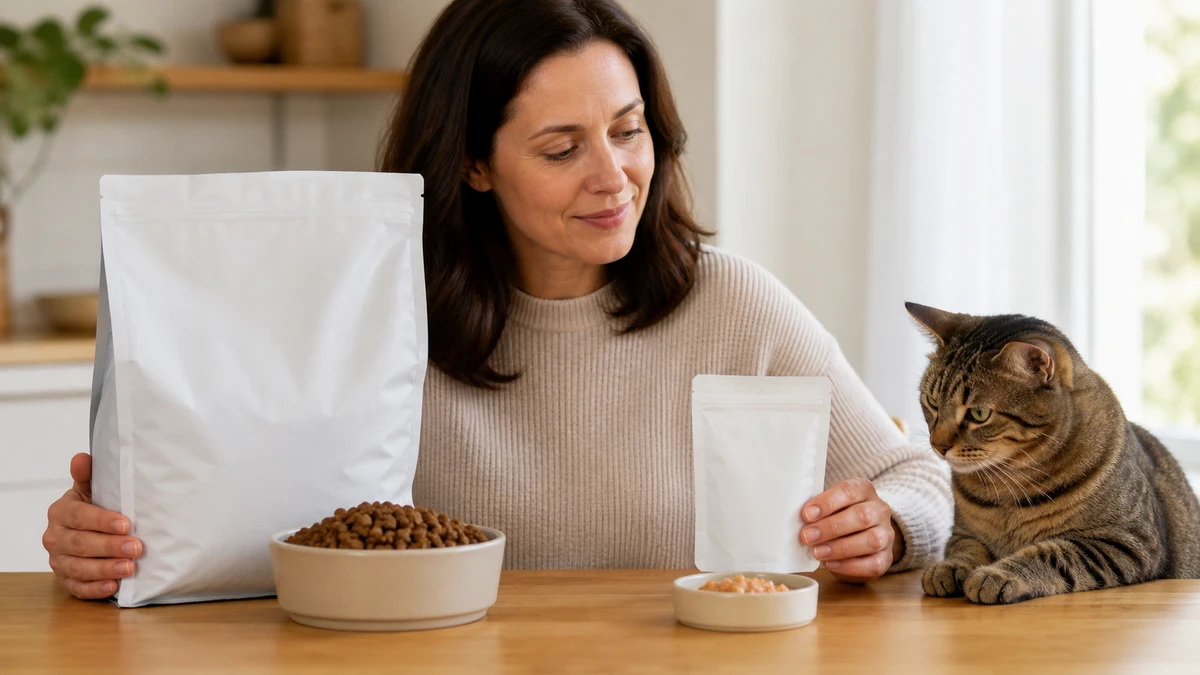
A topper can be useful without being complete. A treat can be safe without being a meal. Neither should silently displace a large share of a complete diet. Therapeutic products intended for intermittent or supervised use are a special case; follow the veterinary team’s plan rather than relabeling them as ordinary food.
Match the life stage, then read how adequacy was established
For U.S. AAFCO profiles, the major categories are growth and reproduction, adult maintenance, and products intended for all life stages. “All life stages” has to cover the more demanding growth/reproduction profile; it does not mean every individual cat should automatically receive the same portion.
Do not treat “senior,” “indoor,” “sterilized,” or a breed image as a substitute for the legally meaningful adequacy and life-stage statement. These front-panel descriptions may help define a product, but the back-panel purpose tells you whether it is complete for the cat’s actual stage.

The adequacy method also has limits. Formulation to a recognized nutrient profile and a feeding trial are different forms of substantiation, but neither front-panel phrase tells you everything about manufacturing controls, digestibility, long-term research, or the level of every nutrient in a production batch. WSAVA therefore recommends asking who formulates the food, what quality-control testing is used, who manufactures it, and whether the company can provide a typical nutrient analysis.
U.S. and European labels should not be read as one global system
As of August 2026, U.S. pet-food oversight combines federal requirements with state rules. The FDA identifies federal basics such as product identity, net quantity, responsible business information, and ingredients. AAFCO publishes model regulations that many states adopt in some form, but AAFCO itself is not a legislature or an approval seal.
U.S. packages may also look different from one another during the Pet Food Label Modernization transition. AAFCO approved new model regulations in 2023 and recommended a six-year transition while individual states consider adoption. A Nutrition Facts-style box and a more traditional guaranteed-analysis panel may therefore coexist; the panel’s shape alone does not tell you which food is better.
In the European Union, Regulation (EC) No 767/2009 governs feed marketing and labeling, and the European Commission recognizes the FEDIAF good-labeling code. European labels commonly use “composition,” “analytical constituents,” and “additives,” and distinguish complete from complementary food. Calorie information is useful but, as WSAVA notes, it is not required on pet-food labels in every market.

Taiwan has its own Chinese-label requirements and a Ministry of Agriculture pet-food portal for product, business, inspection, and noncompliance information. Other places have their own competent authorities. An imported product can carry several panels; use the legally applicable local panel rather than assuming U.S. AAFCO wording or European FEDIAF terminology controls everywhere.
Calories and the nutrient panel answer different questions
Calories tell you how much energy a portion supplies. In the current U.S. model, the calorie statement is expressed as kilocalories per kilogram as sold and per familiar unit such as a can or cup. For practical feeding, kcal per can, pouch, cup, or gram is usually easier to use than percentages.
The nutrient panel describes selected nutrients, not meal size. A traditional U.S. guaranteed analysis generally gives minimum crude protein and crude fat and maximum crude fiber and moisture. A minimum is not the exact average in every batch; a maximum is not the exact amount either. European “analytical constituents” use a different legal format. Do not compare numbers without first checking what basis and type of declaration they represent.
If calories or a nutrient you need are not on the applicable label, contact the responsible company. Ask for calories per gram and a typical analysis, preferably per 100 or 1,000 kcal when comparing nutrients. That energy basis can be more informative than percentages alone because cats eat food to obtain calories, not equal package weights.
How to compare wet and dry food on a dry-matter basis
Package percentages are usually “as fed,” meaning water is still included. That makes a direct wet-versus-dry comparison misleading. Use the FDA’s dry-matter method:
dry matter (%) = 100 − moisture (%)
nutrient on a dry-matter basis (%) = as-fed nutrient (%) ÷ dry matter (%) × 100
Consider this math example only—not a product recommendation:
| Example food | As-fed crude protein | Moisture | Dry matter | Protein on dry-matter basis |
|---|---|---|---|---|
| Wet food A | 10% | 78% | 22% | (10 ÷ 22) × 100 = 45.5% |
| Dry food B | 32% | 10% | 90% | (32 ÷ 90) × 100 = 35.6% |
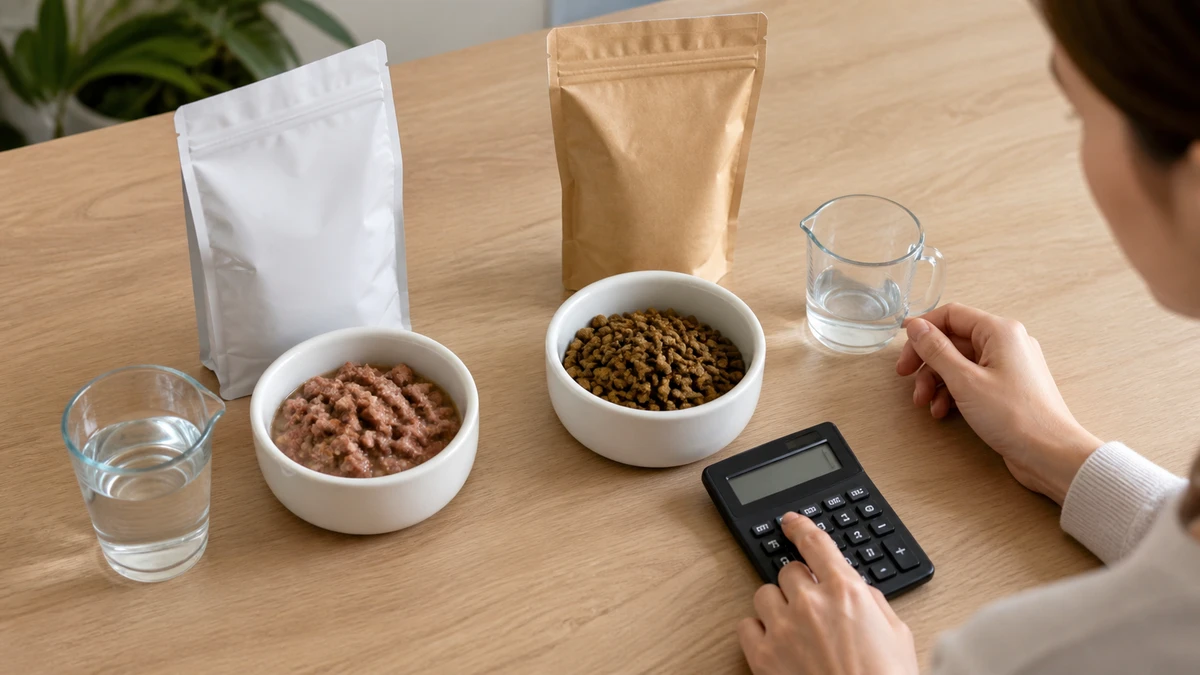
The dry food looks higher in protein on the original package—32% versus 10%—but the order reverses after removing water from the comparison. This calculation solves only the moisture mismatch. It does not tell you amino-acid balance, digestibility, ingredient quality, calorie density, manufacturing control, or whether either food is appropriate for a particular cat. Guaranteed minimums also remain guarantees, not exact averages. For a serious comparison, ask for typical nutrient values per calorie and discuss medically important nutrients with the veterinary team.
For a broader format decision, see the separate guide to wet versus dry cat food.
The first ingredient is a weight clue, not a quality score
In the United States, ingredients are listed in descending order by weight as they enter the formula. Water counts. A moisture-rich meat can rank above a dry ingredient partly because it brings more water before processing; a concentrated meal has already lost much of that water. The order therefore cannot show which ingredient supplies the most usable protein in the finished food.
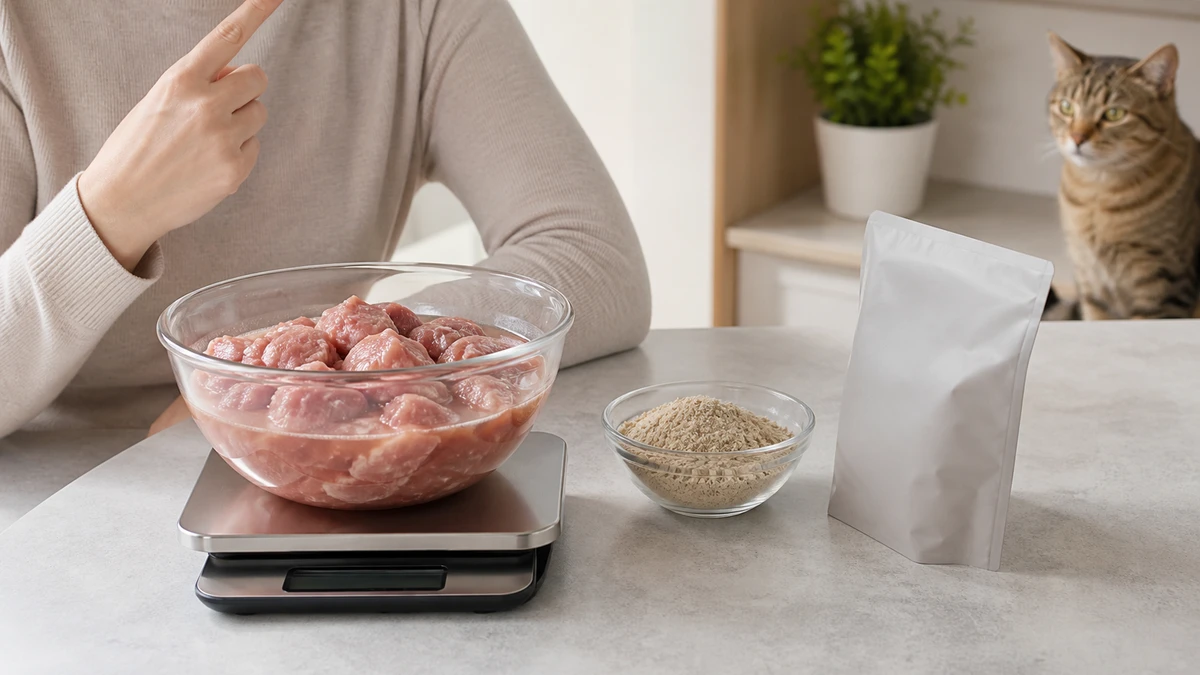
The list also does not reveal ingredient digestibility, supplier testing, batch consistency, final nutrient concentrations, or whether qualified nutritionists formulated the product. WSAVA explicitly cautions that an ingredient list alone can mislead an overall quality judgment.
Use the list for concrete needs: identifying an ingredient a veterinarian has told you to avoid, checking whether a flavor claim has a source, or preparing precise questions for the manufacturer. Do not use it to award points for a first ingredient or subtract points for every unfamiliar scientific name; vitamins, minerals, and amino acids may have technical names because they are declared ingredients.
Marketing words and pictures cannot establish nutritional quality
Words such as “premium,” “holistic,” “natural,” “grain-free,” “ancestral,” and “human-grade” are not interchangeable with complete nutrition. Their definitions and controls vary. AAFCO notes that “premium” has no special feed-law requirements in the United States, while “natural” follows a definition but is not a statement of safety. WSAVA likewise treats unregulated marketing phrases as having little practical value for nutritional assessment.
Product-name wording may have specific regional rules. Under AAFCO models, names such as “chicken cat food,” “chicken dinner,” “cat food with chicken,” and “chicken-flavor cat food” represent different inclusion rules. That can help interpret the name, but it still does not prove the whole food is complete, well manufactured, or right for this cat.
Images of meat, vegetables, forests, or laboratory coats are presentation. Claims should be objective and supportable, but a package scene is not a nutrient analysis. Start with adequacy, calories, and the responsible company even when the front panel is persuasive.
Feeding directions are a starting point, not a prescription
AAFCO explains that feeding directions for complete foods are guidelines that may need modification for an individual animal. The printed amount cannot see this cat’s body condition, activity, neuter status, treats, mixed feeding, health, or weight trend.
Use the label amount as an initial estimate. Measure it consistently—grams are usually more repeatable than a loosely filled cup—include treats and toppers in the total, and monitor body weight and body condition over time. If wet and dry foods are combined, do not serve the full stand-alone label amount of each; plan the combined calories.
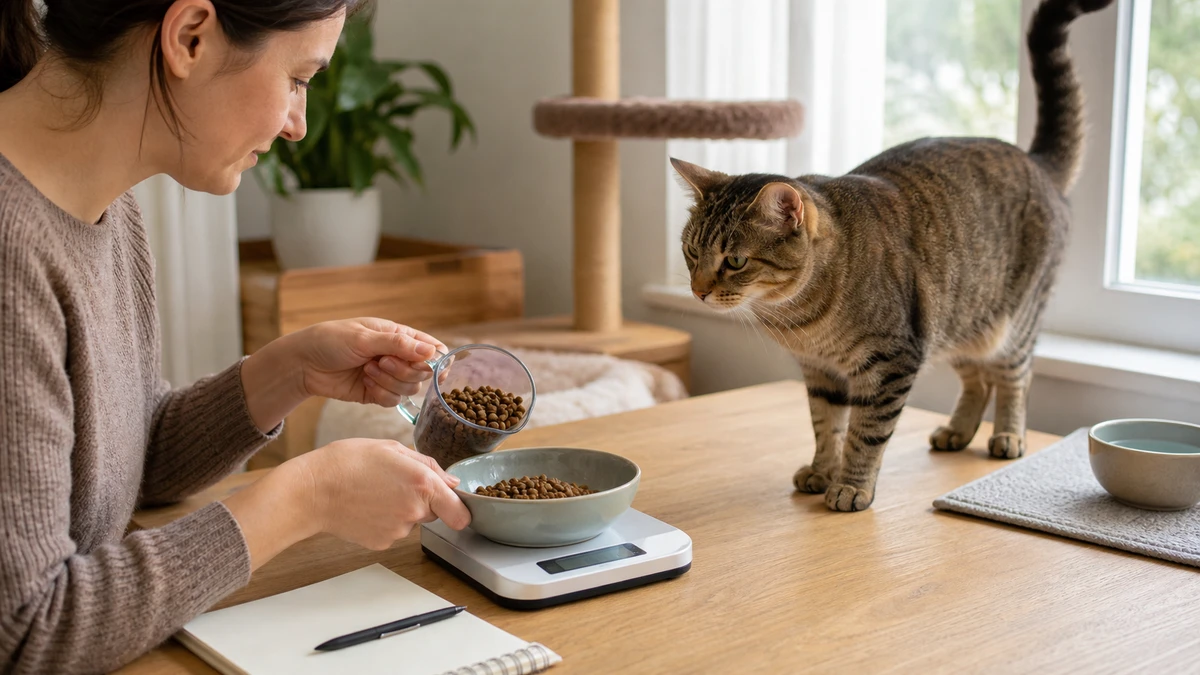
Ask a veterinarian before making a medically significant change, especially for a kitten, a pregnant or nursing cat, a cat with diagnosed disease, or a cat on a therapeutic diet. A new loss of appetite, weight change, vomiting, diarrhea, or change in drinking or urination is a reason for veterinary assessment, not a reason to diagnose the label at home.
Save the lot code, date, company contact, and original package
The responsible-company line matters because many useful values are not printed. Ask who formulates and manufactures the food, what quality checks are performed, whether the company tests the finished product, and whether it can provide typical nutrient values. A complete answer is more useful than a slogan.
The lot or batch code and best-before or expiry information connect your package to a production run. Photograph them when opening the food. Keep the receipt if a problem arises. Record when it was opened, and follow the product’s own storage directions.

The FDA recommends retaining dry food in its original bag; if using a storage container, placing the entire bag inside preserves the label, lot code, best-before date, and packaging barrier. Keep food cool and dry, close it between uses, and wash and fully dry a container before starting a new bag. Follow package directions for opened wet food rather than inventing one universal refrigerator time.
A final label checklist
Before buying or changing a food, confirm:
- It is identified for cats and the intended use is clear.
- A sole diet is complete for the correct life stage; complementary or supplemental food stays in its intended role.
- The adequacy basis and regional wording make sense for where it is sold.
- Calories are available per practical serving or from the manufacturer.
- Nutrient numbers are compared on the same basis; wet versus dry percentages are not compared raw.
- The ingredient list is used for facts, not as a finished-product score.
- Marketing terms, package art, and the first ingredient do not override adequacy and quality control.
- The feeding guide is treated as a monitored starting point.
- The responsible company can answer reasonable formulation and quality questions.
- Lot, date, storage, and local-regulator information are saved.
The best label is not necessarily the prettiest or the longest. It is one that clearly identifies a complete purpose, lets you calculate the food actually fed, provides traceability, and belongs to a company able to explain how the finished diet is formulated and controlled.
FAQ
Is the first ingredient the most important ingredient in cat food?
No. It is the heaviest ingredient before processing, including its water. That does not reveal the finished food’s digestibility, nutrient balance, or quality control. Use the adequacy statement, calories, finished-product information, and manufacturer answers alongside the ingredient list.
What is the difference between complete and complementary cat food?
Complete food is intended to provide the full daily nutrient supply when used as directed for the stated species and life stage. Complementary or supplemental food has a limited role—such as a topper, mixer, treat, or supervised use—and should not automatically replace the complete diet.
Can I compare the protein percentage on wet and dry cat food labels?
Not directly when moisture differs greatly. Convert both to a dry-matter basis, or preferably obtain typical nutrient values per 100 or 1,000 kcal. Dry-matter conversion corrects for water but does not determine overall quality or medical suitability.
Does “natural,” “premium,” or “grain-free” mean a food is better?
No. These words have varying definitions or may be marketing terms, and none substitutes for complete nutrition, suitable calories, qualified formulation, finished-product testing, or a match to the individual cat.
What if the package has no calorie information?
Requirements differ by market. Contact the responsible company for kcal per gram and per familiar serving, check the applicable local regulator, and be cautious if the company cannot provide basic nutrition information. For an individualized amount, ask the veterinary team rather than guessing from package volume.