Why Do Cats Like Boxes? Safety, Warmth, and Better Box Choices
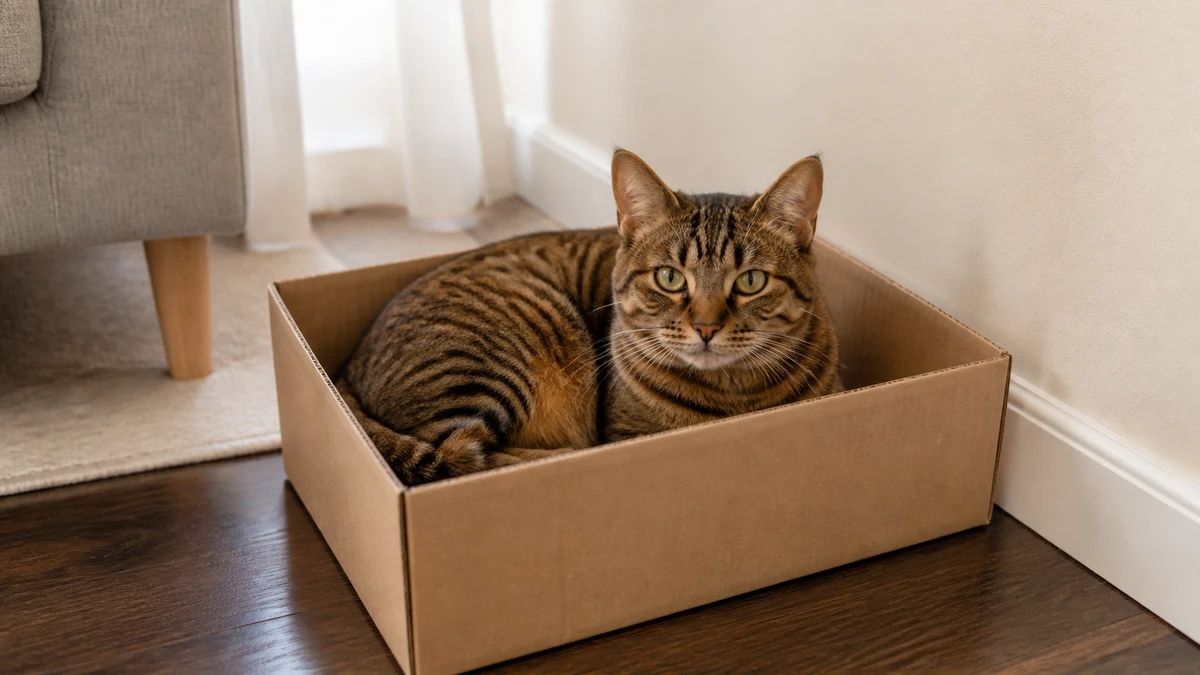
Cats often like cardboard boxes because one simple object can provide concealment, a quiet resting boundary, a warmer microclimate, something new to explore, and a place to watch or pounce from. Those functions can overlap, and no study proves that every cat enters every box for one universal reason. A cat that naps in a box, emerges for normal meals and litter-box use, and freely changes resting places is usually making an ordinary choice. A sudden increase in hiding—especially with reduced eating, altered toileting, lower activity, pain signs, or failure to come out—needs a different response and may warrant veterinary advice.
The useful question is therefore not “What secret rule makes all cats love boxes?” It is “What does this particular box let this cat do, and can the cat enter, leave, cool down, and choose another place safely?”
A box can meet several needs at once
1. Concealment can create a sense of safety and control
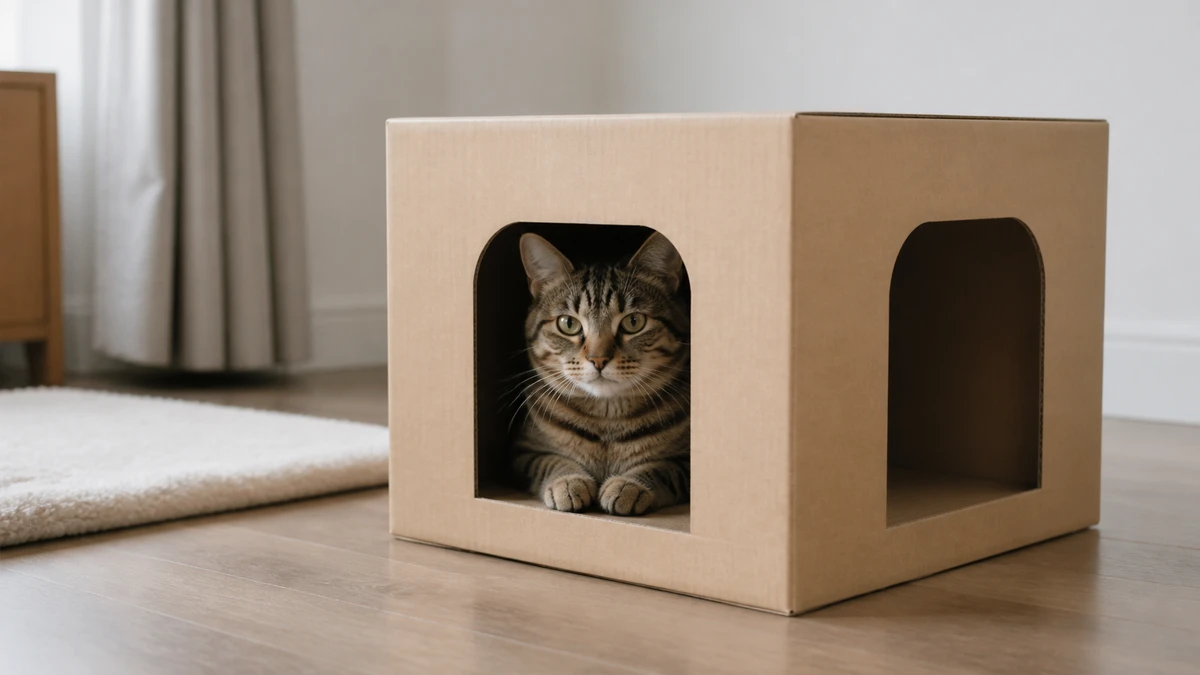
A box reduces the number of directions from which a cat can be approached or watched. From inside, the cat may monitor an opening without remaining exposed on every side. The AAFP/ISFM environmental guidelines describe a safe place as private and secure, often raised or enclosed, and specifically list a cardboard box placed on its side as one option.
“Safe” does not mean a cat believes cardboard is armor. It means the setup may make contact more predictable and give the cat control over whether to observe, withdraw, or leave. That choice matters in unfamiliar homes, busy rooms, multi-pet households, and veterinary or shelter settings.
2. A defined boundary can support undisturbed rest
Cats Protection notes that hiding is part of normal feline behavior: cats may seek a safe sleeping place, lie in wait for play, or simply feel safer out of view. A box also creates a clear resting boundary that people, children, and other animals can learn not to cross. It may reduce passing movement and visual interruption even when the room itself cannot be made completely quiet.
The box should be an optional retreat, not a place where a cat is cornered for petting, medication, or introductions. Reaching in whenever the cat withdraws removes the control that made the space useful.
3. Cardboard may form a comfortable microclimate—but heat is not the whole answer
Corrugated cardboard contains air spaces, and box walls reduce some drafts. A curled cat also exposes less surface area than a stretched cat. Together, these features can make a small box feel warmer than an open floor. Cats do show thermal behavior: the 2023 EFSA review describes cats seeking heat, sunlight, insulating materials, and curled postures in cooler conditions, while choosing cooler surfaces and more extended postures in warmer conditions.
However, there is no direct evidence that warmth explains every box choice. The often-repeated claim that a domestic cat’s thermoneutral zone is 30–38°C (86–100.4°F) came from interpretations of older metabolic-chamber studies. EFSA concluded that this range may have been misinterpreted for adult cats and should be reconsidered. It is not a target home thermostat, and it certainly is not a reason to put a box beside a heater or in strong sun.
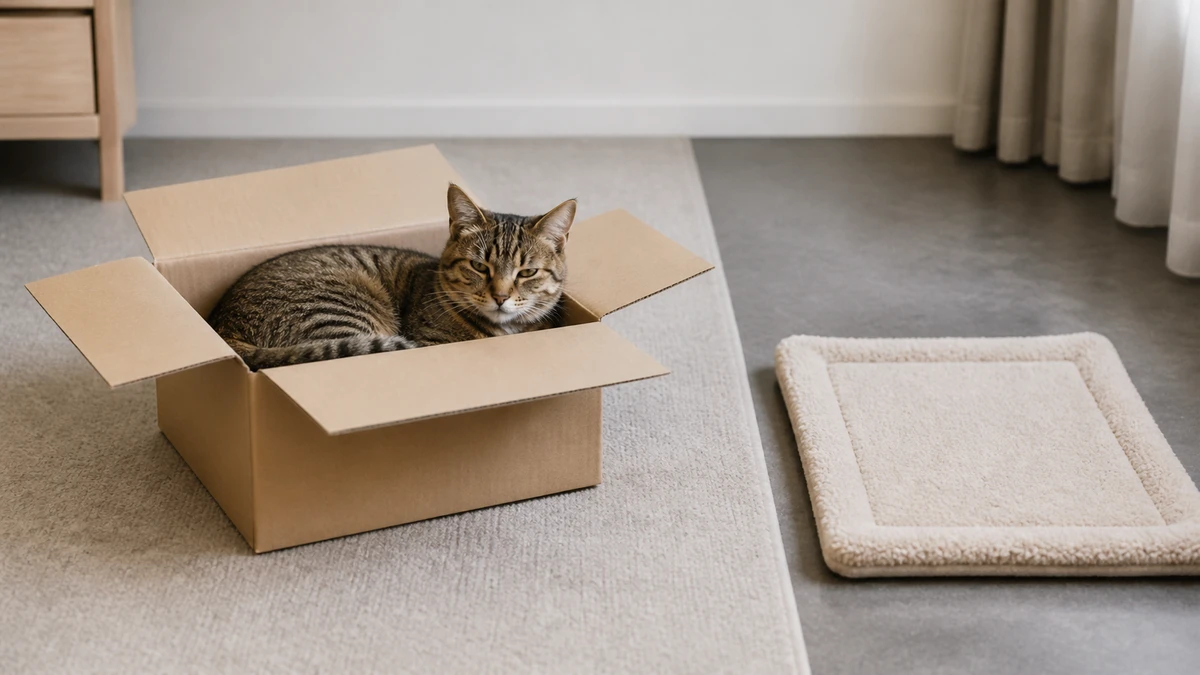
Offer choice instead: a snug box, a more open bed or mat, and access to a cooler area. Keep every box ventilated and easy to leave. Seniors, kittens, ill cats, flat-faced cats, and cats with limited mobility may need more active temperature monitoring and individualized veterinary guidance.
4. A new box is an object to investigate
Cats use smell, whisker contact, paws, and body position to assess changes in their territory. A newly opened delivery box brings different surfaces, edges, cavities, and odors. Investigation may involve sniffing, stepping in and out, rubbing, scratching, or sitting briefly. Curiosity explains why a cat may inspect a box and abandon it five minutes later; lasting affection is not required.
Remove shipping contents first. Strong chemical smells, powders, food residue, pest treatments, or unknown spills are reasons not to offer the box at all.
5. An opening can support stalking and ambush play
A box creates cover from which a cat can watch a toy, reach through an opening, or burst out during play. Cats Protection includes lying in wait and pouncing among normal reasons for hiding, and Cornell notes that play can encourage stalking, pouncing, and problem solving.
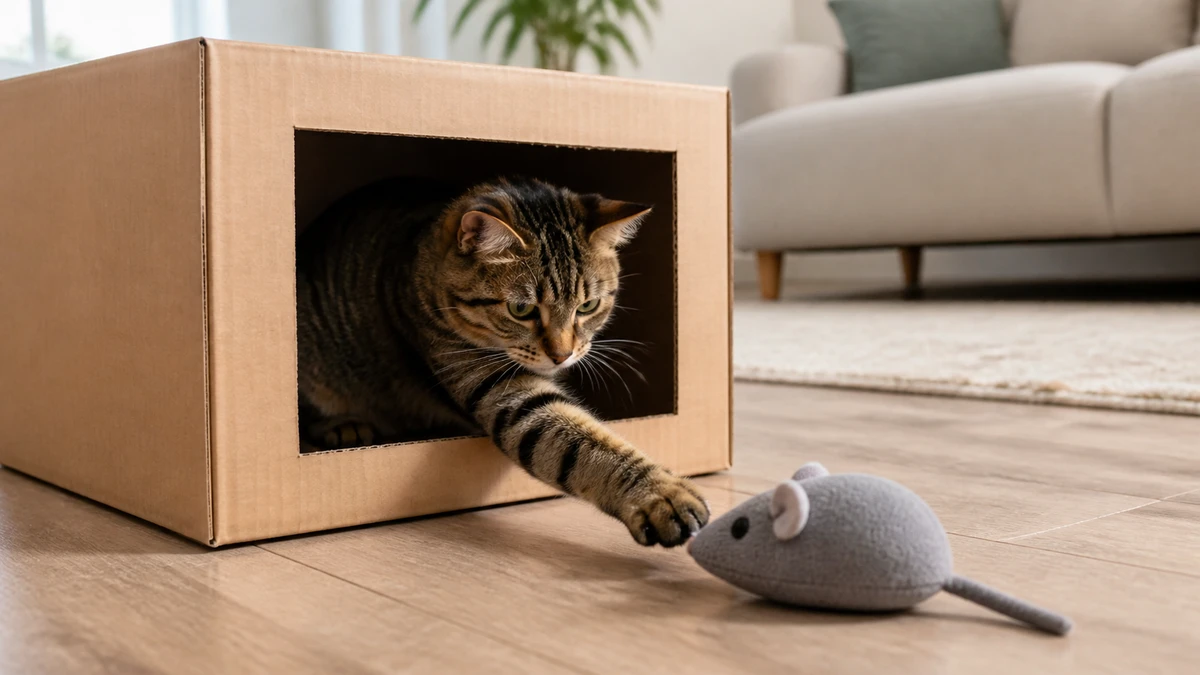
Keep the game safe: move a sturdy toy past the opening, let the cat catch it, and stop before arousal spills into grabbing hands or chasing another pet. Never use fingers as the target. Put away string, ribbon, feathers, and toys with detachable pieces after supervised play.
What the hiding-box research actually found
The strongest evidence is about hiding opportunities in stressful confinement, not a universal preference for online-shopping boxes.
A 2019 randomized controlled trial followed 23 newly arrived adult cats during their first 12 days in quarantine at one Dutch shelter. Twelve cats received a cardboard hiding box measuring 44 × 31 × 26 cm with two openings; 11 cats did not. Behavioral Cat-Stress-Scores decreased in both groups, but the box group declined faster and reached a lower stable score seven days sooner. The difference was largest early in the stay.
Important limits keep that finding in proportion:
- the sample was small and came from one shelter;
- cats were individually housed in quarantine cages, not roaming familiar homes;
- observation lasted 12 days;
- the outcome was a behavioral stress score, not proof of a specific emotion inside the box;
- boxes did not significantly prevent weight loss, and adoption rate and length of stay did not differ.
The study supports offering a hide to cats coping with an unfamiliar, confined environment. It does not prove that every home cat is stressed when entering a box, that cardboard is superior to every covered bed, or that one box replaces veterinary care, predictable routines, separated resources, and appropriate social management.
Choose by posture and access, not a single size formula
Cats vary in body size, flexibility, coat, age, mobility, temperature preference, and desire for concealment. Instead of declaring one “perfect” box, place two or three safe options and watch what the cat does.
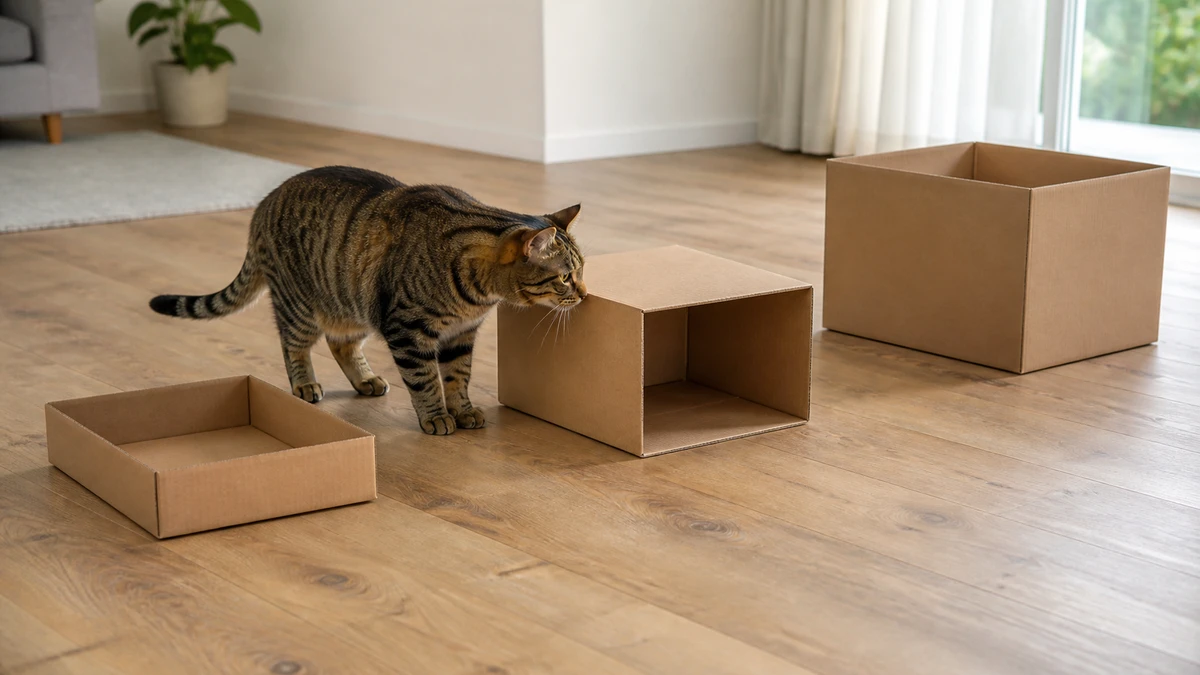
- For curling and concealment: try a box whose floor supports the curled body without forcing the spine or limbs against a hard edge. The cat should enter and turn without getting stuck.
- For stretching: offer a longer open box or bed nearby. A cat should not have to choose between cover and the ability to change posture.
- For observation: a side opening or low front edge lets the cat see the room while keeping part of the body covered.
- For cautious cats: two openings can prevent another pet or a child from blocking the only exit.
- For mobility limits: use a low, smooth entrance and keep the box on the floor. Do not expect an older, painful, weak, or disabled cat to climb or jump into a high-sided box.
- For multi-cat homes: provide multiple resting and hiding places in separate locations. One coveted box in a narrow corridor can become a resource another cat guards.
Location matters as much as dimensions. Start in a dry, quiet, low-traffic area away from doors that can swing into the box. Keep food, water, and litter resources accessible but not inside the hiding place. A raised box is only acceptable on a broad, stable surface with a safe route up and down; a cardboard tower is not automatically a safe perch.
Let preference be data. If the cat chooses a larger open box, do not keep replacing it with a tiny “cute” one. If the cat ignores cardboard but uses a carrier with soft bedding, that is a valid safe-space choice too.
A 12-point cardboard-box safety check
Inspect a box before offering it and again as it wears.
- Start clean and dry. Discard boxes with mold, moisture, oil, food residue, powders, pests, or a strong unknown odor.
- Remove every staple. Check folded flaps and the bottom, not just the visible opening.
- Remove tape, labels, and exposed adhesive. A cat may chew or lick loose strips.
- Remove string, twine, ribbon, plastic wrap, foam, and handles. Linear and small detachable materials can be swallowed.
- Smooth every opening. Cut away sharp points and loose cardboard fibers; make the opening large enough for shoulders and hips.
- Confirm ventilation. Never seal a cat inside, close all flaps, or place the box where airflow is poor.
- Give an easy exit. In homes with children or other animals, add a second opening and keep both routes clear.
- Place it on a stable surface. Keep it away from stairs, balconies, doors, and furniture that could fall during play.
- Do not stack casually. A box that holds a resting cat may collapse when jumped on. Avoid unstable towers and heavy objects above it.
- Watch chewing. Replace the box if the cat tears off and swallows pieces; ask a veterinarian about repeated non-food eating.
- Replace soiled or damaged cardboard. Cardboard is difficult to disinfect thoroughly once wet, contaminated, crushed, or heavily shredded.
- Check before moving or recycling. Look and feel inside every time. Never assume the box is empty.
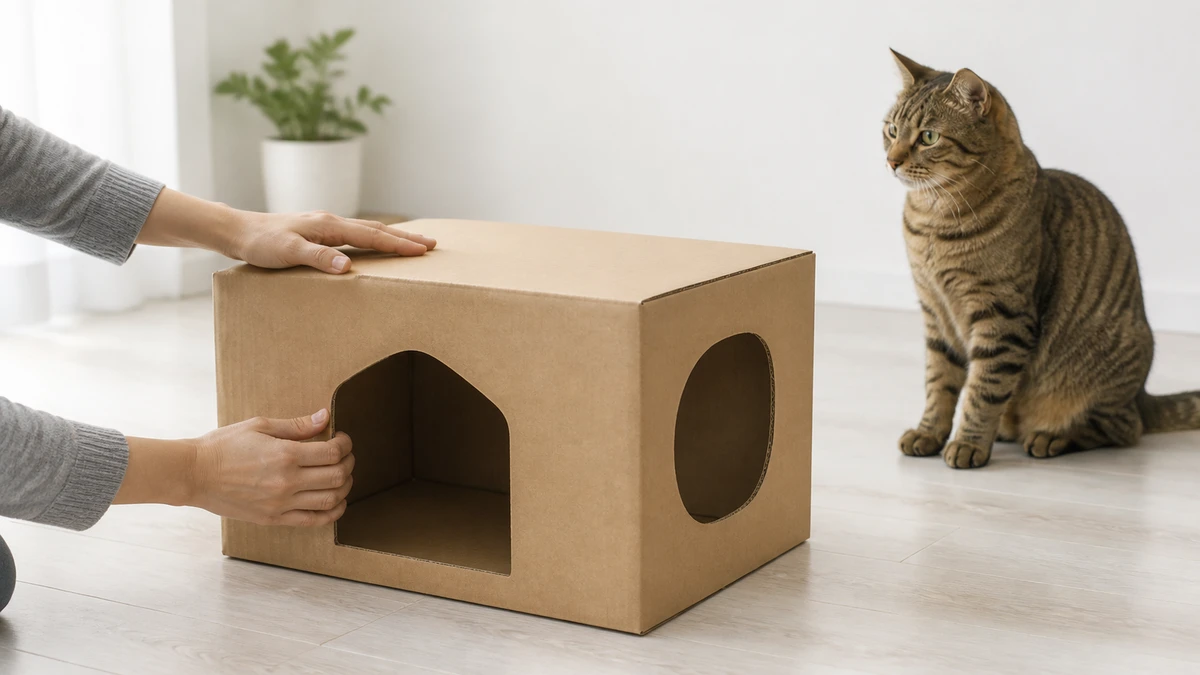
Also protect the exit from well-meaning people. Children should not climb on the box, reach inside, or close the flaps. Dogs and other cats should not be allowed to stare into or guard the entrance. A hiding place stops functioning as a refuge when someone can trap its occupant.
Normal box time versus a change that needs attention
Ordinary use has context and flexibility. The cat rests or plays in the box, comes out voluntarily, eats and drinks normally, uses the litter box, moves as usual, and still uses other locations. A newly adopted cat may hide more at first; quiet access to essentials and time are usually more helpful than repeated coaxing. Our guide to signs of stress in cats can help you look at combinations of changes rather than one behavior alone.
Contact a veterinarian when hiding is new, markedly increased, prolonged for that individual, or paired with reduced appetite, drinking changes, vomiting, altered urination or defecation, lower activity, trouble walking or jumping, unusual posture, breathing changes, pain on touch, poor grooming, confusion, or a major personality change. Seek prompt care when the cat is not eating, is straining or unable to urinate, has breathing difficulty, collapses, or cannot leave the box normally.
Do not pull the cat out to perform a home diagnosis. Record when the change began, food and water intake, litter-box output, movement, and any other signs, then contact a veterinary clinic. Stress and medical problems can overlap; an article cannot separate them for an individual cat.
FAQ
Why does my cat choose a box that looks too small? A close boundary may provide concealment, contact, or warmth, and the cat may simply like that posture for a short rest. Keep the box only if entry, breathing, turning, and exit are easy, and offer a larger option rather than assuming tighter is always better.
Do cardboard boxes reduce stress in cats? Hiding boxes reduced behavioral stress scores faster in a small 2019 study of newly arrived shelter cats in 12-day quarantine. That supports providing hides in stressful unfamiliar settings, but it does not prove every box visit at home signals stress or that a box solves every stressor.
Is a box warmer than a cat bed? It can form a warmer microclimate by reducing drafts and surrounding the curled body, but material, bedding, room temperature, airflow, sunlight, and the cat all matter. Offer a cooler alternative and never use a closed box as a heating device.
Should a cat box have one opening or two? One wide opening may be fine in a calm single-cat room. Two exits are safer when another cat, dog, or child could block the entrance. Both openings must stay clear and be large enough for easy passage.
Is it normal for a cat to sleep in a box all day? Some cats spend long periods resting in preferred covered spots. Judge the pattern against that cat’s baseline and check whether the cat still eats, drinks, toilets, moves, grooms, and interacts normally. A sudden increase or any accompanying change deserves veterinary advice.
Can I keep a delivery box for my cat? Yes, if it is clean, dry, sturdy, odor-free, and stripped of staples, tape, labels, plastic, strings, and loose pieces. Make safe openings, place it where it cannot fall or trap the cat, inspect it regularly, and check inside before recycling.