Signs of Stress in Cats: What to Notice and How to Make Home Feel Safer
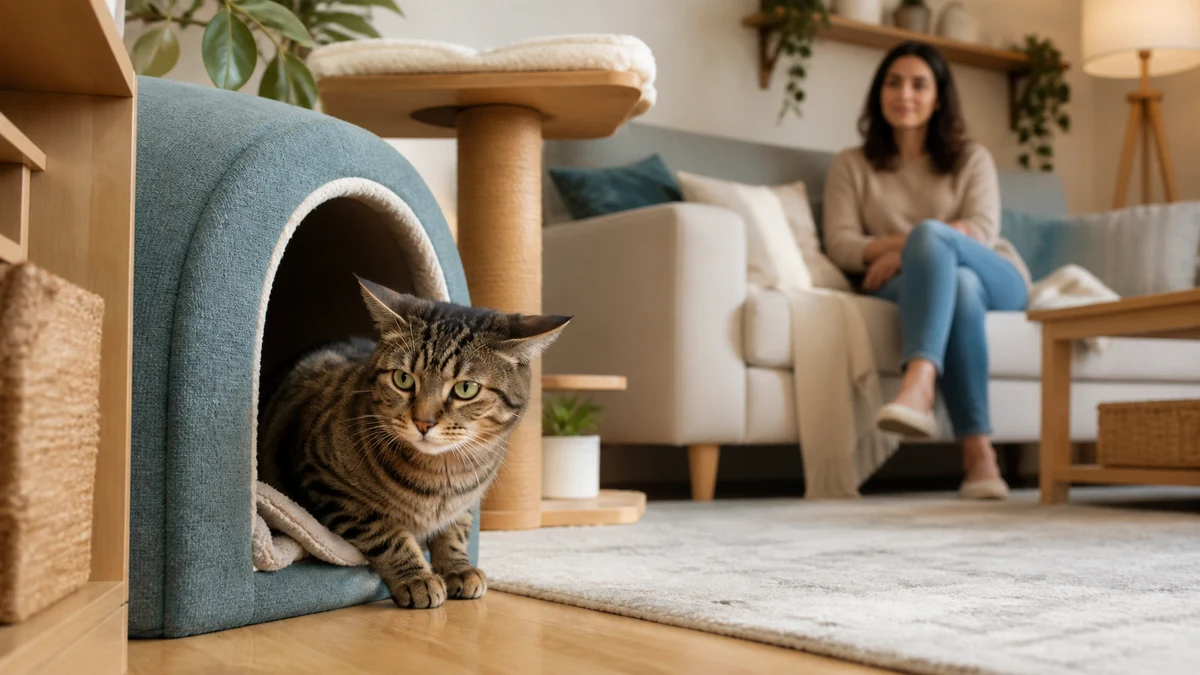
Possible signs of stress in a cat include more hiding, less play, altered sleep or appetite, overgrooming or a neglected coat, toileting changes, irritability, freezing, scanning the room, and withdrawing from people or other cats. None of these signs proves that stress is the cause. Pain and other medical problems can look similar, so compare the behavior with that cat’s normal pattern and take sudden, persistent, or worsening changes seriously. Difficulty passing urine, refusing food, breathing trouble, collapse, or obvious pain needs prompt veterinary help—not a home behavior experiment.
The useful question is not “Does my cat have the stress symptom?” It is “What changed, when does the behavior happen, what else happens at the same time, and can the cat reach safety and essential resources without conflict?” That approach protects the cat from being mislabeled and gives a veterinarian or qualified behavior professional better evidence to work with.
Stress clues are patterns, not a diagnosis
Stress is a response to a perceived challenge or threat. A short response can be adaptive: a strange noise makes a cat pause, assess, and move to safety. Trouble is more likely when the pressure is intense, repeated, hard to escape, or unpredictable. Cats also differ. A visitor that one cat investigates may send another under the bed.
Look for a change from baseline, a cluster of signs, and a connection with context. Hiding for a normal afternoon nap is not the same as a sociable cat staying concealed through meals after construction begins. Wide pupils in a dim room are not automatically fear. A cat who skips play once may simply be tired; a cat who stops playing, eats less, crouches, and avoids the litter box needs a wider assessment.
| Possible change | What you might notice | Why it is not proof of stress |
|---|---|---|
| Hiding or withdrawal | Staying concealed longer, avoiding familiar people, choosing distant rooms | Hiding is also normal rest and may increase with physical discomfort |
| Activity or sleep | Less exploration, less play, restlessness, disturbed sleep, pacing | Age, pain, temperature, and illness can also alter activity |
| Appetite or drinking | Eating less, eating only when alone, occasionally eating more | Dental pain and many other medical problems can change intake |
| Grooming | Repeated licking of one area, missing fur, or a rough and neglected coat | Skin discomfort, pain, and mobility limits can look similar |
| Toileting | Hesitating at the tray, going outside it, spraying, or changing frequency | Urinary, digestive, mobility, tray, and access problems must be considered |
| Irritability or aggression | Hissing, swatting, biting, chasing, or tolerating less touch | Fear and pain can both reduce tolerance; “bad attitude” is not an explanation |
| Vigilance or freezing | Lowered body, ears turned back, tense muscles, scanning, escape attempts | Body language must be read with lighting, sound, distance, and the individual cat |
| Social change | Less contact, avoiding another cat, blocking or being blocked in doorways | Relationships, health, and resource placement can all contribute |
| Reduced normal behavior | Less scratching, climbing, scent rubbing, hunting-style play, or exploration | The environment may lack an outlet, but physical limits are also possible |
| Vocal or repetitive behavior | More calling, lip licking, repeated routes, or difficulty settling | These are nonspecific changes and should be interpreted with the whole picture |
Cats Protection notes that stress and pain can produce overlapping changes. That is why punishing house-soiling, hiding, or hissing is especially risky: it adds another threat without identifying the cause. Our guide to peeing outside the litter box explains the same medical-first principle for toileting changes.
Know the health warning signs first
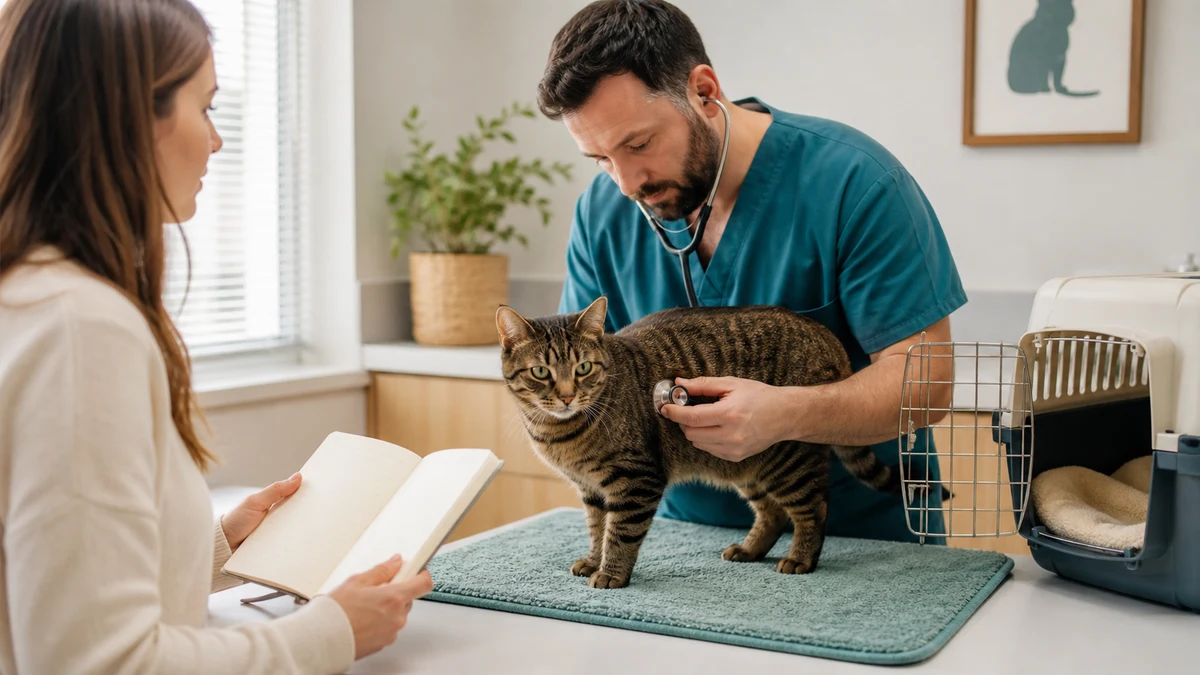
Call a veterinary clinic when a behavior change is sudden, persists, keeps worsening, or comes with a physical change. Mention appetite, water intake, urine and stool, vomiting, movement, breathing, weight, sleep, grooming, and any event that preceded it. A short video and a written timeline are more useful than arriving with the conclusion “my cat has anxiety.”
Seek urgent advice if a cat repeatedly strains but produces little or no urine, cries or becomes increasingly distressed around the litter box, has trouble breathing, collapses, cannot walk normally, or shows obvious severe pain. Cornell describes inability to pass urine as an emergency. Do not wait to see whether a new hide, diffuser, or toy fixes it.
A cat who refuses food also deserves prompt veterinary contact. Cornell explains that sustained appetite loss is a broad clinical sign, not a diagnosis, and can seriously affect a cat’s health. Do not force food into the mouth or give human or leftover pet medication. The clinic can tell you how quickly the individual cat should be seen and how to support it safely.
Eight common sources of pressure
The trigger may be obvious, but sometimes it is visible only from the cat’s route through the home. More than one source can operate at once.
- A move or changed layout. A new home, renovation, closed room, relocated litter box, or furniture rearrangement changes familiar routes and scents.
- An unpredictable schedule. Shifting meal times, a caregiver’s new work hours, irregular sleep, travel, or boarding can remove familiar cues.
- Noise and unfamiliar activity. Construction, fireworks, appliances, parties, children running, or frequent door traffic can make rest and movement difficult.
- New or unfamiliar people and animals. Guests, a baby, a new pet, or a neighborhood cat at the window may change how safe a space feels. For a new resident cat, use a gradual process such as the one in our cat introduction guide.
- Tension and resource competition. Cats do not have to fight to be in conflict. One cat may stare, follow, guard a hallway, or make another wait until night to eat or use the tray.
- Too few safe options. A room without a covered hide, elevated resting place, or alternate exit can leave a cat exposed or cornered.
- Forced or unpredictable interaction. Being picked up, restrained for petting, chased, punished, or repeatedly approached after moving away removes control. A cat may like touch at one time and decline it at another.
- Too little appropriate activity or sensory disruption. Lack of hunting-style play and exploration can contribute to frustration, while strong cleaners, unfamiliar animal scents, or constant visual exposure to an outdoor cat can make the territory feel less secure.
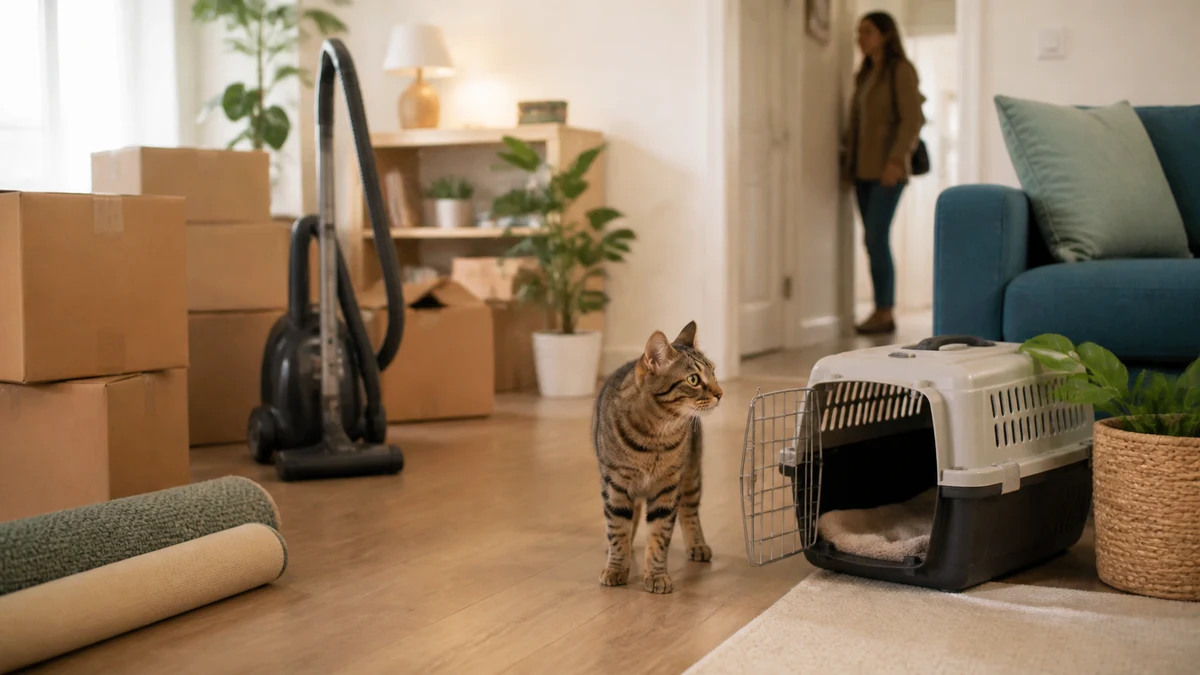
The Ohio State University Indoor Pet Initiative emphasizes that even small environmental changes can matter to a sensitive cat. This does not mean the household must never change. It means the cat benefits from advance preparation, familiar resources, gradual exposure, and somewhere to retreat.
Improve the environment without forcing the cat
FelineVMA organizes a healthy feline environment around five pillars: a safe place; multiple, separated key resources; opportunities for play and predatory behavior; positive, consistent, predictable human interaction; and respect for the cat’s sense of smell and other senses. Those pillars translate into practical, low-risk steps.
1. Preserve a predictable core routine
Keep regular meal, play, cleaning, and quiet periods where possible. During a move or schedule change, preserve familiar food, bedding, litter, and a few daily anchors. Predictable does not mean rigid to the minute; it means important events stop arriving as total surprises.
2. Add safe hiding and vertical space
Offer covered beds, open carriers, sturdy boxes, shelves, or cat trees in quiet locations. A useful refuge lets the cat enter and leave voluntarily and is not used as a place to grab the cat. High options can help a cat observe without being approached, but they must be stable and accessible.
3. Separate essential resources
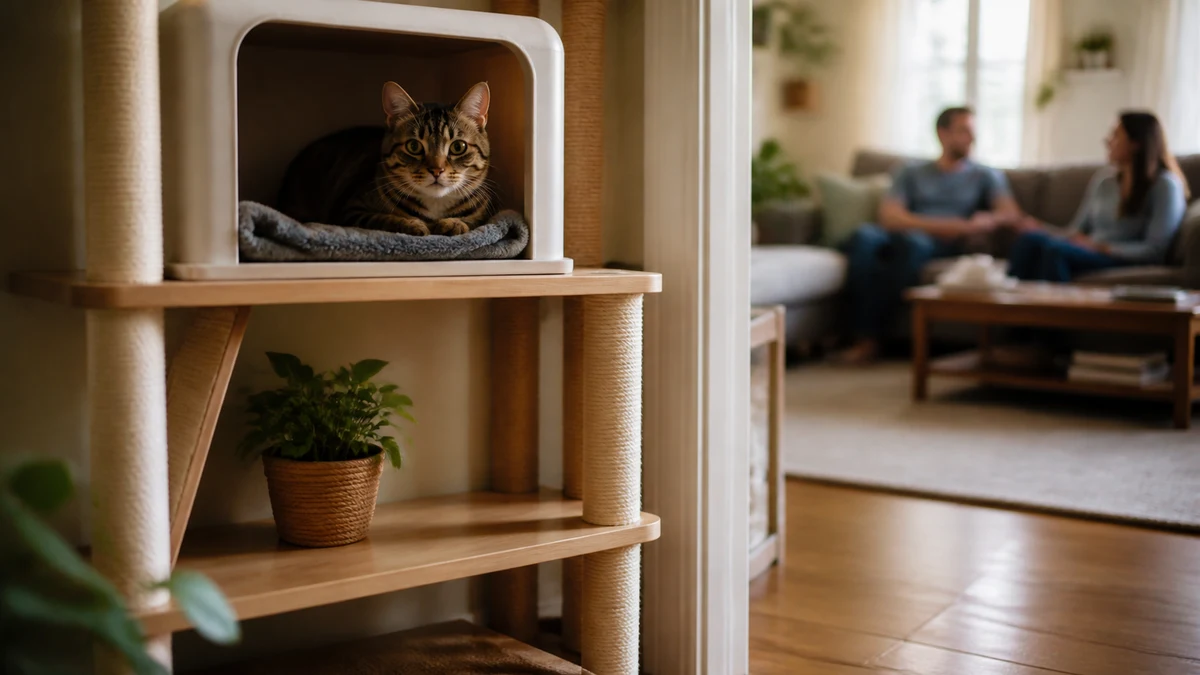
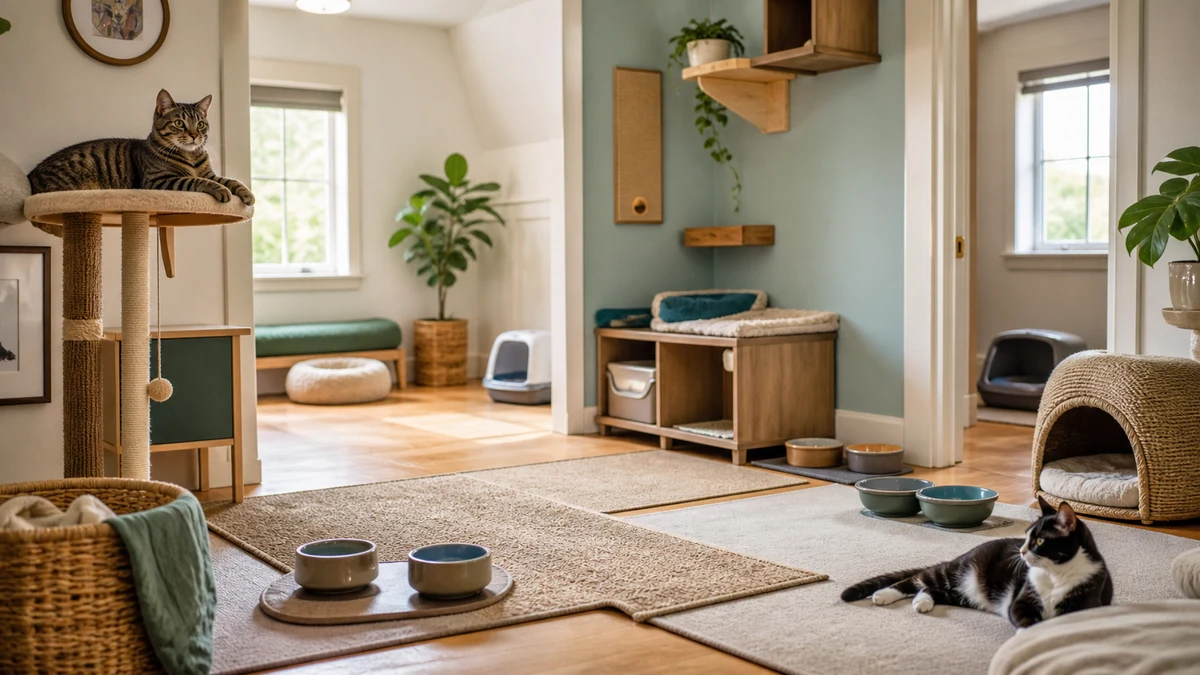
Distribute food, water, litter boxes, scratching surfaces, beds, hides, and play areas so one cat or one noisy event cannot control all access. Avoid lining everything up in a single busy corridor. In a multi-cat home, provide more than one route between zones and watch for silent blocking, not only fights.
4. Make toileting feel safe
Place clean, accessible litter boxes in quiet areas where the cat can see an exit and another animal cannot trap it. Offer enough options for the household and avoid abrupt changes to every box at once. If toileting has changed, improve access while arranging the medical assessment; do not assume a new litter alone solves the problem.
5. Offer short play and foraging opportunities
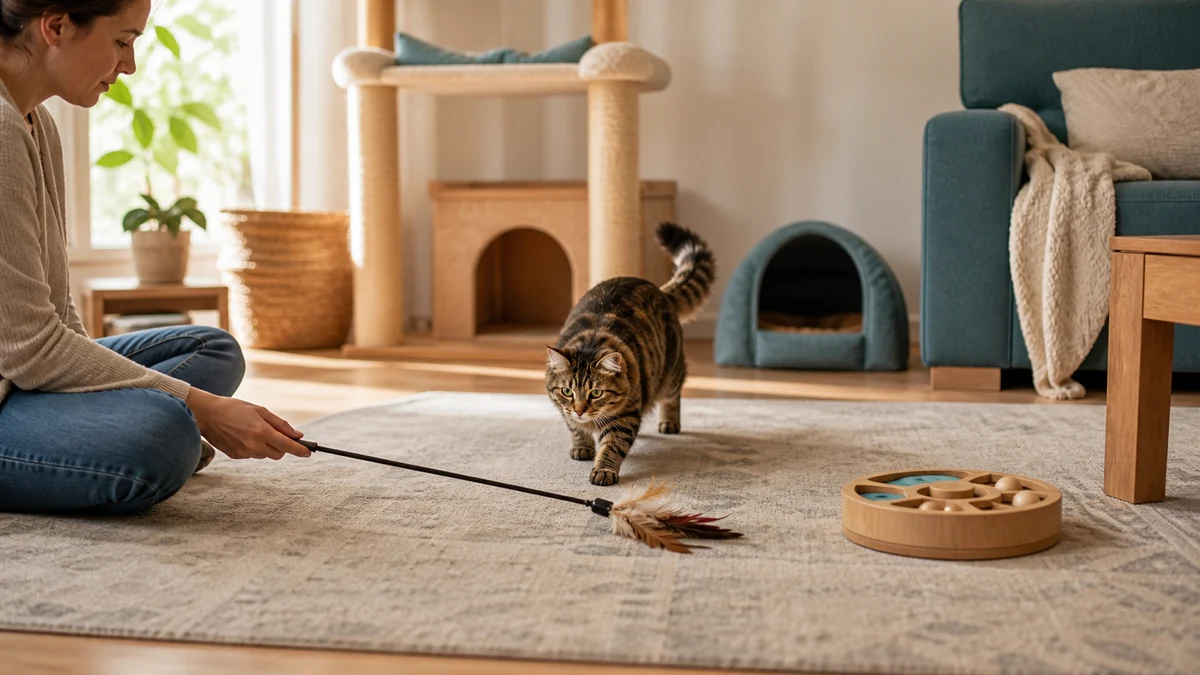
Use wand toys, tossable toys, scratching surfaces, and simple food puzzles that fit the cat’s abilities. Let the cat stalk, chase, and finish the sequence; stop before frustration or exhaustion. Participation is information: invite rather than placing the cat in front of a toy. A cat who suddenly will not play may need a health check, not more energetic prompting.
6. Introduce change in small, reversible steps
Let the cat choose distance from a new object, person, or animal. Pair a manageable exposure with something the cat already values, and retreat to an easier step if body tension rises or the cat stops engaging. Do not carry a hiding cat to a guest or hold two cats together “so they get used to it.”
7. Respect consent and teach people the exit signals
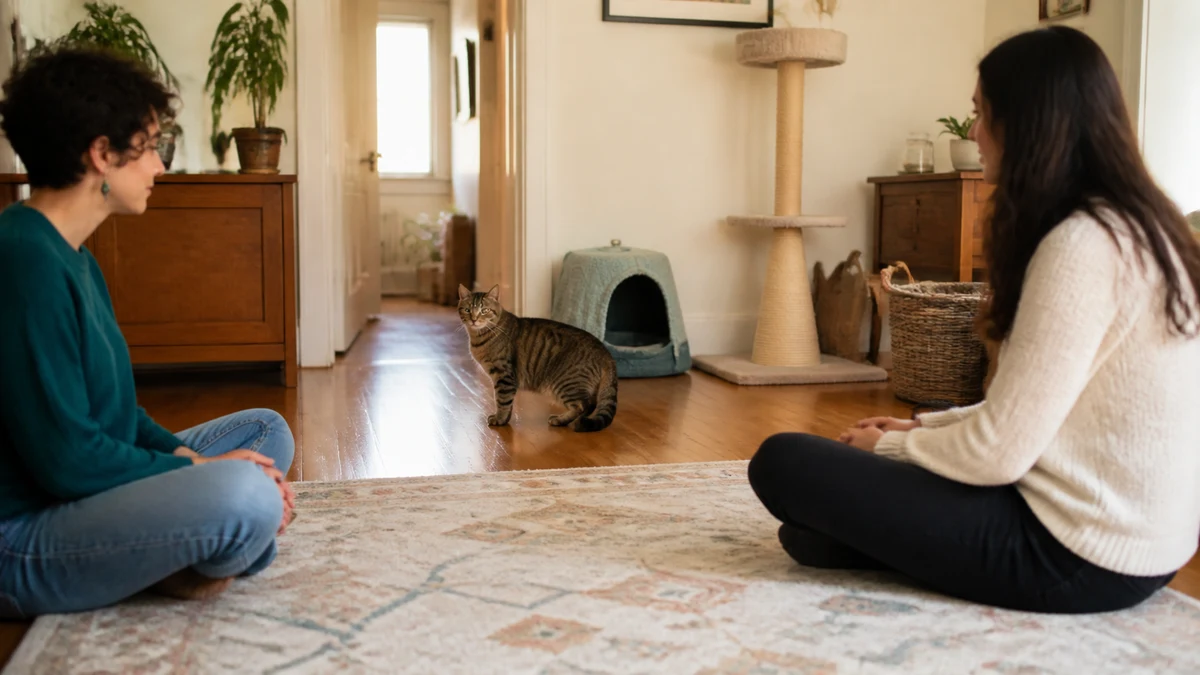
Approach sideways, offer a hand rather than reaching over the head, and pause after a few strokes. If the cat turns away, stiffens, flattens its ears, lashes its tail, or leaves, let the interaction end. Trust grows when moving away works; our article on how cats show trust gives more context for choice-based contact.
8. Reduce sensory pressure
Create a quiet room during work or visitors, close a visual barrier if an outdoor cat triggers prolonged watching, and avoid heavily scented products around core resources. Preserve familiar bedding scents instead of deep-cleaning every cat item at once. Commercial feline pheromone products may help some cats, but response varies. Treat them as an optional support—not a guaranteed fix or a substitute for veterinary and environmental assessment.
Use a trigger log, then change one thing at a time
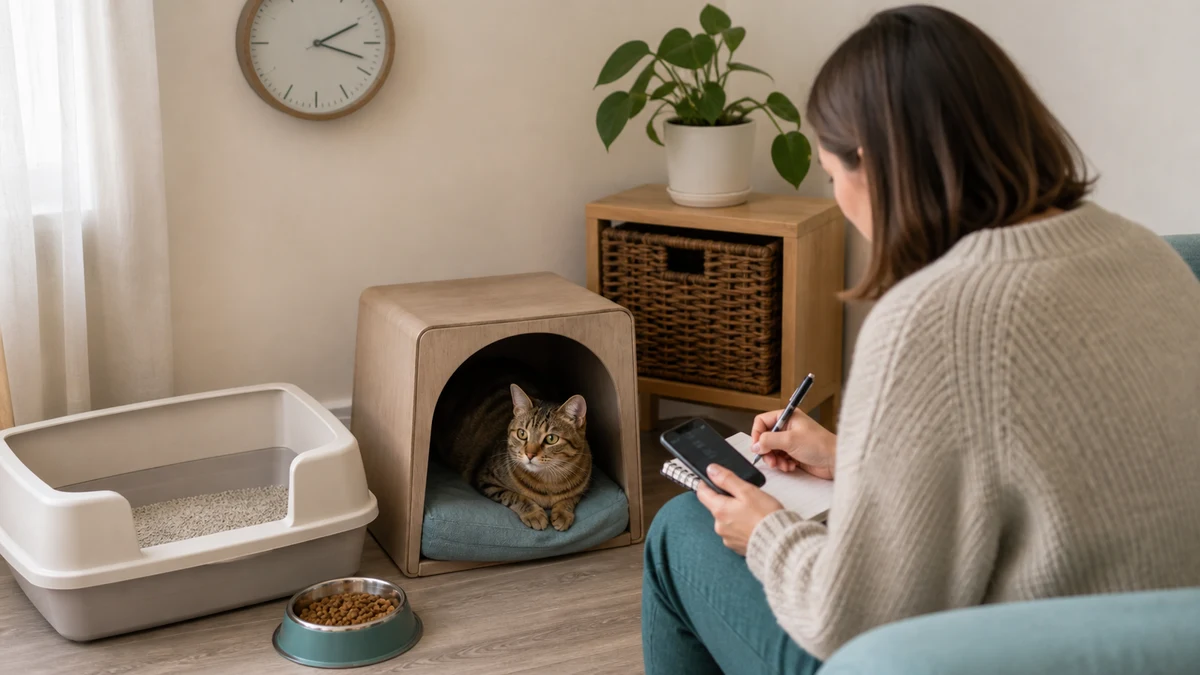
For three to seven days, note the time, location, people and animals present, sound level, the cat’s posture, what happened in the previous ten minutes, access to resources, and what happened next. Also record appetite, drinking, urine, stool, play, sleep, and grooming. Never delay care for a warning sign just to finish the log.
Look for repeatable patterns: hiding begins when a delivery arrives; one cat waits until another leaves the kitchen; grooming intensifies after a loud appliance starts; play returns when a clear escape route is opened. A phone video can help if filming does not crowd the cat.
For non-urgent issues, change one or two variables and watch the same measures. Moving every bowl, buying several products, changing litter, and altering the schedule on one day makes the result impossible to interpret. Improvement may look gradual: the cat emerges sooner, eats in daylight, resumes cheek rubbing, plays briefly, or uses a less-isolated perch. “Quieter” is not enough if the cat is simply frozen or shut away.
A practical order of action
- Check the cat, not just the room. Screen for urgent signs and call the clinic when the change is sudden, physical, persistent, or worsening.
- Remove immediate pressure. Stop forced contact, restore access to food, water, litter, hiding, and an escape route, and reduce noise.
- Map resources and routes. See whether another animal, person, appliance, or closed door blocks essential movement.
- Restore predictability. Keep familiar routines and introduce unavoidable changes gradually.
- Track response. Record specific behaviors rather than assigning an emotion from one pose.
- Ask for qualified help. If medical contributors have been assessed and the problem remains, ask the veterinarian about a qualified feline behavior professional or veterinary behaviorist.
The goal is not a home in which a cat never experiences a surprise. It is a home with enough safety, choice, resources, and predictable support that the cat can cope and recover. Observe the individual in context, respond early to physical warning signs, and judge an environmental change by the cat’s behavior—not by the product label.
Frequently asked questions
Can one behavior prove that my cat is stressed? No. Hiding, grooming, aggression, appetite changes, and house-soiling all have multiple possible explanations. Compare the behavior with the cat’s baseline, look for clusters and context, and involve a veterinarian when it is new, persistent, worsening, or physical.
Should I pull my cat out of hiding to help it adjust? No. Make sure the hiding place is safe, provide nearby access to essential resources, and let the cat leave voluntarily. Pulling the cat out removes control and may make the location or person feel less safe.
How do I know whether cats are competing if they never fight? Watch doorways and resource routes. Staring, following, waiting, guarding, or one cat using food or litter only when the other is absent can matter. Add separated resources and alternate paths, then record whether access changes.
Are pheromone diffusers guaranteed to calm a cat? No. Some cats may benefit, while others show little obvious change. A diffuser is an optional adjunct; it cannot replace a medical check, safe resource layout, gradual introductions, or choice-based interaction.
When is a change an emergency rather than stress to manage at home? Repeated straining with little or no urine, trouble breathing, collapse, inability to walk normally, obvious severe pain, or rapidly increasing distress needs urgent veterinary advice. Refusing food and other sudden physical or behavioral changes also warrant prompt contact with a clinic.