Why Do Cats Purr? Happiness Is Only Part of the Answer
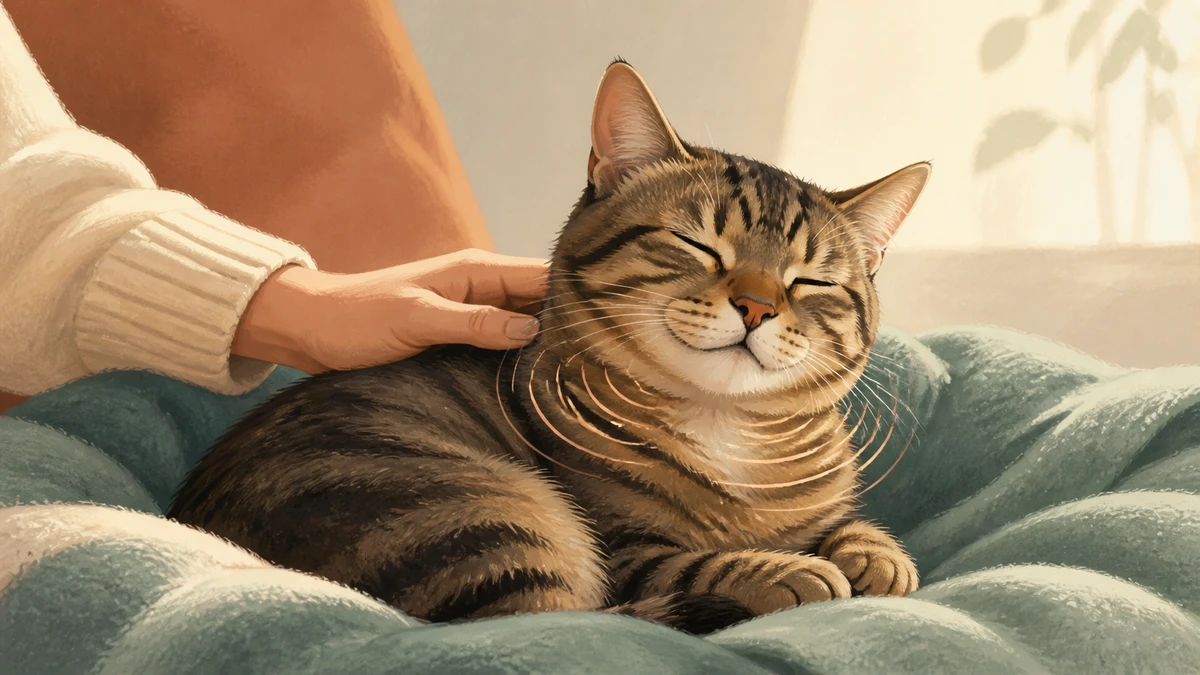
A cat purrs for more than one reason. Contentment is the familiar answer, but cats also purr to communicate with their kittens or people, to ask for food, and possibly to steady themselves during stress, illness, or pain. A purr is therefore not a tiny certificate of happiness. It is a signal whose meaning comes from the cat’s posture, surroundings, routine, and other symptoms. A loose body and soft eyes on a familiar lap tell a very different story from a crouched cat hiding under a bed and refusing dinner.
That context-first rule makes purring more useful, not less. Instead of translating every rumble as “I am happy,” you can ask a better question: what is this cat doing, and what changed? The answer may be ordinary pleasure. It may also be a request or an early reason to call a veterinarian.
What a purr is — and why the mechanism is still being revised
A purr is a low, rhythmic vocalization that a cat can sustain through both inhalation and exhalation. That continuity distinguishes it from a meow, which is mostly shaped during exhalation. You can often hear a small change where the breathing phase turns, but the motor-like rhythm continues while the mouth remains closed.
For decades, the standard explanation came from electromyography. Researchers recorded regular bursts in the intrinsic laryngeal muscles about 20 to 30 times per second. In that model, a neural oscillator repeatedly activates the muscles around the glottis — the opening between the vocal folds — and the changing airflow produces the sound. PetMD’s veterinarian-written overview describes cycles of roughly 20 to 40 milliseconds as air moves across the glottis during breathing.
Then a 2023 Current Biology study complicated that tidy account. Researchers passed warm, humidified air through eight excised domestic-cat larynges. All eight produced self-sustaining oscillations at typical purring fundamentals, about 25–30 Hz, even though there was no brain input and no active muscle contraction. The team found small connective-tissue pads embedded in the vocal folds that may help such a small larynx generate an unusually low sound.
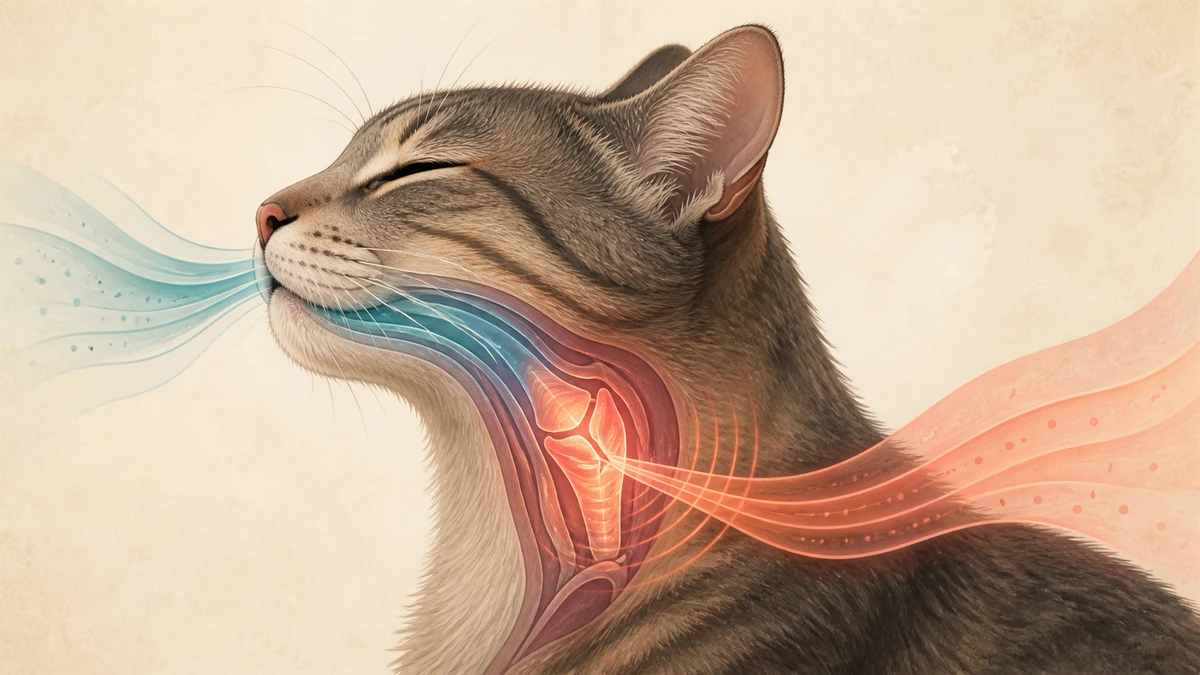
The new experiment does not prove that nerves and muscles play no role in a living cat. Its authors explicitly say it does not completely reject the active-muscle model. It shows that laryngeal tissue can produce the purr range by the same broad myoelastic-aerodynamic principle used in many other vertebrate voices, perhaps with muscular activity helping to start, regulate, or sustain it. The honest 2026 answer is that the larynx, airflow, and breathing rhythm are central, while the exact division of labor between passive tissue vibration and active neural control remains under study.
Numbers also need careful labeling. The fundamental rhythm measured in controlled work is commonly around 20–30 Hz. A recorded purr can contain stronger harmonics and energy at higher frequencies, which is why popular summaries often describe a broader band — sometimes about 25–150 Hz. Those figures are not contradictory if one is the fundamental and the other includes overtones, but “every cat purrs across 25–150 Hz” is too blunt.
Purring begins almost at the beginning of life
PetMD reports that kittens may purr from about two days old. Their eyes are still closed, their hearing is immature, and they cannot wander far, yet vibration offers a close-range channel during nursing. A kitten can purr while latched, pausing briefly to swallow. Mother cats can purr when approaching the nest, too.
Cats Protection describes purring as part of the mother-kitten bond: kittens signal where they are, that they are all right, and perhaps that feeding is underway. Because a low purr is quieter than a sharp cry, it can maintain contact within the nest without broadcasting as widely. The exact private “message” cannot be read word for word, but the timing and context support a communication function.
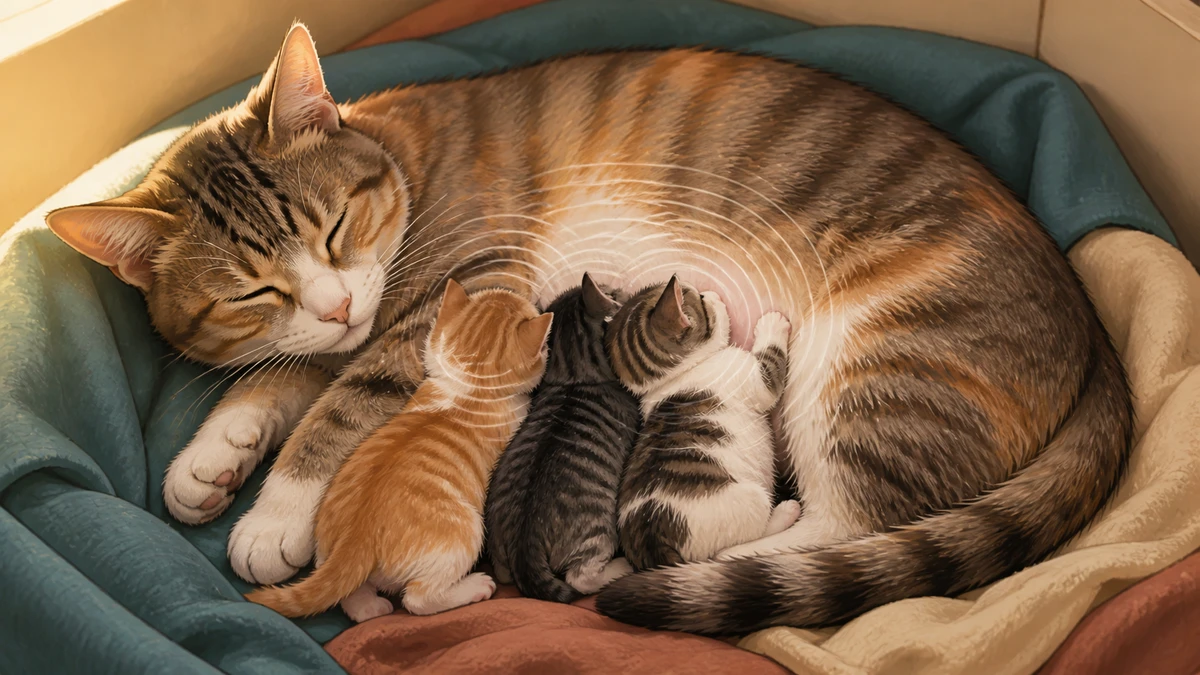
This early association helps explain why purring later appears alongside kneading. Both occur during nursing and can survive into adulthood as part of a familiar comfort pattern. If you want the companion origin story, our article on why cats knead follows that paw-by-paw behavior from milk flow to the adult blanket ritual.
The main reasons an adult cat purrs
There is no reliable “purr dictionary” based on sound alone. Even a familiar cat can produce similar low vibrations in very different situations. Start with these recurring contexts, then check the rest of the body.
1. Contentment and friendly contact
The classic happy purr is real. A comfortable cat may purr while dozing in warmth, sitting on a trusted person, eating, kneading, or receiving gentle touch. Look for a loose body rather than a compressed one; ears in a neutral position; soft, partly closed eyes; relaxed whiskers; and ordinary appetite, movement, and social behavior.
Purring can also greet. PetMD notes that a cat may give a short purr when meeting a person or another cat, and mother cats may purr as they approach kittens. In those moments, the sound participates in a calm social exchange rather than simply reporting an internal mood.
2. Attention and food solicitation
Some cats reshape the purr into a particularly effective breakfast alarm. In a 2009 Current Biology study, Karen McComb and colleagues recorded cats purring in food-solicitation and non-solicitation settings. Human listeners rated the solicitation purrs as more urgent and less pleasant, including listeners who had never owned a cat.
Acoustic analysis found a higher-frequency voiced component embedded in the otherwise low purr, reminiscent of a cry or meow. When researchers removed that component from resynthesized recordings, listeners judged the purrs less urgent. The study does not mean cats consciously imitate a baby or that every food purr contains the feature. It suggests that some cats exploit a sound quality to which mammalian caregivers are especially sensitive.
The practical translation is wonderfully plain: if the cat purrs near the food cupboard, looks between you and the bowl, and repeats a well-rehearsed routine, the purr may mean “please act” more than “I am blissful.”
3. Self-soothing during stress
Cats may purr at the veterinary clinic, during travel, after a frightening event, or while recovering in an unfamiliar environment. Cats Protection advises reading ears, eyes, whiskers, and setting together: flattened or sideways ears, wide pupils, forward or lowered whiskers, a tense body, and a noisy or novel environment point away from simple relaxation.
Calling this “self-soothing” is a plausible behavioral interpretation, not proof that the sound cures distress. The cat may be regulating arousal, asking for contact, or expressing a mixed state. What matters to a caregiver is that purring does not cancel the other stress signals. Reduce pressure, allow hiding and distance, and avoid forcing touch merely because the cat is rumbling.
4. Pain, illness, labor, and severe distress
Veterinary sources repeatedly warn that sick or painful cats can purr. VCA advises arranging a veterinary visit when a cat purrs more often than usual and also hides, becomes reluctant to climb or jump, or shows a change in energy. PetMD also notes purring during illness and, in some cases, near death. The sound may be communication, a coping response, or both; it is not evidence that the cat feels fine.
Cats can also purr during labor. That setting makes the “purr equals happiness” shortcut especially inadequate: birth combines communication, exertion, discomfort, and physiological stress. No single emotional label covers it.
Does purring heal cats? An appealing but unproven hypothesis
You may have seen the claim that frequencies around 25–150 Hz improve bone density, heal tendons, reduce pain, or explain why cats recover so well. It is an intriguing hypothesis, not an established veterinary treatment and not a demonstrated purpose of purring.
The reasoning usually joins two observations: cat purrs contain low-frequency vibration, and some experimental or clinical vibration research in other settings has investigated effects on bone and tissue. That overlap does not show that a cat’s own purr delivers a sufficient dose to injured tissue, improves meaningful outcomes, or evolved for healing. Frequency alone is not a therapy; amplitude, exposure time, tissue, injury, and study design matter.
The 2023 larynx study explains how low frequencies may be physically possible, but it did not test healing. The solicitation-purr study tested human perception, not tissue repair. Until controlled studies directly demonstrate clinical benefit in cats, “purring may have a restorative function” belongs in the theory column. It should never replace examination, pain relief, or treatment prescribed by a veterinarian.
How to read the cat, not just the sound
Use a quick three-part check whenever a purr seems unusual.
First, read the whole body. A relaxed cat rests with easy muscles and neutral ears. A cat in discomfort may crouch or hunch, pin or rotate the ears, widen the pupils, protect a body part, resist handling, or stop jumping. No one sign diagnoses pain, but a cluster changes the picture.
Second, compare with that cat’s baseline. Some cats purr loudly every day; others are so quiet you feel the vibration before you hear it. A naturally quiet purr is not a defect. A sudden increase, disappearance, change in tone, or new context matters more than comparison with somebody else’s cat.
Third, check ordinary functions. Appetite, water intake, breathing, movement, grooming, litter-box use, weight, play, and social contact supply information a purr cannot. A pleasant-sounding rumble does not outweigh a day of not eating or labored breathing.
When to call a veterinarian
Arrange veterinary advice promptly when new or unusual purring accompanies any of the following:
- reduced appetite, refusal to eat, or unexplained weight loss;
- hiding, withdrawal, unusual aggression, low energy, or a marked behavior change;
- reluctance to jump, stiffness, limping, a hunched posture, or sensitivity to touch;
- vomiting, diarrhea, changes in drinking or litter-box habits;
- breathing that is rapid, noisy, open-mouthed, or visibly effortful;
- recovery from injury, surgery, or illness that is not progressing as instructed.
Breathing difficulty is urgent. A cat breathing with an open mouth, struggling for air, showing blue or very pale gums, or collapsing needs emergency veterinary care rather than home observation. Do not use the presence or absence of purring to grade the emergency.
For less dramatic changes, a short video and a note about timing can help your veterinarian. Record what happened before the purr, the cat’s posture, breathing, appetite, and how long the episode lasted. Do not press hard on the throat or chest to “find the vibration,” and do not give human pain medicine. This article explains signals; it cannot diagnose an individual cat.
The best translation is a question
Purring is not a lie when a cat is hurting, nor is it a code with one fixed definition. It is a versatile behavior laid down in kittenhood and used for quiet social contact, requests, comfortable rest, and difficult moments. Science is still revising how the larynx makes the sound, just as behavior research continues to test what different purrs accomplish.
So enjoy the warm motor on your lap. Just keep the rest of the cat in view. “What is happening around this purr?” is a better translation than “happy,” and sometimes it is the question that gets a cat timely care.
FAQ
Does purring always mean a cat is happy? No. Relaxed cats often purr, but cats may also purr while requesting food or attention, experiencing stress, coping with pain, giving birth, or seriously ill. Context, body language, and changes from the cat’s normal routine determine what the sound is likely to mean.
How early can kittens purr? Veterinarian-written guidance reports that kittens can begin at about two days old. Purring occurs during nursing and helps maintain close contact with the mother; mother cats purr around their kittens as well.
Why does my cat purr so loudly before meals? It may be a solicitation purr. Research found that some food-seeking purrs contain a higher-frequency voiced component that human listeners perceive as more urgent. It is not universal, but cats can learn that a particular sound-and-routine combination gets a fast response.
Can a cat’s purr heal bones or injuries? That is an unproven hypothesis. Purrs contain low-frequency vibration, but direct clinical evidence that a cat’s own purr heals bone or tissue is lacking. Never substitute purring for veterinary diagnosis or treatment.
Why is my cat purring while hiding or not eating? Purring can accompany pain, illness, fear, or an attempt to self-soothe. Hiding and appetite loss make the context concerning. Contact a veterinarian promptly, and seek emergency care for difficult or open-mouth breathing, collapse, or pale or blue gums.