Why You Should Never Hit Your Cat — and What Works Better

Never hit your cat. Do not replace your hand with a squirt bottle, a shout, or a sudden blast of noise. Those methods may interrupt what your cat is doing for a moment, but stopping is not the same as learning. Punishment does not tell a cat what to do next. It can, however, teach a much simpler lesson: when you appear, pain, fear, or an unpleasant surprise may follow. The result may be a cat who still performs the behavior when you are gone, hides when you arrive, or uses claws and teeth to create distance when escape feels impossible.
This is not a lecture about being a bad cat guardian. Most people who clap, yell, spray, or give a quick swat are trying to stop danger or restore order immediately. The intention is understandable. The problem is that the tool does not match the way cats learn. Changing the tool is usually far more effective than increasing the force.
Why punishment teaches the wrong lesson
Cats learn by making associations between events that occur close together. The Feline Veterinary Medical Association’s 2026 training toolkit explains classical conditioning with a veterinary example: when the sight of a needle repeatedly predicts a painful pinch, the sight itself can begin to trigger a protective response. If a person is consistently part of that scene, the cat may develop the same kind of response to the person.
That is the central weakness of punishment. You think you are communicating, “Do not scratch this sofa.” Your cat may experience, “When I scratch, this person rushes toward me and something frightening happens.” You mean, “The kitchen counter is off limits.” The cat may learn, “The counter is dangerous only while that person is watching.” When you leave, the food, height, warmth, and view are still rewarding. Nothing about the original motivation has changed.
Timing makes the message even less reliable. The FelineVMA’s positive reinforcement statement recommends delivering a reward within three seconds of the behavior so you do not accidentally reinforce whatever the cat does next. That narrow window illustrates how closely cause and consequence need to be paired. Pointing at a broken planter after work, scolding beside a urine spot, or carrying a cat back to an old mess may form a complete story in a human mind. For the cat, the only clear event is the threat happening now. Cornell’s Feline Health Center notes that cats cannot connect after-the-fact punishment with a house-soiling incident, even when the mess was made only moments earlier.
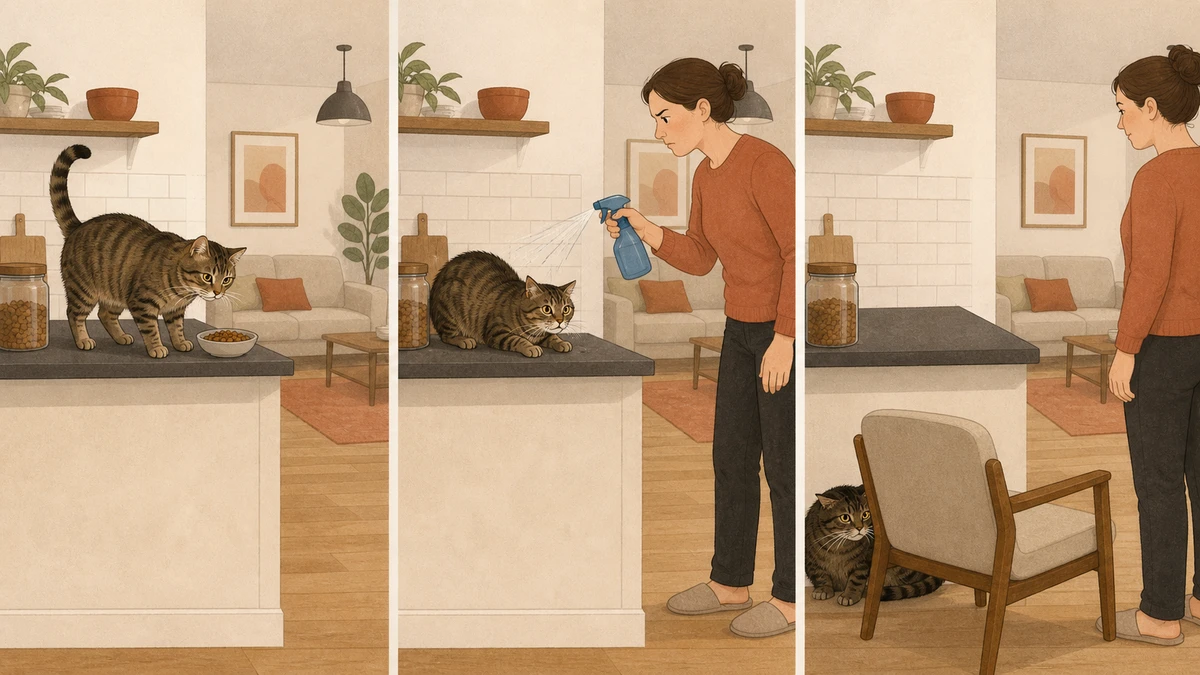
When punishment appears to “work,” one of two things has usually happened. The startling event interrupted the current movement, or the cat learned to suppress the movement while the punisher was present. Neither outcome answers the real training question: where can the cat go, and what can the cat do, to meet the same need appropriately?
A squirt bottle and a shout are punishment too
Punishment does not have to leave a physical mark to create fear. The FelineVMA includes yelling, water spraying, and startling devices among aversive methods that should not be used for training. Its guidance warns that these methods can increase fear-anxiety, make new learning harder, produce additional unwanted behavior, and damage the human-cat relationship. The association’s positive reinforcement position statement also lists possible fear aggression, stress-associated health and behavior problems, and breakdown of the bond.
That does not mean every cat sprayed once will develop a lifelong problem. It also does not mean one scolding can be blamed for any later illness. The fairer conclusion is simpler: a method that adds stress while failing to teach an alternative offers little benefit for avoidable risk.
Fear usually speaks quietly before it becomes a hiss or bite. Early signals can include ears rotating sideways or back, widening pupils, a lower body posture, a tail held close, looking away, or hiding. If the pressure continues and the cat cannot leave, protective behavior may escalate to hissing, striking, or biting. Cornell’s aggression guidance warns that physical punishment can increase fear or anxiety and worsen aggression. Reaching for a highly aroused cat is especially risky because the cat may use force to create the distance that the situation denied.

Stress is not only a mood. The AAFP/ISFM environmental needs guidelines connect unmet feline needs and stressful environments with unwanted behavior and health concerns. Cornell’s overview of feline lower urinary tract disease says stress appears to be an important factor in feline idiopathic cystitis (FIC), while environmental modification can reduce the severity and frequency of episodes. That does not mean punishment directly causes FIC or that an article can diagnose a urinary problem. It does mean there is no good reason to make chronic fear part of everyday training.
Your cat is not taking revenge
Many behaviors called “bad” are normal feline functions happening in inconvenient places. Scratching maintains the claws and leaves visual and scent marks. Counter jumping provides height, proximity to people, warmth, or food. Midnight running and pouncing can reflect a need for activity and hunting-style play. Urinating outside the box can involve pain or illness, litter-box conditions, location preferences, social stress, or learned habits. Like kneading, a normal ritual carried forward from kittenhood, these behaviors are not moral statements about their human audience.
“She knows this bothers me, so she is doing it on purpose” is an appealing explanation because it turns chaos into a familiar human conflict. Cornell’s house-soiling guidance rejects the revenge story: cats probably do not perform the complicated tit-for-tat reasoning it would require, and they do not share our disgust toward urine and feces. A more useful question than “Why is my cat trying to upset me?” is “What does this behavior accomplish for my cat right now?”
Try translating common scenes this way:
- Scratching the sofa: the surface is stable, the texture feels right, and the location is socially or territorially important. It may also sit directly on the route from a favorite sleeping place.
- Jumping on the counter: the counter offers food smells, warmth, a clear view, or a place near the person cooking.
- Racing or attacking feet at night: the cat may have too few safe outlets for stalking, chasing, pouncing, and catching during the day.
- Eliminating outside the litter box: medical causes come first, followed by box size, cleanliness, litter, location, accessibility, and competition with other cats.
Once the need is translated, the plan changes from “make the cat afraid” to “make the right option easier and more rewarding.”
Six steps that work better
1. Put sudden behavior changes on the veterinary track first
Pain, illness, and other changes in physical health can alter behavior and make learning difficult. Contact a veterinarian about new house soiling, overgrooming, appetite or activity changes, or new biting and scratching. A cat repeatedly straining in the litter box while passing little or no urine needs emergency veterinary attention, not a training experiment.
This article explains general behavior. It does not diagnose an individual cat or recommend medication. Once a veterinarian has assessed physical health, environmental and training changes have a safer foundation.
2. Identify the real payoff before trying to stop the action
Keep a short log for several days. When and where does the behavior happen? What occurs immediately before it? What does the cat gain afterward: food, attention, play, distance, access to height, or relief from discomfort? If a cat jumps on the counter and you throw a treat onto the floor to get her down, the sequence may look wonderfully successful from her perspective: jump up, and a treat appears.
Remove accidental rewards where possible. Store food, cover trash, move breakable objects away from edges, protect cords, and stop using hands and feet as toys. Management is not cheating. It prevents repeated practice of the old pattern while a new one is being built.
3. Offer a legal option that meets the same need
An alternative must compete with the original reward. A short, wobbly scratching post hidden in a spare room cannot beat a tall, sturdy, prominent sofa. Put a stable vertical scratcher beside the current scratching site and offer a horizontal option to learn the cat’s preference. Because many cats scratch after waking, another scratcher near a favorite sleeping area often makes sense.
Use the same logic everywhere. To keep a cat off a kitchen counter, provide a stable perch where the cat can watch you but cannot leap directly back to the work surface. To reduce nighttime foot attacks, schedule play that allows chasing, pouncing, and catching. In a multi-cat home, separate food, water, litter boxes, resting places, scratching areas, and elevated spaces so one cat cannot control access to everything.
4. Reinforce the behavior you want immediately
Positive reinforcement is not endless treat distribution. It means placing an outcome the cat values immediately after a behavior you want to see more often. Reward contact with the scratcher, choosing the designated perch, or waiting quietly for breakfast. The reward may be a tiny food portion, a toy, a brief play session, or preferred social contact. It must matter to that individual cat, and it should arrive within seconds.
At first, reinforce small steps: looking at the scratcher, approaching it, touching it, and finally scratching. Once the behavior is reliable, rewards can become less frequent and more varied. The cat learns a clear route to success without first having to make a mistake.
5. Redirect early and calmly
If a cat is preparing to stalk an ankle, move a wand toy away from your body before the pounce begins. If the cat starts watching the counter, cue the nearby perch and reward the choice. Redirection works best before the old behavior starts or at its earliest stage. Keep your voice ordinary and movements small. Do not chase, grab, or turn the replacement toy into another startling event.
Safety still comes first. If a cat approaches a hot burner or a dangerous object, use a door, barrier, or object placement to block access and remove the hazard. An emergency interruption is for safety, not an opportunity to punish. If the cat is already hissing, puffed up, or highly aroused, provide distance and an exit rather than trying to pick the cat up with bare hands.
6. Make play and daily life predictable
The FelineVMA recommends interactive object play at least twice daily. Short, complete hunting-style sequences are easier to repeat consistently than an occasional marathon. Schedule one before bed and follow it with a small meal to create a reliable evening rhythm. If a cat wakes people early for breakfast, a timed feeder set to open shortly before the usual wake-up campaign can break the connection between harassing a sleeping person and receiving food.
Predictable does not have to mean exact to the minute. It means food, play, litter-box care, and calm social time occur in a broadly dependable order. A cat with some control and reliable options is in a better emotional state for learning than a cat waiting for the next surprise.
Four common problems, translated into practical plans
Scratching the sofa: Protect or cover the current surface and place an appropriate scratcher directly beside it. Offer sturdy vertical and horizontal choices with different safe textures. Entice the cat toward the scratcher with a toy, but do not hold the paws and drag them over it. Reward voluntary approaches, stretches, and scratches. Move the scratcher toward your preferred location only after the habit is well established.
Jumping on the kitchen counter: Remove food and loose objects that make the surface rewarding, and use a door or barrier while cooking when necessary. Set up an elevated station with a view of the activity. Invite the cat there and reward the choice while all four paws are still off the counter. Avoid waiting for the jump and then producing a treat to lure the cat down; that can make the jump the first step in a reward chain.
Midnight zoomies or attacks on feet: Add several brief hunting-style play opportunities during the day and evening. Let a wand or tossable toy hide, flee, get chased, and finally get caught. Hands and feet are never prey. Safe solo toys or food puzzles can provide nighttime activity, but remove strings, small swallowable parts, and anything unsafe without supervision.
Urinating or defecating outside the box: Call the veterinarian first to rule out medical causes. Then assess the litter setup: enough boxes, separated locations, quiet access, suitable size and entry height, unscented litter the cat accepts, and regular cleaning. One box per cat plus one extra is a common starting point for a multi-cat household, but placement and individual preferences still matter. Do not yell, hit, rub the cat’s face in the mess, or attempt to treat the problem with unprescribed food or medication.
If you have already hit or frightened your cat
The relationship can often recover, but repair comes from a series of predictable, safe experiences rather than one forced reconciliation. Stop the punishment and startling tools. Preserve hiding places and escape routes. Let the cat choose the distance. When you are present, you can quietly set down preferred food, begin wand play from a comfortable distance, or simply sit without staring or following. Do not pull the cat out from under furniture or hold on to prove that you are now safe.
Watch for the return of relaxed eating, play, grooming, and resting in your presence before increasing contact. If hiding, fear, or defensive aggression persists, start with a veterinary examination and ask for a veterinarian or qualified behavior professional with feline experience. Severe aggression needs an individual safety plan; it is not something to troubleshoot from an article alone.
The most useful shift can be stated in one line: do not ask how to make your cat afraid to perform a behavior; ask how to make the right behavior more worthwhile. Fear depends on your continued presence. Learning can keep working after you leave the room.
FAQ
Can I ever tell my cat “no”? You can use a calm, consistent cue to interrupt an interaction, but a word does not teach an alternative by itself. Follow it by managing the environment, guiding the cat toward an acceptable option, and reinforcing that option. The issue is not a banned vocabulary word; it is relying on volume and fear as the entire training plan.
Is a squirt bottle really harmful if it does not hurt? The purpose of spraying is to create something the cat wants to avoid, so it is still aversive. The FelineVMA warns that it can increase fear-anxiety and additional unwanted behavior. It also leaves the food, height, view, or social reward on the counter unchanged. The spray may interrupt the moment, but it provides no answer for the next one.
Will reward-based training make my cat gain weight? It does not require adding large amounts of food. Reserve a small portion of the daily ration for training, or use play, toys, and preferred social contact when those are rewarding. If your cat has dietary restrictions or a weight-management plan, discuss suitable rewards with your veterinarian.
How long will behavior change take? It depends on how long the old behavior has been practiced, how rewarding it is, whether the alternative truly meets the same need, and how consistently the household responds. Track small signs: more approaches to the scratcher, longer stays on the approved perch, or less immediate hiding when a person enters. Stable small changes mean more than one quiet evening produced by a frightening event.
When should I get professional help? Ask a veterinarian about any sudden behavior change, house soiling, possible pain, persistent fear, compulsive behavior, or biting and scratching. If aggression is severe, a person or animal is at risk of injury, or careful environmental changes are not helping, request a referral to a board-certified veterinary behaviorist or another appropriately qualified feline behavior professional for an individual assessment.