A Disaster Plan for Cats: Carriers, Go-Bags, and Evacuation Drills
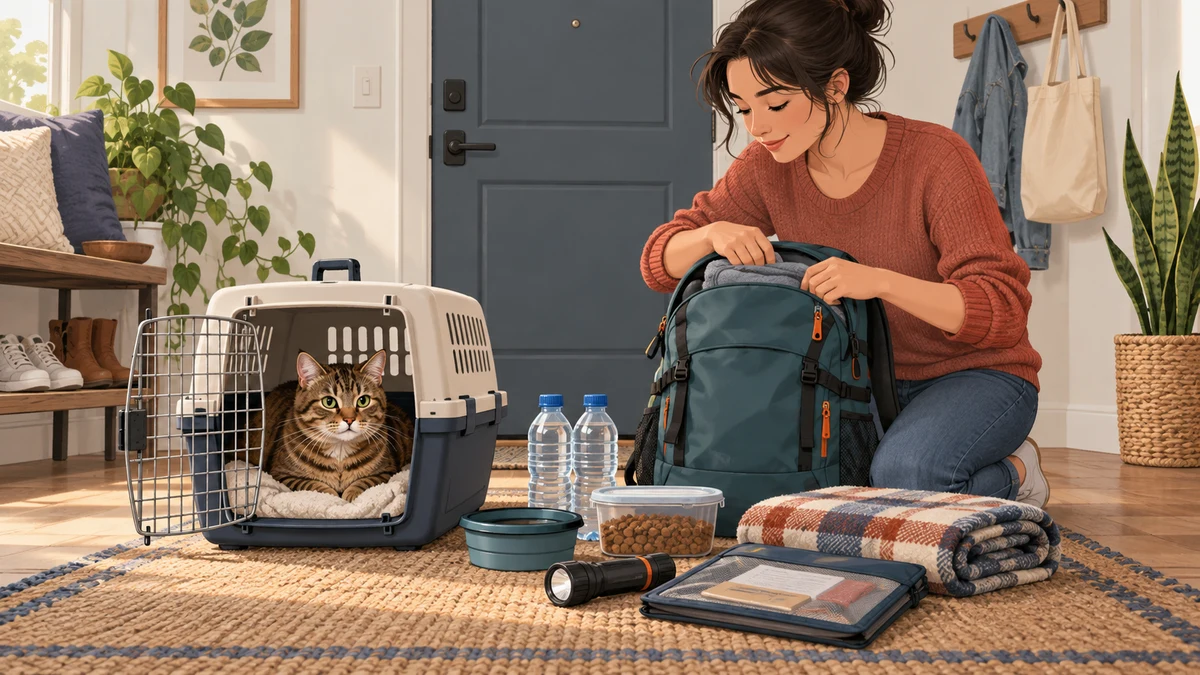
A useful cat disaster plan is a rehearsed system, not just a bag of supplies. Keep one secure, correctly sized carrier for each cat; assign people to locate and load cats, close doors, take the kit, communicate, and lead the exit; map two ways out and two meeting points; confirm transport, pet-accommodating destinations, and a trusted backup caregiver; then practice under calm conditions. Follow current local emergency instructions. If a building is dangerous, human safety comes first: do not delay escape or go back inside to catch a cat.
Start with local hazards and local rules
Fire, earthquake, flood, severe storm, a long power failure, extreme heat or cold, and a chemical incident can create very different decisions. One event may require immediate evacuation; another may require sheltering in an interior room. Write down the hazards relevant to your address, building, season, and transport network. Subscribe to the official alert channels used where you live, and learn who can order evacuation, where public shelters are, and whether household pets are accommodated on site, nearby, or not at all.
Supply targets also vary. As checked on September 13, 2026, Taiwan’s National Fire Agency presents a three-day emergency-bag checklist with a pet section, while New Taipei City animal-protection guidance describes three to five days of pet food. A U.S. CDC pet-kit checklist uses a two-week supply of food, water, and applicable medications. These are location-specific examples, not a universal prescription. Use your current local authority’s minimum, your cat’s normal needs, likely travel time, storage conditions, and what household members can safely carry. If a full home reserve is too heavy to evacuate, separate it from a lighter grab-and-go kit.
Use an all-hazards plan, then add scenario rules
The same carrier, contacts, and records help in every emergency, but the first action changes with the hazard.
| Scenario | First decision | Cat-specific backup |
|---|---|---|
| Home fire or smoke | Use a safe exit immediately and meet outside. Never delay escape or re-enter a dangerous building for a pet. Tell responders how many cats may be inside and where they usually hide. | Keep carriers accessible near an exit without blocking it; maintain a current pet-alert notice if local responders use them. |
| Earthquake | Protect people during shaking and follow building and local emergency guidance before moving. Expect broken glass, damaged doors, and frightened hiding behavior afterward. | Store carriers where falling objects will not bury them; keep shoes, a flashlight, and a clear loading path nearby. |
| Flood or severe storm | Follow official evacuation timing and routes; leaving early may preserve safer transport choices. Avoid floodwater and damaged electrical areas. | Move cats indoors before conditions worsen and keep them contained; never let them drink or walk through suspect water. |
| Power outage or extreme temperature | Track indoor temperature, water access, ventilation, and official warming or cooling locations. Relocate before the home becomes unsafe. | List two temperature-safe destinations and a non-electric way to open food; never leave a carrier in a parked vehicle. |
| Chemical release or unsafe outdoor air | Follow local instructions to evacuate or shelter in place; the correct action depends on the incident. | Prepare a low-clutter interior room with few windows and no accessible chemicals, plants, vents, or gaps where a frightened cat could become trapped. |
| Sudden building closure or temporary evacuation | Assume you may not return on schedule and take the documented kit if officials say it is safe to do so. | Use a verified destination and backup caregiver rather than improvising after every nearby hotel or shelter fills. |
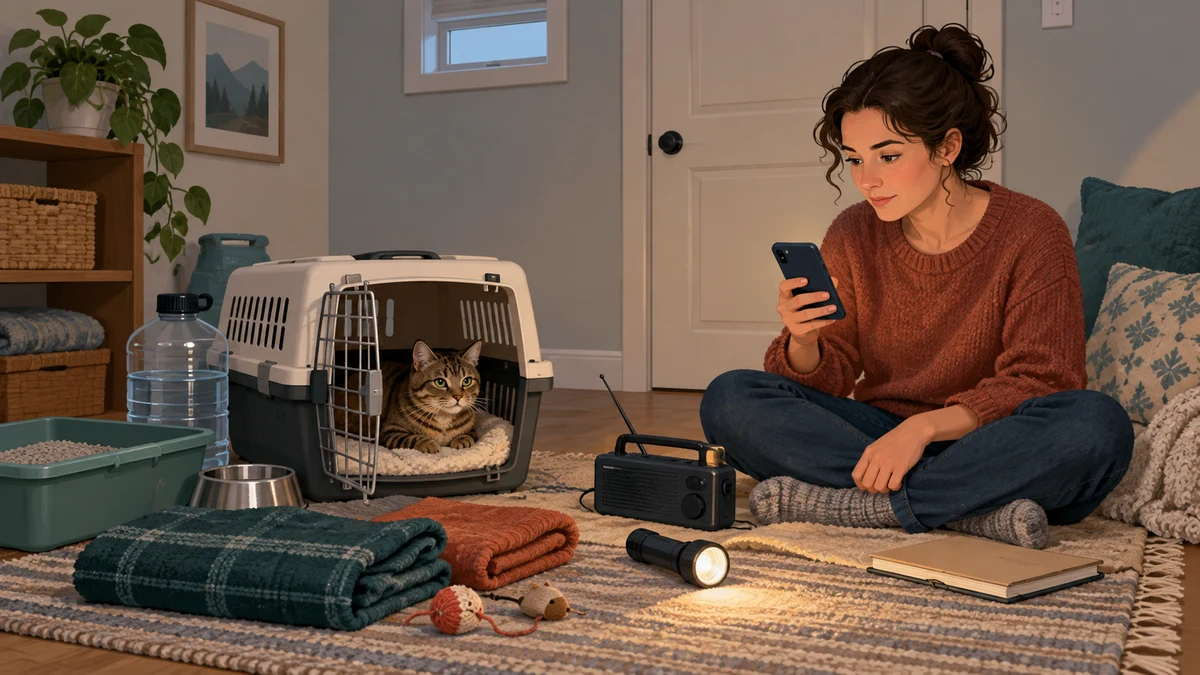
Assign roles before anyone is stressed
“Everyone helps” is not an assignment. Give each action one primary person and one backup. In a one-person household, the backup may be a nearby trusted person with agreed access, written authority where needed, and a clear way to report what they did.
| Function | Primary action | Backup question to resolve now |
|---|---|---|
| Cat lead | Visually account for each cat, close the loading room, and secure one cat per labeled carrier. | Who knows every likely hiding place and a safe loading method? |
| Boundary lead | Close interior and exterior doors in sequence and keep the route from becoming an escape path. | Who confirms that no one opens a door during loading? |
| Kit lead | Take the human kit, cat go-bag, records, keys, lighting, and needed mobility items. | Can this person carry the load while keeping hands free and exits clear? |
| Communication lead | Monitor official alerts, call the destination, and notify the proxy and meeting contact. | What works if mobile data fails or family members separate? |
| Route lead | Choose the safe exit and transport option; conduct the head count at the meeting point. | What is the second exit, second meeting point, and no-car option? |
| Proxy caregiver | Enter only when conditions and authorities allow, retrieve cats if the household is away, and report status. | Do they have current access, carrier practice, written instructions, and consent to seek veterinary care? |
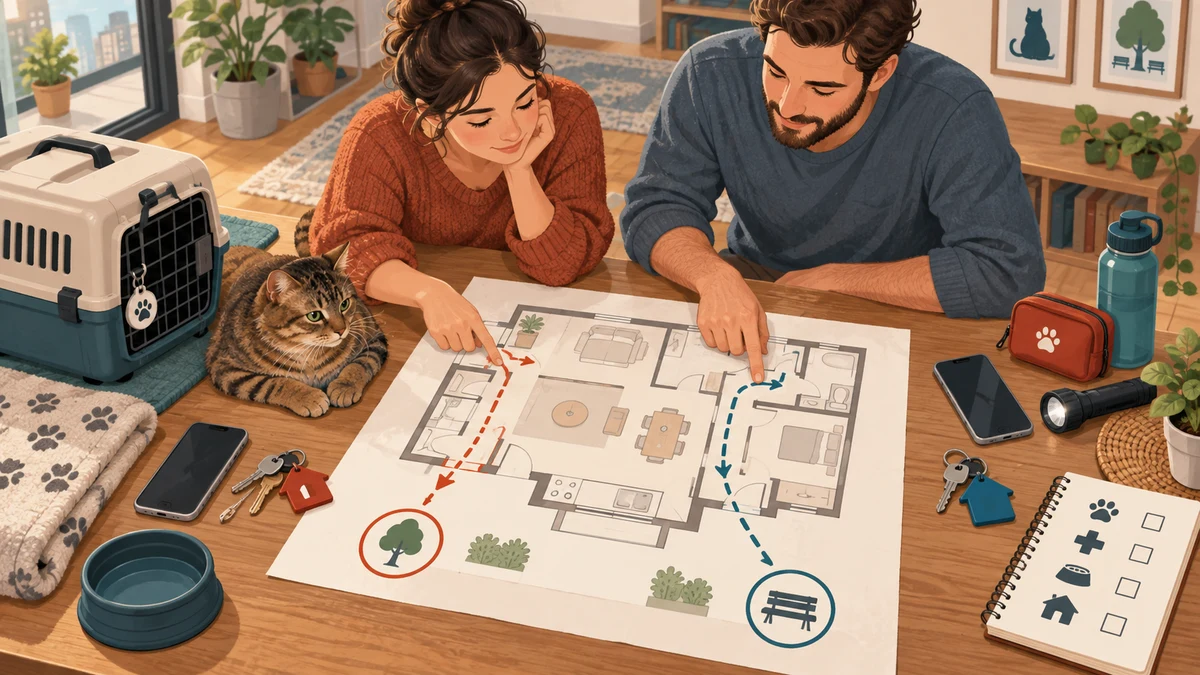
Choose a primary outdoor meeting point a safe distance from the building and a backup outside the affected neighborhood. Map two usable exits from each sleeping area if the building permits, but never treat a planned route as safe when smoke, structural damage, floodwater, or officials say otherwise. Keep a paper contact and route card because batteries and networks can fail.
Give every cat a carrier that works today
Each cat needs a separate sturdy, ventilated carrier that closes quickly and can be secured for transport. International Cat Care recommends one carrier per cat even for cats that usually get along, because stress and confinement can change behavior. Check the door, fasteners, removable top, seams, handle attachments, and base. The cat must have room to stand, turn, and settle without the carrier becoming too large to control safely. Label it with the cat’s name and current household contacts.
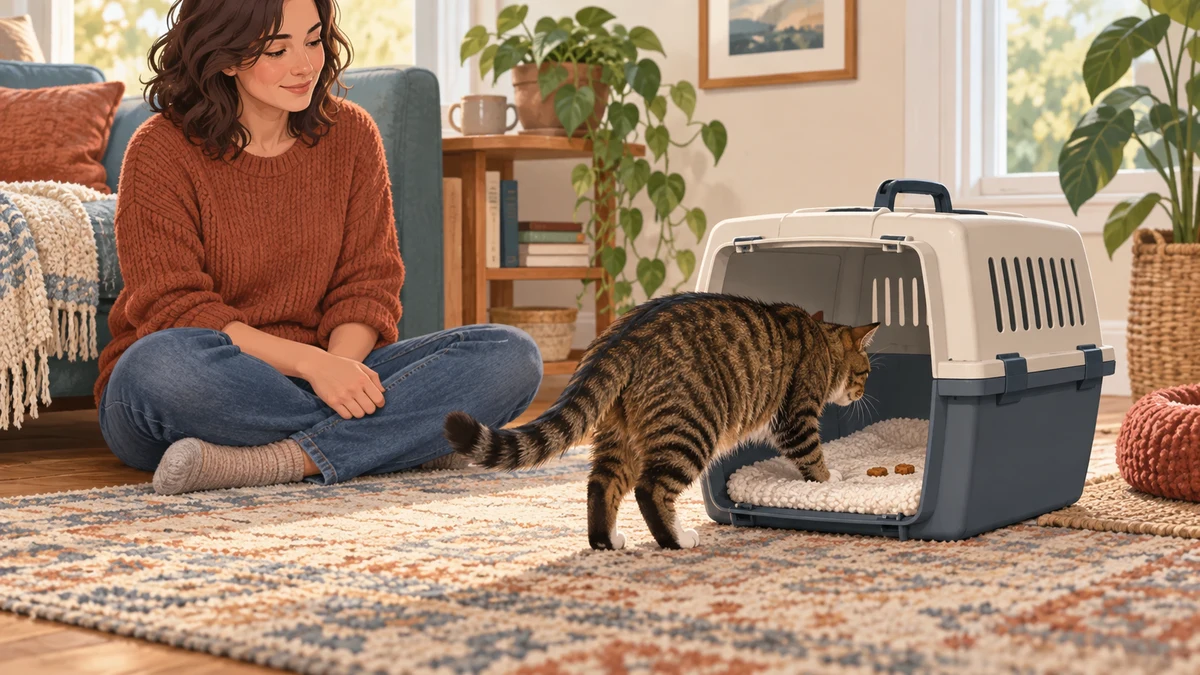
Carrier training should happen during ordinary life. Leave the carrier open in a quiet, useful location with familiar bedding. Reward looking, approaching, entering, remaining while the door moves, brief closure, lifting with the base supported, and short travel as separate steps. Let the cat retreat between sessions. Do not chase, corner, flood, or repeatedly force a frightened cat into the carrier as “practice.” If a cat still cannot be loaded safely, ask the veterinarian for an individualized pre-emergency plan; do not improvise medication.
Store carriers where adults can reach them fast, not behind stacked boxes or in a detached space. In a multi-cat home, attach a distinct color marker to each carrier and matching record pouch. During a real evacuation, load inside a closed room, latch and test every closure, and only then open the route. Never open a carrier in a hallway, parking area, vehicle transfer point, outdoor queue, or other space that is not genuinely escape-proof.
Build a kit you can carry and maintain
Pack by function. A list of objects is not enough: quantities must match each cat, containers must fit the carrier and transport plan, and another caregiver must understand the instructions.
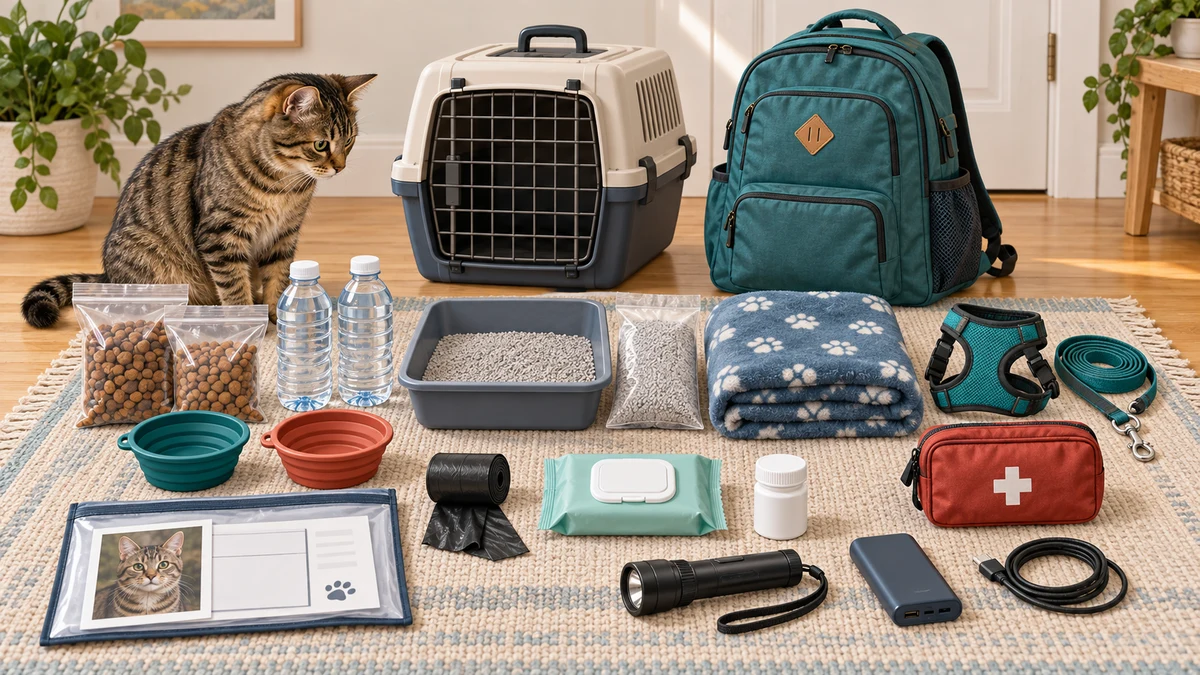
| Category | What to prepare | Maintenance check |
|---|---|---|
| 1. Food | Normal food in sealed, waterproof portions; manual opener if required | Rotate before the product date; reject swollen, damaged, wet, or pest-exposed packaging |
| 2. Water | Cat drinking water in containers the household can transport | Follow the container and local storage guidance; replace after heat, damage, or contamination |
| 3. Bowls and feeding instructions | Stable or collapsible bowls, portions, schedule, and safe preparation notes | Confirm a proxy can follow the current routine |
| 4. Prescription medicines | Only the cat’s current veterinary prescriptions in original labeled containers | Ask the veterinarian in advance about a lawful emergency supply, storage, expiry, and what to do if a dose is disrupted |
| 5. Medical information | Medical summary, vaccine records, prescriptions, clinic and emergency-hospital contacts | Replace after any diagnosis, medication, clinic, or contact change |
| 6. Identity and ownership | Microchip registry details, current household contacts, proof of ownership or adoption | Verify registration after a move or phone change |
| 7. Recent photographs | Clear face, full-body, both-side, and distinctive-mark images, plus a photo with the caregiver | Refresh after a major appearance change |
| 8. Carrier and familiar bedding | One checked carrier per cat, absorbent liner, spare familiar towel or blanket | Inspect closures, cracks, ventilation, base, and size before disaster season |
| 9. Escape-control equipment | Cat-appropriate harness and leash if the cat has been trained to use them; spare ID | Check fit and condition; this equipment never replaces a closed carrier |
| 10. Litter and elimination | Portable tray, familiar litter, scoop, waste bags, absorbent pads | Keep dry; size the amount to the official supply target and destination |
| 11. Cleaning and hygiene | Paper towels, pet-safe cleaning product, bags, gloves, and hand hygiene | Replace leaks and dried products; never mix cleaning chemicals |
| 12. First-aid information and supplies | Veterinarian-recommended kit, current first-aid guide, gloves, gauze, and contact numbers | Review with the veterinary team; first aid does not replace care |
| 13. Comfort and handling | Small familiar toy, bedding, and a carrier cover that preserves airflow | Wash or replace while keeping familiar scent available |
| 14. Light and power | Flashlight, spare batteries, power bank, charging cables, and battery radio if locally advised | Charge and test on a calendar |
| 15. Documents and local plan | Waterproof paper copies, digital backup, shelter rules, routes, destinations, and proxy instructions | Reconfirm before local disaster seasons and after policy changes |
| 16. Human needs | The human emergency kit, medications, mobility, communication, clothing, water, and food | A cat plan fails if the people cannot leave and remain safe |
Put a dated inventory on the outside. Check the kit on a fixed schedule and after every use. Also use the shortest expiry, battery condition, seasonal hazard, and the cat’s changing health as triggers; a twice-yearly reminder cannot rescue food that expires sooner. Do not replace veterinary prescriptions with human medicines, supplements, sedatives, or leftover drugs. If refrigeration or another storage condition is required, make a veterinarian-reviewed outage plan before the emergency.
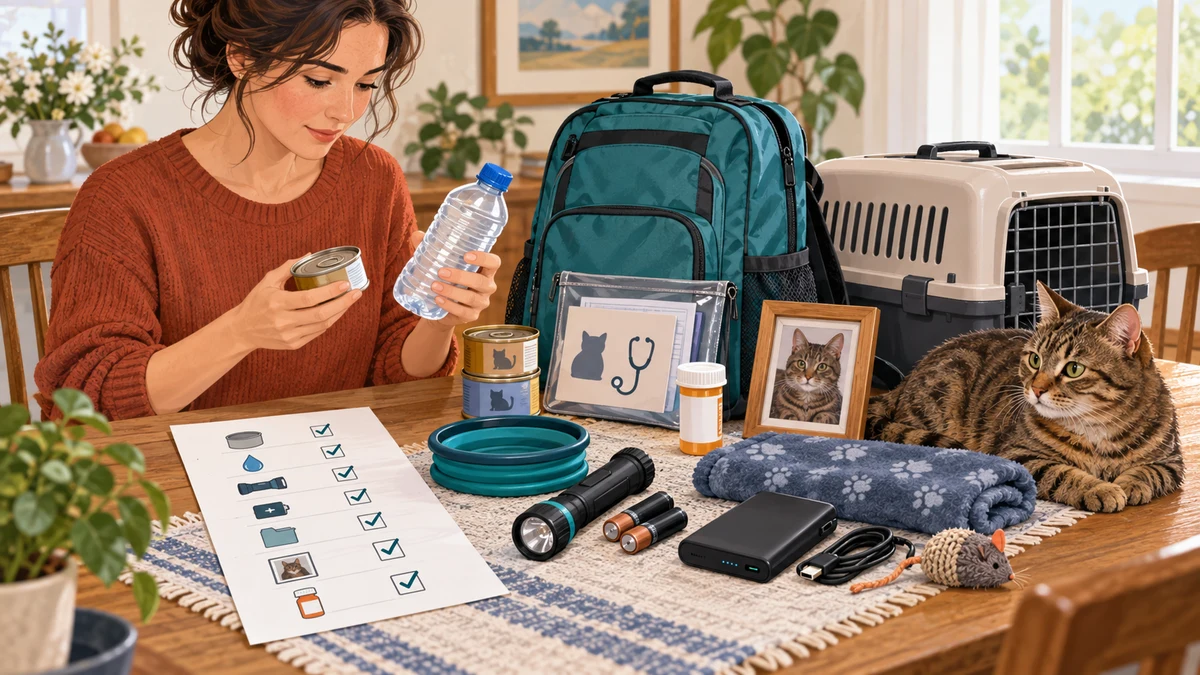
Confirm destinations, transport, and a proxy
CDC and Red Cross guidance both warn that animal accommodation varies. Do not assume a public shelter, hotel, taxi, train, airline, boarding facility, or clinic will accept a cat simply because it did last year. As of September 13, 2026, verify the current local process directly and record the contact, date, restrictions, fees, required documents, carrier rules, check-in location, and what happens if people and animals are housed separately.
Prepare at least:
- a primary destination outside the most likely hazard zone;
- a backup destination using a different route or area;
- a veterinary or boarding option near each destination;
- a vehicle plan with the carrier level and restrained;
- a no-car plan based on current local emergency transport information; and
- a trusted proxy for an emergency that starts while nobody is home.
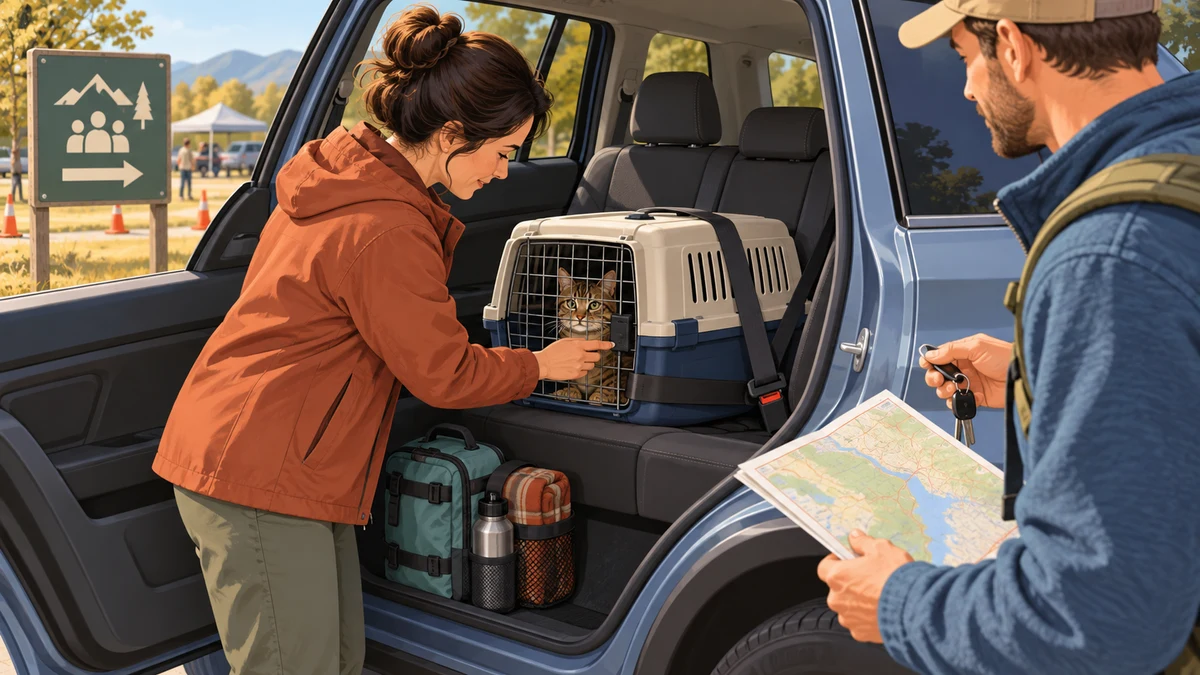
The proxy needs more than a key. Walk them through cat locations, carrier colors, loading, alarms, shutoffs they are authorized and able to use, records, destination contacts, and the point at which they must stop and wait for responders. Agree on a short status format such as “people safe / cats accounted for / destination / next contact time.” Never ask a proxy to enter an officially closed or visibly dangerous building.
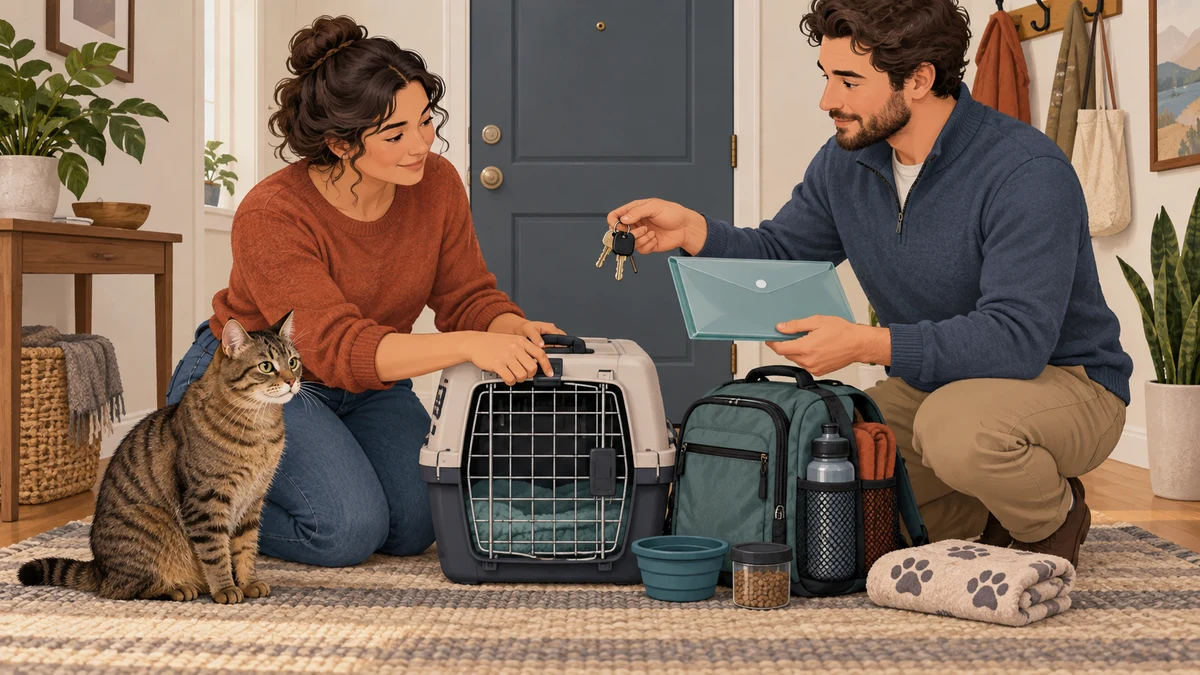
Practice a ladder, not one dramatic test
Good drills reveal friction without creating a crisis for the cat. Stop or simplify when the cat freezes, struggles, hides longer afterward, refuses normal activities, or shows escalating distress. Keep the ordinary carrier work separate from a full-volume emergency alarm. Never disable a working alarm for training.
Use at least these eight practices:
- Carrier entry: the cat chooses to enter for familiar bedding, food, play, or rest.
- Closure and lift: close each latch, check it, support the base, lift, and set down calmly.
- Short carry: move through the indoor route without striking walls or swinging the carrier.
- Two-exit drill: walk the primary route, then the backup route, without opening an unsafe exterior boundary with a loose cat.
- Transport drill: load the restrained carrier into the actual car or rehearse the current no-car handoff.
- Night and outage drill: use shoes, flashlight, backup lighting, and paper instructions with household lights off.
- Cue practice: teach a calm, distinct household cue that predicts moving toward the carrier; introduce recorded sounds only at a low intensity the cat can handle.
- Proxy and destination drill: the backup person finds the kit and carrier, then everyone confirms arrival procedures in the secure room.
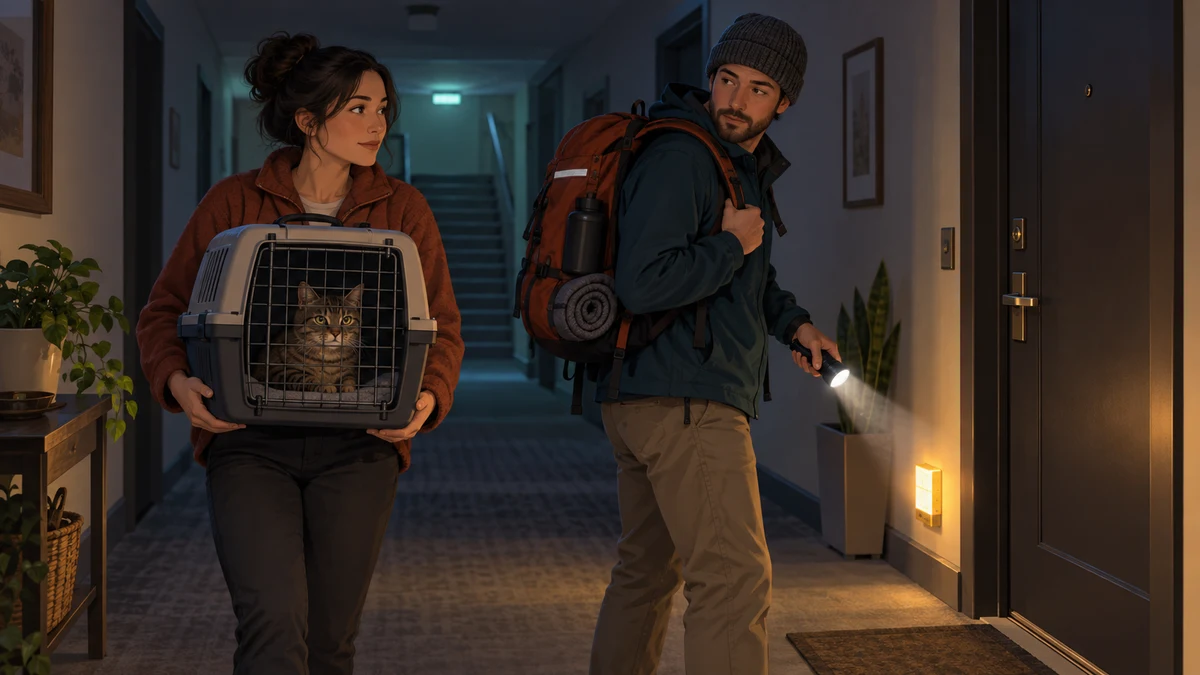
After each drill, record the date, loading problems, blocked route, missing supply, dead battery, carrier fault, contact that did not answer, and one change to test next time. A successful drill is not the fastest one; it is one in which people stayed safe, every cat remained contained, and the plan produced usable information.
When an alert becomes real
Follow official instructions first. If there is time and the route is safe, close the loading room, visually account for cats, put each into its assigned carrier, test the latches, take kits and records, close doors behind you, and report at the meeting point. One person calls out the head count. If the primary exit, destination, or transport fails, switch to the written backup rather than debating from memory.
Fire is the hard limit. American Red Cross guidance says never delay escape or endanger people to rescue a pet. If a cat hides and cannot be reached without entering smoke, fire, a collapsing area, or another immediate danger, leave, remain outside, and tell responders the number of cats, last known location, hiding places, and carrier location. Do not go back inside. The same principle applies to any building closed by emergency authorities.
If officials direct sheltering in place, use the preselected safe room, keep carriers immediately available, remove accessible hazards, close escape gaps, and monitor official updates. Do not invent ventilation, water, decontamination, or evacuation steps for a chemical event; incident-specific public instructions take priority.
Open the carrier only inside a secure destination
On arrival, one person checks the room before any carrier opens: exterior door shut, windows secure, vents and gaps blocked, other animals separated, litter and water ready, and everyone briefed. Then place the carrier on the floor, let the room settle, and open it without pulling the cat out. A shelter or hotel lobby, outdoor tent, parking area, or vehicle beside an open door is not a secure room.
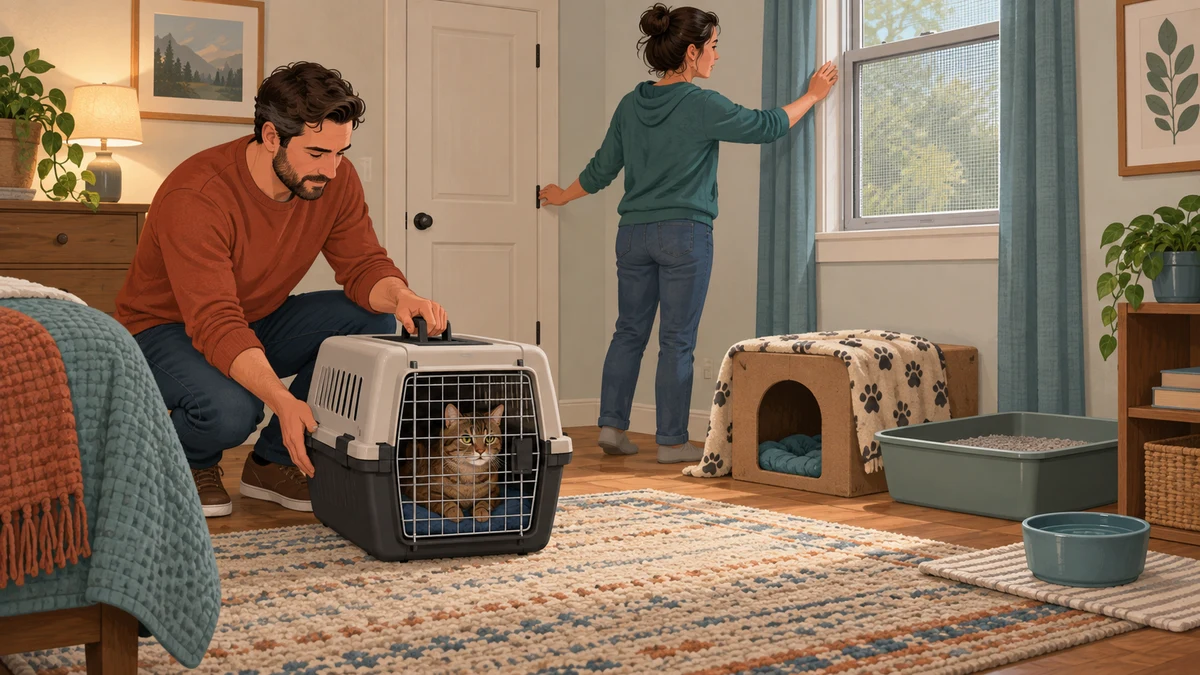
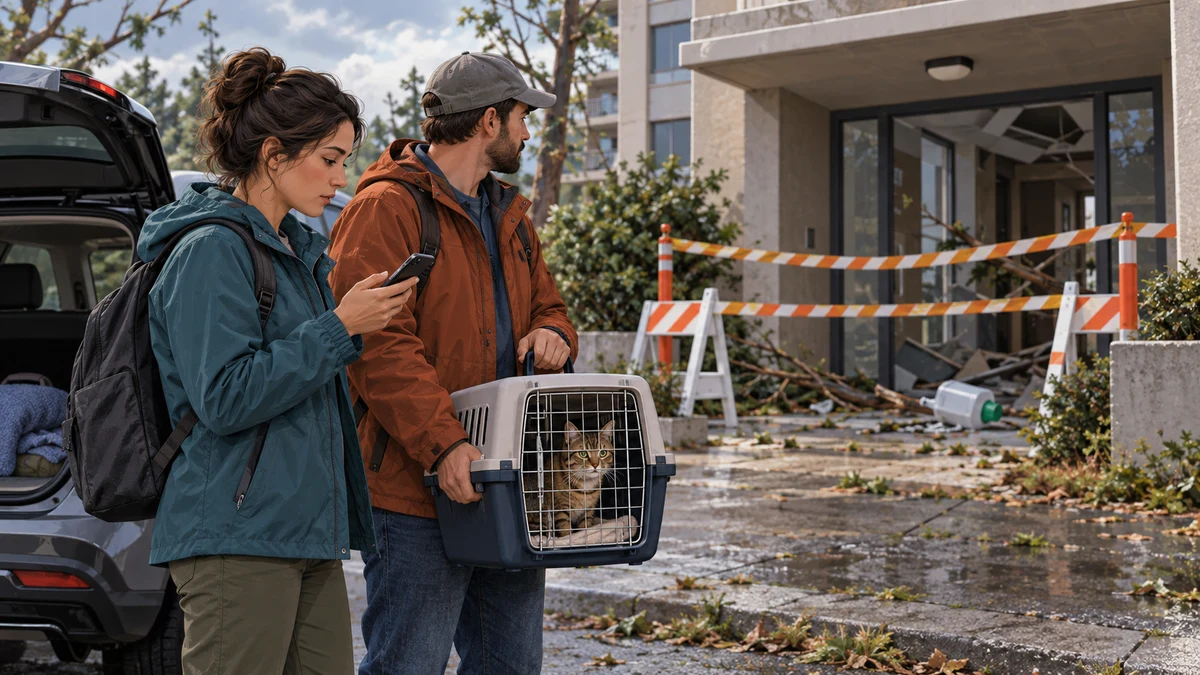
After the emergency, keep cats contained during movement. CDC notes that familiar scents and landmarks may have changed, while damaged fences, debris, exposed wiring, spilled chemicals, stagnant water, and displaced animals create new risks. Return only when authorities say the building and route are safe. Current identification and a lost-cat file matter because even an indoor cat may become disoriented after displacement.
Know when the plan becomes a veterinary emergency
Arrange local emergency-veterinary and animal-poison contacts before a disaster. Seek prompt professional guidance for injury, abnormal or difficult breathing, smoke exposure, collapse, unusual weakness, heat or cold stress, persistent refusal to eat, repeated vomiting or diarrhea, burns, bleeding, or known or suspected contact with floodwater, chemicals, fuel, cleaners, toxic plants, spoiled food, or other contaminants. Tell the clinic what happened, when, what signs you see, and what product may be involved; bring the container only if it is safe.
The AVMA advises contacting a veterinarian, emergency hospital, or animal poison service after suspected poisoning and not inducing vomiting or giving medication unless directed. Do not use human painkillers, leftover prescriptions, home remedies, or a social-media dose. First aid can support transport, but it is not a substitute for veterinary care. Protect yourself too: pain and fear can make even a gentle cat scratch or bite.
A practical setup for this week
Do not wait for a perfect kit. Label and inspect one carrier per cat; put them where they are reachable; save current photos and records; assign the six roles; mark two exits and two meeting points; call two destinations; confirm transport and proxy access; assemble the sixteen kit categories; and run a calm carrier-entry drill. Then add one improvement after each review. The aim is not certainty. It is fewer decisions, fewer open doors, and safer choices when time and attention are limited.
Frequently asked questions
How many days of cat food and water should I store?
Use current local official guidance and your cat’s normal needs. Checked September 13, 2026, Taiwan examples use three days for the general emergency bag and three to five days of pet food, while the U.S. CDC pet checklist uses two weeks. These are not interchangeable global rules. Keep a carryable evacuation kit and, if appropriate, a larger home reserve; rotate both safely.
Should two bonded cats share one carrier?
Plan one carrier per cat. International Cat Care notes that even cats who normally get along may behave differently when stressed and confined. Separate carriers also make weight, ventilation, identification, medical handling, and emergency separation easier to manage.
What if my cat will not enter the carrier during a drill?
Stop the escalation and return to an easier step: carrier left open, familiar bedding, rewards near the entrance, then voluntary entry. Do not chase or flood the cat. Ask the veterinarian for an individualized safe-loading plan well before an emergency if progress remains difficult.
May I open the carrier to comfort my cat during evacuation?
Not in an open vehicle, hallway, parking area, queue, shelter common area, or outdoors. Wait until you are inside a checked, escape-proof room with the exterior door and windows secure. Calm voice and a breathable carrier cover can be used without opening it when appropriate.