Do Cats Need Baths? When to Wash at Home and When to Get Professional Help
Most healthy indoor cats that groom normally do not need scheduled baths. Their own grooming, supported by appropriate brushing, usually keeps the coat serviceable. Bathe only for a specific reason: a widespread but known non-toxic mess, feces or urine in the coat, inability to self-groom, a special coat-care need, or a veterinarian-directed treatment. Use the least cleaning that solves the problem, and never turn “every few weeks” into a universal rule.
An unknown chemical, oil, medicine, pesticide, essential oil, or potentially toxic substance on the coat is different. Prevent licking, move the cat away from the spill, keep the package, and call a veterinarian or the animal poison service for your location immediately. Do not induce vomiting, give medicine, neutralize one chemical with another, or reach for a solvent. The substance determines whether and how decontamination should begin.
Start with the reason, not a calendar
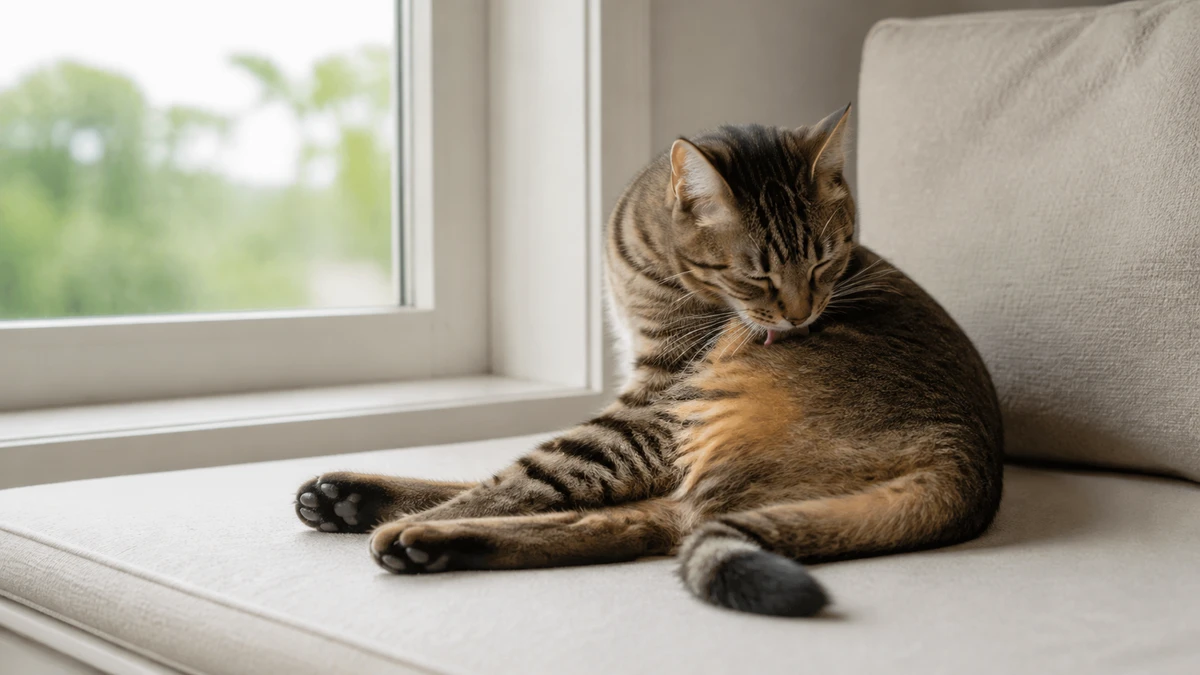
Texas A&M veterinary dermatologist Dr. Alison Diesel explains that cats generally do not need owner-given baths because normal self-grooming makes them unnecessary. VCA likewise notes that most healthy adult cats rarely need one. Age, mobility, body condition, coat type, lifestyle, and health can change that answer, so the useful question is not “How many days since the last bath?” but “What is on the coat, can the cat remove it safely, and is there a health or handling risk?”
| Situation | Best first step | Is a full bath usually needed? |
|---|---|---|
| Healthy indoor cat with a clean coat and normal grooming | Inspect and brush as appropriate | No; do not bathe by schedule alone |
| Small patch of ordinary, known non-toxic dirt or food | Wipe or rinse only the affected area | Often no |
| Feces, urine, or a widespread ordinary mess in the coat | Spot-clean if sufficient; use a careful bath if the mess is extensive | Sometimes |
| Older, overweight, painful, or mobility-limited cat that cannot reach part of the body | Ask a veterinarian why grooming changed; use only the assistance the cat needs | Possibly, but the cause matters |
| Post-operative cone or another temporary barrier to self-grooming | Follow the clinic’s wound and grooming instructions | Only if the veterinary team says it is safe |
| Hairless breed or another specific coat-care requirement | Follow breed-appropriate advice from the cat’s veterinary team | Sometimes, on an individual plan |
| Veterinarian-prescribed medicated shampoo | Follow the exact product, contact time, frequency, and drying directions | Yes, when prescribed and safe to perform |
| Unknown chemical, oily substance, medicine, pesticide, or potentially toxic product | Prevent licking and call a veterinarian or local animal poison service now | Do not improvise; obtain substance-specific directions first |
Four broad situations can therefore justify washing assistance: an ordinary mess the cat cannot safely remove, impaired self-grooming, a known special coat need, or a veterinary treatment plan. Even within those groups, a damp cloth, partial rinse, brushing, clipping by a professional, or a leave-on veterinary product may be more appropriate than a full bath.
A suddenly untidy coat can be a health clue
A greasy, clumped, unusually dull, odorous, or poorly groomed coat is not automatically a shampoo problem. Cats may stop reaching parts of the body when movement is uncomfortable or limited. A cone can block access temporarily. Skin irritation can also change how much a cat licks. Cats Protection and the RSPCA advise seeking veterinary guidance when normal grooming or coat condition changes.
Do not diagnose the cause at home from the coat alone. Note when the change began and whether appetite, movement, toileting, breathing, or behavior also changed, then speak with a veterinarian. Cleaning the fur may improve hygiene, but it does not explain or correct the reason the cat stopped grooming.
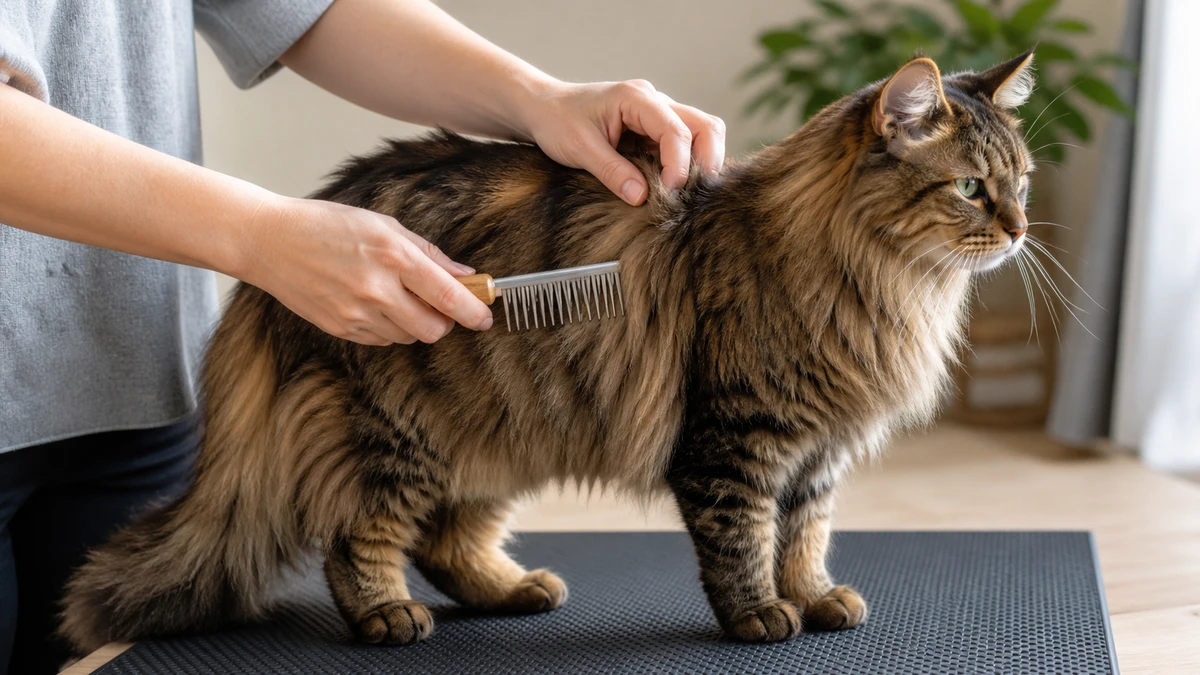
For routine loose hair and small tangles, see the guide to brushing a cat without pulling. Brush only a loose, painless tangle that separates easily. Water can tighten existing tangles, so check before bathing. Do not slide scissors under a mat: cat skin is thin, mobile, and easily drawn into the blades. Dense felted mats, skin irritation under a mat, or a cat that resists because the area hurts belongs with a veterinarian or qualified cat groomer.
If the substance may be toxic, stop and call first
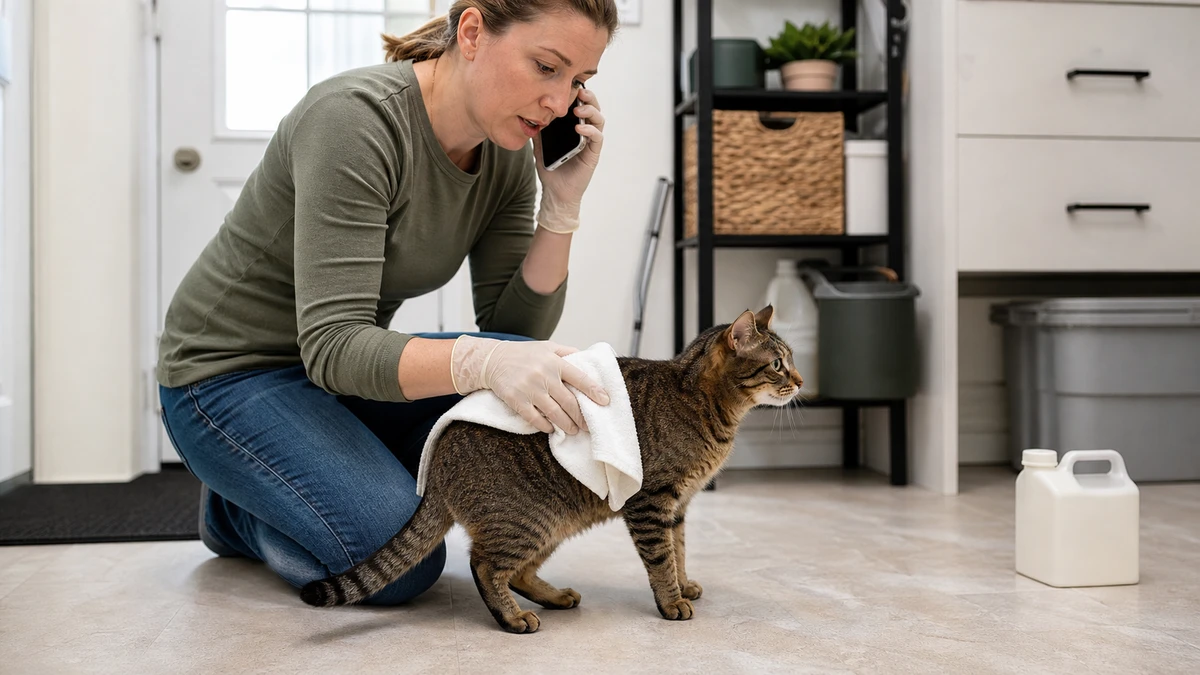
Treat an unknown coating as a possible poisoning exposure, not as an ordinary grooming task. Cats can absorb some substances through skin and can swallow them while grooming. MSD Veterinary Manual describes topical decontamination as substance-dependent; ASPCA poison specialists warn that at-home vomiting attempts can be dangerous. A quick phone call is part of first aid because water, soap, clipping, or another response may be right for one product and wrong for another.
- Prevent grooming without starting a struggle. Use a clean towel as a loose barrier or place the cat in a safe carrier if that can be done without spreading the material.
- Move away from the source and ventilate if fumes are present. Do not expose yourself; use gloves when the product label or professional instructs you to do so.
- Keep the container, label, ingredient list, and approximate exposure time. Photograph them if the container cannot travel safely.
- Call a veterinarian or the animal poison service for your country or region immediately. Report the product, route of exposure, body area, amount if known, and any signs.
- Follow the product-specific decontamination instruction. Do not delay urgent travel if the cat has breathing trouble, collapse, tremors, seizures, marked drooling, repeated vomiting, an eye exposure, a chemical burn, or altered awareness.
Never use paint thinner, mineral spirits, fuel, alcohol, concentrated cleaner, or another solvent to strip a cat’s coat. Do not apply essential oils as a “natural” cleanser. Veterinary toxicology sources document that concentrated essential oils can be absorbed through skin or swallowed from fur and may cause serious signs in cats. Do not give milk, food, charcoal, medication, or induce vomiting unless the consulted veterinarian or poison specialist specifically directs it for that exposure.
Use only a product clearly intended for cats
For an ordinary bath on healthy skin, choose a mild rinse-off shampoo whose label explicitly says it is for cats and matches the cat’s age. Human and baby shampoos are not substitutes; their formulation can irritate feline skin. A dog product is not automatically safe for cats. This is especially important for flea, tick, and medicated shampoos: the FDA says the product must match the animal species and warns never to use a dog-labeled product on a cat.
Medicated shampoo is treatment, not a stronger general cleanser. The veterinarian selects it for a particular problem and sets the frequency and contact time. Do not borrow another animal’s prescription, combine shampoos, add essential oil, or extend contact time. Cats commonly lick their coat after a bath, so every rinse-off product must be removed thoroughly according to its label or veterinary directions.
Prepare the room before bringing in the cat
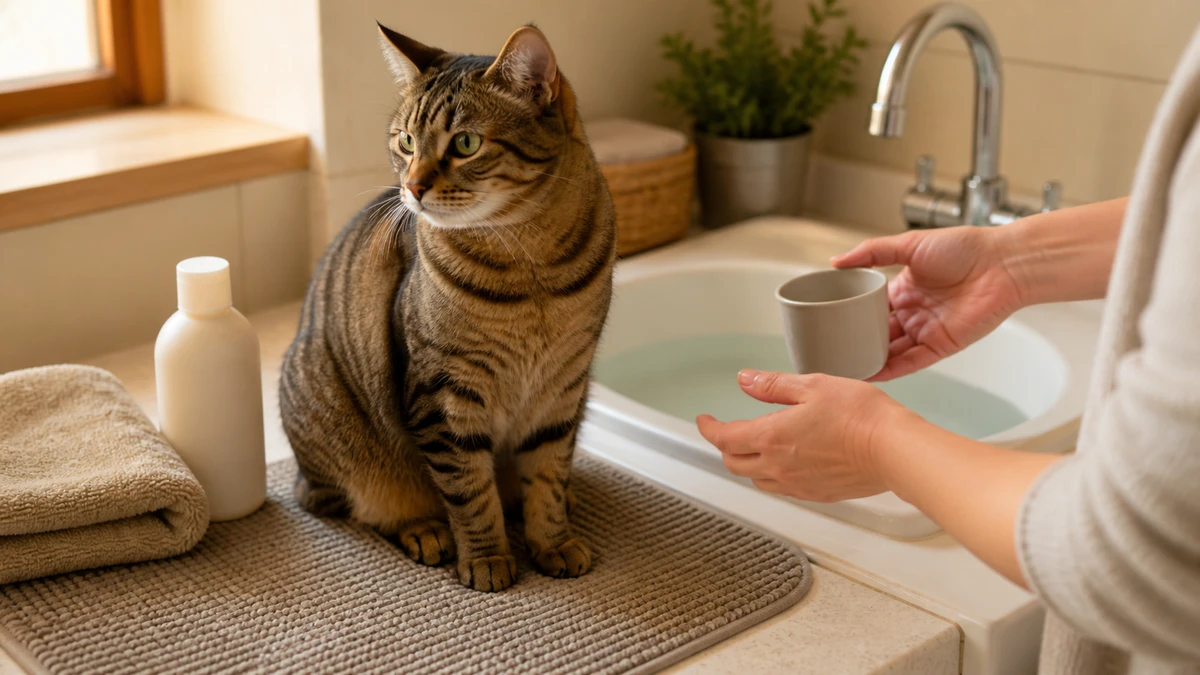
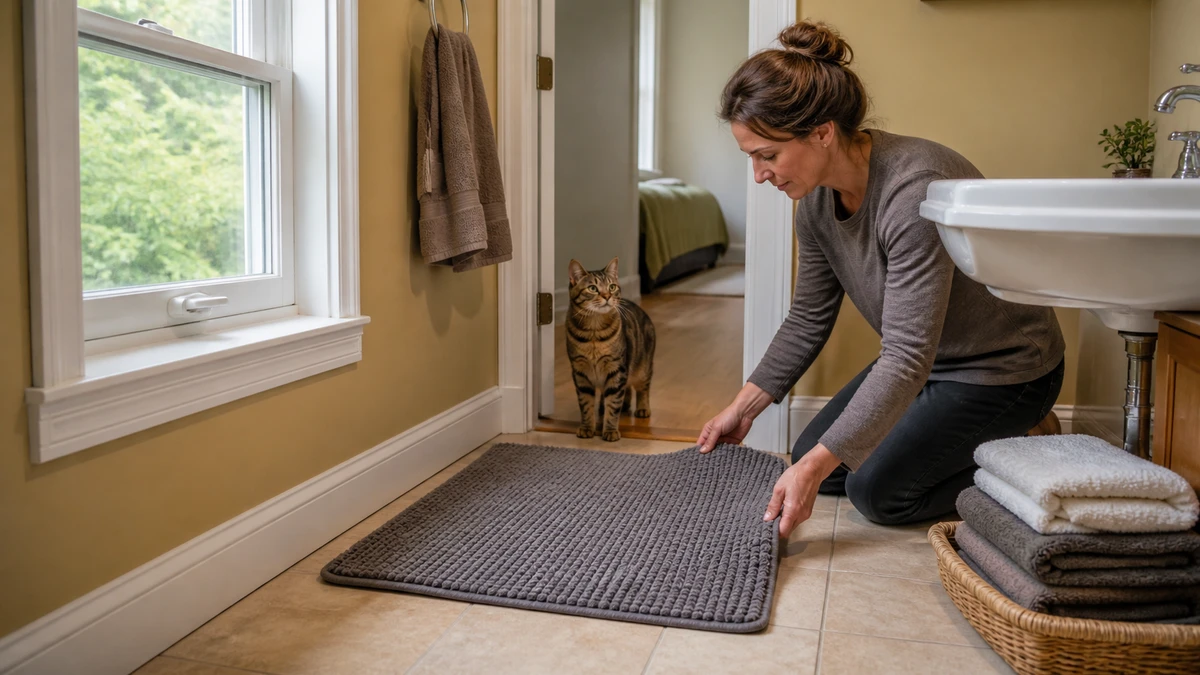
The safest home bath is short because every supply and exit is handled first. Choose a warm, quiet, draft-free room. Close exterior doors and windows, block unsafe hiding gaps, and remove breakable items. The bathroom door can be closed, but the cat still needs a stable place to stand and a clear way to step away from your hands; “prevent an outdoor escape” does not mean “pin the cat in the tub.”
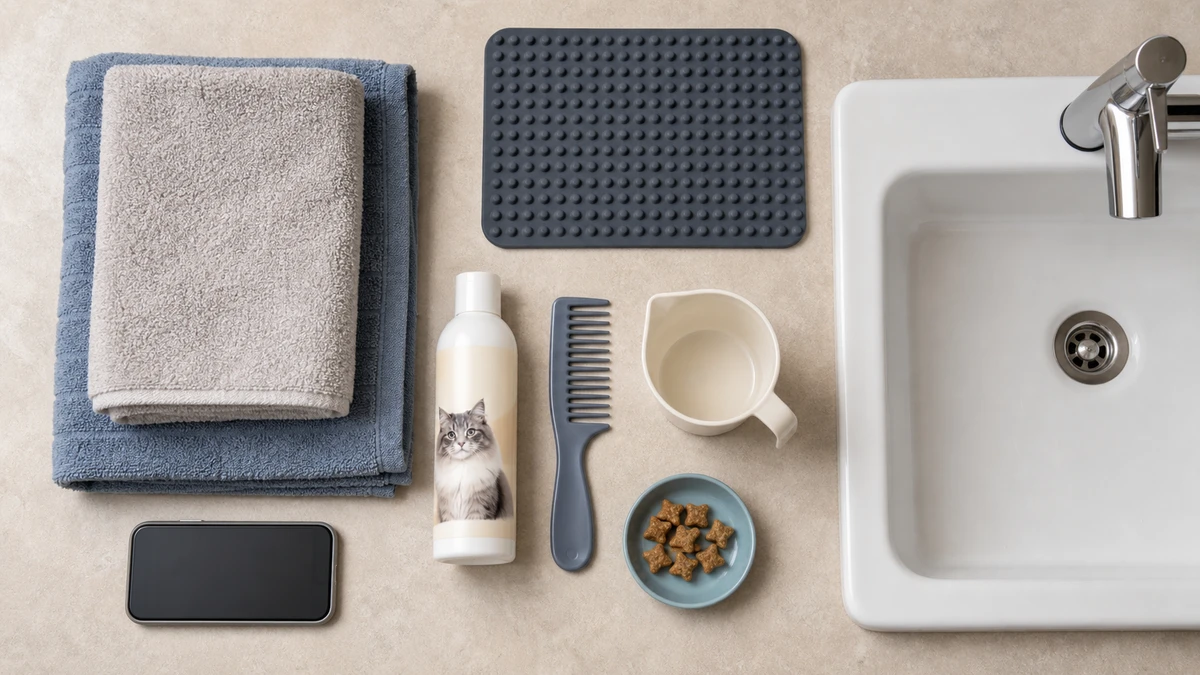
Gather two or more absorbent towels, a nonslip rubber mat, a rinsing cup or very gentle low-flow attachment, cat-labeled shampoo if needed, a comb for loose tangles, and small rewards. Put the dry towel within arm’s reach but away from splashes. Open the shampoo cap in advance. Keep electrical appliances and the phone away from water.
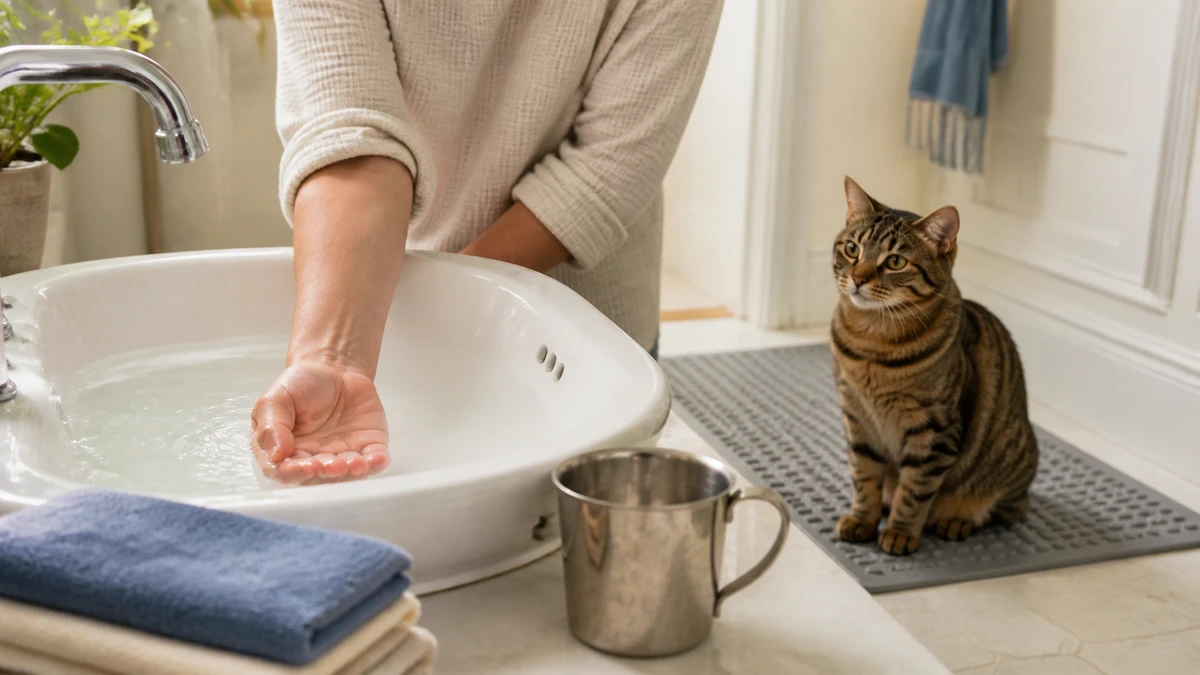
Check the cat before you start. Postpone the bath and call the clinic if there is an open wound, painful area, extensive matting, trouble standing, breathing change, marked weakness, shivering, or a recent procedure without clear bathing permission. If the cat is already hiding, panting, growling, or trying to bite when you approach the room, a forced bath is not a low-stress bath.
A 12-step low-pressure home bath
This process is for a stable cat, a known ordinary mess, and a product confirmed for cats. It is not a chemical-decontamination protocol or a substitute for veterinary care.
- Choose the smallest effective clean. If a damp cloth or partial rinse removes the mess, stop there rather than soaking the entire cat.
- Inspect and gently comb first. Remove only loose debris and small tangles that release without pulling. Leave dense mats and painful areas to a professional.
- Warm and secure the room. Close routes to outdoors, eliminate drafts, and keep the floor dry enough that neither participant slips.
- Arrange every item within reach. Set out towels, nonslip mat, cup, rewards, and the opened cat-labeled product before the cat enters.
- Prepare shallow lukewarm water. It should feel comfortably neutral-warm, never hot. Avoid a deep pool and sudden running-water noise.
- Invite rather than chase. Let the cat approach the mat. If body tension rises before water begins, pause and use professional help rather than escalating restraint.
- Keep all four feet supported. A textured mat gives traction. Use a steady hand near the body only as needed for balance; do not scruff, pin the chest, or stretch the legs.
- Wet from the shoulders backward. Use a cup or a very gentle flow close to the coat. Keep water out of the eyes, ears, nose, and mouth; never immerse the face.
- Use the minimum labeled product. Distribute it gently through the wet body coat according to the label. Do not scrub an inflamed area or improvise additives.
- Rinse longer than seems necessary. Continue with clean lukewarm water until no lather, slippery film, or product odor remains, including the belly and skin folds that can be reached safely.
- Move directly to a dry towel. Support the chest and hindquarters or let the cat step out. Blot and press the coat; vigorous rubbing can tangle long fur and upset a sensitive cat.
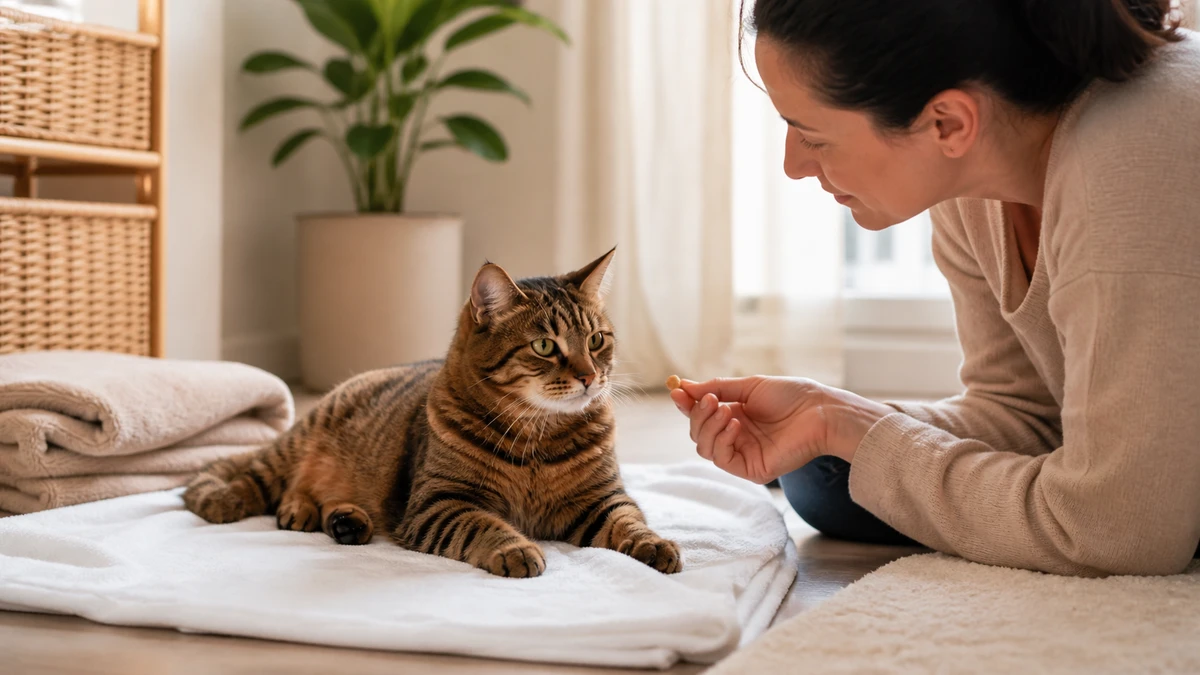
- Keep warm and observe. Use fresh towels in a draft-free room until the coat is fully dry. Offer a reward and watch for persistent shivering, weakness, breathing change, skin redness, or unusual behavior.
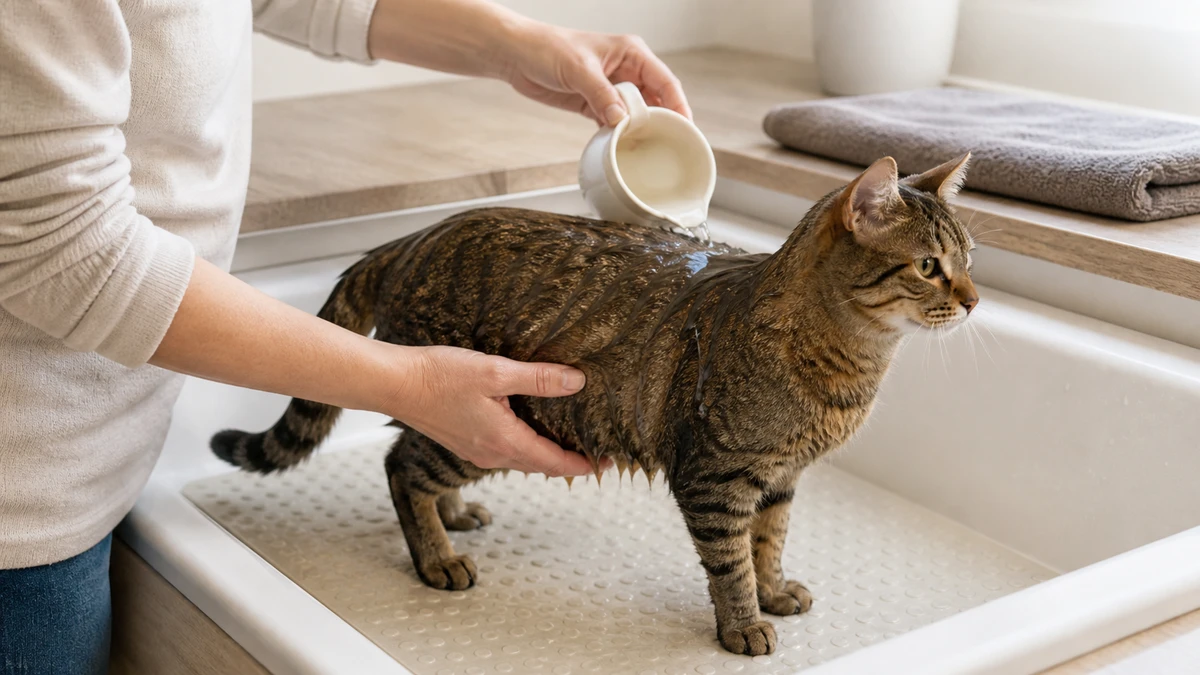
Do not clean the ear canals with bath water or cotton swabs, and do not pour water across the face. If ordinary dirt is near the face, use a separate barely damp soft cloth while keeping clear of the eyes, nose, and mouth. Eye exposure to a chemical or a painful red eye needs immediate professional direction rather than a routine face wash.
Body language is the stop button
A cat does not have to hiss or bite before the bath becomes too much. Early signs include leaning away, repeated attempts to leave, freezing, a tense crouch, ears turning sideways or back, rapid tail movement, enlarged pupils, refusal of a usual reward, or repeatedly looking toward the hand. Release pressure, turn off water, and offer an exit at the first escalation.
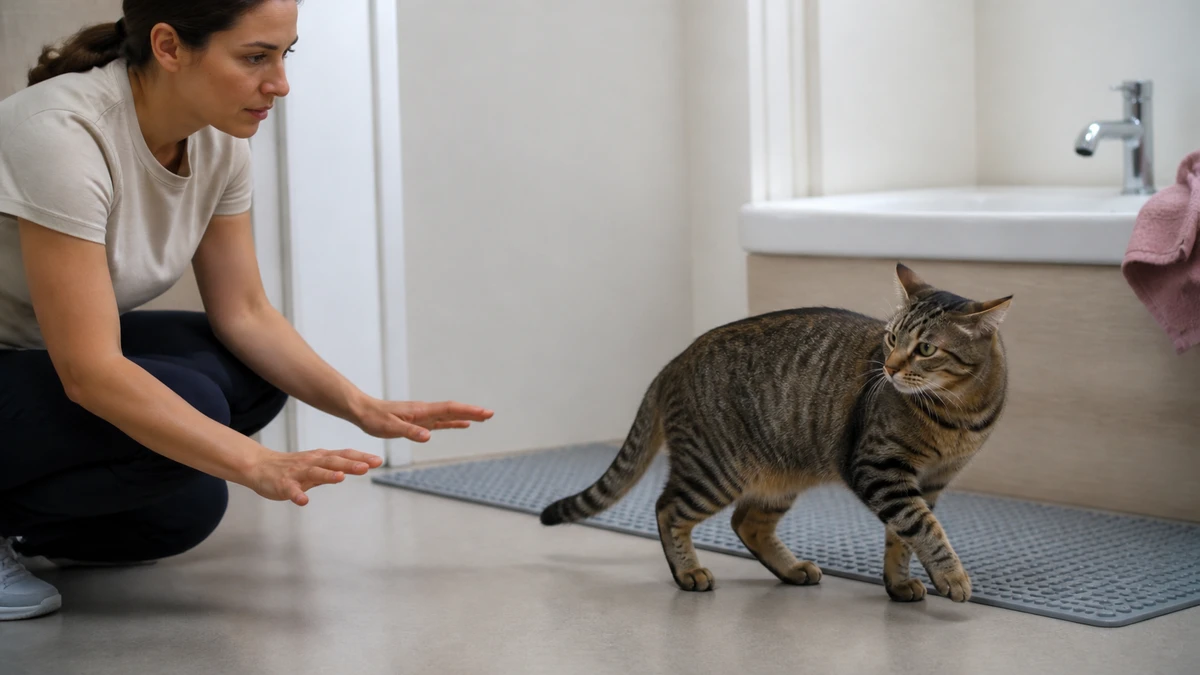
End the attempt for growling, hissing, swatting, biting attempts, frantic escape, open-mouth breathing, collapse, or suspected pain. The guide to recognizing stress signs can help you read subtler behavior before a grooming task. Do not add more people to hold the cat down, scruff the neck, punish, shout, or give a sedative on your own. A veterinarian can decide whether a medical concern or professionally supervised medication changes the plan.
Dry fully without adding heat risk
Blot with one towel, replace it when saturated, and keep the cat in a comfortably warm room until dry. Separate long coat sections gently with fingers or a suitable comb only if they are already free of mats and the cat accepts it. A damp undercoat can remain cool long after the surface looks better.
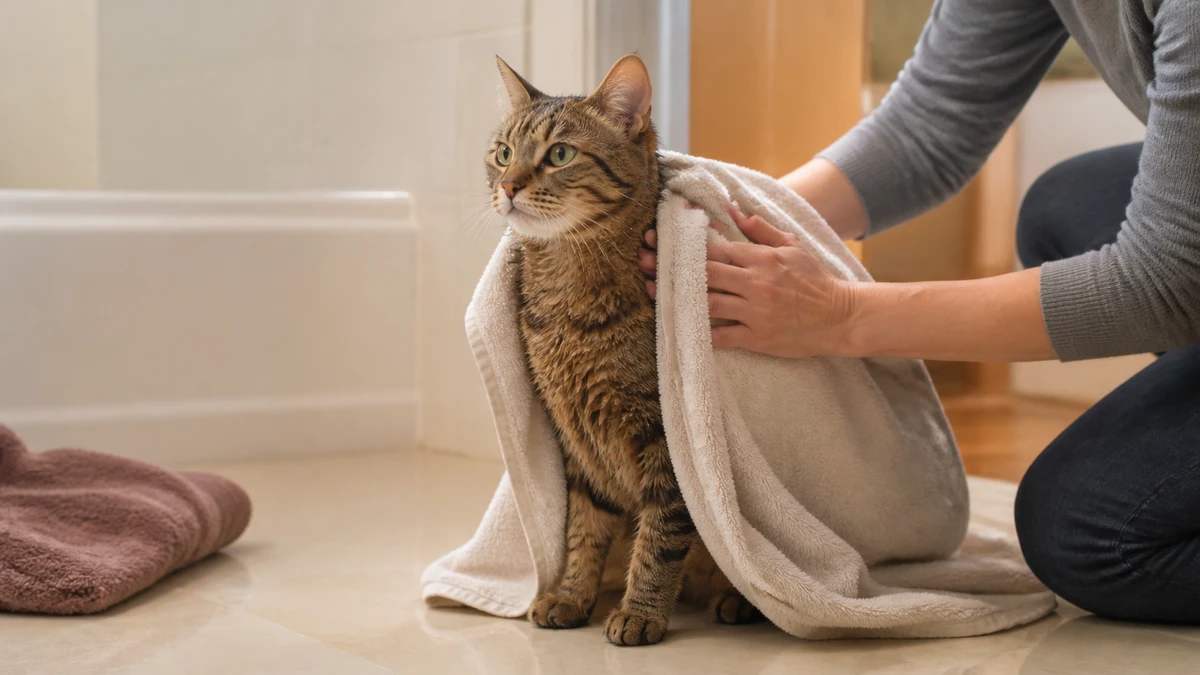
Avoid a hot human hair dryer. Heat, noise, and air directed at the face can frighten or injure a cat. If a dryer is genuinely necessary for a special coat or medical protocol, ask the veterinary team or qualified cat groomer to demonstrate cat-safe equipment, temperature, distance, and handling. Persistent shivering, unusual weakness, pale or bluish gums, labored breathing, or a cat that is not returning to normal needs urgent veterinary advice.
When a veterinarian or qualified professional should take over
Home bathing should stop before safety depends on force, guesswork, or treating a medical problem. At least these situations need professional input first:
| Situation | Who to contact | Why home bathing is not the first move |
|---|---|---|
| Unknown chemical, oil, medicine, pesticide, essential oil, or possible toxin on the coat | Veterinarian or local animal poison service immediately | The correct decontamination depends on the substance and route |
| Contamination in an eye, on the face, or accompanied by fumes or breathing difficulty | Emergency veterinary service | Eyes and airways can be injured quickly |
| Severe felted mats, a mat fixed close to skin, or irritation beneath it | Veterinarian or qualified cat groomer; veterinarian if skin is sore | Water may tighten mats, and blind cutting can slice skin |
| Open wound, burn, active bleeding, discharge, swelling, marked redness, or obvious pain | Veterinarian | Shampoo and handling may worsen tissue injury or delay treatment |
| Trouble standing, major mobility limits, severe weakness, temperature risk, or serious ongoing illness | Veterinarian | The cat may not tolerate standing, heat loss, or handling safely |
| Extreme fear, frantic escape, or a realistic bite and scratch risk | Cat-experienced veterinarian or qualified cat groomer | Finishing by restraint raises injury and future fear |
| A prescribed medicated bath whose product, frequency, contact time, or compatibility is unclear | Prescribing veterinary team | Treatment details are condition- and product-specific |
| Repeated need for baths or a sudden decline in self-grooming | Veterinarian | Frequent soiling or coat change may reflect an underlying problem |
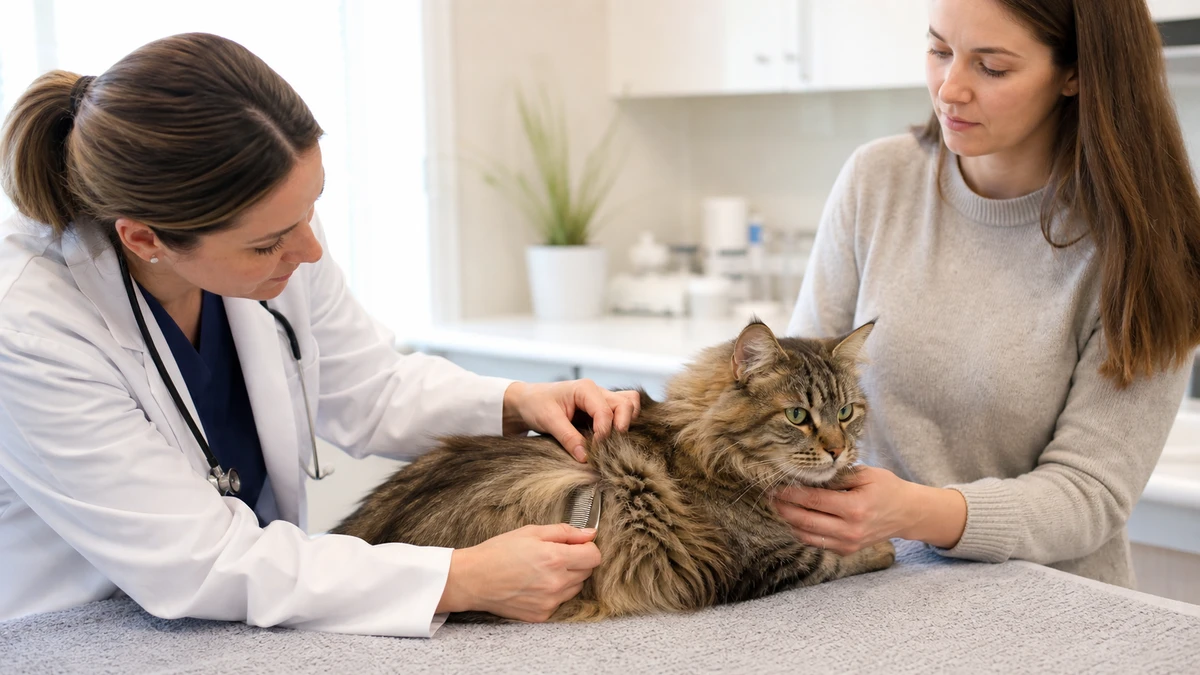
A qualified cat groomer can help with routine bathing or coat clipping in a medically stable cat that can be handled safely. Choose a professional who is transparent about training, feline handling, sanitation, and when they refer to a veterinarian. Wounds, pain, skin disease, toxic exposure, breathing or temperature concerns, and unexplained grooming changes belong with a veterinarian, not a salon.
The goal is not a perfectly scented coat. It is the least intrusive cleaning that protects skin, prevents ingestion of dirt or contaminants, preserves body temperature, and leaves both cat and caregiver safe. For many healthy cats, that still means no bath today.
FAQ
How often should an indoor cat be bathed? There is no universal interval. A healthy indoor cat that grooms normally may rarely or never need a full bath. Inspect the coat, brush as appropriate, and bathe for a specific need rather than a calendar. Ask a veterinarian if bathing becomes frequent.
Can I use human or baby shampoo just once? No. Use only a product explicitly labeled for cats and suitable for that cat’s age and purpose. Human and baby products are not formulated for feline skin. If no cat product is available and cleaning is not urgent, postpone and obtain the correct product.
Can I use dog flea shampoo on a cat? No. Dog-labeled flea, tick, and medicated products may contain ingredients or concentrations unsafe for cats. The FDA advises matching the exact species on the label. Contact a veterinarian immediately if a dog product was applied accidentally.
What should I do if paint, motor oil, cleaner, medicine, or essential oil gets on the fur? Prevent licking, leave the spill area, keep the product container, and call a veterinarian or local animal poison service immediately. Do not use a solvent, essential oil, medication, or home vomiting method. Follow substance-specific instructions.
Should I bathe a new kitten so it gets used to water? Do not create unnecessary full baths. Gentle, brief practice with the dry room, mat, towel, touch, and rewards can build familiarity without soaking the kitten. If a bath is truly needed, confirm that the kitten is stable, warm, old enough for the labeled product, and safe to handle; ask the veterinary team when uncertain.
Is a hair dryer the fastest way to finish? Not a hot human dryer. Towel-blot and keep the cat in a warm, draft-free room. Ask a veterinarian or qualified cat groomer about appropriate low-noise, temperature-controlled equipment only when a special coat or medical plan requires it.