How to Introduce a New Cat to Your Resident Cat: 7 Careful Stages
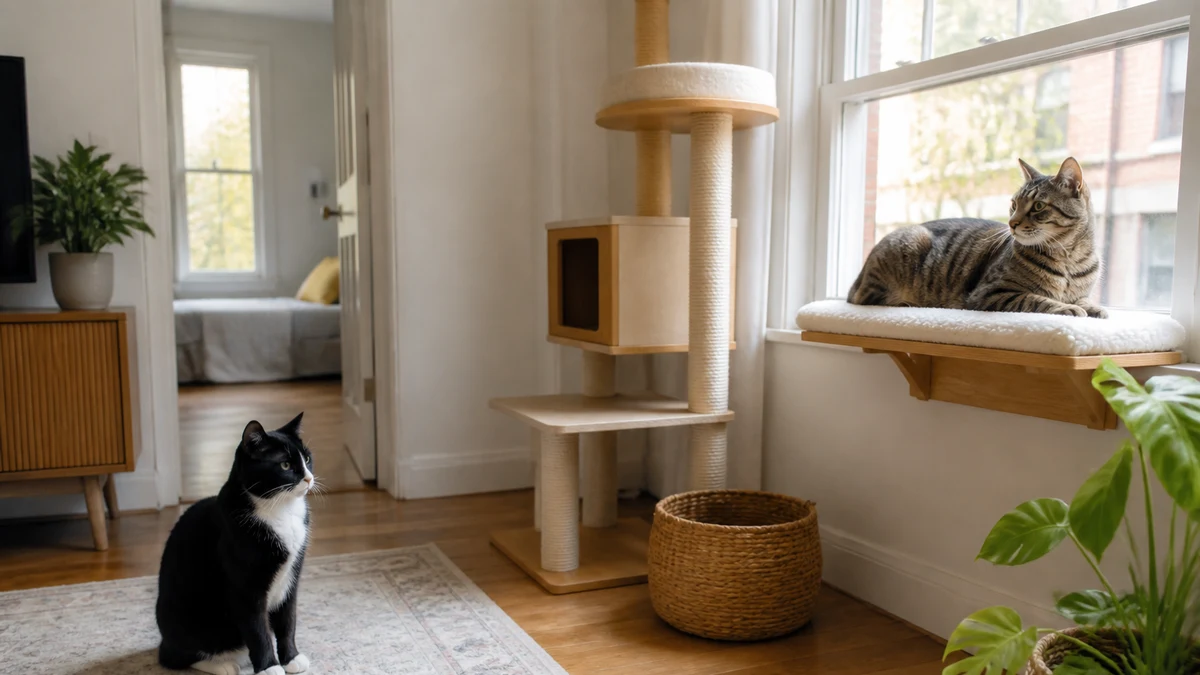
The safest way to introduce a new cat is to prevent an immediate meeting and move through small, reversible stages: health and home preparation, a private transition room, scent exchange, site swapping, visual access through a barrier, short supervised meetings, and gradually longer shared time. Advance only when both cats can eat, play, explore, rest, and disengage at the current level without persistent tension. If staring, blocking, stalking, hiding, appetite or litter-box changes, repeated growling, or attempts to chase appear, increase distance and return to the last comfortable stage. Peaceful coexistence—not cuddling—is a successful outcome.
What “getting along” should look like
Some compatible cats groom or sleep together. Others share a home successfully while choosing different beds, routes, and people. The practical goal is that each cat can reach food, water, litter, resting places, height, and human attention without being watched, pursued, or displaced. They should also be able to pass through the home or leave an interaction.
Do not use nose touching, sleeping in one bed, or playing together as a graduation requirement. Calmly ignoring each other is useful social behavior. A brief hiss can communicate a boundary; it becomes more concerning when it repeats, intensifies, or comes with a rigid body, fixed stare, pursuit, cornering, or loss of normal routines.
The full process may take days, weeks, or longer. Calendar time is not the test. Behavior at the current distance is.
The seven-stage introduction plan
| Stage | Main job | Ready to advance when |
|---|---|---|
| 1. Health and home | Reduce medical and resource-related stress before arrival | Health questions are addressed and separate resource stations are ready |
| 2. Transition room | Let the newcomer settle without meeting resident cats | The new cat eats, uses the litter box, rests, plays, and explores normally |
| 3. Scent | Make the other cat’s odor ordinary at a safe distance | Both cats can investigate or ignore exchanged scent without sustained tension |
| 4. Site swapping | Learn the other cat’s spaces without direct contact | Each cat explores and returns to normal behavior while the other remains separated |
| 5. Visual barrier | Add sight while preventing contact | Both cats can look away, take rewards, play, or leave the barrier calmly |
| 6. Supervised meeting | Share a large room briefly with exits and distractions | Both remain loose and can disengage during repeated short sessions |
| 7. Longer coexistence | Extend shared time while preserving choice and resources | Normal routines continue without chasing, blocking, guarding, or intimidation |
Stage 1: Check health and prepare the whole home
What to do: Arrange a recent veterinary check for the new cat and discuss appropriate screening for contagious disease with the veterinarian. A sudden behavior change, pain, illness, or poor appetite in a resident cat also deserves veterinary attention before adding social pressure. This is not a diagnosis step; it is a way to avoid asking a sick or uncomfortable cat to manage a major change.
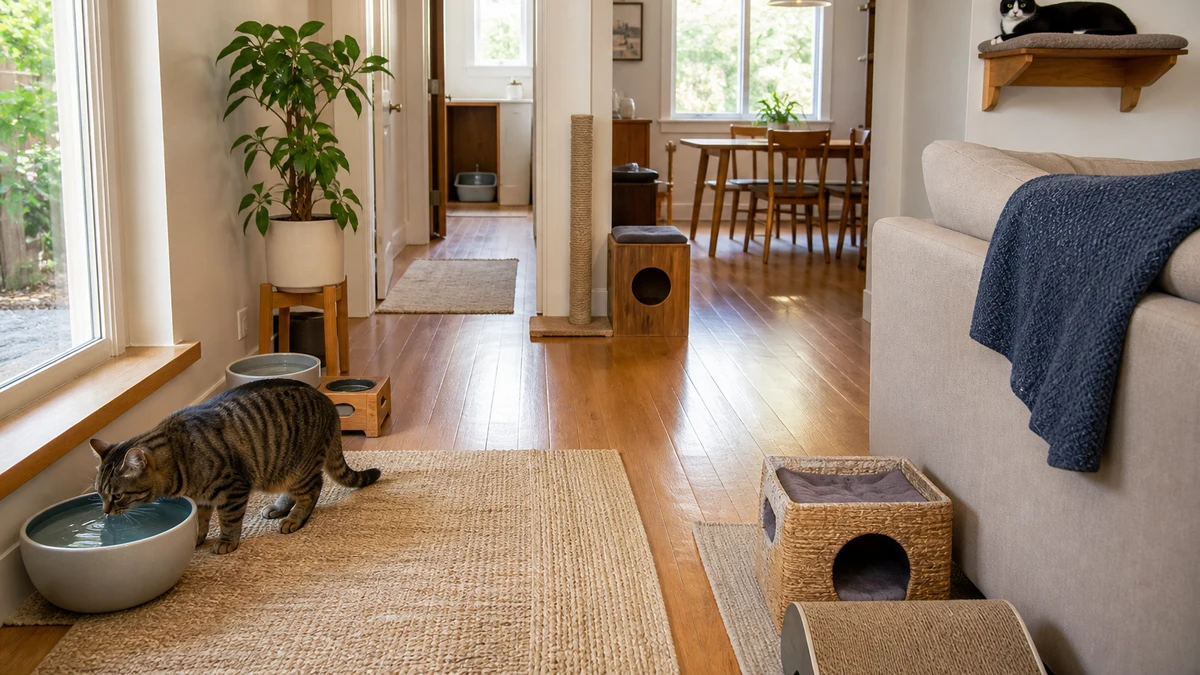
Map the home before arrival. The FelineVMA guide recommends one of each key resource per cat plus one extra, visually separated and spread through private but accessible locations. That includes litter boxes, food and water stations, scratching surfaces, beds, hiding options, and elevated perches. “Three bowls beside one another” is one crowded station, not three independent choices. Avoid placing every litter box in one room or every water bowl along a route one cat can guard.
A complete new-cat supply plan can help prepare the transition room. Keep the resident cat’s familiar resources and routine stable rather than moving everything to make space.
Advance when: The transition room can be secured, every cat has access to essential resources, and relevant health concerns have been discussed with a veterinarian.
Step back or pause when: A resident cat is unwell, normal eating or elimination changes, or the only available setup forces cats through one narrow route to reach essentials.
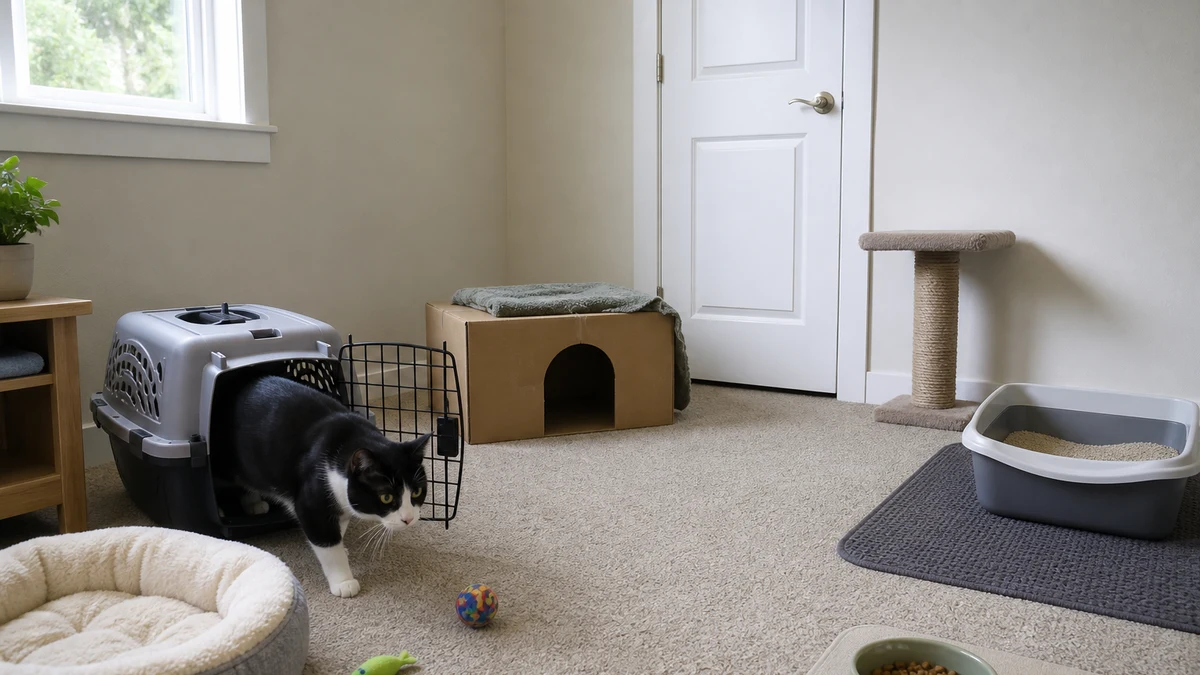
Stage 2: Let the new cat settle in a private transition room
What to do: Carry the covered carrier directly into the prepared room before resident cats see the newcomer. Close the door, open the carrier, and let the cat choose when to emerge. Provide hiding places, height, a bed, toys, scratching, food, water, and a litter box. Spend quiet, predictable time in the room, but do not pull the cat from hiding.
Keep resident cats away from the door if they camp, paw, or stare there. A second barrier several feet from the door can create a neutral buffer. Continue the resident cats’ ordinary meals, play, and attention so the newcomer does not predict the loss of everything familiar.
Advance when: The new cat is no longer hiding continuously and can eat, drink, eliminate, groom, rest, play, and explore in a pattern that looks normal for that individual. Resident cats can also move through their area without fixating on the closed door.
Step back or pause when: The newcomer remains shut down, avoids essentials, or repeatedly startles at sounds outside; a resident cat guards the door; or any cat’s appetite or litter habits change. Keep separation and ask a veterinarian about health changes.
Stage 3: Exchange scent without presenting a cat
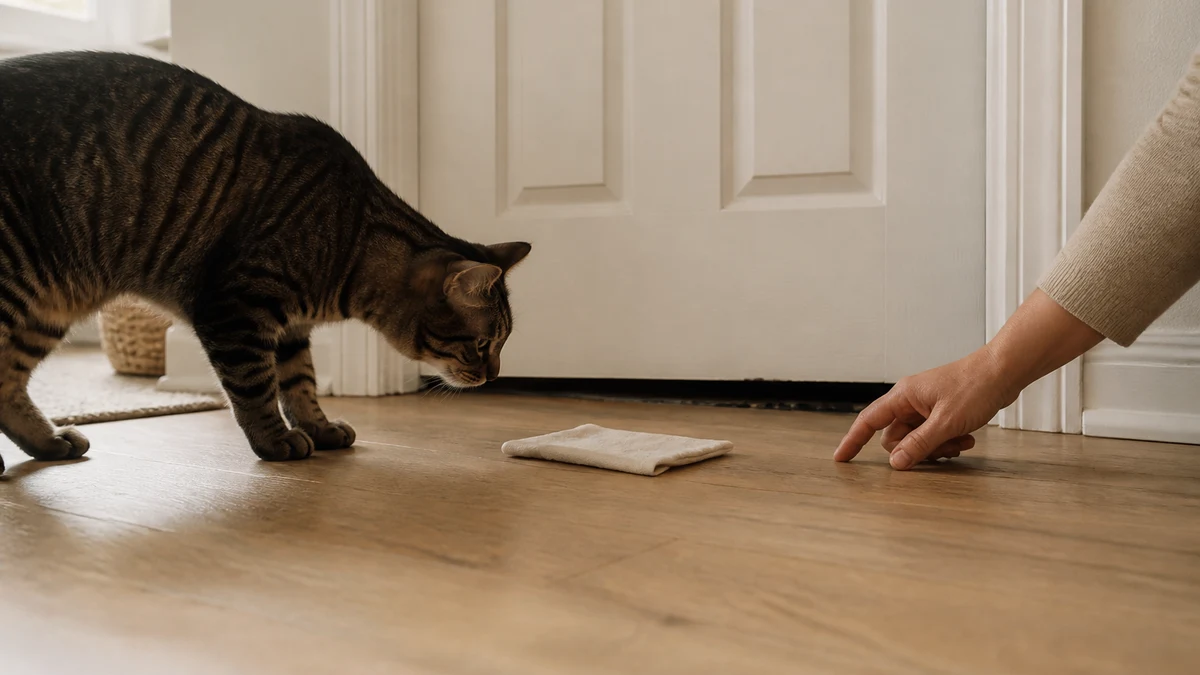
What to do: Swap bedding or soft toys between spaces. Another option is to gently collect cheek scent on a clean cloth when a cat already welcomes that touch, then place the cloth in open floor space for the other cat to approach or ignore. Do not push it under the cat’s nose or put it in a bed, bowl, or litter area where avoidance would cost access to a resource.
Pair calm exposure with something each cat already likes: a small treat, meal, play, brushing, or quiet attention. Start far enough from the closed door that each cat can participate comfortably; distance can shrink gradually. The goal is not to make the cats eat nose-to-nose through a door.
Advance when: Both cats repeatedly sniff and move on, ignore the item, play, eat, or rest after noticing the scent. A quick investigation followed by ordinary behavior is more useful than prolonged surveillance.
Step back or pause when: A cat avoids the area, paces, growls repeatedly, eliminates outside the box, stops eating, or remains tense after the item is removed. Increase distance or use a lower-intensity object and wait for normal behavior to return.
Stage 4: Swap access to rooms while the cats stay separated
What to do: Secure resident cats in a favored room with their own resources, treats, or play. Let the newcomer explore a small shared area for a short period, then return the new cat to the transition room before releasing the residents. On another session, allow a resident cat to investigate the transition room while the newcomer is safely elsewhere. Never move cats past one another in arms.
Site swapping expands the newcomer’s map and layers household scent without requiring eye contact. Keep the sessions modest so exploration does not turn into frantic searching or door guarding.
Advance when: Each cat can sniff, walk, scratch, play, or accept a reward in the exchanged space, then settle after returning to their own zone. The cat does not have to ignore every scent; recovery matters.
Step back or pause when: A cat freezes, hugs the walls, urine-marks, refuses rewards they normally value, rushes a door, or cannot settle afterward. Shorten the next exchange or return to scent-only work.
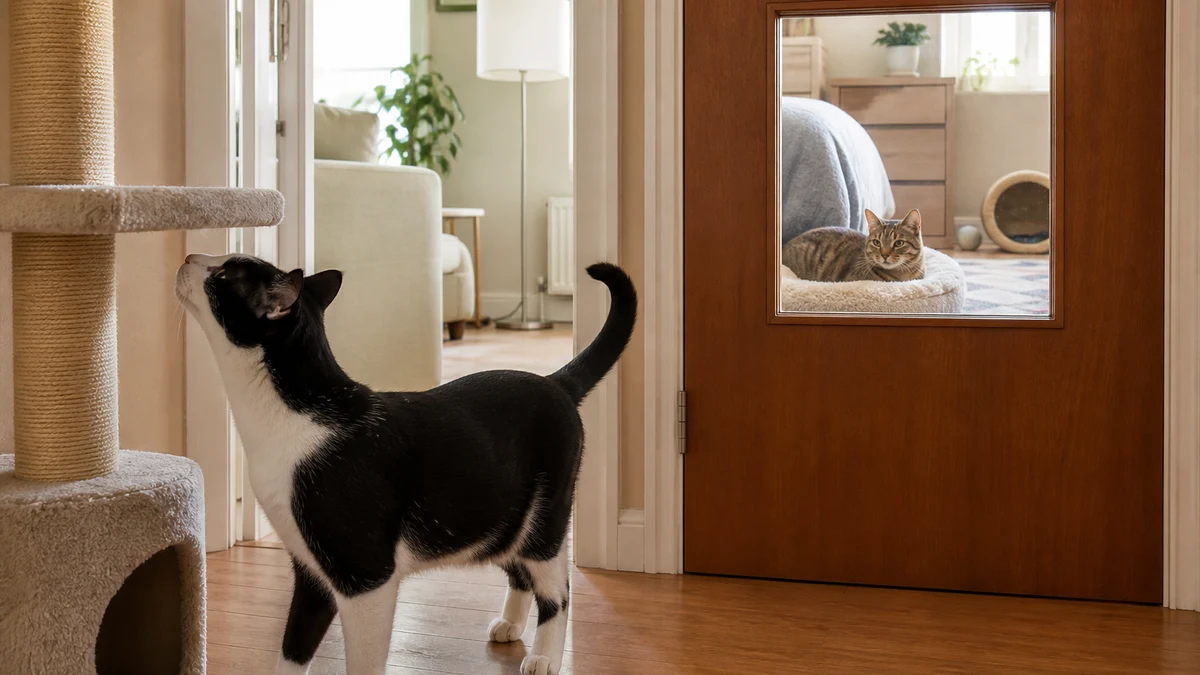
Stage 5: Add short visual contact through a secure barrier
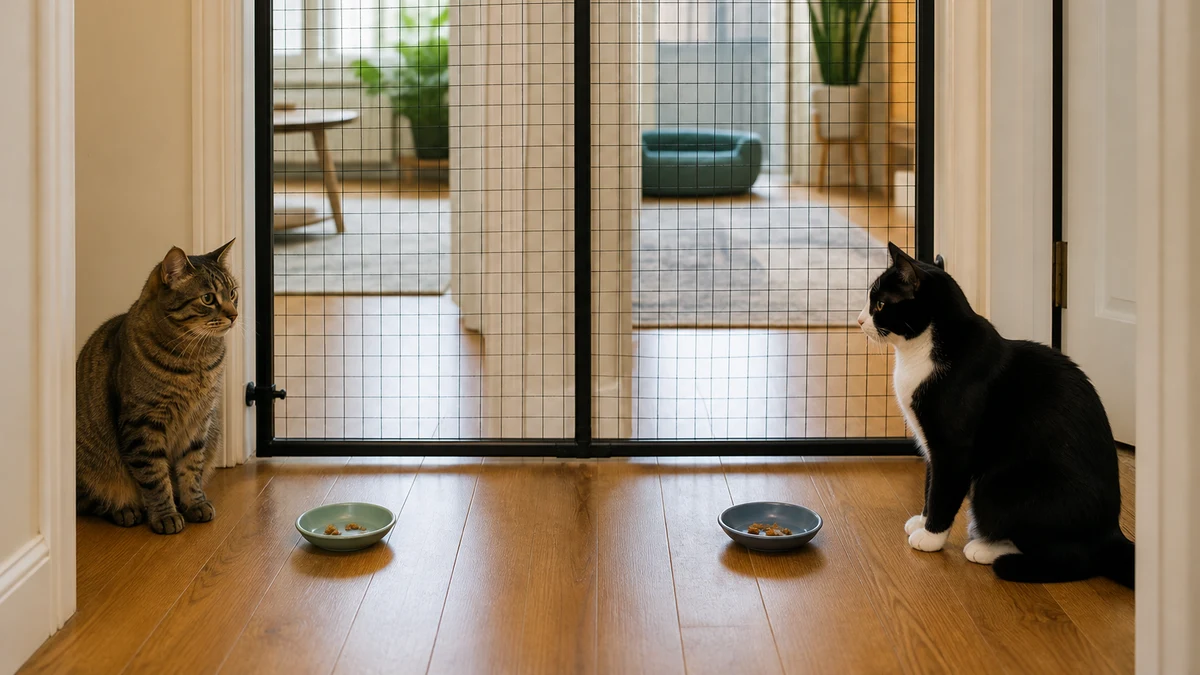
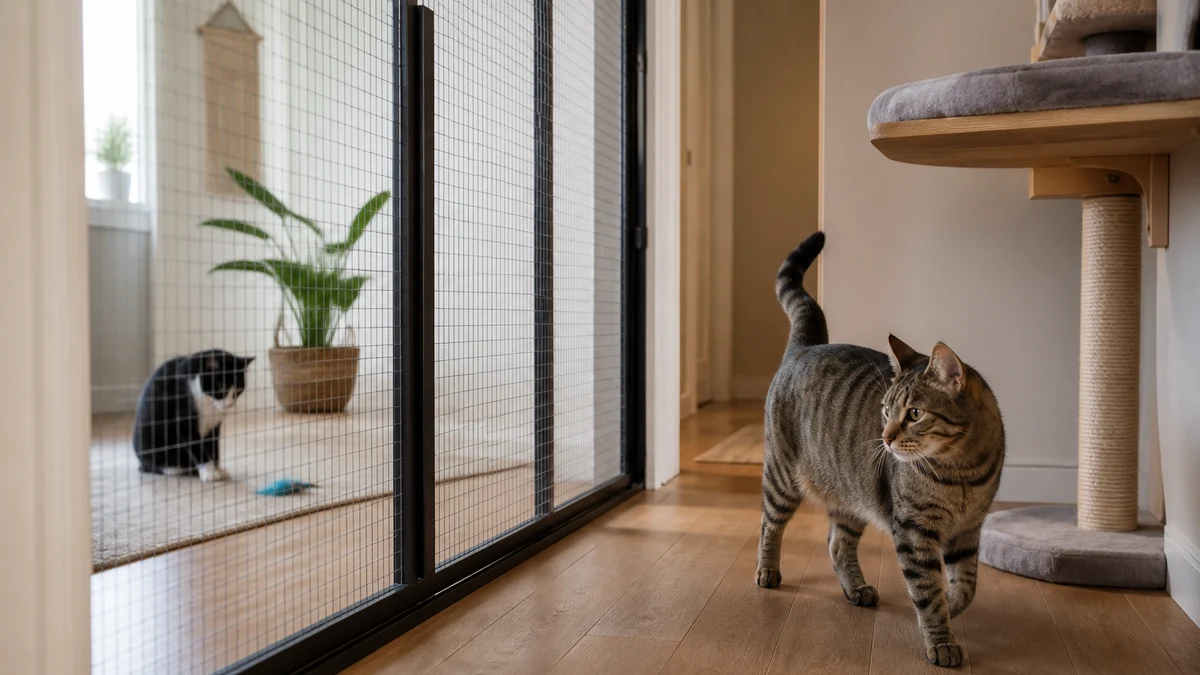
What to do: Use a tall, secure mesh gate, screen, glass door, or another barrier that neither cat can jump, squeeze through, or knock down. Kittens can pass through surprisingly small gaps. Begin with the barrier partly covered or with cats far away. Keep sessions short and give each cat a separate reward or activity. Never carry one cat up to the other.
Watch the whole body. Loose muscles, neutral ears, normal movement, eating, play, grooming, and looking away support progress. A cat should be free to retreat; approaching the barrier is optional.
Advance when: Both cats can notice each other and then disengage. They can take food gently, play, investigate the room, or leave without being followed by the other cat’s stare. Repeat this across several calm sessions before removing the barrier.
Step back or pause when: Hard staring persists, bodies become rigid or very low, ears flatten, tails lash or puff, growling escalates, a cat strikes the barrier, or one cat will not leave the area. Cover the view, increase distance, and return to scent or site swapping.
Stage 6: Hold short, supervised meetings in a large room
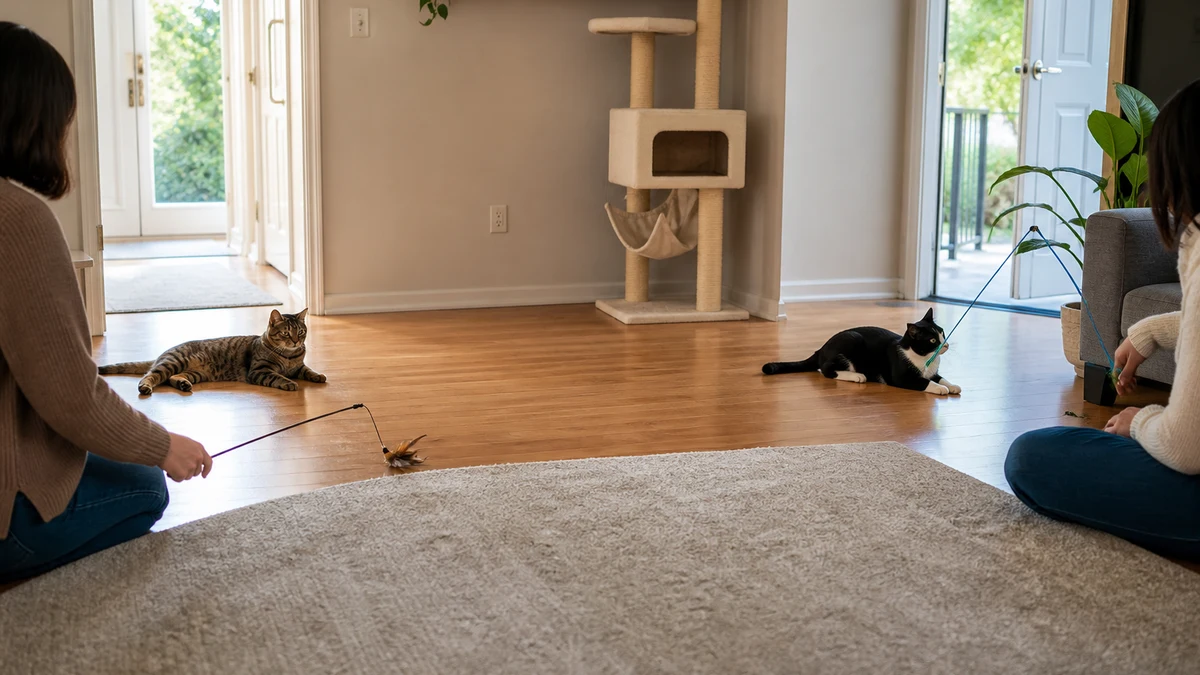
What to do: Choose a room with more than one exit, high places, hiding options, and no narrow corner where a cat can be trapped. If possible, have one calm adult monitor each cat. Start after individual play has taken the edge off high energy, and use separate wand toys or rewards at a generous distance. Keep the first meetings brief and end while body language is still loose.
Do not hold cats, make them sniff, place food bowls together, or let them “fight it out.” Forced proximity removes the retreat option that makes learning safer. Avoid punishment as well; hitting, yelling, or spraying adds fear without teaching a safe alternative.
Advance when: Across repeated meetings, both cats can move naturally, choose distance, play or accept rewards, look away, and leave without pursuit. Calm parallel activity and mutual indifference count as success.
Step back or pause when: One cat stalks, chases, corners, mounts, blocks an exit, repeatedly pounces on a resting cat, or cannot disengage. Separate calmly and return to the barrier stage at a distance where both can succeed.
Stage 7: Extend shared time without removing the safety net
What to do: Increase the duration and variety of supervised time gradually. Let the cats experience ordinary household moments rather than arranging constant interaction. Keep the transition room available, preserve multiple routes, continue separate feeding, and maintain distributed resources. High-energy cats may need extra individual play so their activity is not redirected toward a quieter cat.
Unsupervised access is a late decision, not the next automatic step. Begin only after a strong pattern of calm supervised coexistence, and start with short absences. A camera may reveal doorway guarding or pursuit that stops when people enter.
Advance when: Both cats maintain normal appetite, elimination, rest, grooming, play, and social behavior; can use essential areas without waiting for the other to leave; and recover easily from small surprises.
Step back or pause when: Conflict appears as time, territory, or competition increases. Restore separation when nobody is supervising and return to the last comfortable duration or area.
Quiet tension is still tension
A multi-cat problem does not always look like a fight. Watch for fixed staring, following, stalking, blocking hallways or stairs, sitting near a litter box, displacing a cat from a bed or person, pouncing while the other cat rests, or controlling access simply through presence. The affected cat may travel only when the other sleeps, stay on one level, hide more, eat quickly or less, stop playing, overgroom, or eliminate elsewhere.
Track which cat can access what, at what time, and by which route. A floor plan and a brief daily log often reveal a bottleneck that “more bowls” did not solve. Move duplicated resources into genuinely separate locations, add visual barriers, and create vertical as well as floor-level routes.
If tension rises, end the session safely
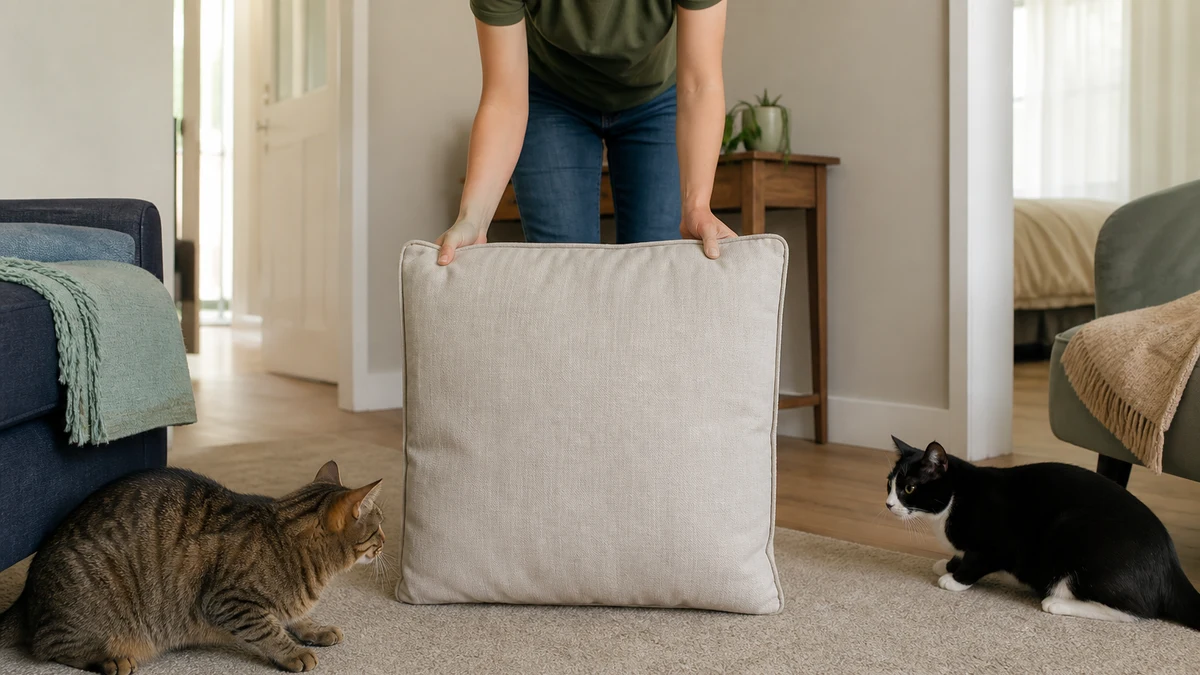
Do not reach between aroused cats or pick one up. Redirected biting can occur when a cat cannot reach the target of its agitation. Instead, interrupt the sightline with a large cushion, piece of cardboard, blanket, or other solid visual barrier. Give each cat an open path into a separate room and let arousal settle fully before any new session.
If a fight has already occurred, use an object—not hands—to create separation if it can be done safely. Check both cats for injury and contact a veterinarian when injury is possible. Restarting immediately usually repeats the same level of difficulty; rebuild from an earlier stage.
When to involve a veterinarian or behavior professional
Seek veterinary help promptly for wounds or possible bites, persistent refusal to eat, elimination changes, vomiting, marked withdrawal, pain signs, or an abrupt behavior change. Medical discomfort can alter tolerance and must be assessed before the problem is treated as purely social.
Ask the veterinarian for qualified feline behavior support when there is repeated chasing, cornering, resource blocking, redirected aggression, severe fear, or no progress despite careful management. Do not give medication or supplements based on a generic introduction guide; any medical plan belongs to the veterinarian who has assessed the cat. The realistic long-term plan may be gradual reintroduction, managed zones, or—when welfare and safety cannot be protected—separate living arrangements.
FAQ
How long should a cat introduction take? There is no reliable deadline. It may take days, weeks, months, or longer. Advance according to the slower cat’s ability to eat, play, rest, explore, and disengage calmly at each stage—not according to a calendar.
Is hissing during an introduction always a failure? No. A brief hiss can communicate distance. Stop or reduce intensity when hissing repeats or appears with rigid posture, flattened ears, fixed staring, swatting, pursuit, guarding, or disruption of normal behavior.
Should the cats be held so they can smell each other? No. Holding removes escape and can put the handler within reach of redirected biting or scratching. Use scent objects, a closed door, and a secure barrier so both cats control their distance.
How many litter boxes do two cats need? A widely used starting point is one per cat plus one extra, so two cats would have three. Placement matters as much as the count: distribute boxes in private, accessible locations rather than clustering them where one cat can guard the whole supply.
What if the cats never become friends? Friendship is not required. If both cats can meet their needs, move freely, rest, and disengage without fear or intimidation, peaceful distance is a valid success. If welfare or safety remains compromised, involve a veterinarian and qualified behavior professional.