Why Do Cats Chatter at Birds? What the Clicking Sound May Mean
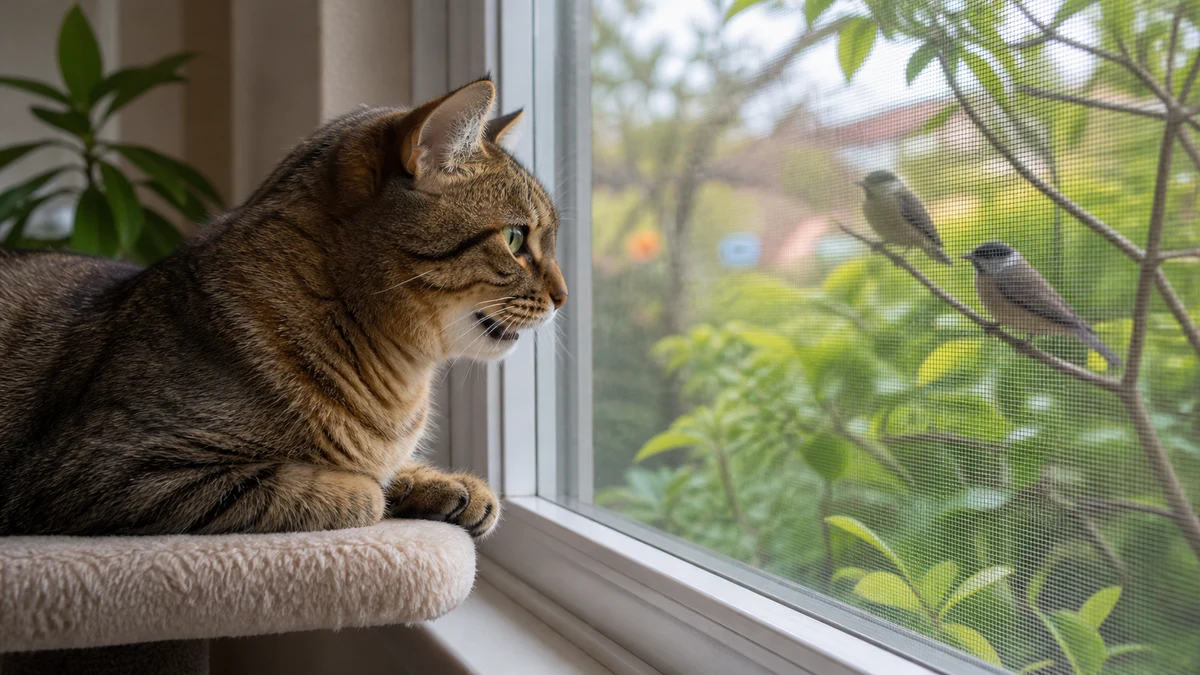
When a cat makes rapid clicking or stuttering sounds at a bird, insect, or squirrel, the cat is most likely responding to prey-like movement with intense attention and arousal. The visible pattern is real, but its exact purpose is not settled science. Excitement, frustration at a barrier, rehearsal of a hunting movement, and prey mimicry are all proposed explanations—not four proven mechanisms. A brief episode that begins with a visible target and ends when the target disappears is usually ordinary behavior. Repeated jaw movement without a target, especially with drooling, mouth discomfort, eating changes, staring, or altered awareness, belongs on the veterinary track instead.
That distinction matters because “chattering” is a behavior label, not a diagnosis and not a translation with one universal definition. The safest approach is to watch the complete sequence: what the cat noticed, how the rest of the body changed, how long the episode lasted, and whether the cat returned to normal afterward.
What cat chattering looks and sounds like
In the familiar window scene, a cat fixes on a small, fast-moving animal and rapidly opens and closes the lower jaw. The sound may be a dry click, a stutter, a squeaky series of short notes, or almost silent teeth movement. Cats Protection describes the pattern as chattering, chirping, or twittering and notes that it commonly appears while a cat watches prey outside a window or door.
The rest of the body often supplies the context: eyes locked on the target, ears pointed forward, whiskers directed ahead, a low or motionless posture, and a tail tip that moves with concentration. Not every cat does all of these things, and some cats never chatter at all. Neither variation is a problem by itself.
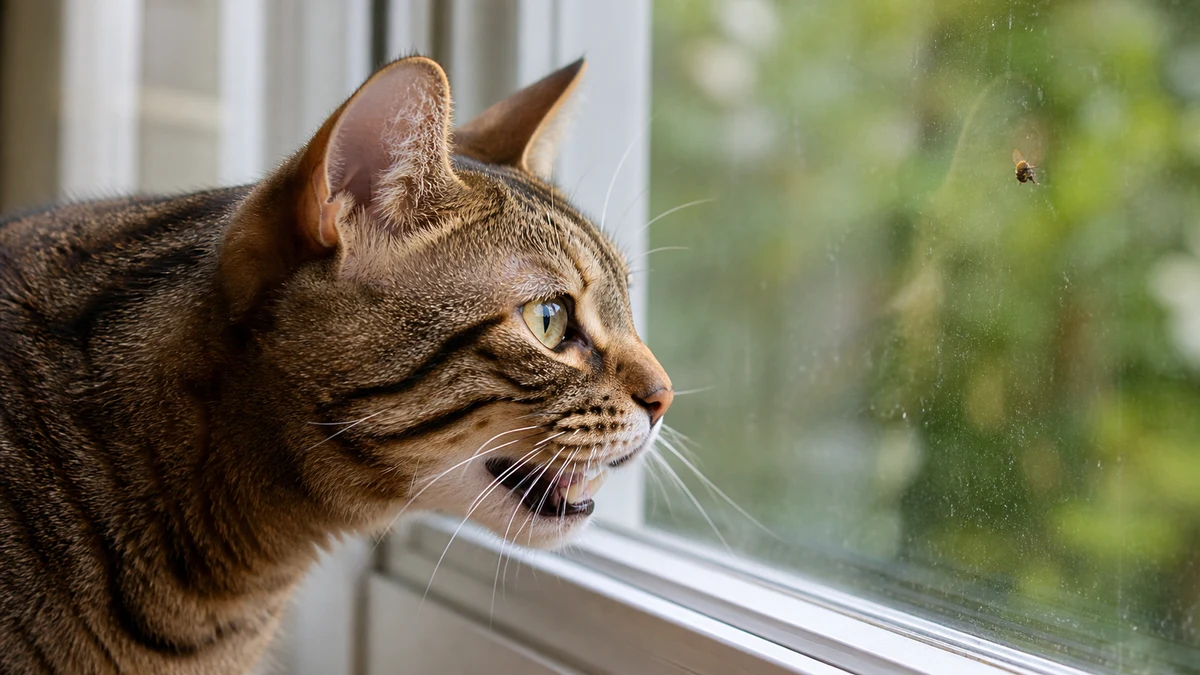
What makes this different from random teeth grinding is the tight link to an external event. The bird lands; the cat focuses and chatters; the bird leaves; the mouth movement stops. That sequence does not reveal the cat’s private emotion with certainty, but it gives a much stronger behavioral context than the sound alone.
Chattering, chirping, chirruping, and trilling are not a perfect dictionary
Everyday English labels overlap. Videos showing nearly identical jaw clicks may be titled “cat chattering,” “cat chirping,” or “cat talking to birds.” People may also use chirp for a single high note that occurs with no visible jaw movement. These are useful descriptions, not a formally standardized acoustic classification that every veterinarian, researcher, and cat caregiver uses identically.
Chirrup and trill often refer to a different sound: a short rolling or rising vocalization made with the mouth mostly closed. Cats Protection describes the chirrup as a call mother cats can use with kittens and domestic cats can use to greet people. A cat may trill while walking toward you, then chatter later at a bird. Online captions may still call both sounds “chirping,” so the word alone cannot identify the behavior.
For a useful observation, describe what happened instead of arguing over the noun: “rapid lower-jaw opening and clicking while staring through the window” is more precise than “my cat made a chirp.” A video that includes the target and the cat’s whole body is more informative to a veterinarian than an audio clip alone.
Four common explanations—and what the evidence actually supports
There is no controlled test showing one universal reason every domestic cat chatters. The following ideas are plausible to different degrees, and more than one could operate in the same episode.
1. High arousal or excitement
This is the least speculative description because it stays close to what can be observed. The cat has detected biologically relevant movement, attention narrows, posture prepares for action, and the jaw response appears. Cats Protection lists excitement among the likely contexts. Still, “high arousal” describes a state; it does not explain why the jaw moves or what the sound accomplishes.
2. Frustration caused by an unreachable target
A closed window creates a clear mismatch: the cat can see and perhaps hear prey but cannot stalk, chase, or catch it. That makes barrier frustration a reasonable theory, especially if the cat paws at the glass, paces, lashes the tail, or stays activated after the animal leaves. But it is not a rule. Cats with outdoor access may chatter too, and a cat can be highly interested without being distressed. Do not assume that every click means suffering or that opening the window is the solution.
3. Rehearsal of a capture or killing bite
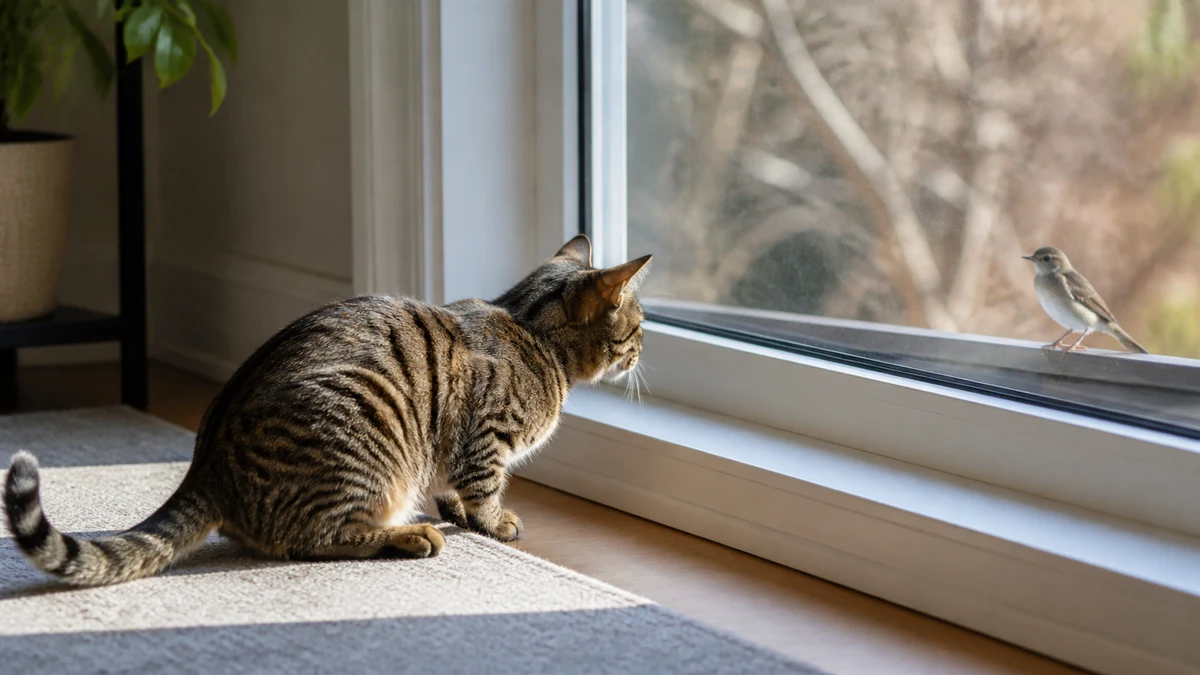
Another popular theory says the rapid jaw movement is a motor fragment related to biting prey. It sounds intuitive because chattering appears in a hunting context. Direct evidence that window chattering rehearses a specific neck bite, however, is lacking. Cats Protection calls this an unlikely theory. It should not be upgraded into a fact merely because the motion resembles chewing or biting.
4. Mimicking prey sounds
Some chatter resembles a bird or rodent call, leading to the idea that a cat is trying to lure or confuse prey. This is an interesting hypothesis, not a demonstrated domestic-cat strategy. Similarity to a sound is not proof of intentional imitation, and a cat vocalizing behind glass may alert rather than deceive the animal. Until direct evidence exists, “the cat is copying the bird” needs words such as may, could, or one theory proposes.
The honest conclusion is modest: prey detection and intense attention are strongly supported by the timing; the specific function of the jaw movement remains uncertain.
Read the whole sequence, not one sound
Start with three questions.
- What triggered it? Look for a bird, insect, squirrel, reflected movement, toy, or sound in the wall. Do not assume there was no trigger only because a person did not see it immediately.
- What did the body do? Forward ears and a stable focused posture fit prey watching. Flattened ears, a puffed coat, frantic escape attempts, redirected swats, or prolonged pacing suggest the experience is no longer simply calm observation.
- How did it end? A short episode that stops with the target is different from jaw motion that persists at rest, interrupts eating, wakes the cat, or appears with confusion.
If window watching repeatedly leaves the cat unable to settle, cover the lower portion of the window temporarily or move the perch to a less intense view. That is a reversible test, not a punishment. Our guide to signs of stress in cats explains why combinations and changes from the individual baseline matter more than a single tail movement or vocalization.
Seven ways to make prey watching safe and useful
1. Build a stable viewing station
Use a perch wide enough for the cat to turn and lie down, with a nonslip surface and a base that cannot tip. Keep breakable objects, blind cords, and dangling strings out of reach. An elevated resting place with an outdoor view fits the environmental opportunities described in the AAFP/ISFM guidelines, but the perch still needs an easy route up and down.
2. Treat the screen as safety equipment
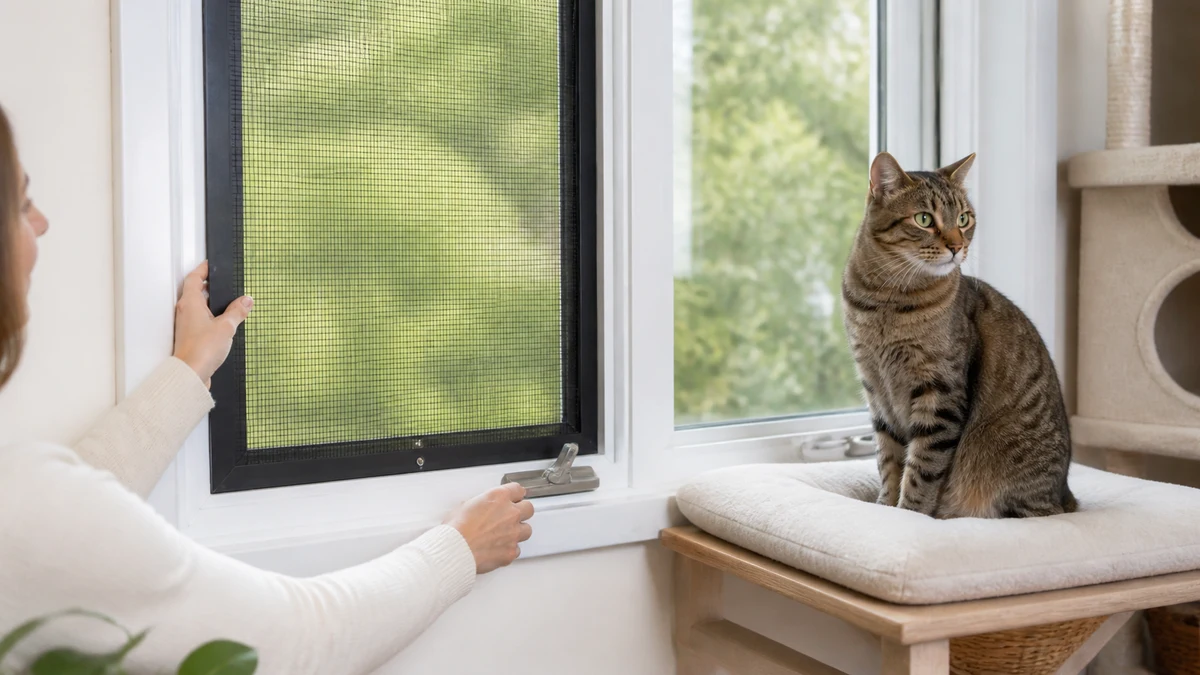
Check the frame, mesh, fasteners, and window latch regularly. A cat focused on a bird can launch before a person reacts. The ASPCA warns that prey can distract a cat near a window and that child window guards do not reliably contain cats. Use a securely fitted screen designed to withstand the household cat; do not rely on a loose insect screen or an open-window gap.
3. Let a toy complete the hunting sequence
After watching, offer a wand toy that moves away like ground prey or sweeps briefly like flying prey. Let the cat stalk, chase, pounce, and catch it. The AAFP/ISFM environmental guidelines specifically recommend opportunities for pseudo-predatory play and letting the cat capture the toy. A short session that ends successfully is more useful than frantic, endless movement.
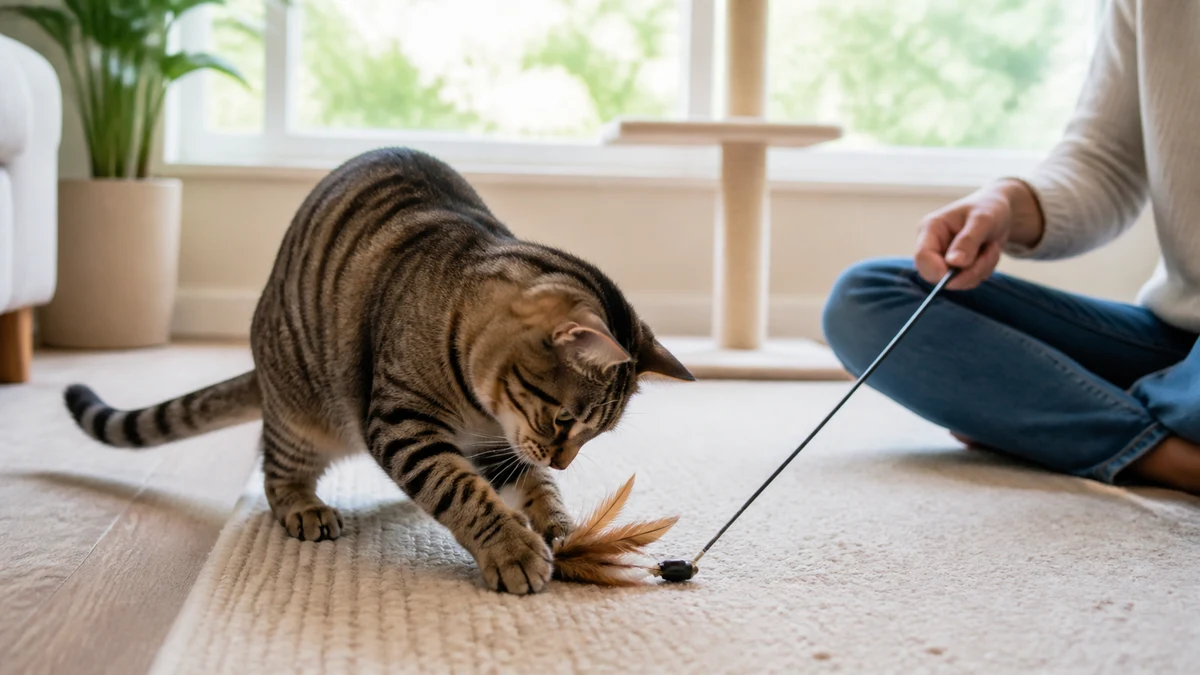
Keep hands and feet out of the prey role. If the cat redirects toward ankles after window watching, pause at a safe distance and use a long toy once the cat can orient to it. The guide to cats attacking feet has a fuller plan for changing that play pattern.
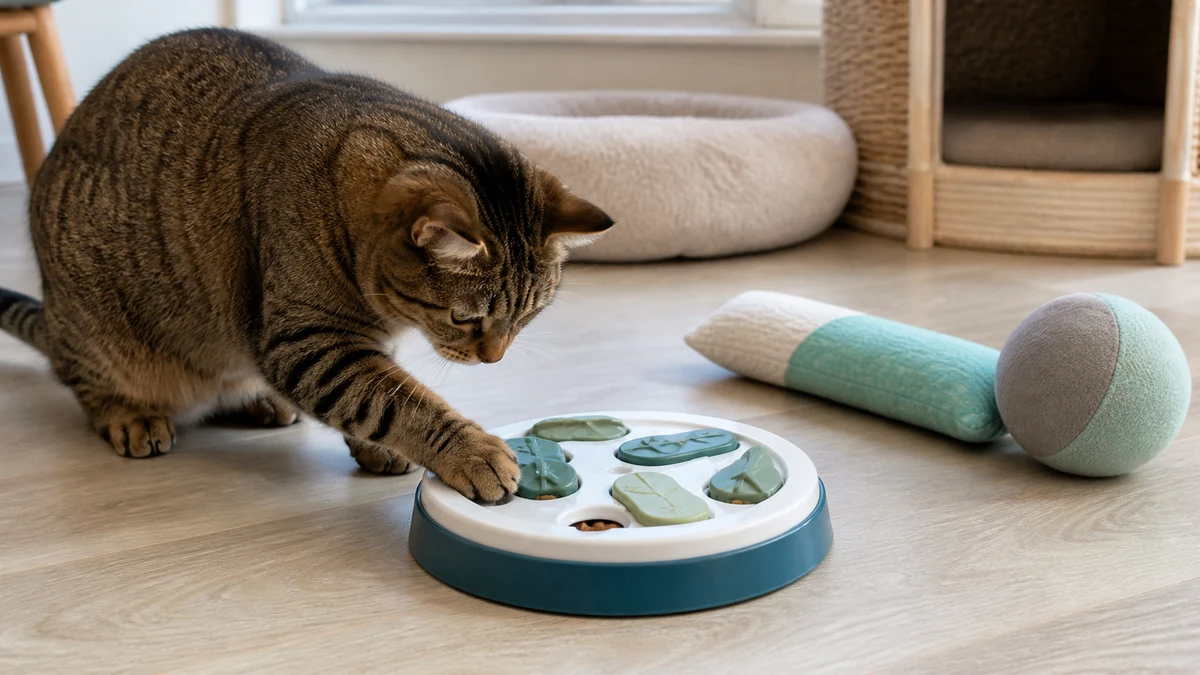
4. Add search and food puzzles
Hide part of the daily food in several safe locations, use a suitable puzzle feeder, or toss individual pieces for the cat to track if the diet and floor setup allow it. Rotate toys rather than leaving every object out forever. Supervise strings and feather toys; put them away after play. Solo items should have no loose parts the cat can swallow.
5. Reduce the view when arousal spills over
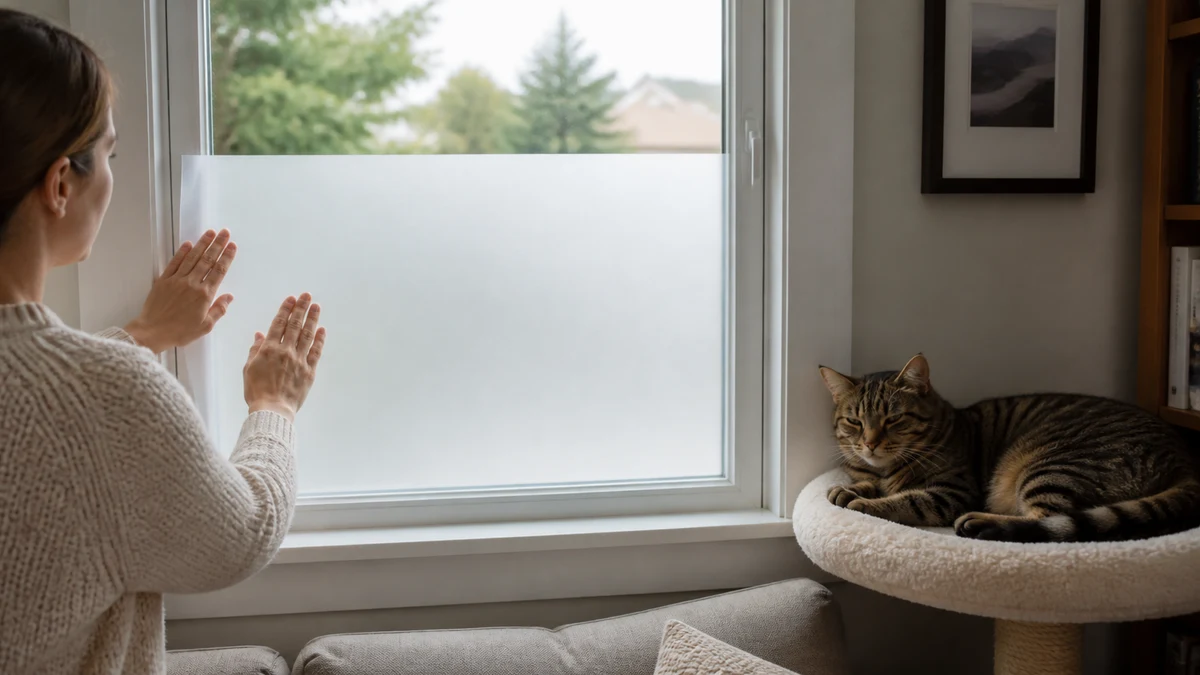
If one window repeatedly leads to prolonged pacing, fighting between household cats, or redirected grabbing, use removable opaque film on the lower pane, close a curtain, or schedule access when the outdoor trigger is absent. Preserve another calm perch if possible. The goal is to lower intensity, not to remove every interesting view from the home.
6. Keep wildlife on the other side of the barrier
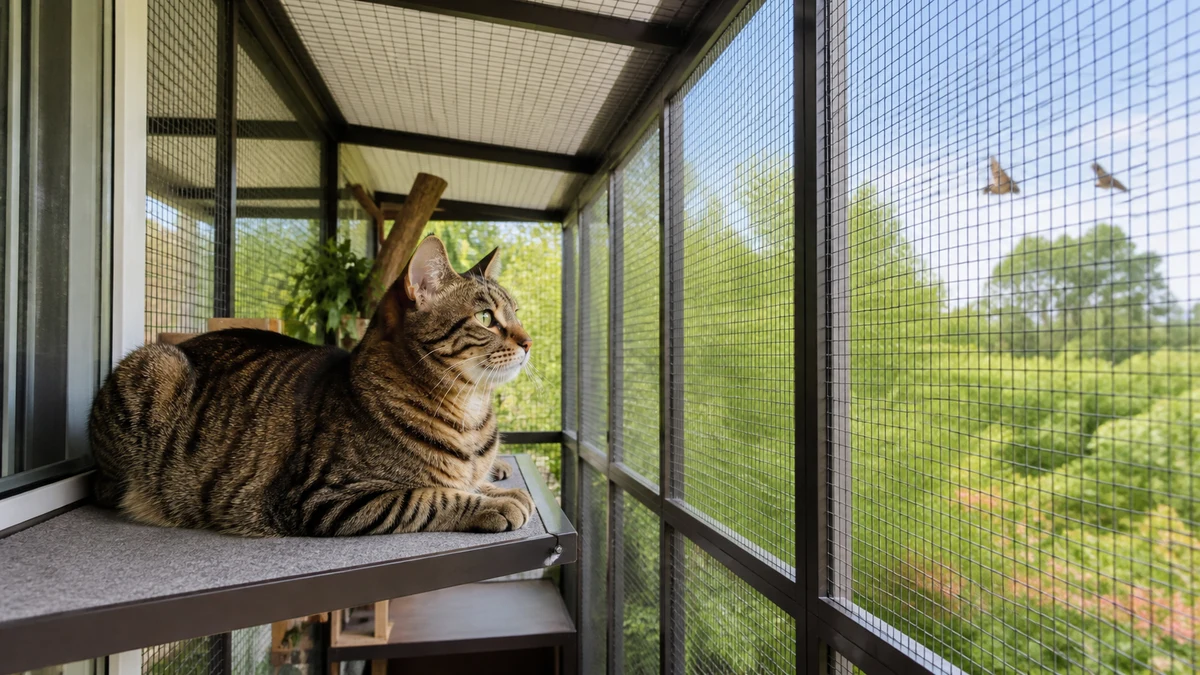
Do not open a door so the cat can “finish” the chase. The 2024 AAFP position statement supports controlled outdoor options such as an enclosure or positively trained harness-and-leash access as ways to provide stimulation while reducing outdoor risks. Suitability depends on the individual cat, the equipment, and the location; an anxious cat should not be forced into a harness walk.
There is also a wildlife reason to prevent free hunting. A 2023 global synthesis documented more than 2,000 species in free-ranging domestic cat diets, including hundreds of species of conservation concern. That global finding does not predict what one pet will catch, but it does show why “my cat only watches” is safer than allowing unmonitored pursuit.
7. Observe without scolding
Do not tap the glass, shout, spray water, or grab a highly focused cat. Those actions add surprise without teaching an alternative. If the setup is safe and the cat settles normally, quiet observation may be all that is needed. If redirection is needed, create distance first and offer an appropriate activity rather than putting a hand next to an aroused mouth.
When jaw movement needs a veterinary check
Prey-linked chattering is usually brief and context-specific. Arrange veterinary evaluation when the pattern is new, much more frequent, has no obvious target, or occurs with any of the following:
- drooling, blood-tinged saliva, bad breath, pawing at the mouth, or facial sensitivity;
- dropping food, chewing on one side, difficulty swallowing, reduced appetite, or reluctance to eat;
- repeated jaw chattering while resting, sleeping, or looking away from any target;
- staring spells, loss of responsiveness, confusion, collapse, tremors, unusual one-sided movements, or trouble walking;
- a sudden change in vocalization, behavior, grooming, activity, or tolerance of touch.
Cornell explains that dental disease can be painful and may show up as drooling, reluctance to eat, or turning the head while chewing. VCA includes jaw chattering among possible dental signs. The Merck Veterinary Manual also lists repetitive chomping and staring among signs that can occur with focal neurologic events. These sources do not mean that every jaw click is dental disease or a seizure. They explain why a repetitive, untriggered, or multi-sign episode should not be dismissed as cute window behavior.
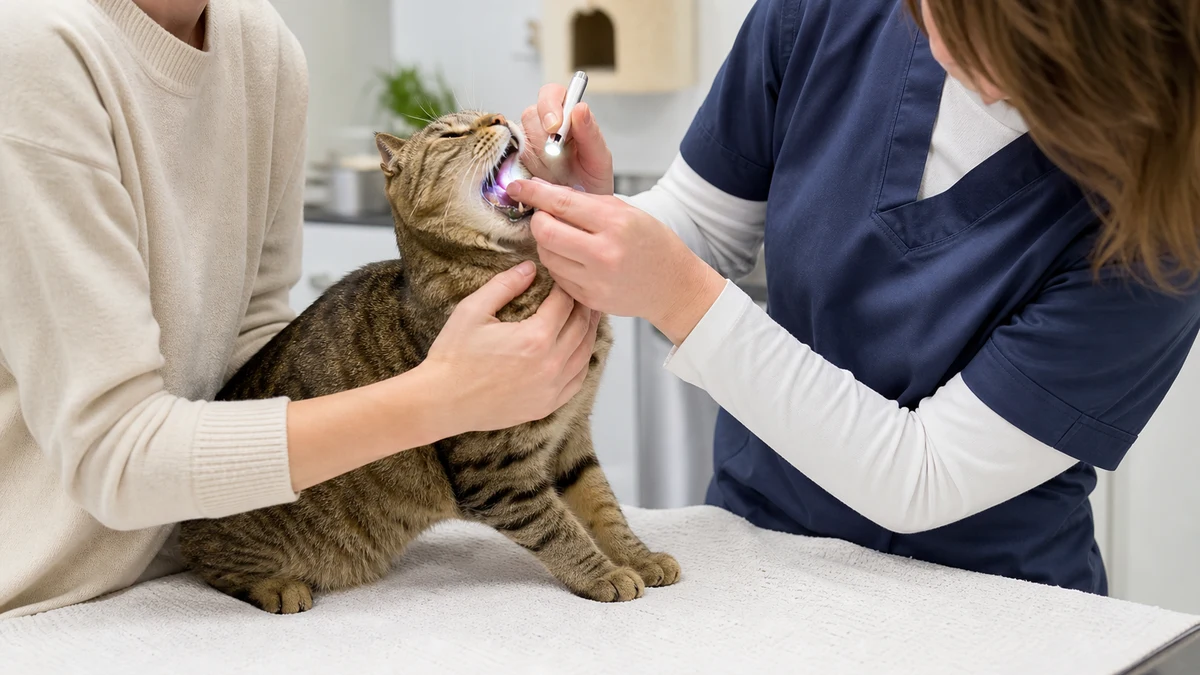
Do not force the mouth open or place fingers between the teeth during an episode. Record a video from a safe distance, note the time and duration, and write down what happened immediately before and after. Contact a veterinarian promptly; seek urgent veterinary care if the cat collapses, cannot breathe normally, is injured, has repeated episodes without returning to normal, or remains unresponsive.
FAQ
Does chattering mean my cat is frustrated? It may, particularly when a window prevents access and the cat remains agitated. It can also accompany excitement and focused prey watching without obvious distress. Look at the full body and recovery, not the clicking alone.
Is my cat trying to imitate the bird? Prey mimicry is one proposed explanation, but it has not been demonstrated as the general purpose of domestic-cat chattering. Describe it as a hypothesis, not a fact.
Are chattering and trilling the same sound? Not reliably. Chattering usually describes rapid jaw movement and clicking in a prey context. A trill or chirrup often describes a short rolling greeting with the mouth mostly closed. Everyday labels overlap, so describe the movement and situation too.
Should I stop my cat from watching birds? Not if the window is secure and the cat settles normally. A stable perch and outdoor view can be useful enrichment. Reduce or block the view only when it repeatedly produces prolonged agitation, redirected behavior, or conflict.
Can I let my cat outside to satisfy the urge to hunt? Free roaming adds risks to the cat and wildlife. A secure enclosure or voluntary, positively trained harness access may provide controlled outdoor stimulation for a suitable cat. Indoor play, food searches, and safe viewing are also valid outlets.
When is chattering a medical concern? Call a veterinarian when jaw movement occurs without prey, changes suddenly, repeats at rest, or comes with drooling, mouth pain, eating difficulty, altered awareness, tremors, or other behavior changes. Context is the dividing line; an article cannot diagnose the cause.