Why Does My Cat Keep Meowing? Read the Sound, Context, and Need
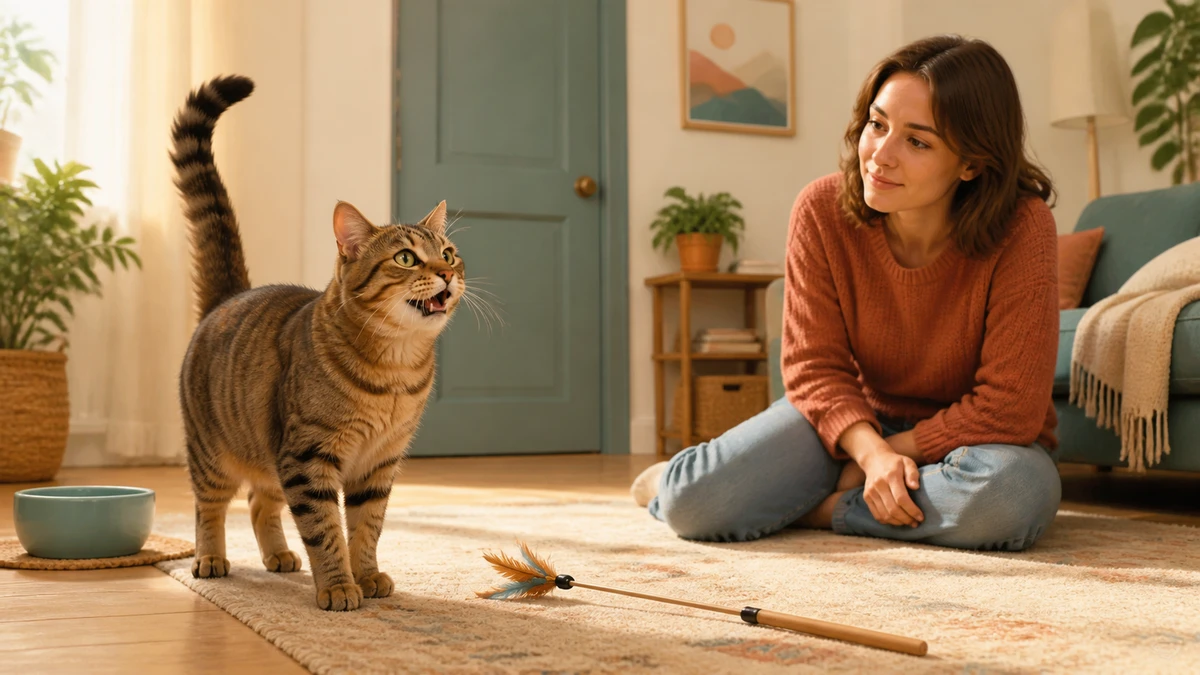
A cat that keeps meowing is asking you to notice something, but the sound does not have one fixed translation. It may accompany a greeting, a request for play, an expected meal, a closed door, stress, reproductive behavior, or physical discomfort. Read the sound, timing, target, body language, surroundings, and change from that cat’s normal pattern together. If the vocalizing is new, markedly more frequent, or paired with changes in eating, drinking, weight, litter-box use, movement, sleep, or awareness, arrange a veterinary assessment before treating it as a training problem.
The practical question is not “What does this exact syllable mean in cat language?” It is “What happened just before the sound, what is the cat doing now, and what reliably happens afterward?” That shift turns guessing into observation and helps you respond without rewarding every demand or overlooking a health concern.
A meow is a clue, not a dictionary entry
Adult pet cats often direct meows toward people. That does not mean every short chirp equals hello or every long call equals pain. In a 2020 study, 225 adults listened to meows recorded while cats waited for food, experienced brief isolation, or were brushed. Fewer than half correctly matched the sounds with their contexts overall. Cat experience and empathy helped with some calls, but a single recording still gave listeners limited precise information.
Research also suggests that acoustic features can shift with context. Duration, pitch, and melodic contour may differ between situations, but they overlap between individual cats and emotional states. A higher or longer sound can tell you that arousal may have changed; it cannot diagnose hunger, anxiety, or illness by itself. Apps and online “meow dictionaries” should never replace the rest of the evidence or a veterinary examination.
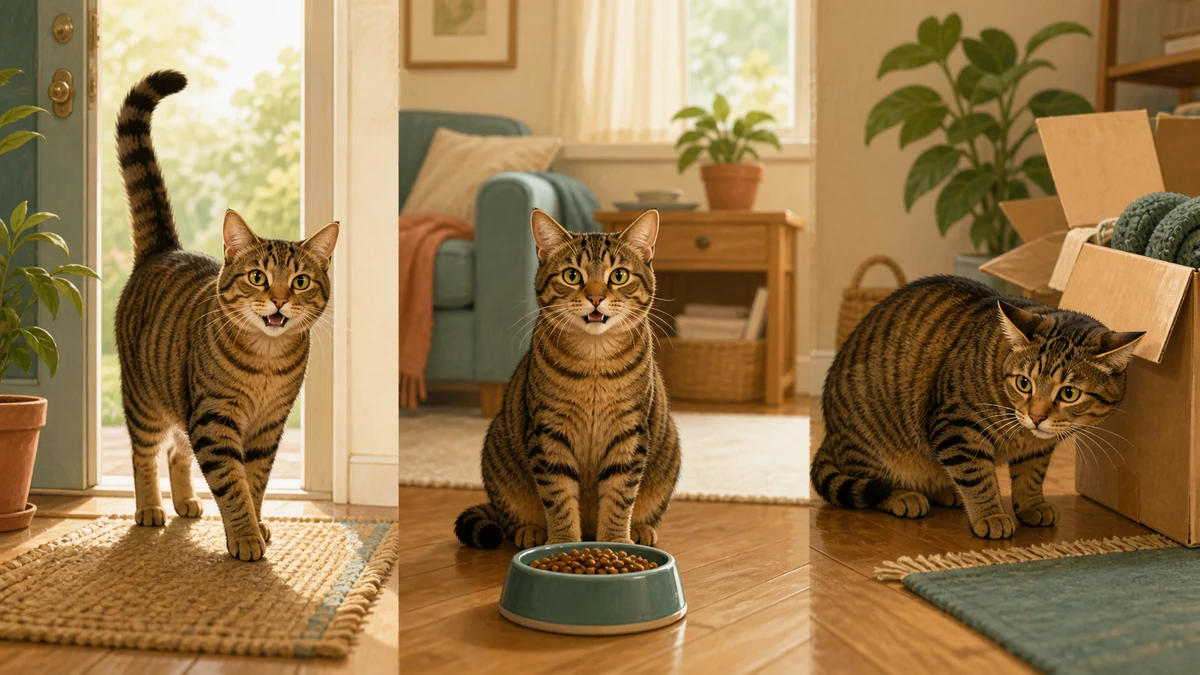
Use five lenses at the same time:
- Sound: Is it a brief meow, repeated series, drawn-out yowl, trill, growl, or hiss? Is it softer, rougher, higher, or longer than this cat usually sounds?
- Timing and target: Does it happen before breakfast, when you return, beside a door, during handling, at night, or while the cat looks at another animal?
- Body language: Is the body loose or tense? Are the ears forward, sideways, or flattened? Is the tail upright, tucked, thrashing, or puffed? Are the pupils affected by bright light, or are they still unusually wide in ordinary light?
- Environment: Is food, water, or litter access blocked? Has furniture moved? Is there a visitor, new pet, loud appliance, outdoor cat, or altered household schedule?
- Change from baseline: A naturally talkative cat greeting you as usual is different from a quiet cat that begins calling repeatedly overnight.
Body language is especially important because the same vocal category can occur in comfortable and uncomfortable moments. Forward relaxed ears, a softly upright tail, easy movement, and willingness to approach fit a different picture from a lowered body, ears turned back, hiding, freezing, or repeated attempts to create distance. Context also matters when reading purring: a sound commonly associated with comfort can occur in other states too.
Seven common situations behind repeated meowing
These categories are starting hypotheses, not diagnoses. More than one can be true at once.
1. Greeting and social check-in
A cat may give a short meow or trill when a familiar person enters, speaks, or walks into a room. Look for an easy approach, upright tail, relaxed ears, cheek rubbing, or a request to be near you. If the pattern is stable and the rest of the cat looks comfortable, it may simply be part of that relationship.
2. Attention, play, or contact
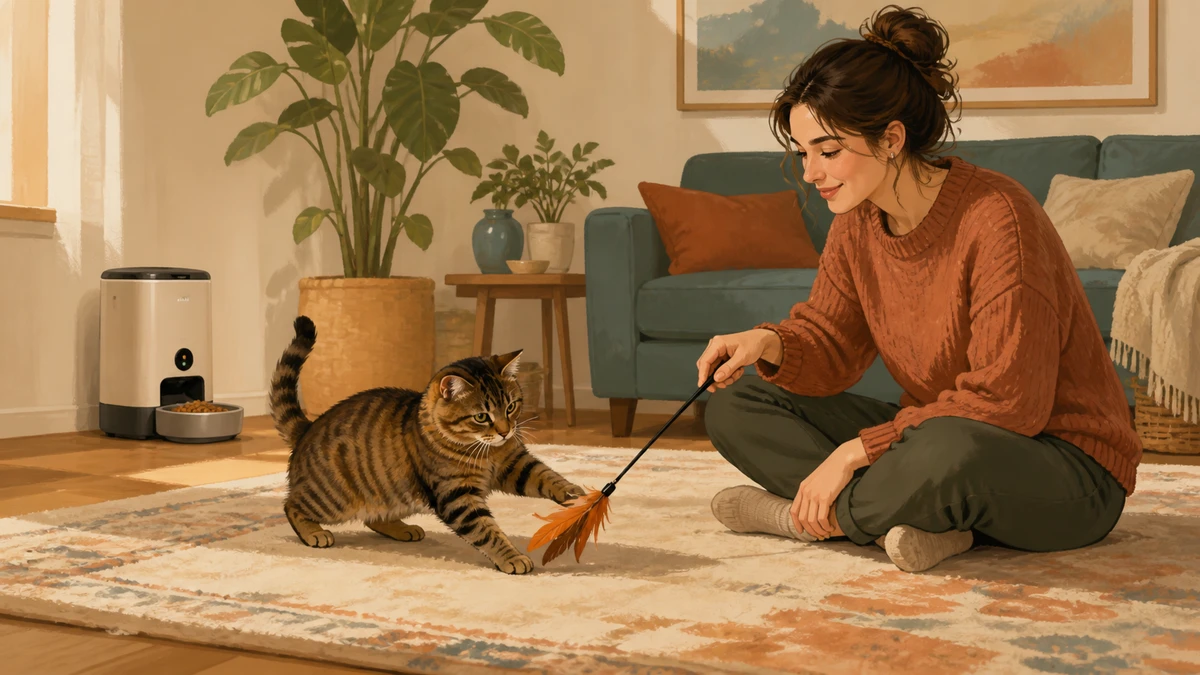
Some cats vocalize when they want a brief interaction, access to a favorite resting place, or an outlet for play. FelineVMA guidance notes that frequent attention-seeking vocalization can appear when opportunities for predatory play or positive, predictable human–cat interaction are not being met. The answer is not necessarily nonstop petting. Offer regular wand-toy play, choice-based affection, climbing, hiding, scratching, and quiet companionship, then see which option the cat actually chooses.
3. Food and learned routines
Meowing near the kitchen before a usual meal can be a request strengthened by repetition. If a person serves food after louder calls, the result may teach the cat that persistence works. First confirm that the diet and feeding plan are appropriate with the veterinarian, especially if appetite has changed. Then use a consistent routine, puzzle feeding, or a timed feeder rather than adding unplanned portions whenever the volume rises.
4. Access to a door, room, perch, or resource
A cat sitting beside a closed door and looking back at you gives useful visual information. The immediate goal may be access rather than “attention” in general. Check whether a needed litter box, water source, safe resting area, or family member is on the other side. You do not have to open every door, but you should make sure essential resources are available elsewhere and offer an acceptable alternative.
5. Stress or a recent environmental change
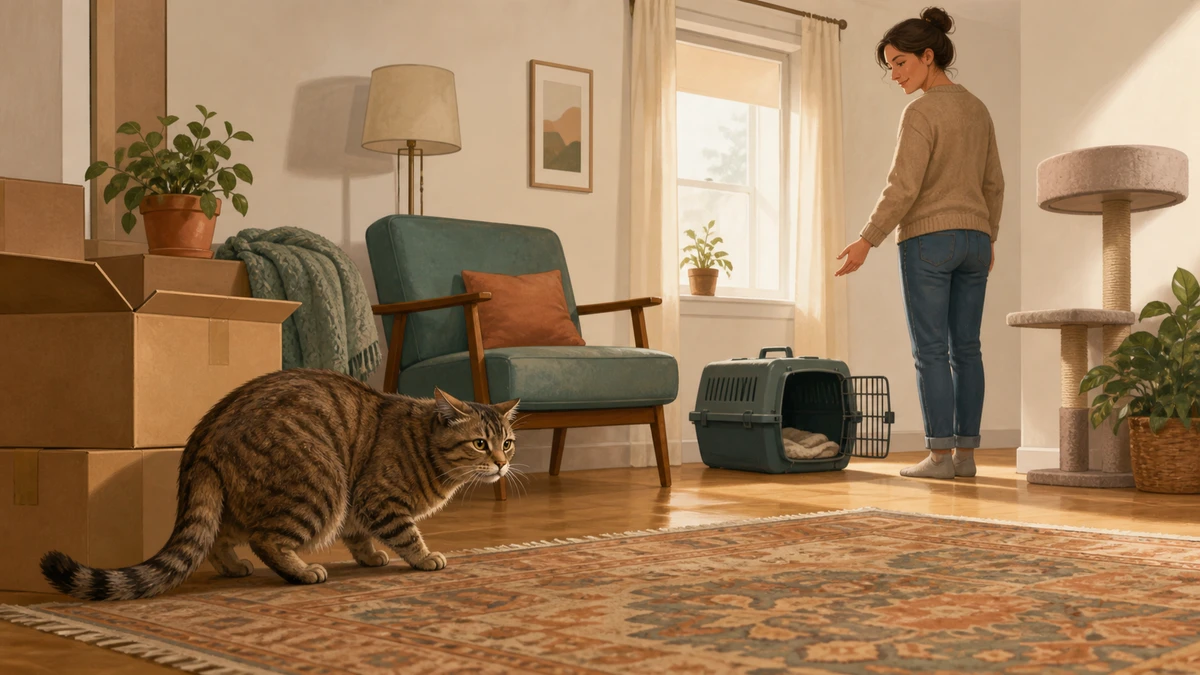
Moving, renovation, visitors, a new animal, schedule changes, unfamiliar smells, or tension between cats can change vocal behavior. Signs such as ears angled sideways, a lowered posture, hiding, reduced exploration, wide pupils in normal light, or restless scanning make stress more plausible than a simple greeting. Do not force the cat toward the new object or person. Preserve familiar routines, hiding places, elevated resting spots, and clear escape routes while the cat adjusts.
6. Reproductive behavior
An unspayed female may call repeatedly during heat, and an intact male may vocalize and pace when detecting a receptive female. The sound alone is not proof, and reproductive timing varies. Discuss spaying or neutering and the individual cat’s health with a veterinarian rather than trying to suppress the calling through punishment or unverified products.
7. Pain, illness, sensory change, or disorientation
Increased vocalizing can accompany discomfort or changes that make a cat unusually hungry, thirsty, restless, irritable, confused, or less able to hear and see. Older cats deserve particular attention when calls begin at night. Cornell lists loud, apparently unprompted nighttime vocalizing among possible signs seen with cognitive dysfunction, while also stressing that physical and neurologic conditions must be considered. Do not assume “senility” or name a disease from one behavior.
Build a short observation record
A useful log does not require surveillance all day. For three to seven days, write one line for each notable episode:
- date and time;
- sound type, duration, and number of repetitions;
- location and who or what the cat faced;
- posture, ears, tail, eyes, movement, and whether the cat accepted contact;
- what happened in the ten minutes before it;
- your response and what happened next;
- food, water, litter-box, activity, sleep, medication, or household changes.
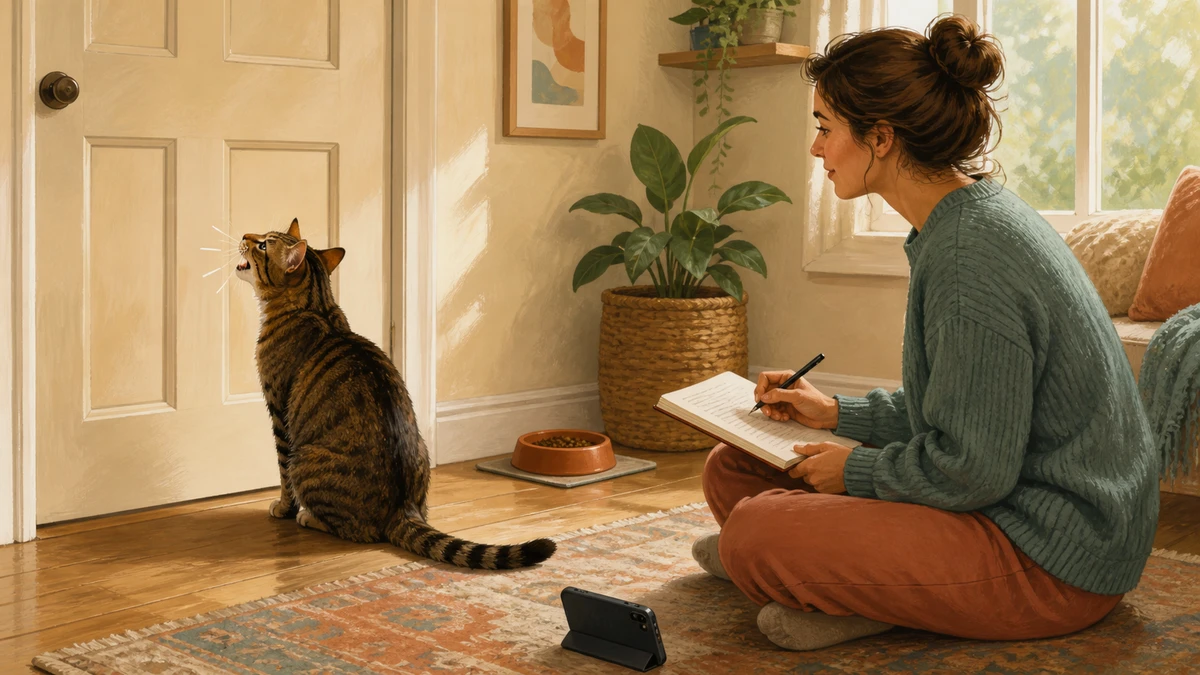
A short video can preserve the sound and body language for a veterinarian, provided recording does not crowd or frighten the cat. The log may reveal that calls cluster just before the automatic feeder opens, after an outdoor cat appears, during a particular kind of touch, or only after dark. It also prevents memory from compressing several different patterns into “all day.”
Change one non-urgent variable at a time. If you simultaneously move the bowl, add a diffuser, alter play, close the curtains, and change feeding time, you will not know what helped. Medical concerns are the exception: do not delay a veterinary appointment just to finish a home experiment.
Respond to the need without teaching louder demands
Start by checking safety and essentials. Make sure the cat is not trapped, injured, unable to reach water or a clean litter box, or showing another sudden change. Once you know the pattern is a predictable learned request and health needs have been addressed, respond consistently.
For attention-related calling, schedule positive interaction before the usual noisy period. Reward calm approaches or a brief quiet pause with the play, touch, or company the cat values. For early food requests, a timed feeder can separate food delivery from waking a person. For door requests, create an accessible alternative perch or resting zone. The goal is not to “win” a contest of will; it is to make the appropriate behavior easier and more reliable.
Do not shout, spray water, hit, or chase. Punishment can add fear and still fails to tell the cat what to do instead. Our guide to why you should never hit a cat explains why fear interferes with learning and trust. Also avoid the opposite extreme of ignoring every sound. ASPCA guidance advises checking needs first; selective non-response makes sense only when you are confident the call is a safe, learned request and you are reinforcing a calmer alternative.
When should a veterinarian hear about it?
Arrange an assessment when vocalizing is new, escalating, unusually intense, or different in quality—especially when paired with appetite, thirst, weight, vomiting, litter-box, mobility, grooming, sleep, vision, hearing, social, or awareness changes. A senior cat calling at night, staring, getting stuck, pacing, or seeming disoriented should not be dismissed as normal aging.
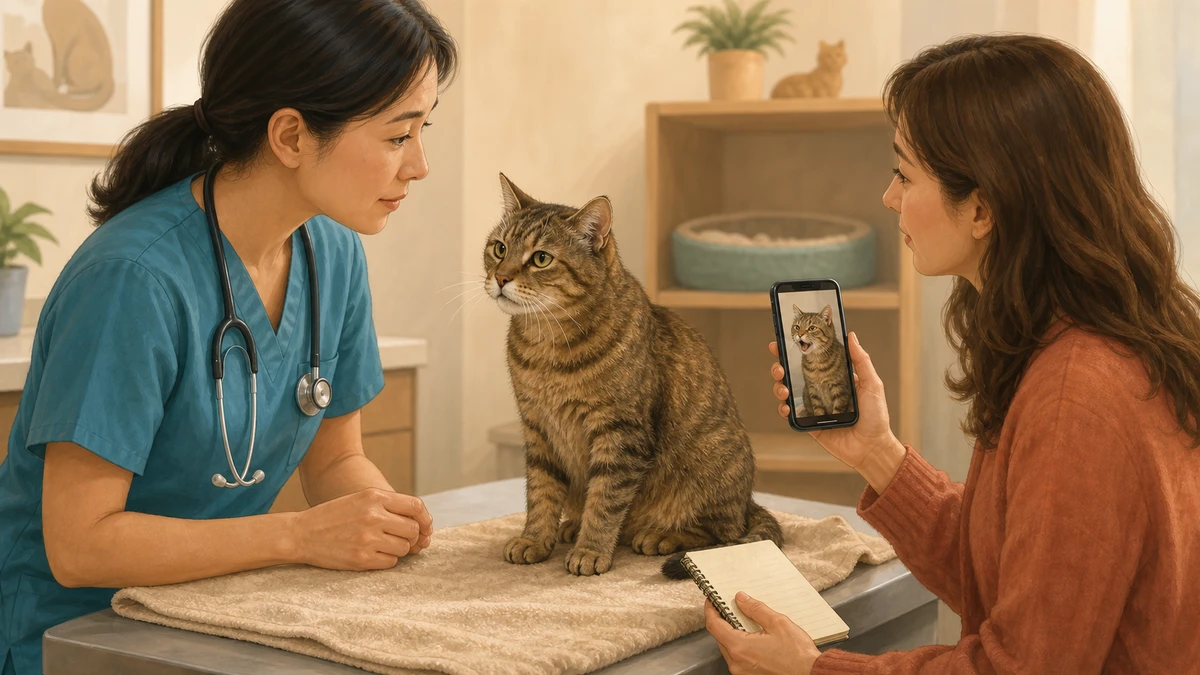
Contact a veterinarian promptly if the cat appears acutely distressed, has trouble breathing, repeatedly strains without producing urine, collapses, cannot walk normally, or has another sudden severe sign. These are not “meowing problems” to train away. Bring the log and a video, and describe the change rather than arriving with a diagnosis from an app.
If medical contributors are addressed and the behavior remains difficult, ask the veterinarian about a qualified feline behavior professional or veterinary behaviorist. The best plan will account for the individual cat, home layout, schedule, other animals, and the exact consequences that follow each call.
Listen for patterns, not secret words
Meowing works because it gets human attention, but attention should begin with careful observation. Sound features add information; they do not function as subtitles. Compare the episode with the cat’s normal voice, read the whole body, identify what changed, and note what outcome follows. Then meet genuine needs, create predictable routines, reinforce a calmer alternative, and involve a veterinarian when the pattern changes.
That approach respects both sides of the conversation. The cat is not reduced to a noise to silence, and the caregiver is not required to obey every call. You are building a shared pattern in which comfort, health, and choice are easier to recognize.
Frequently asked questions
Does a high-pitched meow always mean my cat is hungry? No. Pitch can vary with arousal, context, age, sex, and the individual cat. Check timing, location, gaze, posture, recent feeding, and other changes instead of assigning one universal meaning.
Why does my cat meow when I come home? A stable pattern with an easy approach, upright tail, and relaxed body often fits greeting or social contact. If the call or posture suddenly changes, consider what else in the home or the cat’s health has changed.
Should I ignore a cat that meows for attention? Not automatically. First check safety, health, and access to essential resources. If it is a predictable learned request, provide enough scheduled interaction and reinforce calm or quiet behavior rather than shouting or responding only after the call becomes intense.
Why has my older cat started meowing at night? Pain, sensory change, physical disease, stress, and cognitive dysfunction are among the possibilities. Nighttime vocalizing is not enough to identify the cause, so arrange a veterinary assessment and bring a log or video.
Can a phone app translate my cat’s meow? An app may sort acoustic patterns, but current evidence does not support treating a single meow as a reliable sentence. Use it for curiosity, never for diagnosis or as a substitute for context, body language, and veterinary care.