Why Does My Cat Eat Plastic, Fabric, or String? Pica and Foreign-Body Risk
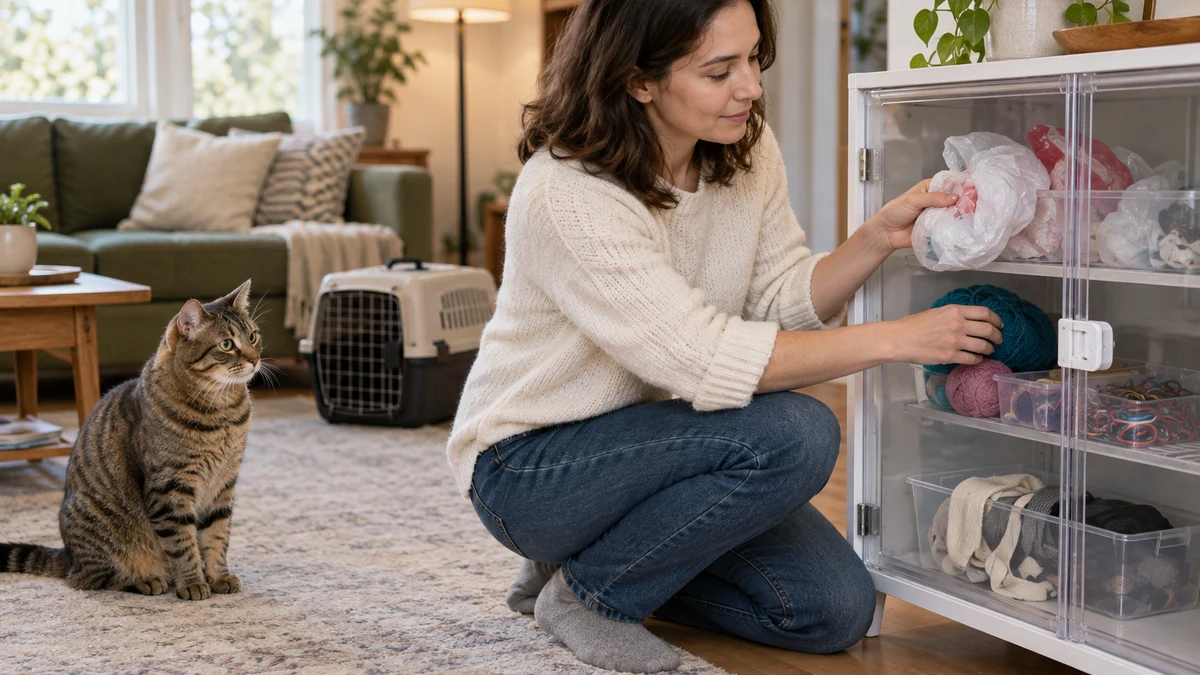
Cats may lick or chew plastic, fabric, wool, elastic, or string while exploring, playing, or seeking a particular texture. Repeatedly swallowing non-food material is called pica, but the object alone cannot tell you why it happens. Medical, dietary, environmental, and behavioral factors can overlap. The immediate question is whether anything may have been swallowed. If ingestion is known or cannot be ruled out—especially with string, thread, ribbon, floss, elastic, a sharp object, or a missing toy part—call a veterinarian now instead of waiting for symptoms. Do not induce vomiting, give oil or laxatives, or pull visible string.
First decide what you actually observed
“My cat ate plastic” may describe four different events. Keep the description literal because each one leads to a different level of risk.
| What happened | What it means now | Next step |
|---|---|---|
| The cat sniffed or briefly licked an intact object, and no material is missing | Contact occurred, but ingestion is not established | Remove the object, inspect it, and monitor without labeling the cat |
| The cat mouthed, sucked, or chewed it, but you can account for every piece | There may be dental or behavior concerns even without swallowing | Block access, record the pattern, and discuss recurrence with your veterinarian |
| The object is damaged, a piece is missing, or you did not see the whole episode | Ingestion is possible; guessing from the cat’s current appearance is unsafe | Call a veterinary clinic promptly with the object, timeline, and amount that may be missing |
| You saw the cat swallow it, a complete object is gone, or string is visible from the mouth or anus | Ingestion is known or strongly suspected | Contact a veterinarian or emergency clinic immediately; do not wait for signs or pull the material |
Pica is not a synonym for every lick, one playful grab, or one chewed corner. A University of Montreal case-control study defines pica as ingestion of inedible items and found that some cats ingested particular materials but only chewed others. A kitten may investigate with the mouth, and a cat may react to movement, smell, sound, or texture. Those observations still deserve prevention, but they do not prove a compulsive disorder, a nutrient deficiency, anxiety, or a gastrointestinal disease.
Why these objects can become dangerous
The hazard depends on size, shape, material, amount, and where an object travels—not on whether it looked harmless on the floor. Merck Veterinary Manual explains that foreign objects can obstruct anywhere from the esophagus through the colon. A blockage may be partial or complete, and early signs can vary.
At least these 7 groups deserve secure storage:
- Plastic film and soft packaging: shopping bags, wrappers, tape, foam, and torn packaging can be bitten into pieces. Bag handles also create an entanglement risk.
- Fabric and wool: socks, blankets, sweaters, felt, carpet fibers, and soft toy covering can fray or disappear in pieces.
- Linear objects: string, yarn, thread, ribbon, tinsel, fishing line, dental floss, and wand-toy cords are especially dangerous if swallowed.
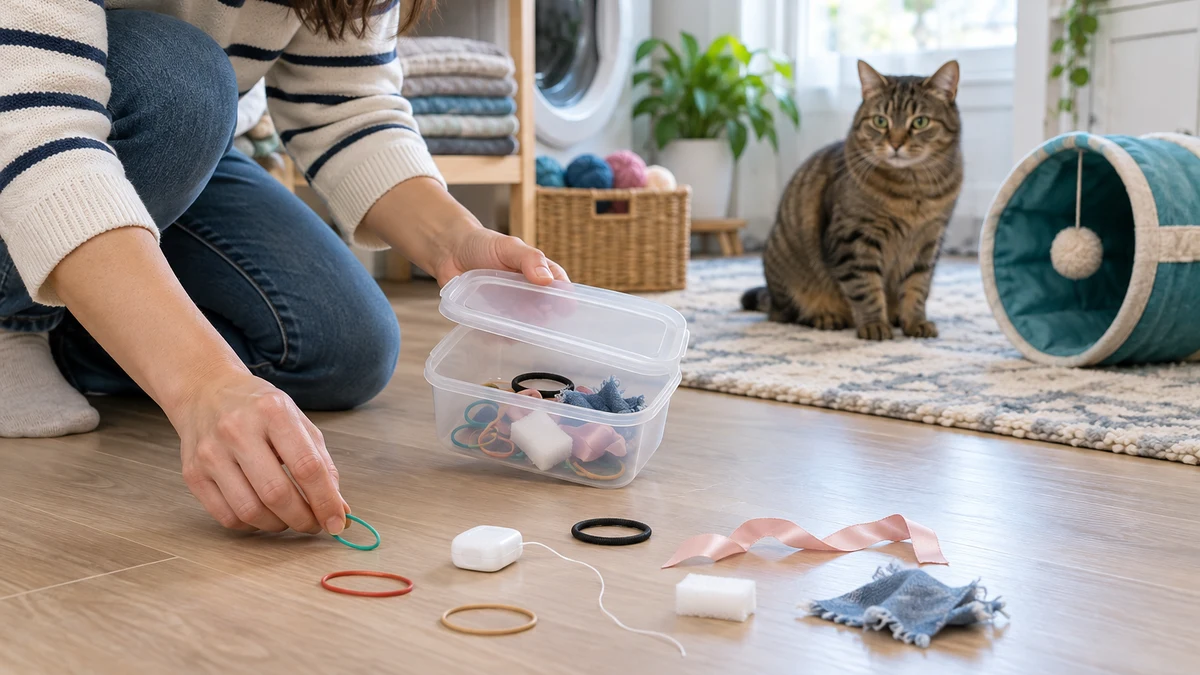
- Elastic loops: hair ties, rubber bands, mask straps, and elastic thread can be swallowed whole or in fragments.
- Craft and sewing materials: needles attached to thread, pins, pom-poms, stuffing, buttons, and stitch markers combine sharp, linear, or small-object hazards.
- Toy parts and household small objects: bells, feathers, glued eyes, earplugs, small corks, erasers, and bits of silicone or rubber may detach or fit in a cat’s mouth.
- Cords and chemically hazardous material: electrical cord chewing can injure the mouth and create an electrical emergency; an object coated with cleaners, glue, medicine, nicotine, or another chemical adds a poisoning concern.
Small does not mean safe for a small patient. The American College of Veterinary Surgeons notes that the outcome depends partly on the object’s material, location, time present, and degree of obstruction. Some smooth objects pass, but many lodge; this is a veterinary decision based on the cat and diagnostic findings, not a home “wait and see” experiment.
String is a special emergency rule
A linear foreign body can anchor under the tongue or in the stomach while the rest moves through the intestines. Normal intestinal contractions may bunch the bowel along the material. Merck describes a higher perforation risk because the taut material can cut into the intestinal wall. ACVS likewise warns that string can create holes, leakage into the abdomen, peritonitis, and sepsis.
Therefore:
- Never pull string, thread, ribbon, floss, yarn, or fabric strip from the mouth or anus.
- Do not cut, shorten, or manipulate it unless a veterinarian instructs you in real time.
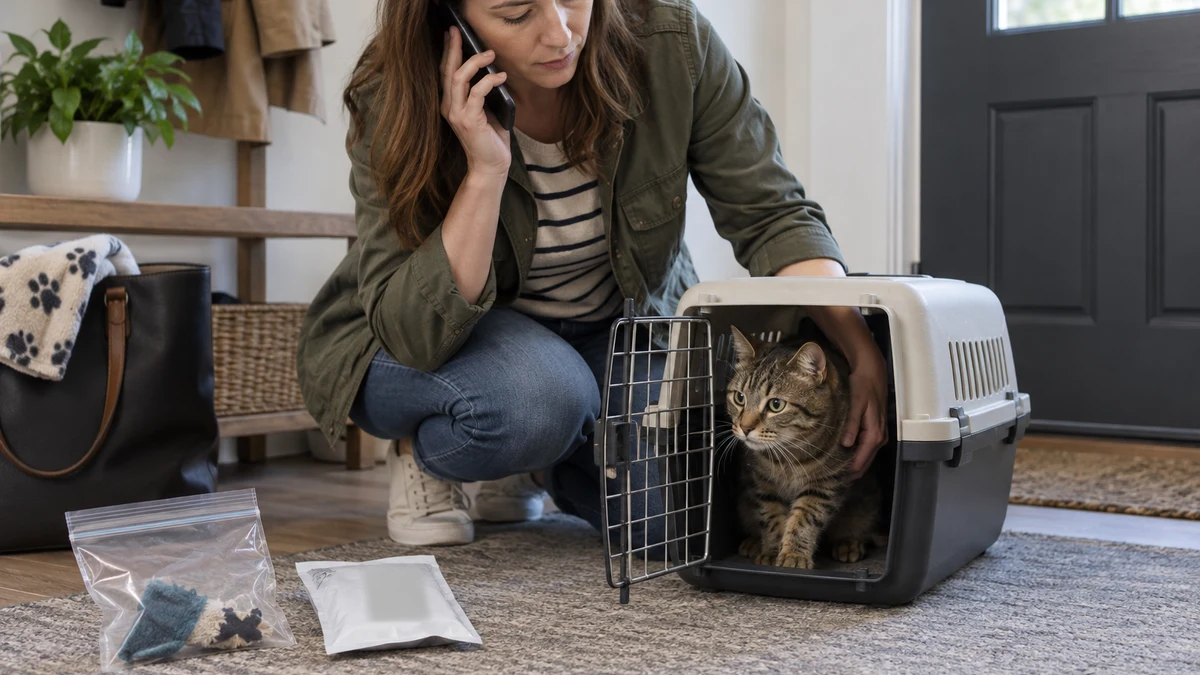
- Prevent the cat from chewing or pulling the exposed end, place the cat in a carrier if this can be done safely, and go where the veterinary team directs.
- Do not reach deep into the mouth or under the tongue. A frightened or painful cat may bite, and hidden material can be anchored.
The ASPCA gives the same practical warning: exposed string may be connected or wrapped around structures inside the digestive tract, so pulling can cause damage. The fact that one end is visible does not mean the rest is free.
What to do after a possible or known ingestion
Start with containment and information, not a home treatment. These 10 actions help the veterinary team triage the event:
- Stop further access. Calmly move the cat to a safe, low-clutter room or carrier and close off the object area.
- Call promptly. State whether ingestion was witnessed, possible, or unknown. Known ingestion does not become safer because the cat still acts normal.
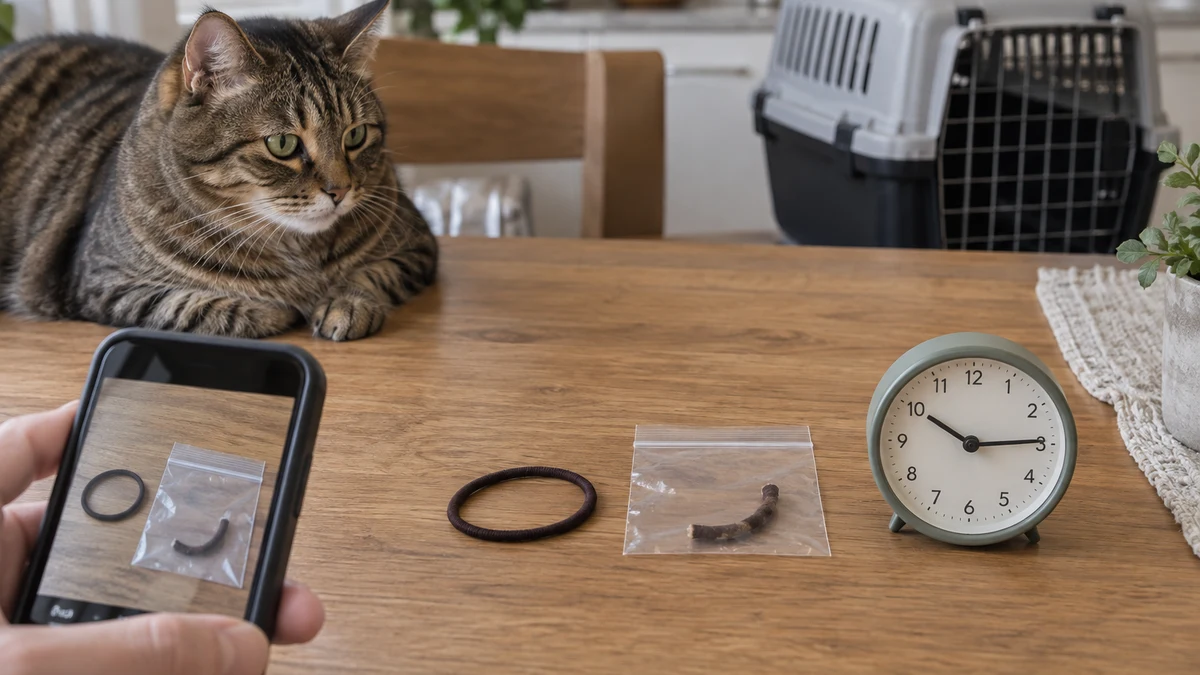
- Name the object precisely. “A 4 cm elastic hair tie” is more useful than “something small.” Mention sharp parts, thread, adhesive, chemicals, batteries, magnets, or attached hardware.
- Account for missing material. Compare with an intact matching item, count remaining pieces, and estimate the maximum amount missing without assuming it was swallowed.
- Record the timeline. Note the last time the object was intact, when the cat had access, when damage was found, and when any sign began.
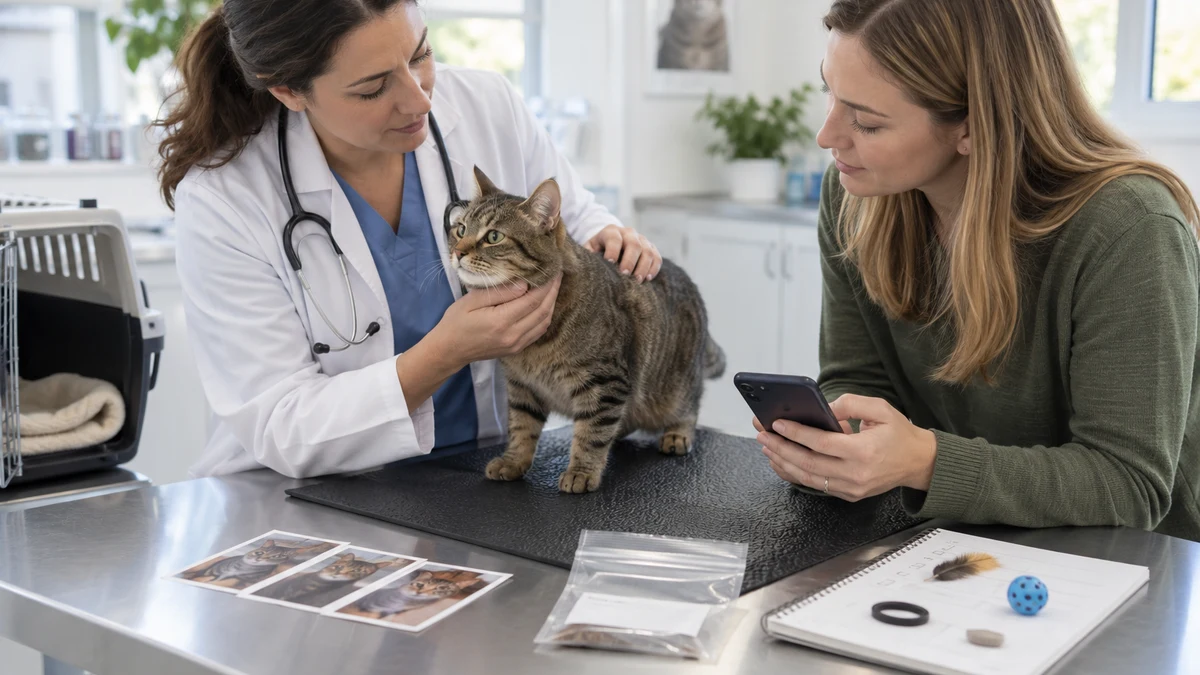
- Take photos. Photograph the damaged object, nearby scene, package, and any vomit or stool that contains material. A short video can document retching, swallowing difficulty, posture, or behavior without delaying care.
- Save evidence safely. Put fragments, packaging, labels, or a matching item in a sealed bag away from the cat. Do not bring loose hazardous pieces.
- Report the cat’s current state. Include appetite, water intake, vomiting or retching, stool, urination, energy, breathing, drooling, abdominal comfort, and any change from baseline.
- Share relevant history. Give age, weight, current diet, medical conditions, current medications, previous foreign-body incidents, and whether the cat may have accessed more than one object.
- Follow transport and feeding instructions. Ask where to go and whether food or water should be withheld. Do not improvise fasting or feeding when the clinic has not advised it.
Do not induce vomiting at home. Do not give hydrogen peroxide, salt, oil, butter, petroleum products, hairball remedies, laxatives, activated charcoal, human medicine, or leftover pet medicine unless a veterinarian or animal poison-control professional directs the exact step for this cat and exposure. AVMA first-aid guidance says not to induce vomiting or give medication without professional direction. A sharp or linear object can cause more injury during an attempted return, and a delayed call can remove safer diagnostic or retrieval options.
Do not wait for these warning signs
Call a veterinary clinic immediately for known or suspected ingestion. Treat the following as urgent warning signs as well, even when no missing object has been identified:
- breathing difficulty, noisy breathing, blue or very pale gums, collapse, or marked weakness;
- choking motions, repeated swallowing, gagging, pawing at the mouth, heavy drooling, or difficulty swallowing;
- string or another object visible from the mouth or anus;
- repeated vomiting, dry heaving, or an inability to keep water down;
- refusing food, sudden loss of interest in usual activity, hiding, or unusual lethargy;
- a tense, swollen, guarded, or painful abdomen; a hunched posture or resistance to being picked up;
- diarrhea, blood in vomit or stool, straining, passing very little stool, or another abrupt bowel change;
- a witnessed needle, sharp object, battery, magnet, chemically contaminated object, or large missing piece.
ACVS lists vomiting, loss of appetite, abdominal pain, dehydration, and diarrhea among common foreign-body signs. Merck emphasizes that signs differ with location, duration, and degree of obstruction; vomiting can even be less prominent in some distal obstructions. That variability is why “no vomiting yet” is not clearance.
Why a veterinarian needs the full pattern
After the immediate foreign-body risk is addressed, recurrent non-food ingestion needs a broader assessment. UC Davis School of Veterinary Medicine describes pica as a complex behavior with possible medical and behavioral contributors. A category list is not a diagnosis, and the favored object does not select one cause. “Plastic means anxiety” and “fabric means a vitamin deficiency” are shortcuts unsupported by observation alone.
A veterinarian may use the history, physical and oral examination, diet review, and clinically appropriate laboratory tests. If obstruction is possible, radiographs, contrast imaging, or ultrasound may be considered. Not every material is obvious on a plain X-ray, so a normal-looking image or a temporarily comfortable cat should be interpreted by the treating team alongside the history. Endoscopy, monitoring, or surgery depends on location, material, movement, signs, and clinical stability.
Bring a pattern rather than a theory:
- exact objects and materials targeted;
- licking, sucking, chewing, shredding, or confirmed swallowing;
- frequency, duration, time of day, and how the episode ends;
- meals and appetite before and after;
- access to trash, laundry, crafts, plants, toys, and cords;
- recent moves, schedule changes, new animals or people, and resource competition;
- vomiting, stool, weight, dental, energy, or other health changes;
- what prevention or enrichment was tried and what changed.
If medical contributors have been assessed and risk remains behaviorally driven, the veterinarian may recommend a qualified veterinary behavior professional. Medication, diet changes, or supplements are individual clinical decisions—not universal pica remedies.
Build prevention around barriers, not perfect supervision
The first treatment layer is physical prevention because an unsafe object cannot become safe through training. Use the broader home safety checklist as a room-by-room base, then add the specific items your cat targets.
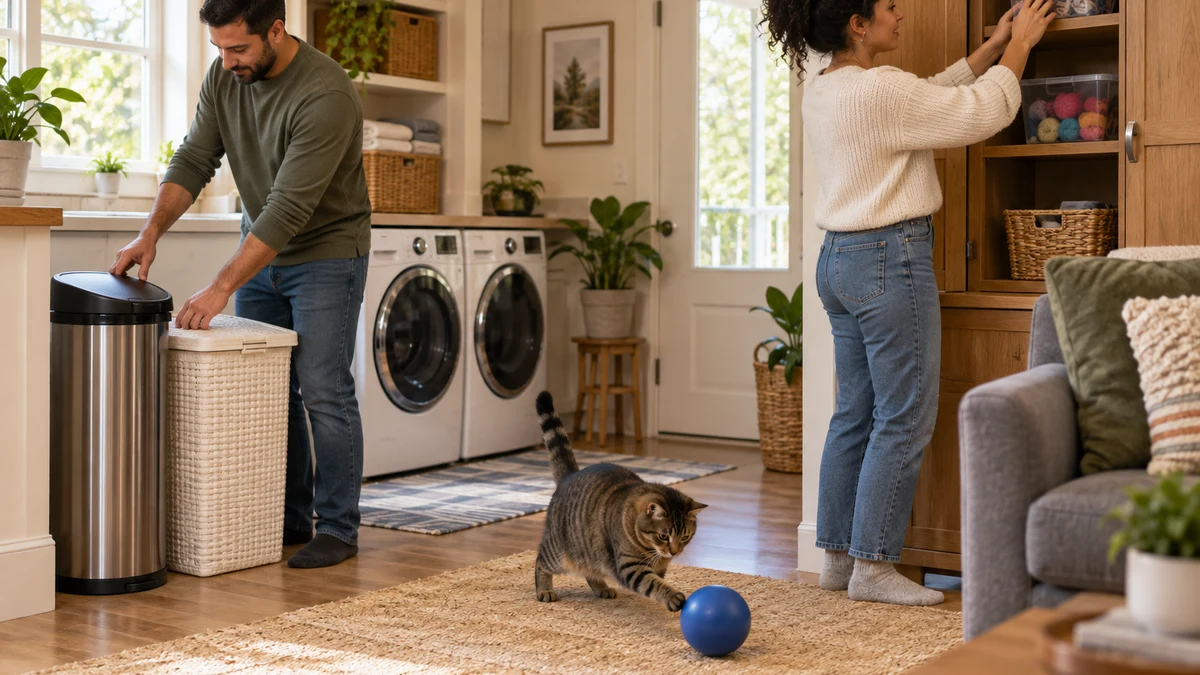
- Put laundry in a hamper with a lid the cat cannot open; close closets and drawers.
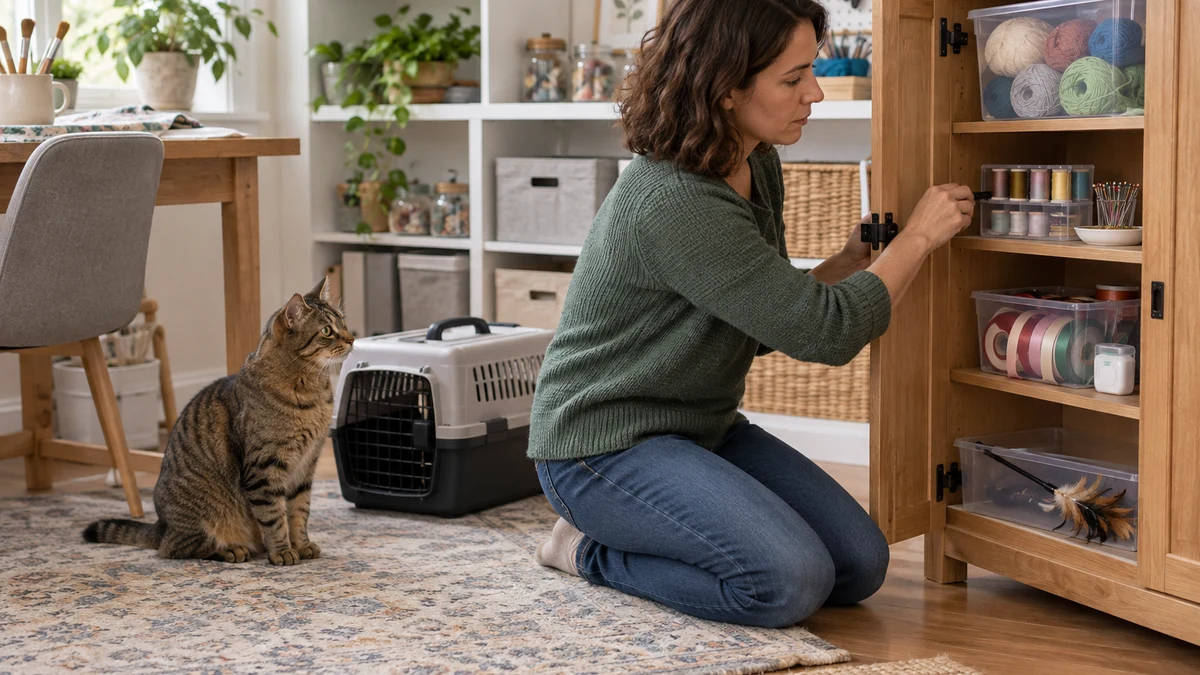
- Store hair ties, rubber bands, earplugs, floss, and small accessories in latched containers, not an open dish.
- Treat craft time as a controlled activity: count tools and materials before and after, sweep the floor, and close the room when finished.
- Keep trash, recycling, food wrappers, and plastic bags behind a solid door or secure lid.
- Cover or route electrical cords with products designed for that purpose; unplug damaged cords and remove access.
- Inspect toys before and after use. Retire anything with loose seams, exposed stuffing, peeling surfaces, detachable pieces, or missing parts.
- Use wand, ribbon, yarn, and feather toys only during active supervision, then place them in closed storage. AAFP/ISFM guidelines specifically advise putting away toys with string or ingestible parts after play.
- Create a truly low-risk room for times when direct supervision is impossible. Recheck it from floor level; “high shelf” is not secure if the cat can climb to it.
- Give every household member the same storage rule. A container works only when it is closed every time.
- Keep a small incident kit: clinic numbers, carrier, sealable bags, phone charger, and a current medication and diet list.
- Check delivered parcels, gift wrap, holiday decorations, sewing, and repairs as temporary risk spikes.
- Review the system after every near miss. Fix the access route instead of blaming the cat.
Punishment, shouting, spraying water, startling, chasing, or forced restraint does not make swallowed material less dangerous. The Feline Veterinary Medical Association warns that punishment can cause fear, stress, impaired learning, and damage to the human–cat bond. It can also drive an unsafe behavior out of sight.
Offer safer activities without calling them a cure
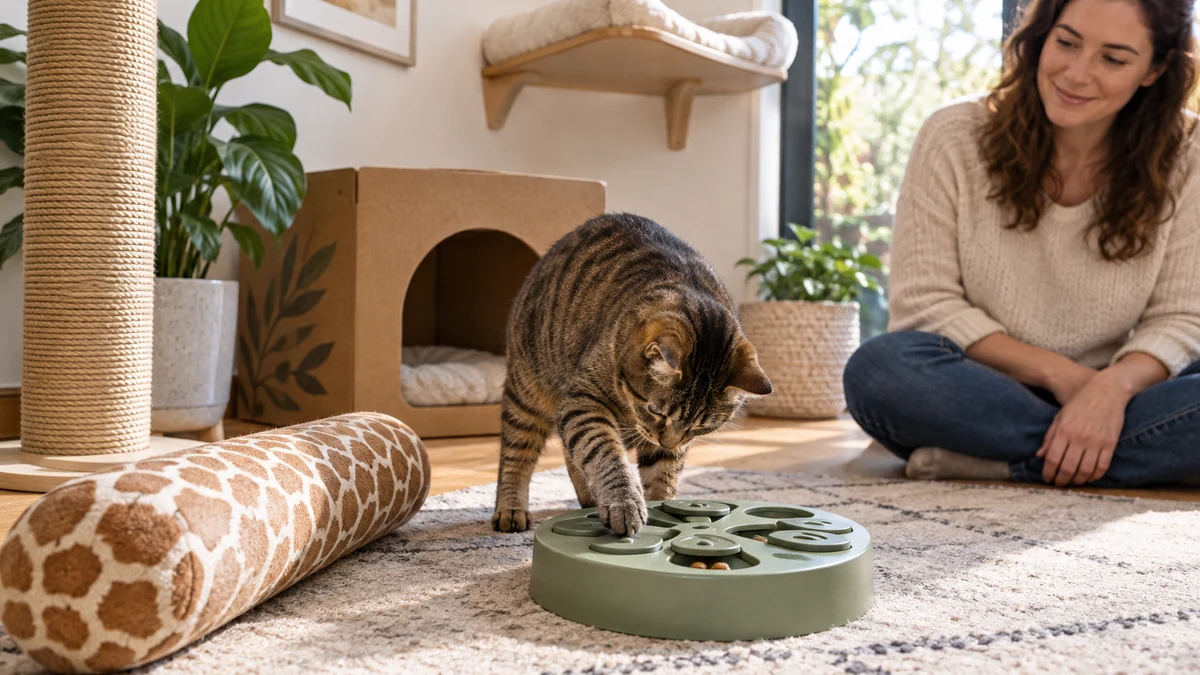
Environmental support can reduce idle access to risky objects and meet normal feline needs, but it does not prove that boredom or stress caused the pica. The AAFP/ISFM guidelines recommend safe places, separated resources, play and predatory opportunities, food-acquisition activities, and predictable positive interaction.
Try a rotating set selected for this cat:
- several short, interactive play sessions in which the cat can stalk, chase, catch, and finish;
- sturdy food puzzles appropriate to the cat’s diet and skill, introduced at an easy level;
- large one-piece toys without strings, glued decorations, or chewable attachments;
- scratching surfaces in preferred orientations and locations;
- elevated resting places and enclosed hiding options;
- separate food, water, rest, play, and litter resources in multi-cat homes;
- predictable meals and activity cues without restricting a medically appropriate diet;
- positive reinforcement for moving to a mat, puzzle, or safe toy—never a contest over an object in the mouth.
No chew item is “pica-safe” merely because it is marketed for pets. Supervise a new product, inspect it, match it to the cat’s chewing style, and remove it if pieces loosen. Do not offer fabric, cardboard, grass, rubber, plastic, or another target material as a substitute if this cat may swallow it.
A practical plan for recurring episodes
Use three layers at the same time:
- Safety today: remove access and respond promptly to every missing object or suspected ingestion.
- Medical assessment: give the veterinarian a detailed pattern and complete recommended follow-up instead of assigning a cause at home.
- Long-term environment and behavior: reinforce safe activities, make resources accessible, and review changes with the veterinary team.
Keep a log for two to four weeks or as your veterinarian requests. Record opportunities as well as episodes: which room was open, who was home, what the cat had just eaten or done, and which safe activity was available. A zero-incident week behind reliable barriers is useful evidence about prevention; it is not proof that the underlying tendency has disappeared. Continue secure storage.
Prepare the carrier before an emergency. Gentle carrier training on ordinary days makes prompt transport more workable, but a suspected ingestion is not the time to delay care for another training session.
Frequently asked questions
My cat only licks plastic bags. Is that pica?
Not necessarily. Pica refers to persistent ingestion of non-food material. Licking may occur without swallowing, but bags still create chewing, ingestion, and entanglement risks. Remove access, inspect for missing pieces, and record recurrence. Discuss persistent licking or chewing with your veterinarian, especially if appetite, vomiting, stool, weight, dental health, or behavior changes.
My cat swallowed a hair tie but seems normal. Can I wait for vomiting?
No. Call a veterinarian or emergency clinic now and provide the hair tie’s size, material, time, and whether it was witnessed or is simply missing. A normal appearance does not rule out a developing or partial obstruction, and signs vary by object and location. Follow the clinic’s plan rather than trying to make the cat vomit or checking passage without veterinary oversight.
A string is hanging from my cat’s mouth or anus. Should I trim or pull it?
Do not pull, tug, or manipulate it. Prevent the cat from chewing the exposed end, place the cat in a carrier if safe, and seek immediate veterinary direction. Linear material may be anchored inside; traction can injure or perforate the digestive tract.
Does eating fabric mean my cat has a nutritional deficiency?
You cannot tell from the material. Nutritional problems are one possible category among several medical and behavioral possibilities, and a complete commercial diet does not by itself rule every contributor in or out. Do not add vitamins, minerals, oil, or supplements without veterinary advice. Bring a diet and behavior history for assessment.
Will more play stop pica?
Play and food puzzles can support normal predatory and foraging behavior, but they are not a guaranteed cure and do not replace barriers or medical evaluation. Continue locking away target objects, use only toys that cannot be swallowed, supervise play, and build an individual plan with the veterinary team.