How to Play With Your Cat: A Hunt-Style Interactive Play Guide
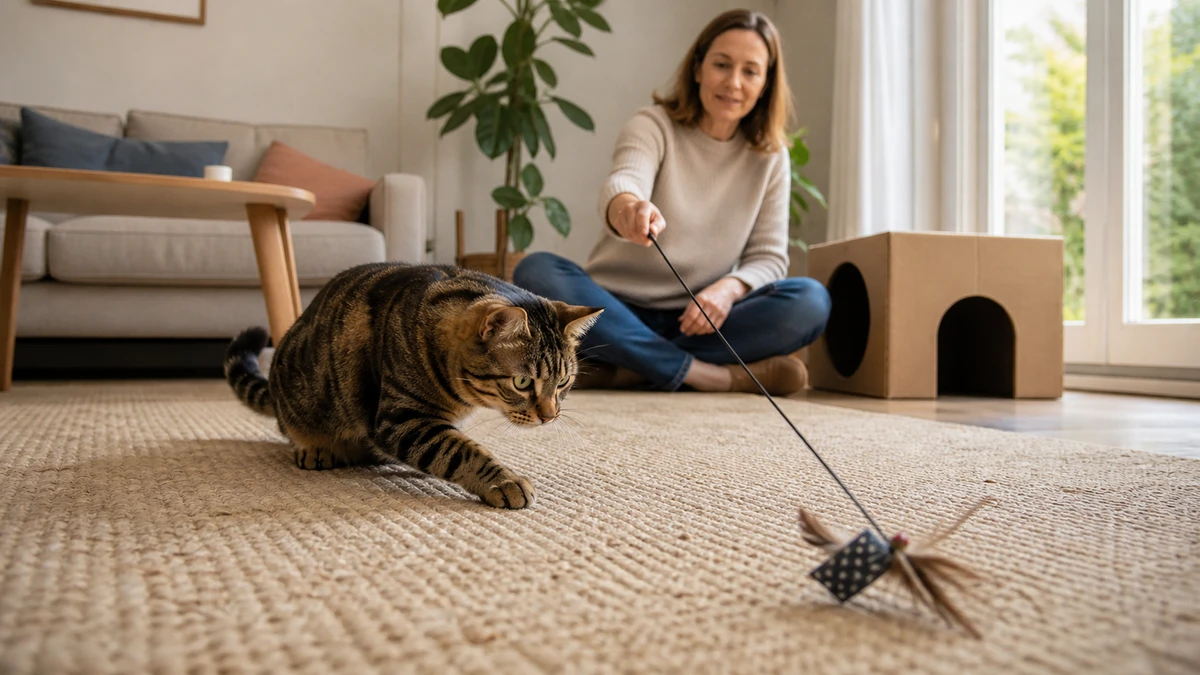
Play with your cat every day by turning a safe toy into catchable prey: let it disappear, pause, move away, change speed, and give the cat real chances to stalk, chase, pounce, and capture it. Finish by slowing the toy and allowing a final catch. There is no single correct number of minutes for every cat. Age, health, mobility, interest, and that day’s body language should decide how often and how long you play.
Interactive play provides an outlet for movement, exploration, and predatory behavior; it is not a test of obedience or athleticism. Watching from a box, tracking the lure with the eyes, or making one deliberate paw swipe can be a complete turn for an older or cautious cat. A kitten may ask for more frequent bursts. The useful measure is engagement followed by comfortable recovery—not a timer.
Build a hunt, not a workout quota
The AAFP/ISFM environmental guidelines identify opportunities for play and predatory behavior as a core part of a healthy feline environment. That principle does not make a rigid schedule evidence-based. Published caregiver resources offer example frequencies and session lengths, but cats vary too much for one number to function as a prescription.
Start with a predictable opportunity at a time when your cat is already alert—often after waking or during a familiar active period. Offer another short opportunity later if the cat still seeks play. Add, shorten, or skip intensity according to the individual. A cat that walks away has answered; do not chase the cat with the toy.
| What you observe | What to do next |
|---|---|
| Eyes and ears orient to the toy; the body lowers or follows | Continue, with pauses and hiding places |
| Cat watches but does not move | Keep the lure farther away, slow it, or let watching be the activity |
| Cat catches, releases, and reorients | Begin another short hunt cycle |
| Cat grooms, lies down, looks away, or leaves | End the session calmly |
| Tail lashes hard, ears flatten, skin twitches, or the cat redirects toward you | Freeze the toy, create distance, and let the cat settle |
| Panting, open-mouth breathing, limping, pain, weakness, or disorientation | Stop immediately and follow the veterinary guidance below |
Interest also changes with novelty. Keep only a few safe toys available, rotate them, and learn whether your cat prefers floor movement, fluttering movement, sound, hiding, carrying, kicking, or food-searching. “Does not play” sometimes means “does not like this toy, location, speed, or social pressure.” A persistent and unexplained change from the cat’s normal interest deserves veterinary discussion rather than a bigger toy collection.
A seven-stage wand-toy hunt
This is a practical play pattern, not a claim that every real hunt follows a perfectly fixed script. Repeat, shorten, or omit a stage according to the cat. The important features are choice, prey-like movement, successful capture, and a gradual finish.
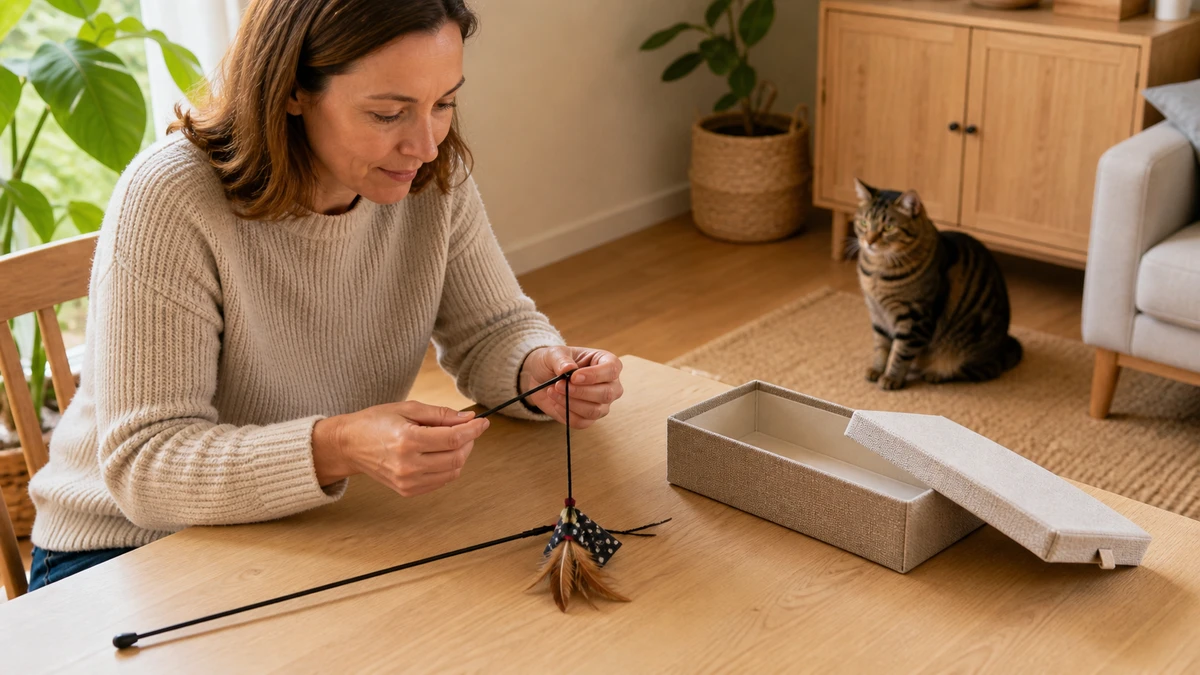
- Search. Place the lure beyond arm’s reach from the cat, partly hidden behind a box, tunnel, chair leg, or paper edge. Make one small rustle, then stop. Do not tap the cat or wave the lure in the face.
- Watch and orient. Let the cat locate it. Hold still long enough for listening, head turns, pupil changes, or weight shifts. The pause is part of the game, not dead time.
- Stalk. Move the lure away in a short ground-level path, then let it disappear again. Prey usually does not run directly into a predator’s nose.
- Chase. Use an irregular pattern: quick movement, a turn around cover, another pause, then a slower escape. Keep traction and clear routes under the cat.
- Pounce and grab. Slow enough that the cat has a realistic chance. Avoid repeated high vertical jumps, sharp turns on slippery floors, and collisions with furniture.
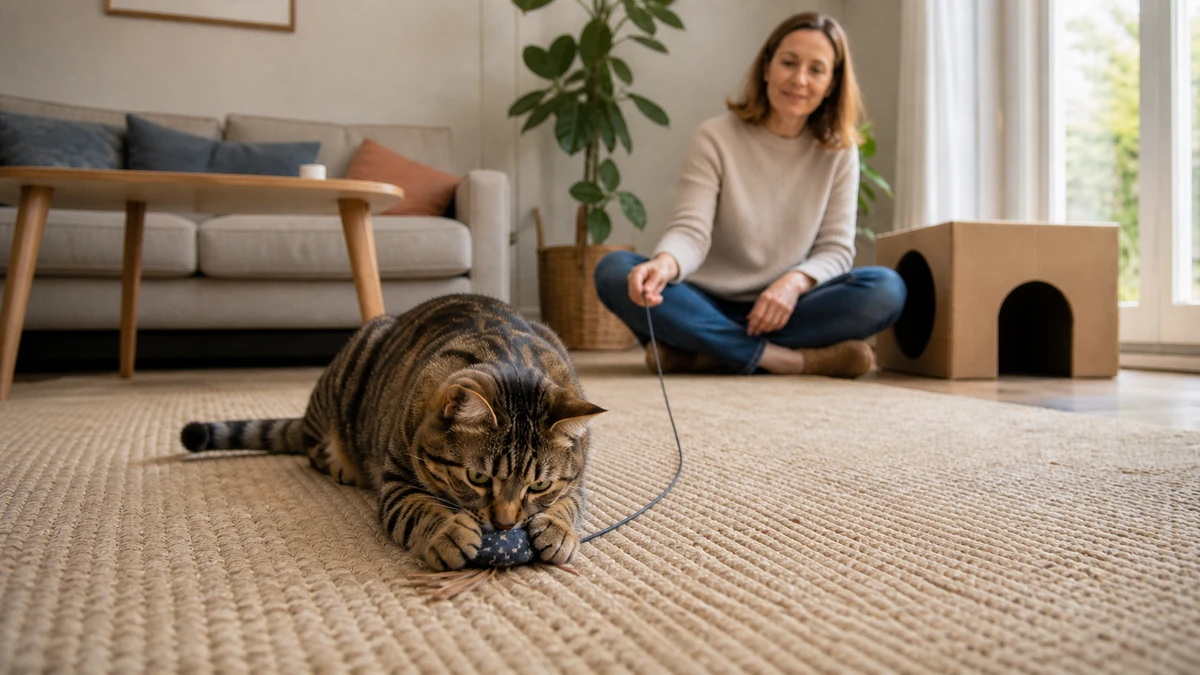
- Successful capture. Release tension on the line. Let the cat pin, mouth, carry, or kick the durable lure briefly while you keep hold of the wand. VCA and Cats Protection both emphasize that catchable prey helps prevent frustration.
- Wind down. Start one last, easier cycle. Make the lure slower and less evasive, allow the final catch, then leave it still. When the cat releases it, exchange calmly if needed and put the wand away. A measured portion of the cat’s planned food can follow if that fits the feeding plan, but food is not a required ending and play does not guarantee sleep.
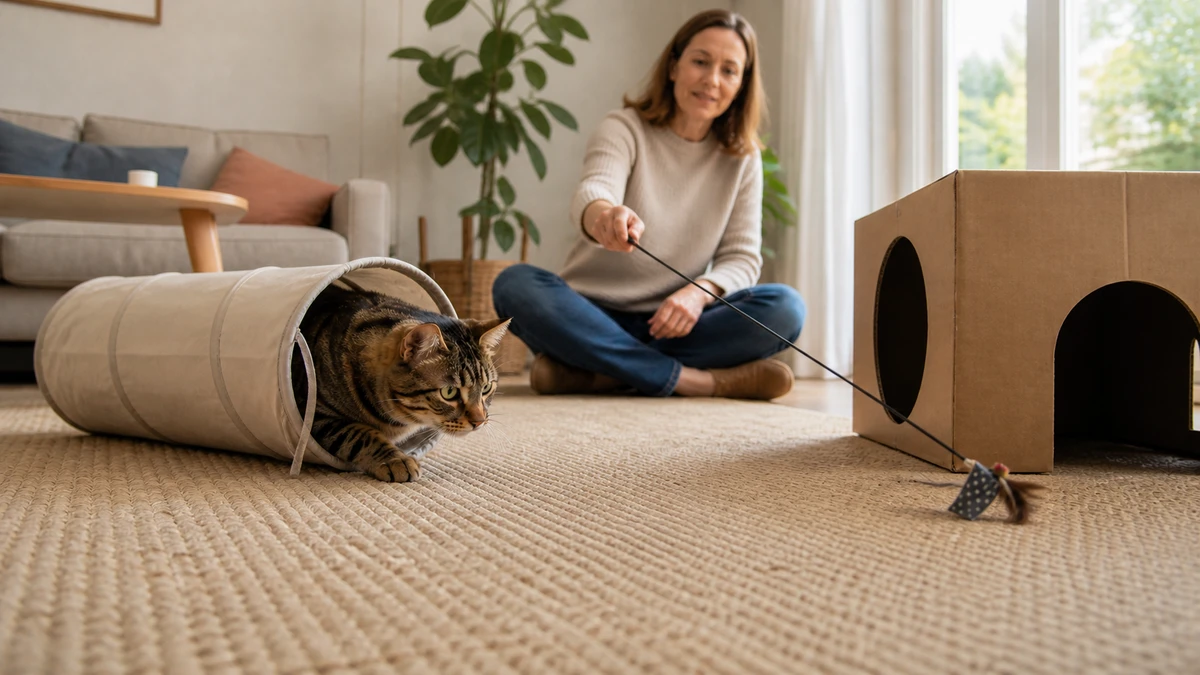
The most common technique error is nonstop motion. A lure that vibrates in one spot or flies constantly above the head asks for reaction without giving the cat time to search and plan. Use cover and stillness. Most movement should travel across or away from the cat; occasional safe upward movement can suit a cat that enjoys jumping, but it is an option, not a requirement.
Eight ways to vary the game
Different play styles exercise different choices. Rotate two or three rather than presenting everything at once.
| Game | How to run it | Best safety adjustment |
|---|---|---|
| Ground scurry | Pull a wand lure along the rug, around a chair, and behind cover | Move away from the cat; provide traction and a clear route |
| Flutter and drop | Let a feather lure rise briefly, land, and “hide” | Keep jumps low and optional; never spin the cat repeatedly |
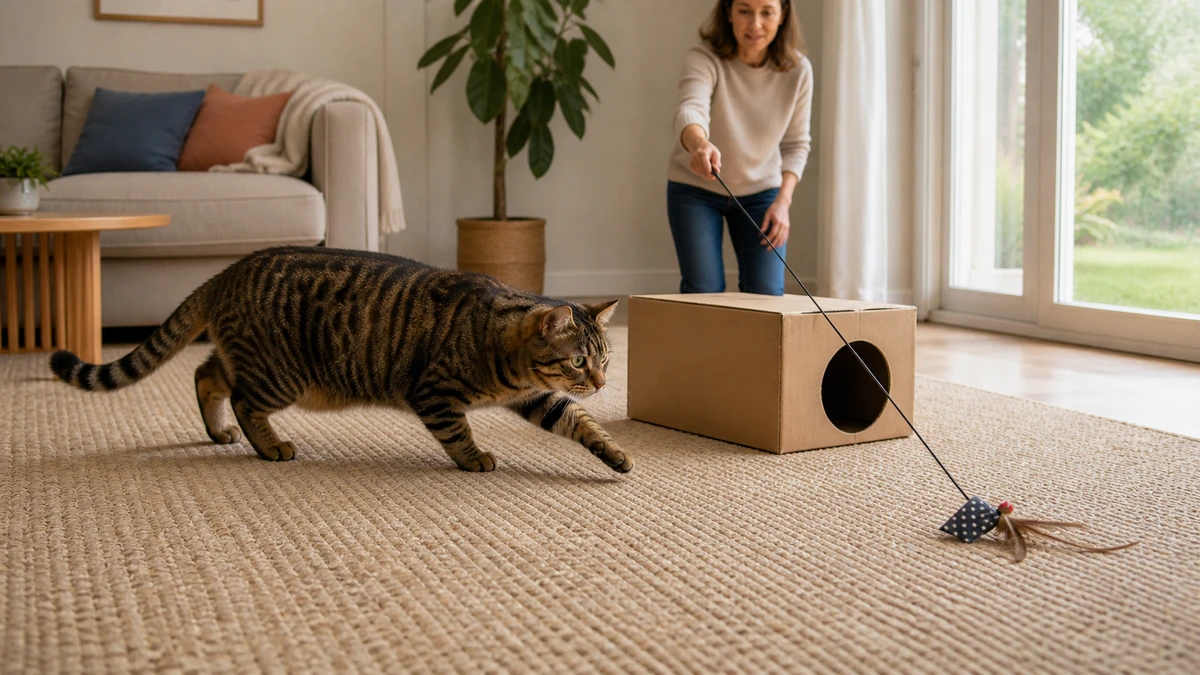
| Box or tunnel ambush | Let the lure appear at different openings | Use stable boxes with easy entrances and exits |
| Ball chase | Roll a cat-safe ball across an open floor or into a track | Choose a ball too large to swallow and inspect for damage |
| Kicker capture | After the chase, offer a large durable kicker to grab and kick | Keep hands away from the hind feet and mouth |
| Food puzzle | Put part of the regular measured meal in an easy feeder | Begin easy, supervise first use, and count food in the daily ration |
| Find-the-toy | Hide a familiar toy partly under paper or behind furniture | Never use plastic bags, staples, rubber bands, or loose yarn |
| Fetch or target game | Toss a safe toy or reward voluntary touch/return | Use positive reinforcement; do not punish a cat that stops |
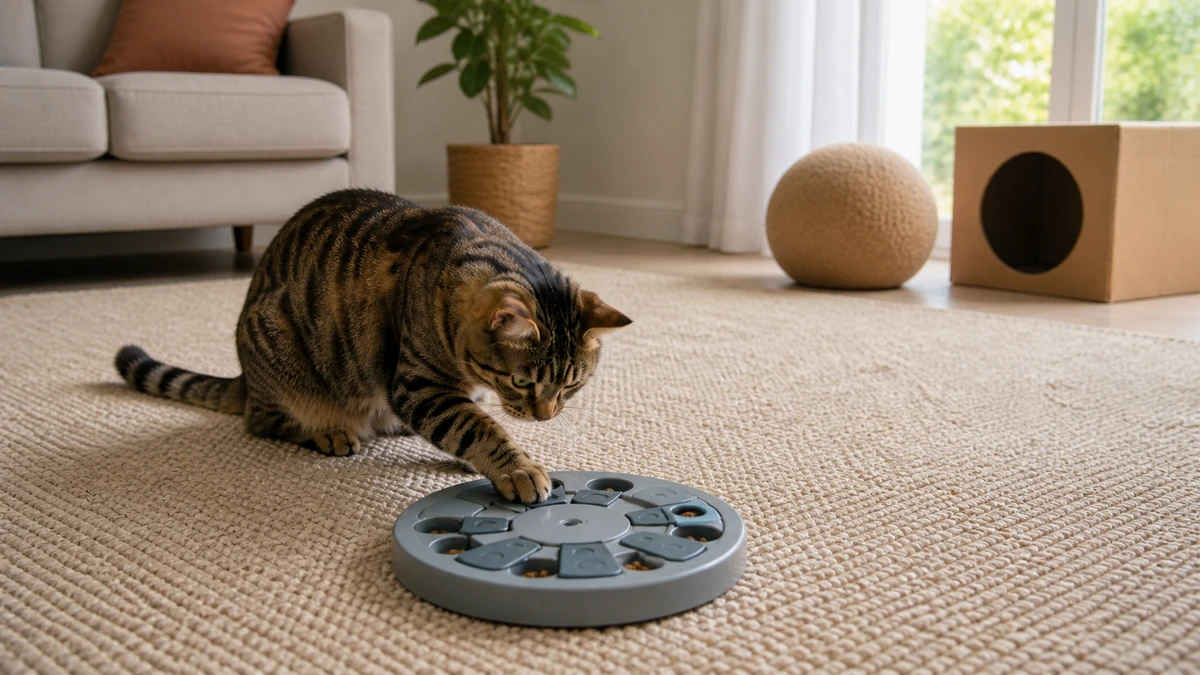
Cardboard gives useful cover and routes at little cost. The guide to why cats like boxes explains how hiding and choice can make a box valuable. Cut openings large enough for easy passage, remove tape, staples, and handles, and discard wet or collapsing cardboard.
Adapt the game to the cat in front of you
Kittens: frequent opportunities, strict boundaries
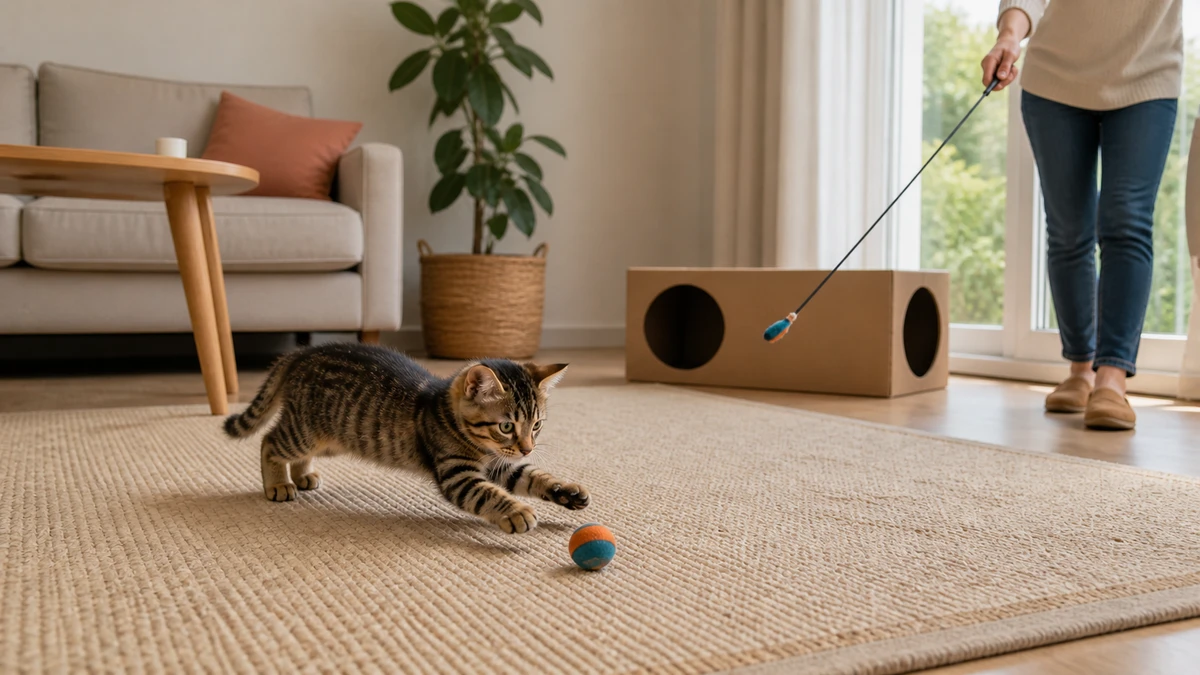
Kittens often have an intense play drive and are still learning what is appropriate to bite and chase. Direct that energy to wands, balls, tunnels, and large kicker toys before a kitten targets ankles. Keep fingers and toes still rather than making them more exciting, then redirect to a toy at a safe distance. Our guide to play attacks on feet covers the same boundary in more detail.
Use toys too large to swallow and supervise. VCA specifically warns against leaving wand toys, fishing-pole toys, feathers, strings, rubber bands, hair bands, or yarn accessible without supervision. A kitten that becomes frantic needs a pause and space, not scolding or rougher play.
Older or mobility-limited cats: lower, slower, and grippier
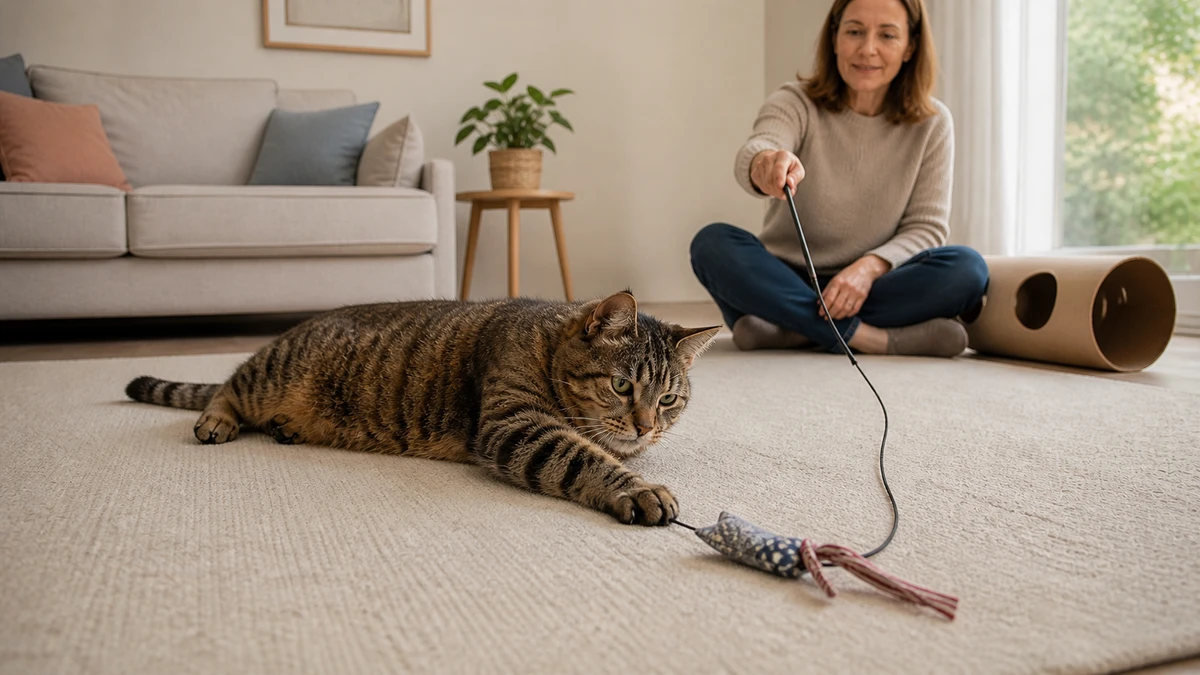
Do not define success as jumping. Cats Protection recommends gentler, shorter play for older cats and notes that watching or slowly swiping still provides stimulation. Work on a nonslip rug. Move the lure past the cat at floor level, turn a box on its side, offer a large kicker while the cat lies down, or use an easy food puzzle. Keep favored activities on an accessible level.
Age alone does not diagnose arthritis, and reduced activity should not simply be dismissed as aging. If the cat becomes reluctant to jump, stiff, lame, sensitive to touch, or newly uninterested in play, stop increasing the challenge and ask a veterinarian to assess the change.
Cautious cats: make participation optional
Begin farther away and use cover. Avoid blocking the exit or placing the toy between the cat and a safe retreat. A glance, ear turn, or slow approach can be the entire first session. Never pull a cat from hiding to “show” the game. If body language is hard to read, the cat stress-sign guide can help distinguish quiet observation from escalating discomfort.
Multi-cat homes: access is not the same as sharing
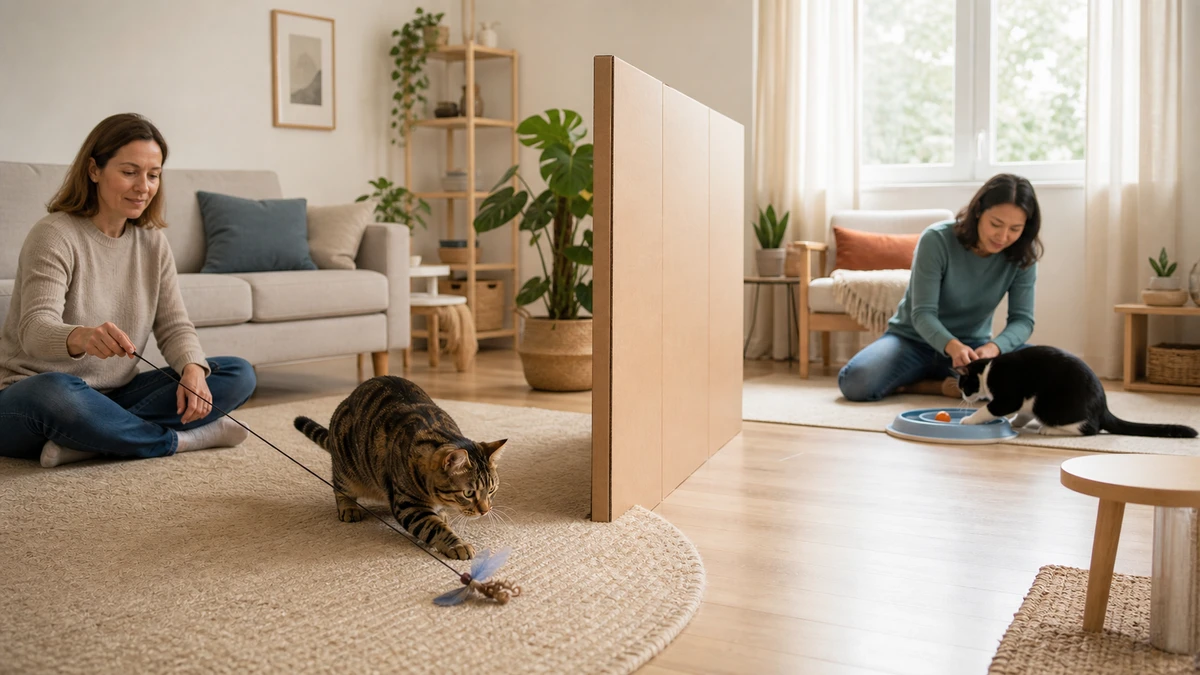
One lively cat can monopolize the lure while another watches from a doorway. The 2024 AAFP intercat tension guidelines recommend play opportunities in each cat’s core area, separated resources, and visual barriers when needed. Offer individual sessions or sessions for compatible social groups. Use separate toys and escape routes; do not swing one lure between cats to make them compete.
Watch for staring, blocking, following, one cat abandoning the area, or a quieter cat playing only when the other is absent. Those details matter more than whether a fight occurs. If catnip makes one cat agitated, remove it from group sessions. Social play between cats does not replace object play with a caregiver, and adding another cat is not a treatment for boredom.
Safety rules that do not change
- Use toys, never body parts, as prey. Hands are for gentle contact; feet are not moving targets. This reduces injury risk and avoids rehearsing attacks on people.
- Supervise string, ribbon, yarn, wire, and feather toys. A cat can become tangled or swallow detached material. Put the entire toy in a closed cabinet or lidded box after play.
- Inspect before and after every session. Replace a frayed cord, loose feather, cracked plastic, exposed wire, open seam, or swallowable piece; do not repair a dangerous lure with more dangling tape or thread.
- Keep the route physically safe. Add traction, close exterior doors, remove breakables, and avoid stairs, hot surfaces, and sharp furniture edges.
- Do not force or punish. If the cat does not engage, change the toy or try later. If arousal rises, freeze the toy, step away, and allow recovery. Shouting, spraying, hitting, scruffing, or grabbing adds threat and does not teach a safe game.
- Prefer a physical, catchable target. A light dot cannot be grabbed. If a light toy is used at all, shift promptly to a physical lure the cat can capture; stop if searching or agitation continues after the light disappears.
When play should stop and a veterinarian should help
Stop the activity immediately for panting, open-mouth breathing, labored or unusually rapid breathing, limping, inability to bear weight, obvious pain, weakness, collapse, disorientation, or injury. Move the cat to a quiet, comfortably cool area without forcing handling.
Open-mouth breathing or any difficulty breathing in a cat warrants urgent veterinary care; Cornell describes respiratory distress as high risk and advises prompt assessment rather than home treatment. A painful or severely lame limb should not be squeezed, stretched, or repeatedly tested. Call the veterinarian and follow instructions for safe transport.
Also arrange veterinary advice for a sudden, persistent loss of interest in an activity the cat normally enjoys, unexplained aggression, a new movement change, or repeated post-play discomfort. These observations do not identify a diagnosis. Record when the change began, what the cat was doing, how long recovery took, and any changes in appetite, drinking, toileting, sleep, or grooming. A short video can help if recording does not delay urgent care.
Daily play works best as a conversation: offer a safe hunt, watch the reply, allow success, and stop while the cat is still comfortable. The goal is not exhaustion. It is a repeatable outlet for searching, moving, choosing, and catching.
FAQ
How many minutes should I play with my cat each day?
There is no universal number. Offer regular short opportunities and let age, health, mobility, interest, and recovery guide the total. A cat that disengages should not be chased with the toy; a kitten that repeatedly seeks appropriate play may benefit from more frequent bursts.
Should I feed my cat immediately after play?
It is optional. A measured portion of the normal meal can follow a successful final catch if it fits the feeding plan. Count it in the daily ration. Do not claim that food is required to “complete” every hunt or that it guarantees sleep.
What if my cat only watches the toy?
Watching, orienting, and making small weight shifts can be meaningful participation, especially for an older, cautious, or mobility-limited cat. Try slower floor movement and more cover. Ask a veterinarian about a sudden change from active play to persistent nonparticipation.
Why does my cat lose interest when I wave the wand?
The lure may be too close, too constant, too fast, or impossible to catch. Move it away, hide it, pause, vary speed, and allow captures. Also test a different texture, location, or time of day.
What should I do if my cat gets too excited and attacks me?
Stop moving, freeze the toy, create distance, and let the cat settle without touching or punishing. Do not use hands or feet to restart the game. If attacks are new, severe, unexplained, or occur outside play, seek veterinary and qualified behavior guidance.