What Colors Can Cats See? Night Vision, Motion, and Distance
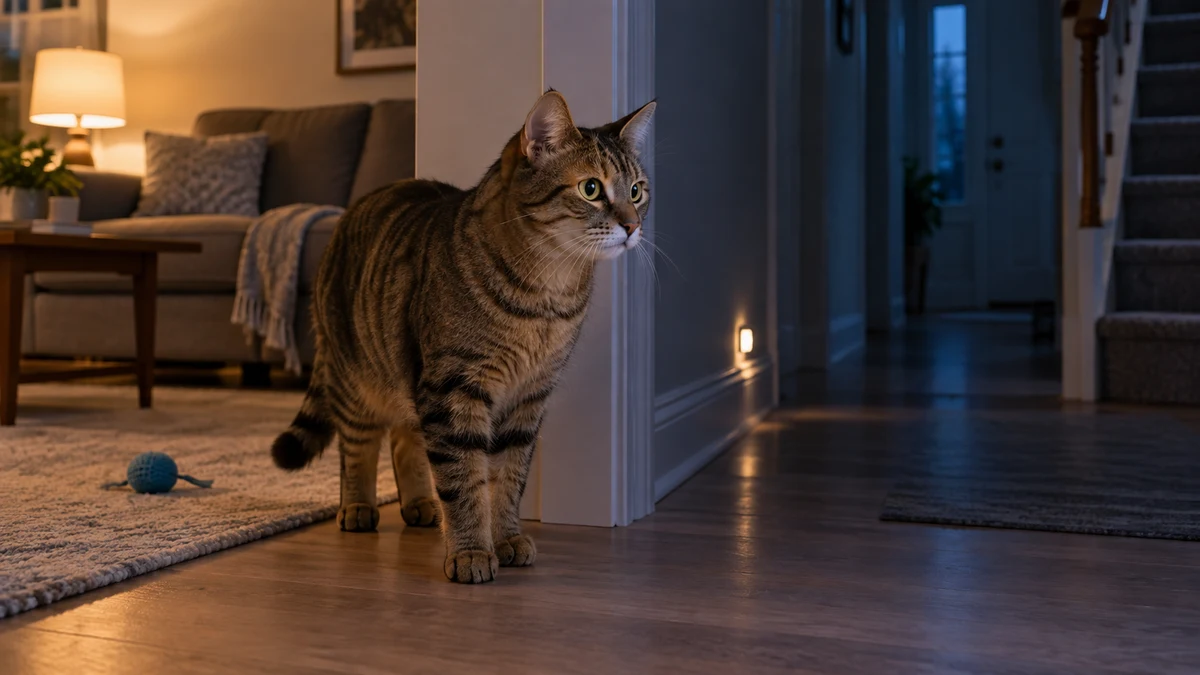
Cats see color, but not the same range or richness that people with typical three-cone vision do. Research supports at least two cone pathways, so the world is not black and white; blue-to-violet and longer-wavelength signals can be distinguished under suitable conditions, while some blue-green combinations may look alike. Cats are also highly sensitive in dim light, yet they still need photons—total darkness remains invisible. Their visual system trades some fine stationary detail for low-light sensitivity, contrast, and useful responses to motion. No photograph or phone filter can reproduce a cat’s exact private experience.
Four shortcuts that distort the science
| Popular shortcut | What the evidence supports | Practical meaning |
|---|---|---|
| “Cats see only black and white” | Behavioral and physiological studies show more than one cone process and chromatic discrimination | Color can help, but brightness, contrast, size, movement, and the individual cat also matter |
| “Cats can see in complete darkness” | Wide pupils, rod-based vision, and the tapetum improve sensitivity when some light exists | Leave gentle route lighting where a cat must cross stairs or unfamiliar space; darkness supplies no image |
| “Cats see every moving thing better than humans” | In one behavioral study, temporal modulation improved detection of coarse gratings but reduced visibility of fine gratings | A moving lure can be salient, but speed, size, contrast, distance, and light change the result |
| “One filter shows exactly what a cat sees” | Experiments measure discrimination and neural responses, not a cat’s subjective scene | Treat simulations as illustrations, never as calibrated feline vision |
The useful question is not “Which Instagram filter looks feline?” It is “Which visual information is supported by experiments, and how can the home make that information easier and safer to use?”
Cats are not completely color-blind
Cones support color vision under brighter conditions. A 1970 behavioral study found that cats could distinguish red or orange from cyan even against a background bright enough to saturate rod responses, supporting more than one cone process. Retinal anatomy also shows short-wavelength-sensitive cones and medium-to-long-wavelength-sensitive cones; one mapping study found M-cones made up most cones while S-cones formed a smaller, unevenly distributed population.
The most direct recent behavioral result came from a 2016 neutral-point experiment. Two trained cats chose between monochromatic and white-light targets while researchers varied brightness to remove simple intensity cues. Both discriminated tested wavelengths on either side of about 505 nanometers, but repeatedly failed at that neutral point. The authors interpreted this as strong evidence for dichromatic vision. The sample was only two cats, and older physiological work has occasionally reported a possible third receptor contribution, so the responsible summary is evidence favors a two-channel color system, not “we know the exact color of every object inside a cat’s mind.”
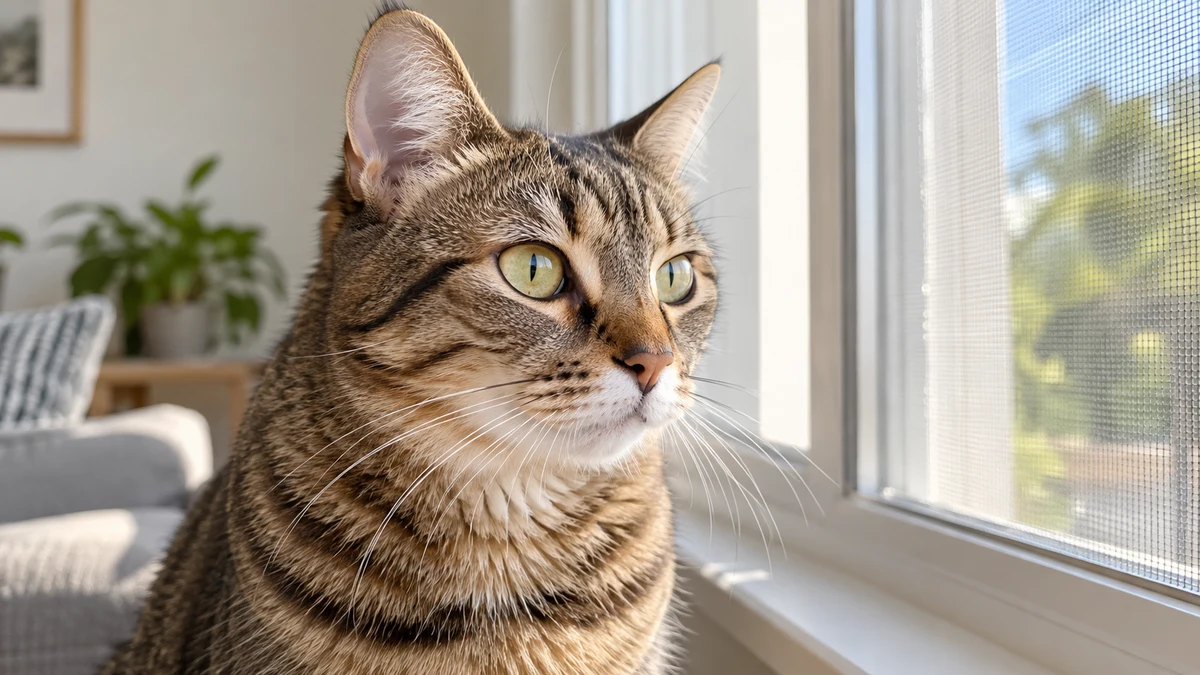
This evidence also explains why familiar human labels can mislead. It is reasonable to say that cats can use short- and longer-wavelength differences and that red–green distinctions are unlike typical human trichromatic vision. It is not reasonable to promise that every blue toy looks bright blue, every yellow toy looks yellow, or every red toy disappears. Materials reflect mixtures of wavelengths; illumination changes those mixtures; brightness and texture add cues; and individual behavior includes attention, learning, smell, sound, and prior experience.
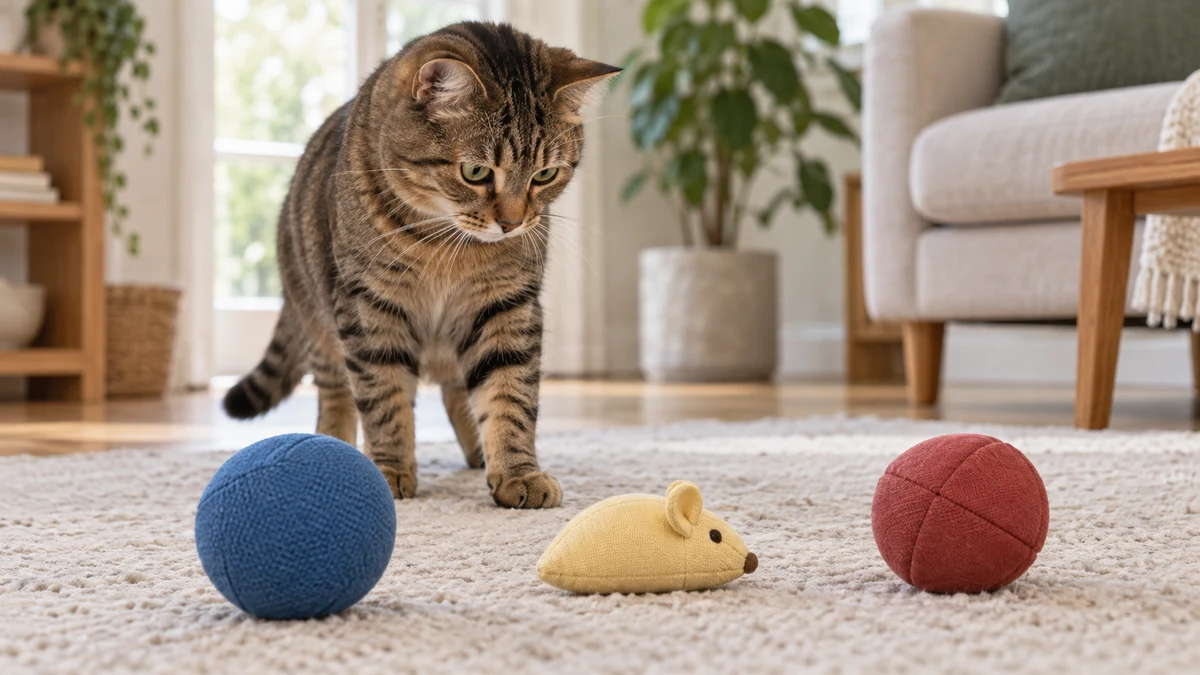
For toys and markers, start with visible contrast and safe size, then test the cat rather than the color chart. A blue fabric lure against a beige floor may stand out well; the same lure on a dark blue rug may not. A muted red ball can still be found through brightness, motion, scent, sound, or texture. Offer two otherwise similar safe objects separately, vary only one feature, and observe repeated choices without claiming a color preference from one reach.
Why dim light is easier—but zero light is impossible
Three features work together as light falls:
- The pupil opens. A wide aperture admits more light. The domestic cat’s vertical pupil can change area dramatically; the 2015 cross-species analysis reported about a 135-fold range between constricted and dilated states.
- Rod pathways dominate. Rods are more sensitive at low illumination than cones, trading color and fine detail for the ability to detect faint contrast.
- The tapetum lucidum returns missed light. This reflective layer behind the retina sends some light back through photoreceptors for another opportunity to be absorbed. It also produces familiar eyeshine when an external light enters at the right angle.
None creates light. In a sealed room with no photons, an open pupil has nothing to collect, rods receive no visual signal, and the tapetum has nothing to reflect. “Night vision” means better use of scarce light, not vision through absolute darkness.
The tapetum is not a tiny lamp, and eyeshine is not proof that a cat sees perfectly. The 1980 microscopy study described a layered choroidal structure containing organized reflective rods; its function was framed as giving light a second chance at absorption. That improves sensitivity, but an optical second pass can never restore every lost detail or color. Low-light performance still falls as illumination, contrast, or eye health changes.
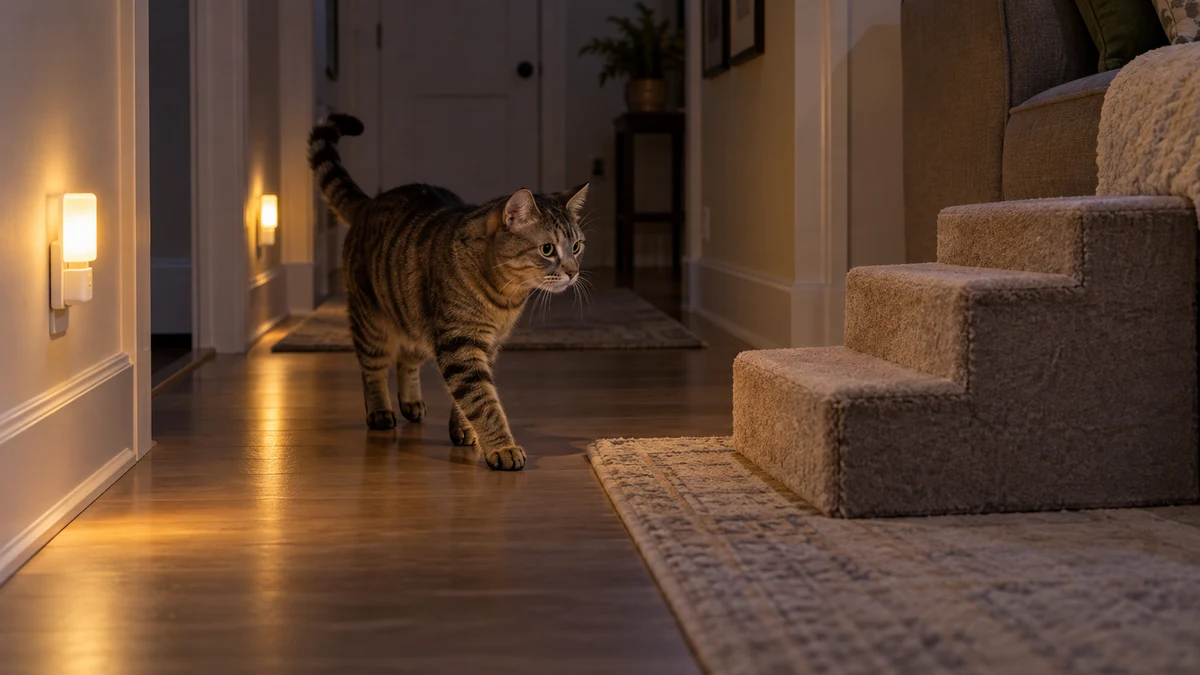
Use light strategically. A shielded low nightlight near a hallway turn, litter route, or stable pet step can reveal edges without flooding the whole room. Avoid pointing a flashlight, phone light, or laser into the eyes. Give the pupils time to adapt when moving from a bright room to a dim one, and do not test vision by suddenly switching the lights off.
Movement can help, but “motion vision” is not one superpower
Cats often engage quickly with a lure that starts, pauses, hides, and moves away. Laboratory findings support a more precise version of that observation. In a 1977 behavioral study, low-spatial-frequency gratings—broad bands rather than fine stripes—became easier for cats to detect when temporally modulated. At high spatial frequencies, modulation instead reduced visibility. Motion and detail therefore interact: movement does not enhance every target under every condition.
That nuance matters in play. Use a lure large enough to see and too large to swallow, keep it low over a clear surface, move it away in short prey-like bursts, pause, and allow catches. Do not whip it unpredictably toward the face or demand repeated high jumps. End with the physical toy, inspect it, and store a wand out of reach. Our guide to playing with a cat covers a complete stalk–chase–catch routine.
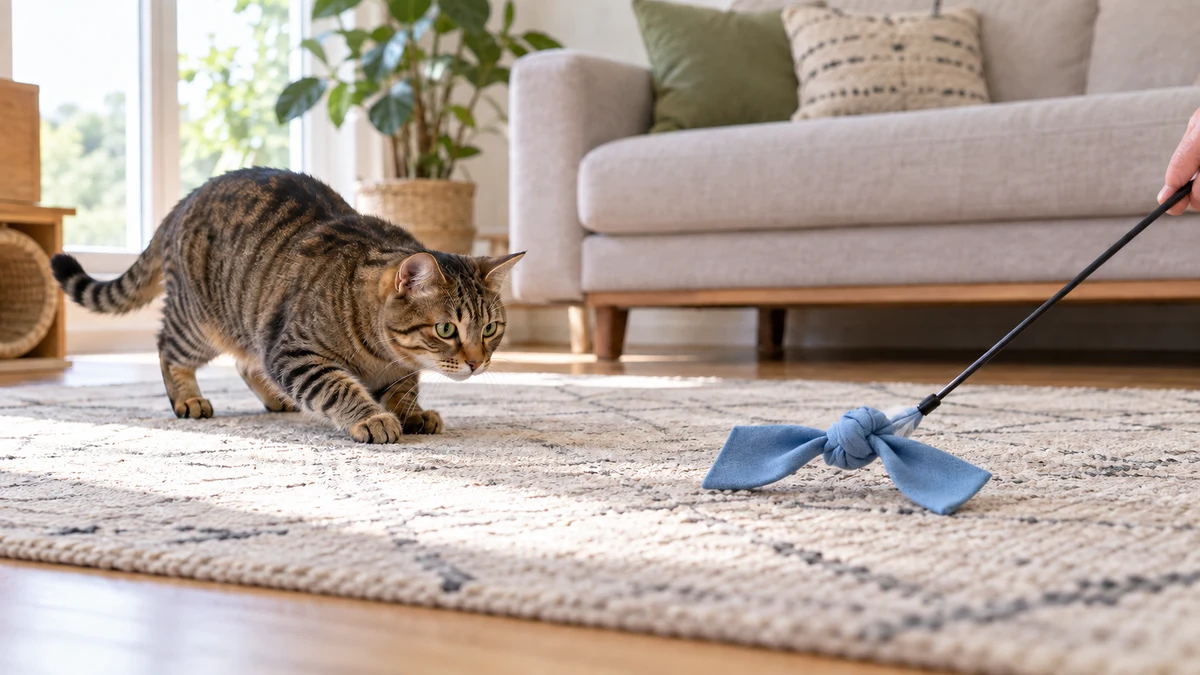
A stationary object may still be visible, and a moving object may still be missed. Check the full scene: is the toy similar in brightness to the floor, too small, behind glare, extremely close to the face, moving too fast, or outside the cat’s attention? Change one variable at a time. Failure to chase is not a home vision diagnosis; the cat may be finished, uncomfortable, afraid, distracted, or simply uninterested.
Fine detail, near targets, and distance judgment are different questions
“Nearsighted” and “farsighted” compress several abilities into one label. Spatial resolution asks how finely separated a pattern can be. Accommodation asks how the optics focus. Depth perception asks how distances and relative positions are inferred. Target detection also depends on contrast, movement, field location, and illumination.
A 1991 behavioral study tested only two normal adult cats but used both detection and orientation-discrimination tasks. Thresholds fell between 8.5 and 9 cycles per degree in both tasks. That supports limited fine-pattern resolution without justifying a universal Snellen conversion such as “every cat sees 20/X.” Test design, brightness, contrast, age, eye health, and what the cat has learned to do all matter.
Normal cats do have binocular depth information. In a 1979 behavioral method, normal kittens distinguished much smaller separations in depth with two eyes than with one, providing evidence for stereopsis. The 2015 pupil-shape paper then modeled why vertical pupils may suit low ambush predators: binocular disparity can help with some contours, while defocus blur may contribute another distance cue. This is a functional hypothesis and optical model, not proof that a pet computes every jump from pupil shape alone.
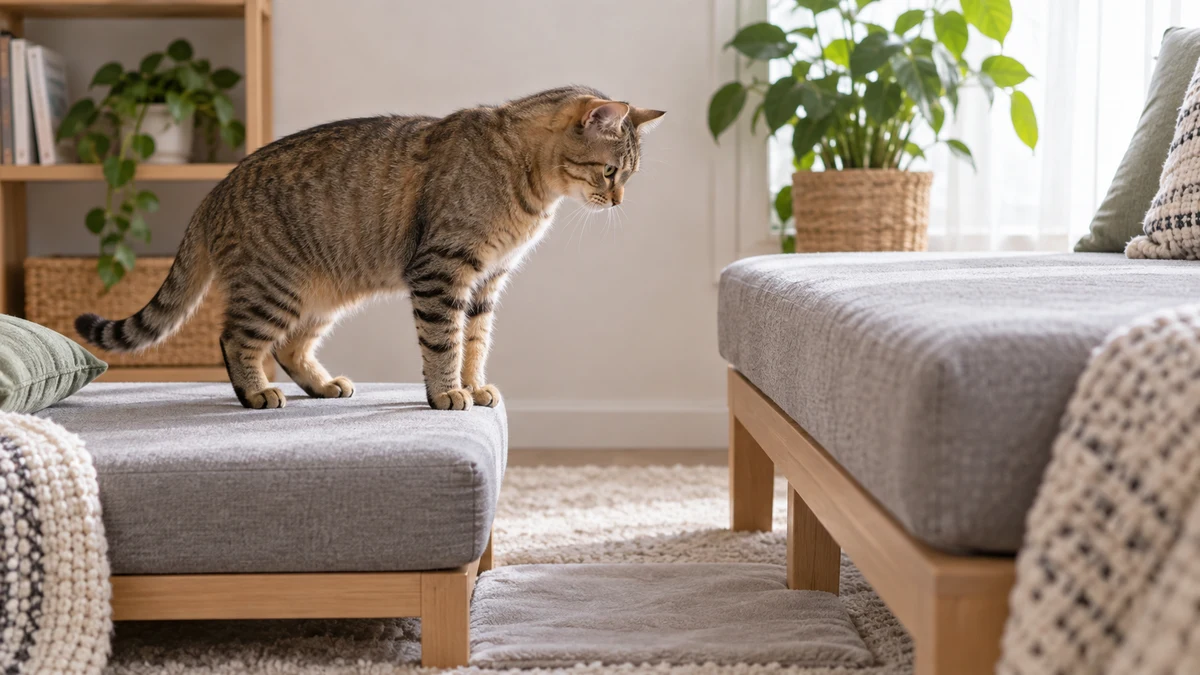
Before a jump, a cat may look from more than one position, lower the head, lean, or pause. Do not turn that normal information gathering into a test. Keep elevated destinations broad and stable, add nonslip intermediate steps, and provide an easy route down. If a cat repeatedly misjudges familiar gaps, stops using one side, circles, freezes, or changes jumping suddenly, arrange veterinary assessment instead of practicing harder jumps.
Eight ways to make a home easier to navigate
- Light the route, not the eyes. Use low, shielded light at stairs, hallway turns, litter routes, and changed rooms. Avoid glare and direct beams.
- Protect every fall edge. Secure windows and balconies, block unsafe rail gaps, stabilize tall furniture, and follow the broader cat-proofing checklist.
- Add stable intermediate levels. Broad nonslip steps or a ramp can reduce the size of a jump. Never improvise a wobbling stack of boxes.
- Use contrast plus texture. Where two surfaces blend together, a securely fixed contrasting mat or edge can provide visual and tactile information. Do not rely on red versus green alone.
- Choose toys by more than color. Combine safe size, contrast, texture, predictable motion, and pauses. Let repeated behavior—not marketing—show what works.
- Change one landmark at a time. Preserve familiar beds, scratching posts, food, water, litter, and open routes while moving one chair or table.
- Keep resources reachable. A cat with suspected impairment should not have to cross a high gap or dark staircase to eat, drink, rest, or eliminate.
- Use a baseline, not a challenge course. Record ordinary navigation in bright and dim conditions. Do not wave a hand at the face, drop objects, rearrange obstacles, or shine lights to “prove” vision.
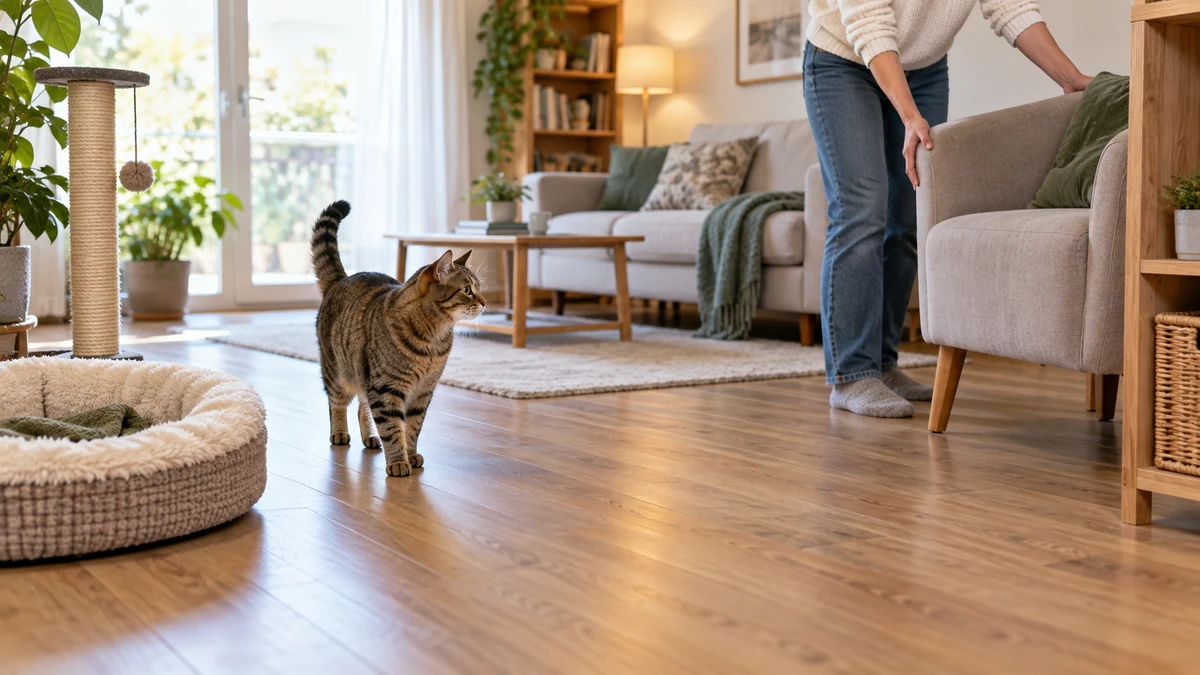
Make changes reversible and observe whether the cat moves with the usual confidence. Seniors may also have mobility, pain, hearing, or cognitive changes that alter navigation; the senior-cat care guide helps separate useful observations without assigning a diagnosis.
Eye or vision changes that need prompt veterinary care
Cornell emphasizes that early assessment can matter because some causes of vision loss may be treatable before damage becomes irreversible. Contact a veterinarian promptly for any sudden eye or navigation change, especially one or more of these 10 warning signs:
- bumping into familiar furniture, freezing in a known room, or suddenly failing to find food, water, or the litter box;
- tripping on stairs, misjudging familiar jumps, or refusing routes the cat used normally;
- pupils that are suddenly unequal, unusually wide in bright light, oddly shaped, or no longer matching each other;
- cloudiness, a new color change inside the eye, visible blood, or an eye that looks enlarged;
- redness, obvious inflammation, swelling, or a protruding third eyelid;
- squinting, holding one eye closed, light avoidance, or another sign of eye pain;
- new tearing, thick discharge, crusting, or a major change in eye surface appearance;
- sudden confusion, fear, withdrawal, or startling in a cat that previously navigated confidently;
- suspected sudden loss of sight in one or both eyes, even if the eye surface looks normal;
- any eye change after a fall, blow, scratch, chemical exposure, or other trauma.
Do not wait for several signs to appear. A painful red or closed eye deserves prompt attention even if the cat still walks normally; suspected abrupt blindness or serious trauma warrants urgent or emergency veterinary guidance. Do not put human eye drops, leftover medication, oils, or home mixtures into the eye, and do not press on the eyelids or test the pupil with a bright beam.
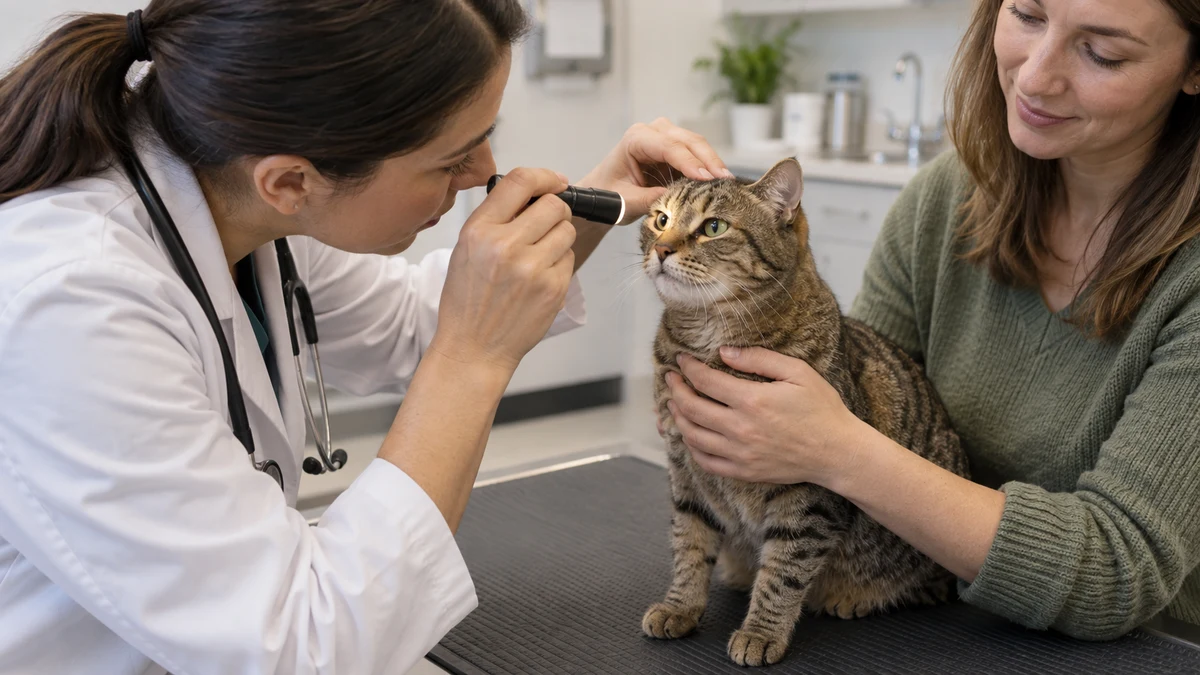
For the clinic, note when the change began, whether one or both eyes seem affected, the lighting in which it is most obvious, any collision or fall, appetite and behavior changes, and current medications. A short video of natural navigation can help if it does not delay care or create hazards. Only an examination can separate an eye problem from neurologic, blood-pressure, injury, or other causes.
Frequently asked questions
What colors do cats see best?
Evidence supports at least two cone pathways and color discrimination, with short-wavelength and medium-to-long-wavelength inputs. That makes cats dichromat-like rather than grayscale viewers, but it does not let us translate every household object into an exact named feline color. Use contrast, size, motion, and individual testing alongside color.
Can cats see when a room is completely dark?
No. Dilated pupils, sensitive rod pathways, and the tapetum lucidum help when light is scarce. They cannot form a visual image when no light reaches the eye. Gentle route lighting can help at stairs, obstacles, and unfamiliar spaces.
Are blue and yellow toys always better than red toys?
No color guarantees engagement or visibility. A blue toy may contrast well with one floor and disappear against another. Brightness, pattern, safe size, motion, sound, texture, and learning all contribute. Compare safe toys in the same setting over several sessions rather than judging one reach.
Why does my cat miss a treat directly under the nose?
Very close targets present a different visual problem from distant moving targets, and the nose or head position can block part of the view. Smell, attention, lighting, contrast, and interest also affect the response. Place the treat a short distance ahead on a contrasting surface; repeated new misses or navigation changes need veterinary advice, not repeated home tests.
Does eyeshine mean my cat’s eyes are healthy?
No. Eyeshine is reflected light from the tapetum under particular angles. Its presence does not measure acuity or rule out disease, and a photo can make the two eyes look different because of angle. Persistent asymmetry, cloudiness, redness, pain, pupil change, or altered navigation should be assessed by a veterinarian.