How to Brush a Cat’s Teeth: A Consent-Based Step-by-Step Guide
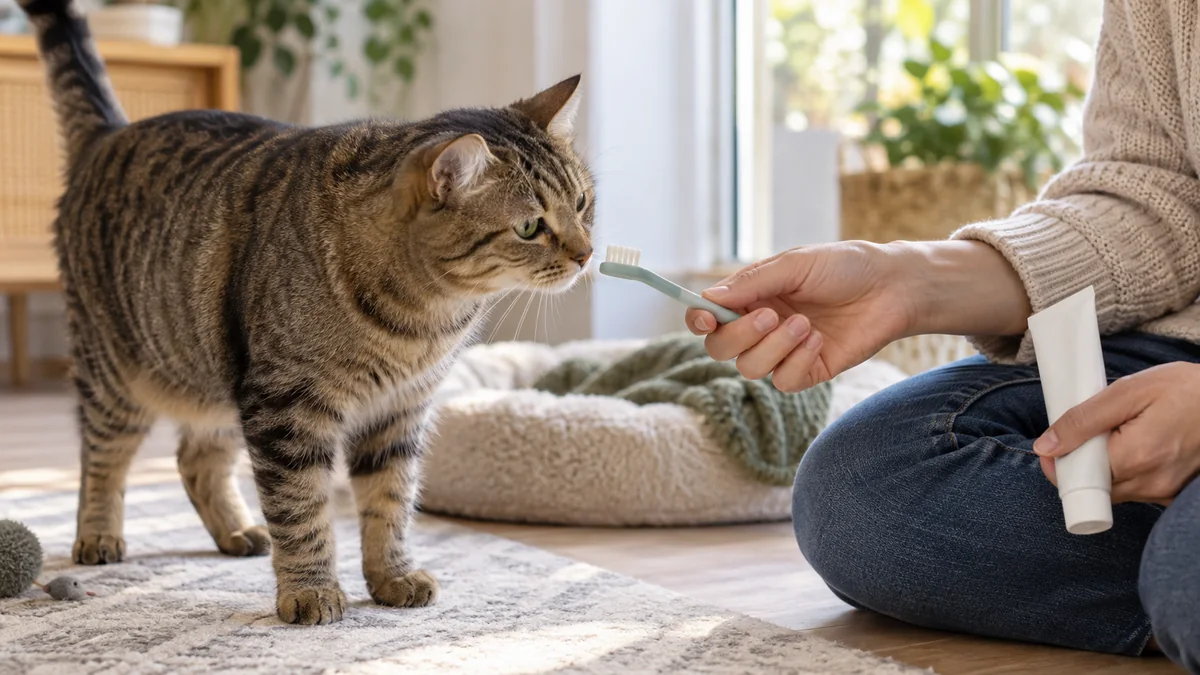
To brush a cat’s teeth, first ask a veterinarian whether the mouth is comfortable enough for home care. Then teach one tiny, voluntary step at a time: calm face approach, cheek touch, brief lip lift, cat toothpaste and brush introduction, one touch to an outer tooth, and only then a few gentle strokes. Reward each easy repetition. Let the cat move away. Stop for pain, fear, or defensive signals; never pry the mouth open or hold the cat down to finish.
Brushing starts with a comfortable mouth
Toothbrushing removes soft plaque from reachable tooth surfaces; it does not diagnose oral disease, remove hardened calculus, repair a damaged tooth, or replace a veterinary oral examination. AAHA describes regular examinations and home care as complementary parts of prevention. Cornell specifically advises consulting a veterinarian before brushing a cat with severe gingivitis because brushing inflamed tissue can hurt.
Pause a new brushing plan and contact a veterinary clinic if you notice any of these changes:
- persistent or newly strong bad breath;
- red, swollen, receding, or bleeding gums;
- drooling, blood-tinged saliva, or repeated swallowing;
- a broken, loose, missing, or discolored tooth;
- facial or jaw swelling, an oral sore, or visible material caught near a tooth;
- pawing at the mouth, jaw chattering, head shaking, or sudden resistance to face touch;
- dropping food, chewing on one side, taking much longer to eat, or switching food texture;
- reduced appetite, weight loss, hiding, irritability, or another change from the cat’s baseline.
These observations do not identify a cause. A cat may also keep eating despite dental pain. The published guide to bad breath and oral warning signs explains what to record and when to seek prompt care. Difficulty breathing or swallowing, uncontrolled bleeding, major trauma, collapse, or inability to handle saliva needs urgent veterinary help rather than a brushing attempt.

Prepare a choice-based session
Choose a familiar, quiet place with nonslip footing and an open retreat route. Work when the cat is awake, relaxed, and not immediately after exciting play or a stressful event. Sit beside rather than over the cat. Put the supplies within reach so you do not have to chase the cat or suddenly rummage behind its head.
Ask the veterinary team to recommend a soft brush and an oral product labeled for cats and appropriate for this individual. A small pet toothbrush may work better than a bulky tool, but the right size depends on the mouth and the handler’s control. Keep the brush dry or use the cat product exactly as its label and the veterinarian direct. Never assume a dog product, human product, homemade paste, or essential-oil mixture is safe for a cat.
Prepare a reward the cat already values. It might be a tiny portion of the normal food allowance, a brief toy interaction, access to a favorite perch, or social contact the cat actively seeks. Do not delay a necessary meal or make the cat hungry to obtain cooperation. If food is used, the cat treat guide explains how extras can fit within the normal diet.
One repetition may be a complete session. Progress is measured by relaxed participation, not by days on a calendar or by forcing a preset number of strokes.
The eight-stage plan
The sequence below adapts Cornell’s gradual introduction and VCA’s brushing technique to cooperative-care principles from the Feline Veterinary Medical Association. Cooperative care means teaching the cat to participate willingly, reducing the need for restraint. Repeat a stage until it feels ordinary. If a later step becomes difficult, return to the last comfortable one.
| Stage and action | Ready to move forward | Stop or step back |
|---|---|---|
| 1. Sit nearby; move a relaxed hand toward the side of the face, then withdraw and reward | The cat stays loose, approaches, sniffs, slow-blinks, or calmly remains | The cat leans away, ducks, freezes, scans for escape, or leaves |
| 2. Touch the cheek for less than a second; release and reward | The cat keeps the head neutral or voluntarily leans back toward the hand | Skin twitches repeatedly, head turns away, body stiffens, ears rotate back, or tail lashes |
| 3. Slide a finger along the cheek and briefly lift the lip without opening the jaw | A small outer tooth surface is visible while the jaw remains closed and relaxed | The cat clamps, pulls away, paws at the hand, vocalizes, or shows possible pain |
| 4. Present cat-labeled toothpaste or gel as directed; let the cat investigate | The cat voluntarily sniffs or tastes and remains interested in the session | The cat avoids the product, drools unexpectedly, gags, or develops irritation; stop using it and call the clinic |
| 5. Show the soft brush, reward approach, then touch it to the cheek or closed lip | The cat investigates or accepts a brief stationary touch without bracing | The brush predicts hiding, swatting, biting, or repeated retreat |
| 6. Lift the lip and touch the brush to one easy outer tooth; withdraw and reward | The cat stays relaxed for a single touch on the cheek-facing surface | The gum bleeds, the cat flinches, chatters, cries, or stops taking a usual reward |
| 7. Add one or two gentle strokes along a few outer teeth | The cat returns voluntarily and accepts the same easy action over several sessions | Tension increases within the session, the head is pinned, or you must follow the cat to continue |
| 8. Gradually cover more outer surfaces, changing only one variable at a time | Short brushing remains predictable and the cat can pause or leave | Any earlier stop signal returns, or a new oral or eating change appears |
The table is a route, not a deadline. A cat may need many sessions between stages, accept one side more easily than the other, or remain comfortable with only a small section. Do not combine a longer duration, a new tooth area, a different tool, and a new room in the same attempt.
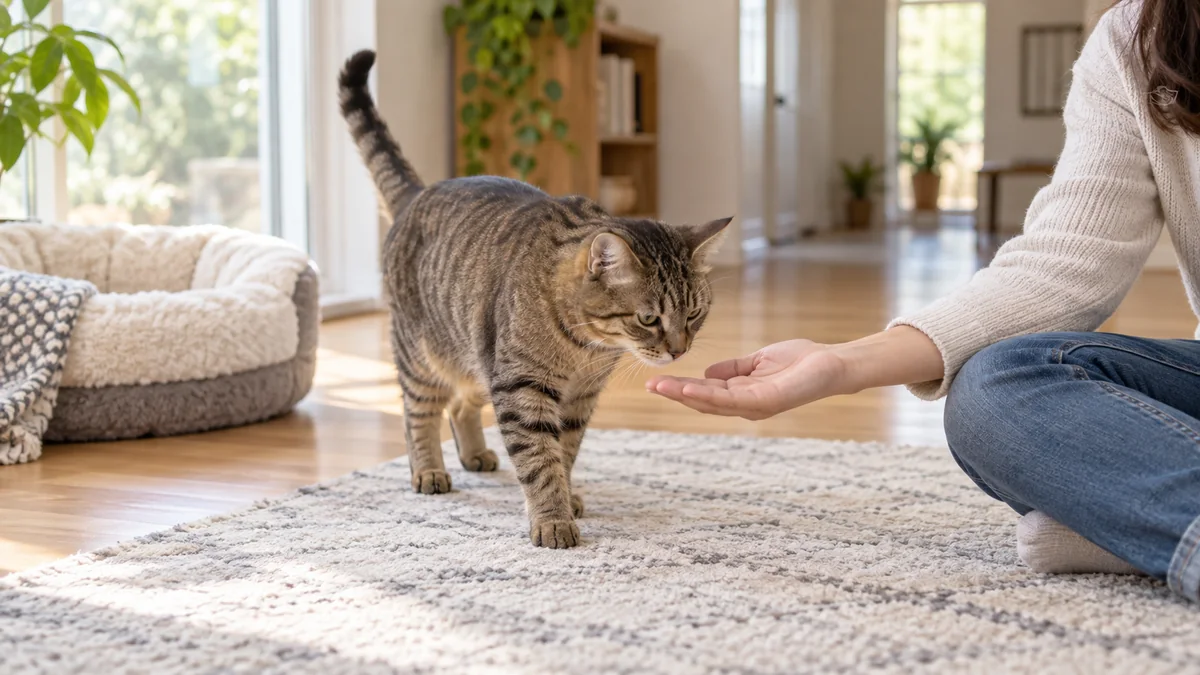
Stages 1–3: teach face contact before dental tools
Begin with a gesture the cat can predict. Move your hand into view from the side, stop before contact, withdraw, and deliver the reward. If the cat chooses to approach the hand, that is useful information, but it is not permission to jump several stages. Touch the cheek briefly and release before the cat needs to escape.
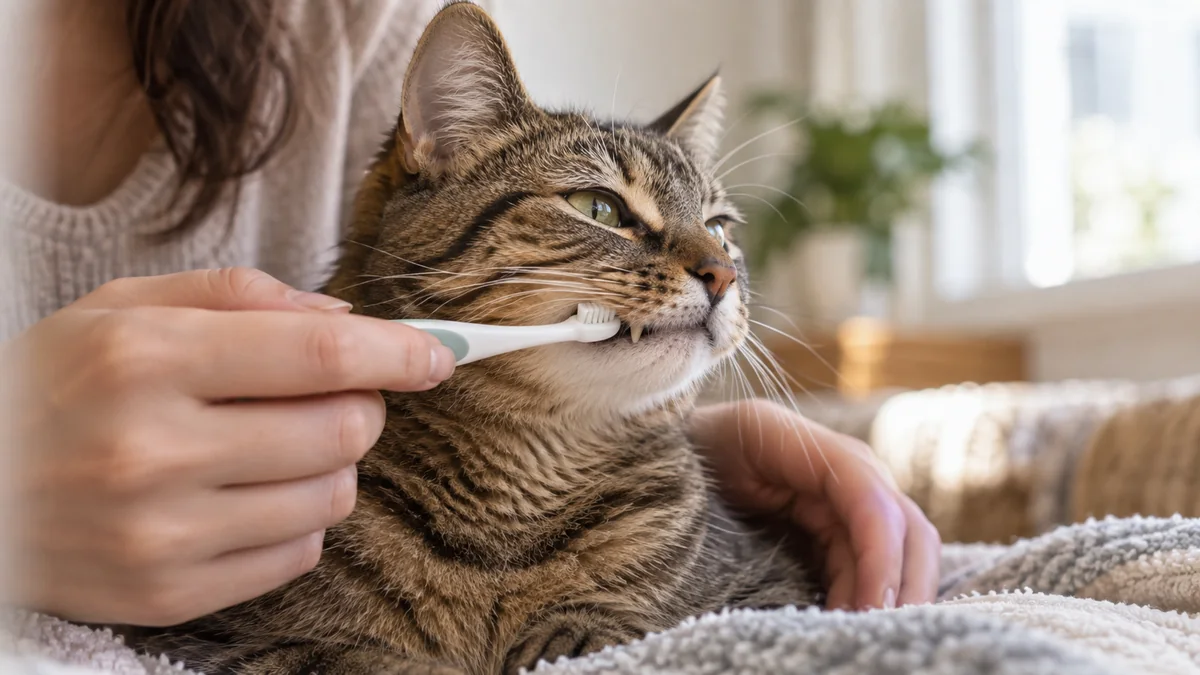
Next, move the cheek skin a few millimeters and let go. Over repetitions, work toward a brief lip lift that exposes only the outer surface of a canine or premolar. Keep the jaw closed. Cornell and VCA both describe reaching the cheek-facing surfaces by moving the lips rather than forcing the mouth wide open.
At this stage, separate handling from inspection. You are not searching the whole mouth, pressing a gum, wiggling a tooth, or deciding whether tissue is healthy. If a naturally visible area looks red, swollen, ulcerated, damaged, or painful, photograph it only if the cat remains comfortable, stop training, and call the veterinary clinic.
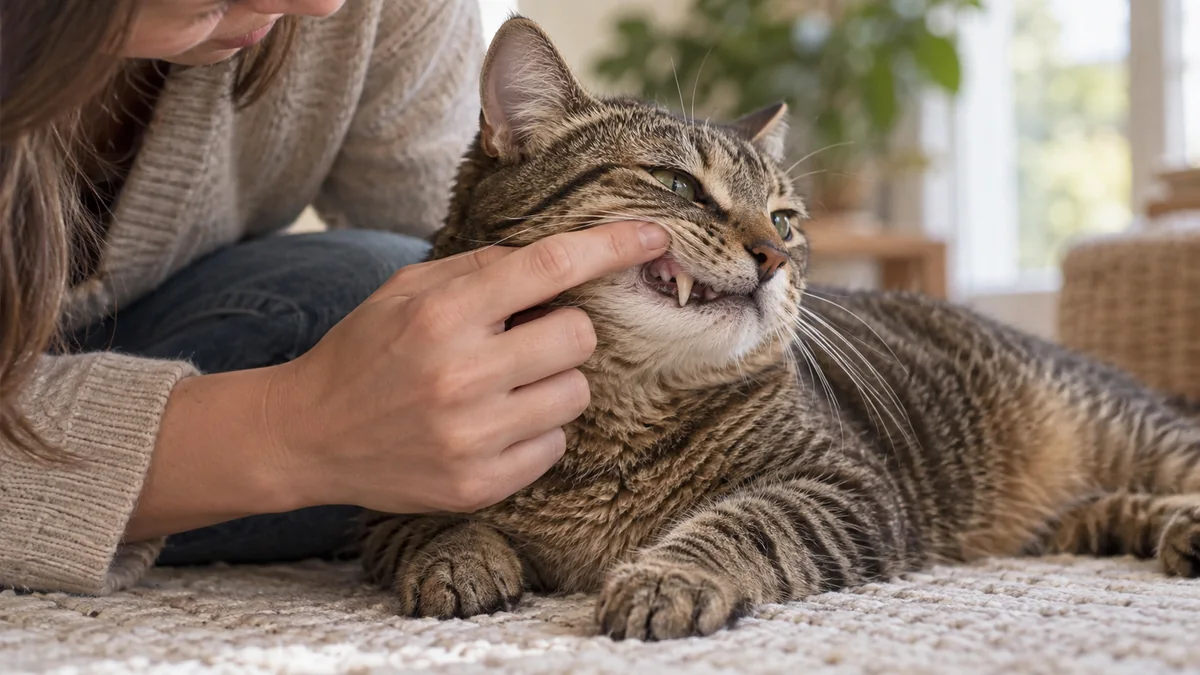
Stages 4–5: introduce the product and brush separately
Use only a product that the veterinary team approves and that is labeled for cats. Present the closed container at a distance first. Then follow its label for offering a tiny amount to investigate. Do not smear an unfamiliar product deep in the mouth. If the cat dislikes the flavor, ask about another cat-appropriate option rather than waiting for hunger to override avoidance.
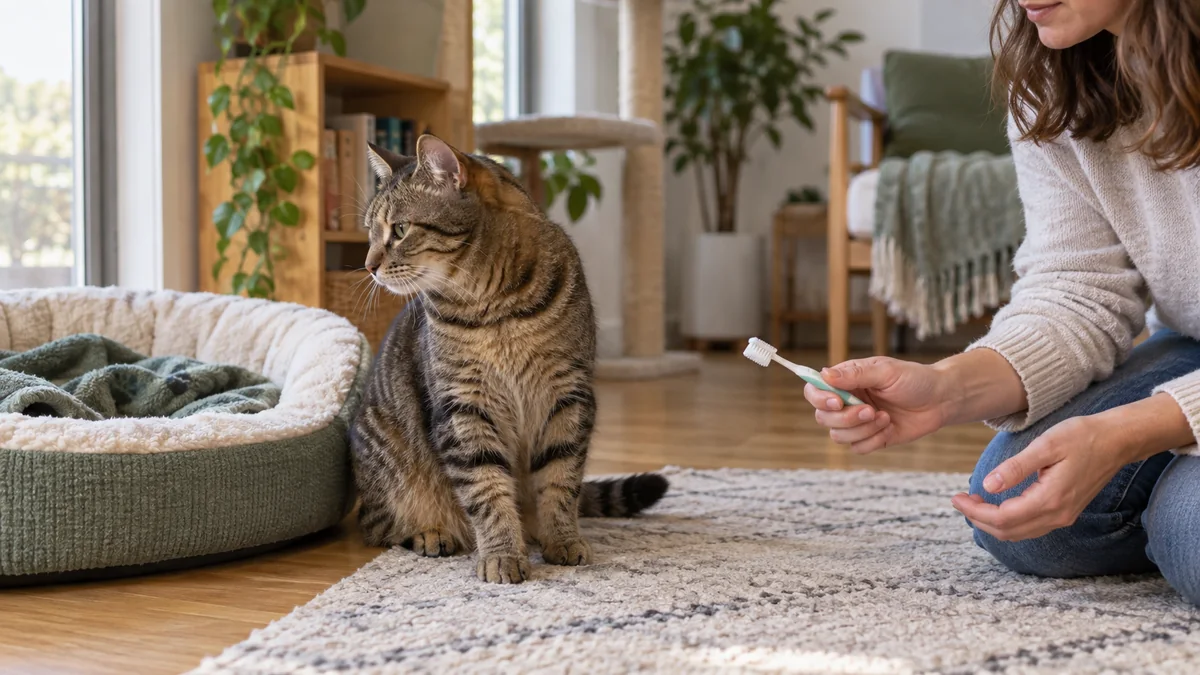
Introduce the brush as a different lesson. Place it on the floor or hold it still at a comfortable distance, reward a look or approach, and put it away. Later, touch the handle or back of the brush to the cheek. Only after those steps remain easy should the bristles approach the lip.
This separation helps identify what changed. If the cat accepts cheek handling but leaves when toothpaste appears, the product—not the hand—may be the problem. If the cat licks the toothpaste but avoids the brush, reduce the tool step. The goal is not to distract the cat so thoroughly that warning signals disappear; it is to create a predictable action the cat can stop.
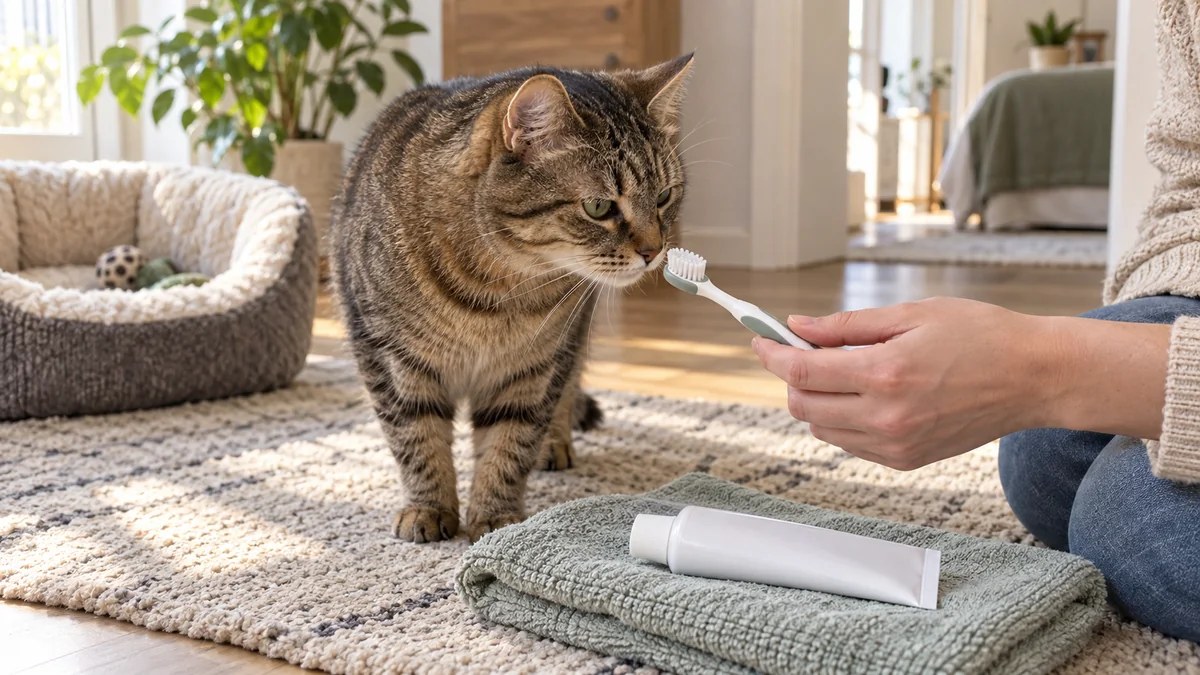
Stages 6–8: brush the outer surfaces gently
Lift the lip without prying the jaw apart. Start on one accessible, cheek-facing tooth. Place the soft bristles near the tooth–gum border and make one gentle motion, then withdraw and reward. VCA advises angling bristles toward the tooth-and-gum interface and moving slowly to avoid poking the gums. Cornell notes that the outer surfaces are the practical target; the cat’s tongue helps clean inner surfaces, so the mouth does not need to be forced open.
When one touch is uneventful, add one or two short strokes. Build coverage before duration: a few calm strokes on separate outer areas are more useful than scrubbing one spot while the cat struggles. Use only light pressure. Do not probe under the gumline, brush an obvious lesion, or try to dislodge hardened material.
Change one criterion at a time. You might add one tooth while keeping the same side, tool, position, and reward. On another session, keep the same teeth but add one stroke. The eventual schedule should be set with the veterinary team. Daily plaque removal is a common preventive goal in veterinary guidance, but missing that target never justifies restraint or brushing a painful mouth.
Read the difference between a pause and distress
A brief pause to swallow a reward, look at a sound, or reposition is not automatically a failure. Lower your hand and wait. Continue only if the body softens and the cat re-engages. A useful start signal can be the cat returning to a mat, touching your hand, or resting the chin in a practiced position; leaving that position ends the attempt.
Stop immediately when you see escalating avoidance or possible pain: repeated head turns, crouching, freezing, ears flattened or held sideways, wide pupils with scanning, rapid tail lashing, pawing, swatting, growling, hissing, biting, frantic escape, jaw chattering, or a pain flinch. The clicker-training guide explains how to mark and reinforce small voluntary steps without punishing an error.
After a stop signal, release first. Do not demand “one last tooth.” Write down the stage, side, product, and signal. At the next calm opportunity, make the task easier. Repeated avoidance at an early stage, sudden loss of previously comfortable handling, reduced appetite, or a new mouth sign belongs in a veterinary conversation rather than more determined training.
Nine unsafe shortcuts to avoid
- Do not use human toothpaste. Cats cannot rinse and spit it out; Cornell and VCA direct caregivers to cat-specific oral products.
- Do not use baking soda as homemade toothpaste. VCA warns that swallowed baking soda can disturb the digestive tract’s acid balance and its taste can increase avoidance.
- Do not add essential oils for flavor, breath, or “antibacterial” action. ASPCA Poison Control notes that cats are especially sensitive to essential oils and advises use only with veterinary approval.
- Do not scrape calculus with a scaler, metal pick, fingernail tool, or another sharp object. A moving cat, delicate gum tissue, and hidden disease make this unsafe.
- Do not pry the jaw open, wrap or pin the cat down, hold the head still, or have another person overpower the cat to finish.
- Do not chase, corner, yell, spray water, punish, or repeatedly re-present the brush after the cat leaves.
- Do not withhold meals or water to make a reward more persuasive. Refusal can be information about fear, nausea, pain, satiety, or preference.
- Do not brush red, bleeding, swollen, injured, or apparently painful tissue while waiting for an appointment.
- Do not treat awake “anesthesia-free cleaning” as a substitute for a veterinary dental procedure. The American Veterinary Dental College explains that surface scraping cannot provide the examination, full-mouth imaging, subgingival cleaning, polishing, and treatment available in comprehensive care under anesthesia.
If brushing is not currently possible
Failure to reach a full-mouth brushing routine is not a reason to use force or abandon dental care. Ask the veterinarian what the individual mouth needs now. The answer may include treating disease first, changing the brush or flavor, returning to an earlier cooperative-care step, or choosing another home-care method.
The Veterinary Oral Health Council awards seals for specific plaque-control or tartar-control claims supported by submitted trials. A seal is not a promise that every product fits every cat, and a product accepted for one claim should not be described as treating all dental disease. Use the current cat list, the label, nutritional needs, other medical conditions, and the veterinarian’s advice together. Dental diets, treats, wipes, gels, or water additives can be components of a plan; none proves that the mouth is pain-free or replaces an examination when warning signs are present.
Keep a small, useful record
Record the date, stage, number of comfortable touches or strokes, area reached, reward, and first stop signal. Note any odor, gum change, drooling, food dropping, texture preference, or appetite change separately. A record prevents “usually fine” from hiding a gradual change and gives the veterinary team specific information.

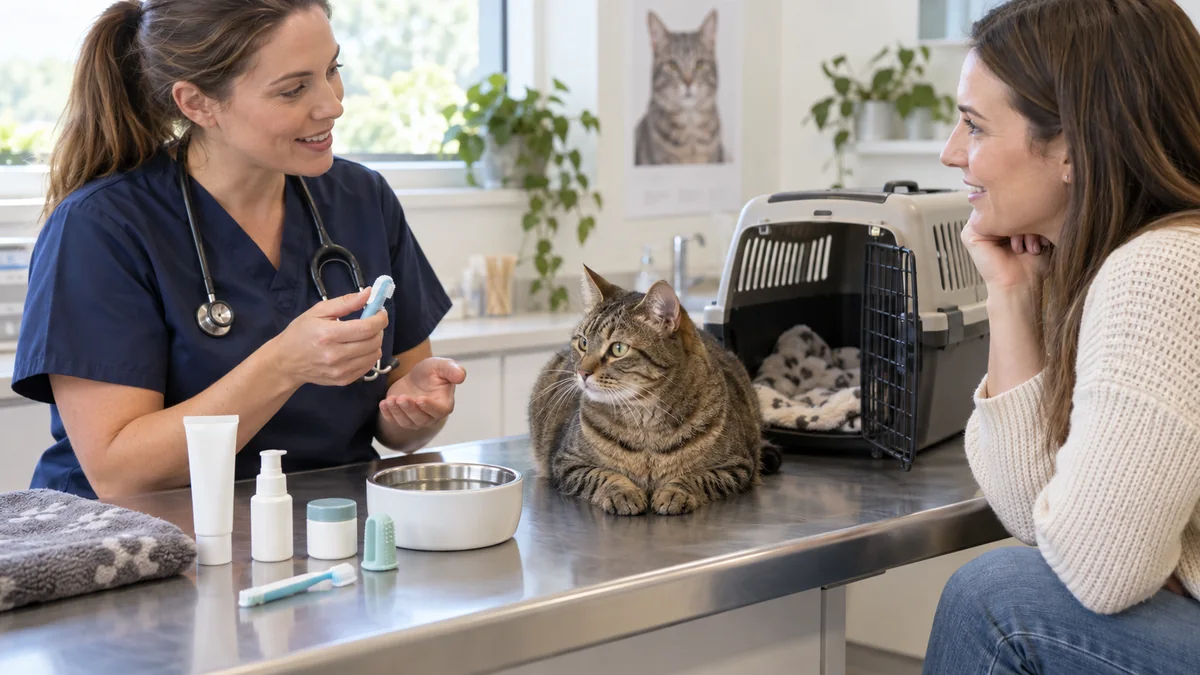
Clean and store the brush according to its instructions, keep oral products out of reach, and check expiry and label directions. Do not share a brush between animals. Revisit technique at routine veterinary visits; the team can see whether the tool, tooth surfaces, and home-care goal still fit the cat’s current mouth.
Success is not holding a cat still long enough to complete a human checklist. It is maintaining preventive care that is physically appropriate, behaviorally sustainable, and paired with veterinary assessment. A calm one-tooth session can be a real step forward. A timely decision not to brush a painful mouth is also good dental care.
FAQ
Do I have to open my cat’s mouth to brush?
Usually not for routine outer-surface brushing. Gently moving the lip can expose the cheek-facing surfaces while the jaw stays closed. Do not force the mouth open. Ask the veterinary team to demonstrate on your cat before trying a new technique.
How long should each session last?
Shorter than the cat’s comfortable participation. At first, one hand approach or one cheek touch may be the whole session. There is no universal number of seconds or days for each stage. End while the action is still easy, and advance from body-language evidence rather than a calendar.
What if the gum bleeds when the brush touches it?
Stop brushing that area and contact the veterinary clinic. Do not assume bleeding is a normal training phase, scrub harder, or apply a home remedy. Report where it occurred and any redness, odor, drooling, pain, or eating change.
Can dental treats or water additives replace brushing?
They may support an individualized plan when the veterinarian says they are appropriate, especially if brushing is not currently possible. Look for the exact VOHC plaque or tartar claim on products accepted for cats. They do not replace an oral examination, and they are not equivalent to brushing or professional treatment in every cat.
What if my cat used to accept brushing but suddenly refuses?
Treat the change as information. Stop rather than restrain, check for eating, drooling, odor, swelling, or behavior changes, and ask the veterinary clinic whether an examination is needed. Pain or illness must be considered before restarting at an easier training stage.