Is Cat Bad Breath Normal? Gum, Tooth, and Eating Warning Signs

Persistent or distinctly foul breath is not a normal feature to hide with a treat or scented product. It can accompany disease in the mouth and, less commonly, health problems elsewhere, so odor alone cannot identify the cause. Arrange a veterinary examination instead of diagnosing by smell. While you wait, watch eating, saliva, facial symmetry, comfort, and weight without prying the mouth open. Inability to eat, uncontrolled bleeding, marked swelling, trauma, or trouble breathing or swallowing needs prompt veterinary help.
What bad breath can—and cannot—tell you
A temporary food smell soon after a meal is different from an odor that persists, becomes stronger, or changes from the cat’s usual breath. Cornell’s Feline Health Center notes that a healthy cat’s breath should not be offensive and that consistent halitosis warrants a veterinary check. Plaque-related gingivitis and periodontal disease are important possibilities, but oral sores, a damaged tooth, material caught around a tooth, a mass, trauma, and some non-oral health conditions can also affect breath.
That range is exactly why smell descriptions found online are poor diagnostic tests. “Sweet,” “metallic,” “fishy,” or “urine-like” is subjective, and food, saliva, timing, and the observer all change the impression. Do not use a particular odor to decide that a cat has—or does not have—a named disease. Report when the change began, whether it is constant, and what else changed, then let a veterinarian examine the whole cat.
Breath fresheners do not remove disease below the gumline. An odor that briefly improves after a snack, additive, or wipe may still return because the underlying problem remains. The useful question is not “How can I cover this smell?” but “What pattern can I document, and how soon should this cat be assessed?”

Observe without forcing the mouth open
Start with what the cat freely shows. Watch from the side during a normal meal, after grooming, and while the cat rests. A yawn may offer a brief view, but do not hold the jaw open, pull hard on the lips, press a tooth, or insert a finger or tool. A painful cat can be frightened or bite, and touching a sensitive area can add pain. AAHA guidance also warns that dental probing on an awake patient can hurt the animal and still cannot reveal the full extent of disease.
The following signs are observations to report, not a home diagnosis:
| What you may notice without forcing the mouth | What to record | What it means for the next step |
|---|---|---|
| Persistent or newly strong bad breath | Start date, whether it is constant, relation to meals | Book a dental or medical examination even if the cat otherwise seems well |
| Red, swollen, or bleeding gum tissue seen naturally | Location, photo if the cat allows, whether bleeding stops | Contact the veterinary clinic; active or continuing bleeding is urgent |
| Yellow or brown buildup on visible tooth surfaces | Which side and whether it has changed | Visible calculus justifies an oral exam but does not show what is happening below the gumline |
| A visibly fractured, discolored, loose, or missing tooth | When first noticed; any recent fall or impact | Call promptly; do not touch, wiggle, or test the tooth |
| Drooling, stringy saliva, or blood-tinged saliva | Frequency, amount, color, and relation to eating | Report promptly, especially with pain, poor intake, or swallowing trouble |
| Pawing at the mouth, face rubbing, head shaking, or jaw chattering | Video the full movement if safe | These behaviors can accompany discomfort and need veterinary interpretation |
| Dropping food, chewing slowly, tilting the head, or chewing on one side | Food texture, meal duration, which side, and a meal video | Arrange an exam; a cat may still consume enough to look “normal” at first |
| Swallowing dry food without chewing or suddenly preferring soft food | Whether this is new and how much is actually eaten | A texture change can be an early pain clue, not proof of pickiness |
| Reduced appetite, walking away from meals, or approaching food but not eating | Amount offered and left, water intake, time of each attempt | Call the clinic promptly and use the cat-not-eating guide for broader triage |
| Weight loss or another unexplained weight change | Same scale and method over time | Share the trend; our body condition guide explains consistent tracking |
| Reduced grooming, hiding, irritability, or resistance to face touch | What is different from this cat’s baseline | Behavior change can reflect discomfort even without an obvious mouth lesion |
| One-sided facial or jaw swelling, nasal or eye discharge, or facial asymmetry | Onset, progression, and photos from matching angles | Call promptly; rapid or marked swelling can require emergency assessment |
One sign can have several explanations, and some significant dental disease produces few visible signs. Conversely, a small amount of visible staining does not tell you how painful a tooth is. Look for change from this cat’s baseline and for signs that cluster together.
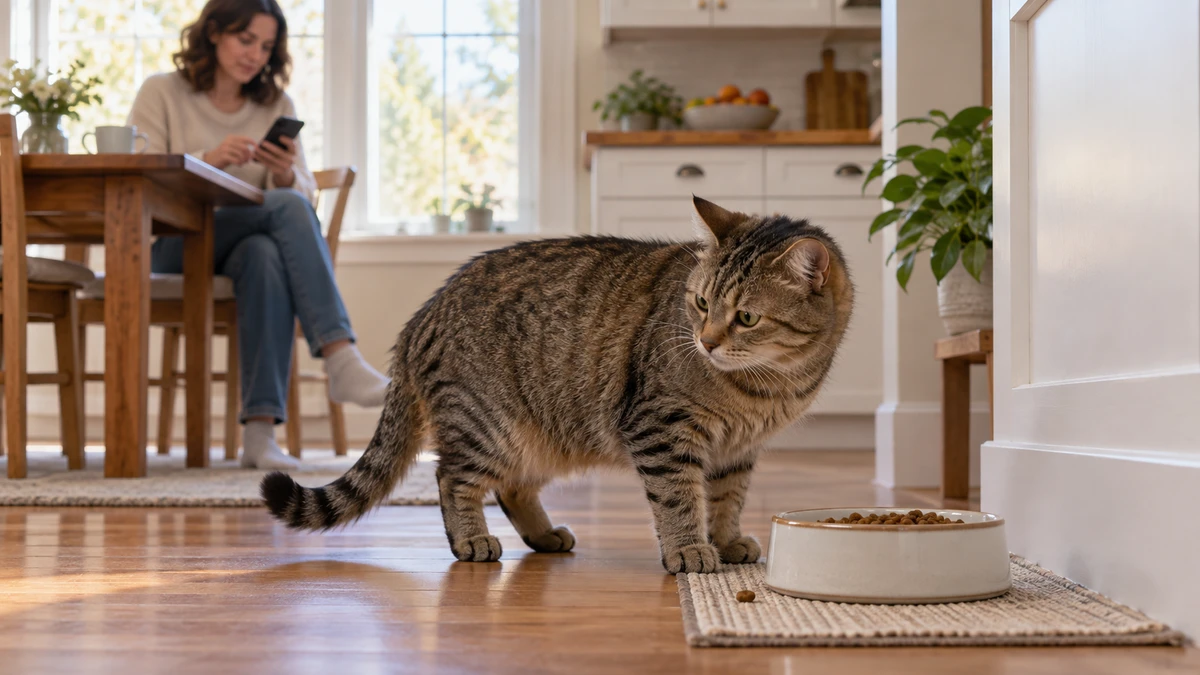
A cat can keep eating while the mouth hurts
“But she is still eating” is reassuring only in a limited sense: it does not rule out oral pain. Cornell’s tooth-resorption information describes cats whose appetite appears normal while they tilt the head, chew on one side, swallow kibble without chewing, drop pieces, or switch toward soft food. Complete refusal may not appear until disease is severe.
Look beyond whether the bowl eventually empties. A multi-cat household can hide who ate what, and a cat may adapt by eating more slowly, taking smaller bites, or choosing a texture that appears easier to manage. Separate supervised meals when practical, without isolating or pressuring the cat, so intake can be attributed accurately. Compare the amount offered with the amount left rather than relying on a quick glance at the bowl.
Film part of a typical meal from the side if doing so does not disturb the cat. Capture the head, jaw, bowl, and dropped pieces. Note whether the pattern occurs with dry food, wet food, treats, or all textures. A recording helps a clinician see the behavior that may disappear in an unfamiliar exam room; it does not prove which tooth or tissue is involved.

Decide how quickly to seek care
Persistent bad breath by itself deserves a scheduled examination rather than months of masking. Call sooner when it is paired with red or bleeding gums, a damaged or loose tooth, drooling, food dropping, one-sided chewing, a new soft-food preference, reduced intake, weight loss, or behavior change. The clinic can decide whether the history calls for an ordinary appointment, a same-day visit, or emergency care.
Seek urgent or emergency veterinary help when any of these occurs:
- breathing is labored, noisy, unusually rapid, or open-mouthed; the gums look blue, gray, white, or markedly pale; or the cat collapses;
- swallowing is difficult, the cat repeatedly gags or cannot handle saliva, or an object may be lodged in the mouth or throat;
- the cat cannot eat or drink, repeatedly tries and backs away, or becomes weak—do not wait for severe weight loss;
- bleeding is heavy, continues, or restarts, including after a fall, collision, bite, or other trauma;
- swelling of the face, muzzle, jaw, or area below an eye is marked, sudden, spreading, or paired with breathing or swallowing difficulty;
- a tooth is broken after trauma, the jaw looks displaced, there is an electrical-cord burn, or another mouth injury is suspected;
- pain or distress is severe, the cat cannot settle, or the overall condition is worsening quickly.
Cornell’s emergency service lists difficulty breathing, excessive bleeding, trauma, facial swelling, collapse, and pain among emergent conditions. Local services and travel times differ, so call the nearest veterinary clinic or emergency hospital while preparing transport. Do not spend time trying to photograph inside the mouth when breathing, bleeding, or safe transport needs attention.
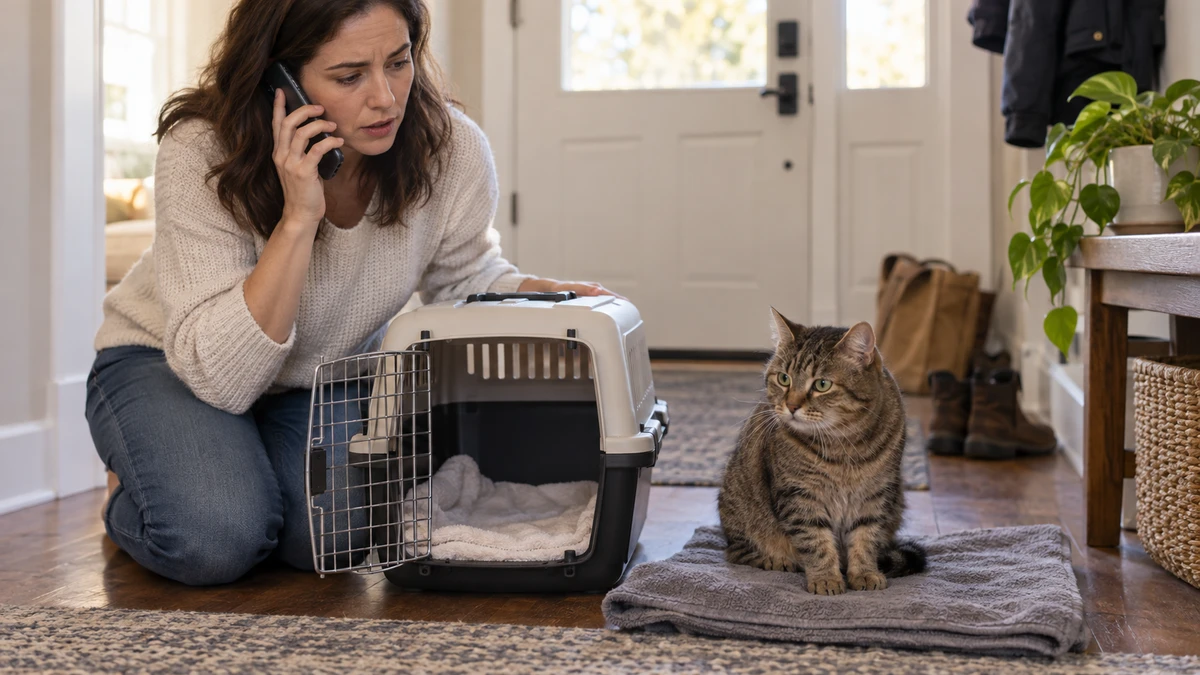
Build a record the veterinary team can use
A short, factual timeline is more useful than a guess about the diagnosis. Write down the date you first noticed the odor, whether it is constant, what food textures are offered, how much is eaten, meal duration, water intake, drooling, grooming, activity, and body weight. Add any fall, chewing incident, product exposure, recent procedure, or change in food. List all medicines and supplements the cat already receives without stopping or restarting a prescribed treatment on your own.
Take matching left, right, and front facial photos in the same lighting to show swelling over time. Photograph only what is visible while the cat is relaxed. If a loose object or string appears in the mouth, do not pull it. If the cat resists, stop. Your safety and the cat’s comfort matter more than a close-up.
When booking, describe observations plainly: “She has dropped dry food at three meals and chews on the right side” is more useful than “She definitely has an abscess.” Ask the clinic what urgency they recommend and whether the cat should eat before the visit; instructions can differ depending on the planned examination or procedure. For a cat who fears the carrier, the published carrier-training guide can help with future routine visits, but do not delay urgent transport for training.
What a veterinary examination may clarify
The veterinarian will consider the breath change together with eating, weight, medical history, and a physical examination. A calm, conscious look is an important first step, but AAHA’s dental guidelines explain that it can underestimate oral disease. Painful pockets, tooth mobility, resorption, root problems, and changes below the gumline may not be visible from the outside.
Depending on the findings and the individual cat, the veterinary team may discuss a more complete oral assessment, dental radiographs, cleaning, or treatment under general anesthesia with airway protection and monitoring. This is not a procedure a caregiver can reproduce at home. The clinician should assess anesthetic needs and risks for the individual rather than treating age or one diagnosis as the whole decision.
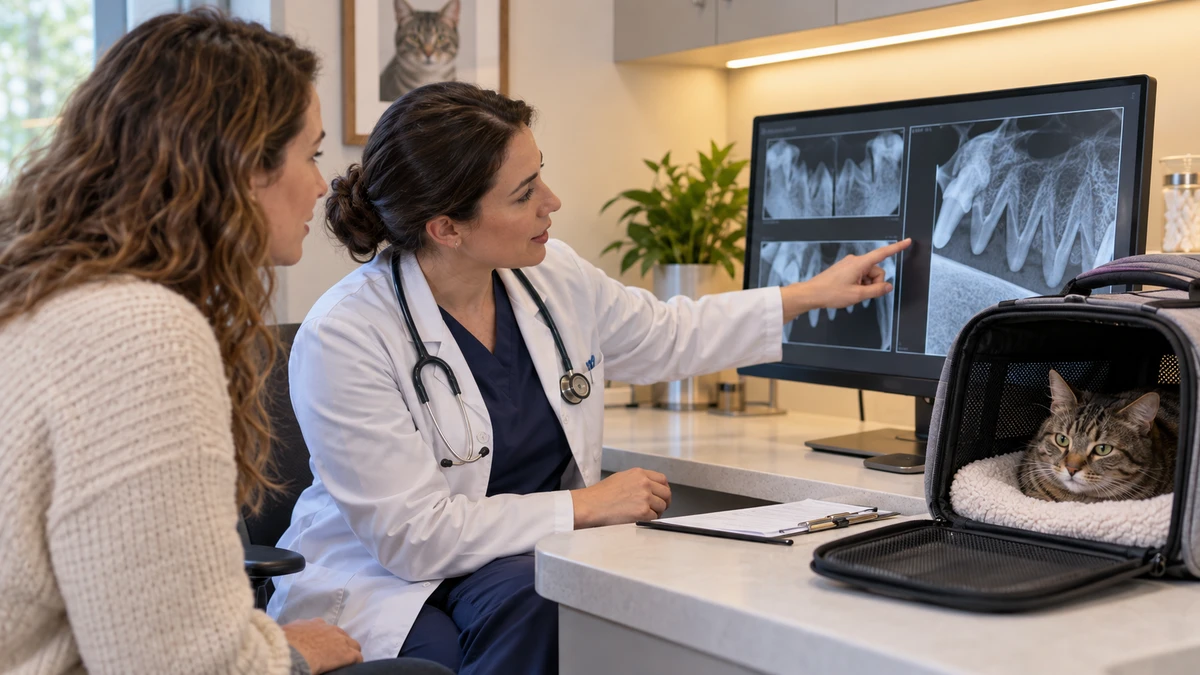
An “anesthesia-free cleaning” is not an equivalent shortcut. AAHA states that it cannot provide comparable cleaning above and below the gumline and does not allow the complete assessment possible in an anesthetized patient. Removing visible tartar from an awake cat may make the surface look different while leaving painful or destructive disease undetected. It also puts a sharp instrument near a moving, potentially painful mouth.

Start home care only when the mouth is comfortable
Toothbrushing is preventive care, not a way to treat a painful mouth or scrape off hardened calculus. Cornell advises consulting a veterinarian before brushing a cat with severe gingivitis because brushing can be painful. If there is bad breath plus redness, bleeding, swelling, drooling, a damaged tooth, or altered eating, pause new mouth handling and arrange the examination first.
If the veterinarian says home care is appropriate, use products made specifically for cats and introduce them in small, voluntary steps. The first sessions may be only seeing and sniffing the brush, tasting a cat toothpaste as directed, or accepting a brief cheek touch followed by a reward. Later steps can be tailored to what this cat comfortably accepts. Stop when the cat turns away, stiffens, hides, paws at the face, vocalizes, or shows another sign of stress or pain. The veterinary team can recommend a technique, frequency, and product type based on the cat’s mouth and tolerance.
No dental treat, food, water additive, wipe, or brush substitutes for an examination when warning signs are present. A product can support a prevention plan only if the cat can use it safely and it fits the clinician’s plan. It cannot prove that disease under the gumline is absent.
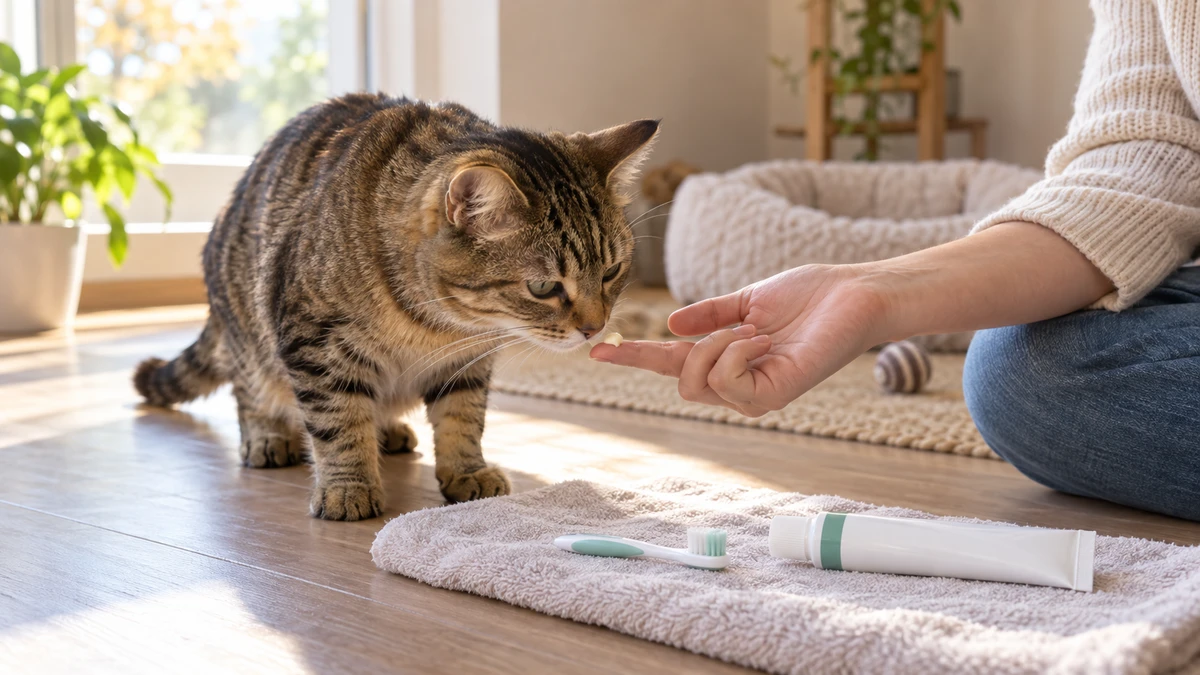
Do not try these breath or dental “fixes”
- Do not use human toothpaste. Cornell specifies feline toothpaste or gel because human products can be unsafe for cats. Do not assume a “natural” human formula is acceptable.
- Do not put essential oils in the mouth, on the gums, on the fur, in food, or in water. ASPCA toxicology guidance notes that cats are especially sensitive to essential oils and that significant exposure can cause serious effects. A strong scent also masks information rather than treating a cause.
- Do not scrape tartar with a metal pick, fingernail, or other sharp tool. You cannot safely clean below the gumline or evaluate roots at home, and a sudden movement can injure the cat or caregiver.
- Do not pry the jaw open or force a finger, camera, brush, or rinse into the mouth. Stop at resistance. Pain can make even a usually gentle cat defend itself.
- Do not give a human pain reliever. The FDA warns that human NSAIDs may harm pets and that acetaminophen is fatal to cats. Do not use another animal’s medicine or leftover prescriptions either; call a veterinarian.
- Do not treat anesthesia-free scaling as a complete alternative to veterinary dentistry. It cannot provide the examination, radiographs, protected airway, and treatment below the gumline needed for comprehensive care.
- Do not assume appetite, a fresher smell, or cleaner-looking crowns prove the problem is gone. Recheck the original signs and follow the veterinary plan.
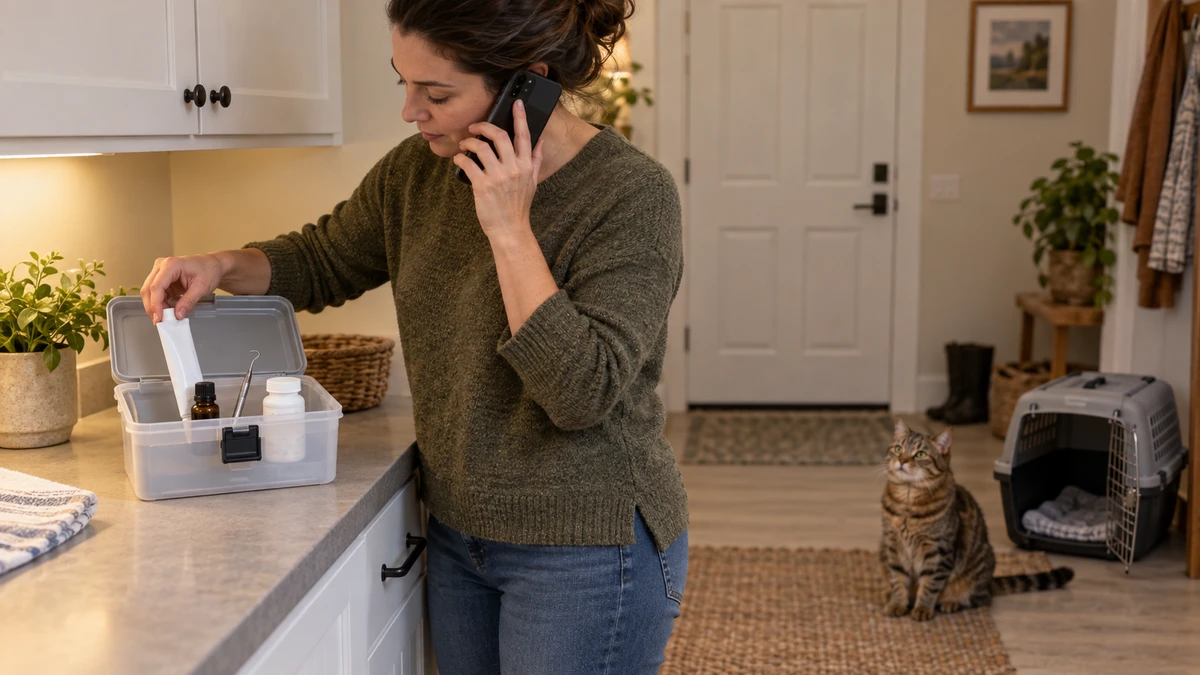
The goal is not to identify a disease from across the room. It is to notice meaningful change without causing more pain, recognize emergencies, preserve useful evidence, and obtain an examination. Persistent bad breath belongs on the veterinary history; eating changes, facial swelling, bleeding, or pain change the urgency. Once the mouth is assessed and comfortable, a gradual cat-specific prevention plan can begin.
Frequently asked questions
Is a little bad breath after eating normal?
A brief food odor can occur after a meal, but persistent, distinctly foul, or newly changed breath should be checked. Odor cannot show whether the source is plaque, a damaged tooth, inflamed tissue, something caught in the mouth, or a non-oral problem. Record the timing and arrange an examination rather than covering the smell.
Can my cat have dental pain if she still eats?
Yes. Some cats compensate by chewing on one side, swallowing kibble without chewing, dropping food, eating slowly, or choosing softer textures. Watch the method and amount, not merely whether the cat approaches the bowl.
Should I open my cat’s mouth to look for a bad tooth?
Do not force it. Observe what is visible during relaxed behavior, take facial photos from outside, and film a meal if safe. Prying, probing, or wiggling a tooth can cause pain and injury, while disease below the gumline still remains invisible.
Can I start brushing to make the smell go away?
Not when pain or active disease may be present. Redness, bleeding, swelling, drooling, damaged teeth, and eating changes call for veterinary advice before new brushing. If the veterinarian says the mouth is comfortable enough, introduce cat-specific products gradually and stop at resistance.
When is bad breath an emergency?
Odor alone usually calls for an appointment, not emergency treatment. Trouble breathing or swallowing, inability to eat or drink, uncontrolled bleeding, significant facial swelling, trauma, collapse, or rapidly worsening pain requires urgent veterinary help.