Clicker Training for Cats: From Marker to Target Stick and Mat
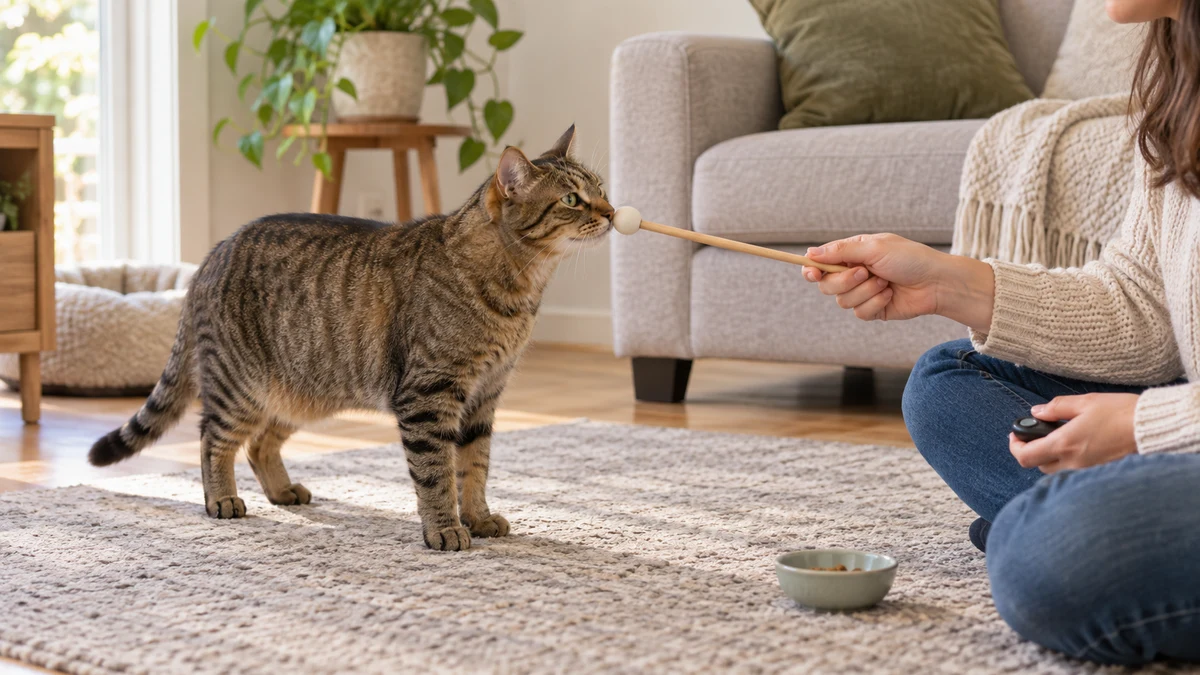
To clicker train a cat, first make the click predict a reward; then click the exact instant the cat performs one small part of the behavior and deliver the reward. The click is a marker, not a command, attention noise, or deterrent. Begin with an easy nose touch, shape one short follow, and then guide the cat to a flat mat. Keep the exit open, change only one criterion at a time, and stop while the cat still wants to participate. A click should always be paid, even if your timing was imperfect.
What the click means—and what it does not
A clicker is useful because the brief, consistent sound can mark a moment more precisely than a hand reaching for food. VCA and the Feline Veterinary Medical Association describe it as a conditioned reinforcer: a previously neutral signal gains meaning after it repeatedly predicts something the individual cat values. It bridges the short gap between the correct action and delivery of the reward.
The click does not tell the cat what to do next. That is the job of a cue, such as the word “mat,” a hand gesture, or presentation of a target stick. The sequence is:
- Cue or setup comes before the behavior.
- Cat performs the chosen action.
- Click marks the exact useful instant.
- Reward follows the click.
Do not click repeatedly to summon a distracted cat, click near an ear, or use the sound to interrupt scratching, meowing, or another unwanted behavior. That makes the marker vague or startling. If the click is too loud, Cats Protection recommends muffling it in a pocket or behind a cushion; a short word or gentle visual signal can also be conditioned as a marker.
Prepare a session the cat can leave
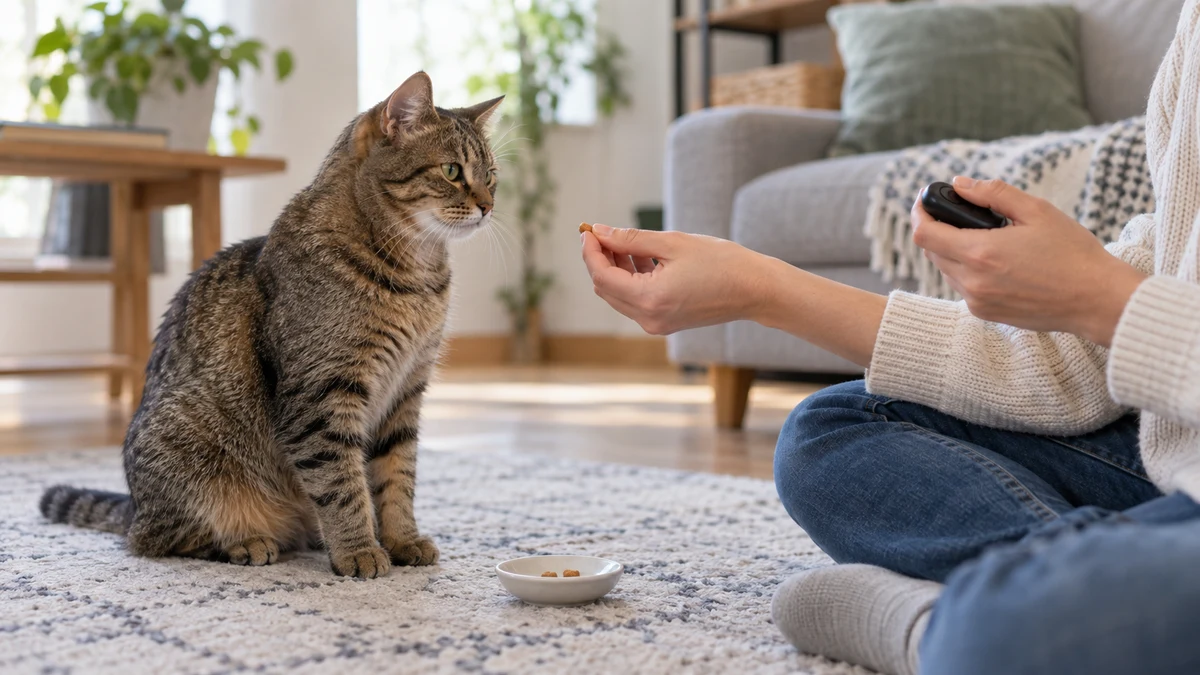
Choose a quiet familiar room, a nonslip surface, and a time when the cat is awake and comfortable. Close exterior doors for safety, but keep access to a normal hiding or resting place. Sit sideways rather than leaning over the cat. Put the clicker in one hand and several tiny, easy-to-eat rewards in the other hand or a pouch so reaching for food does not delay the marker.
A reinforcer is defined by its effect: if it does not make the behavior more likely, it is not working as a reward for that cat in that moment. Food is convenient, but some cats prefer a brief toy interaction, a chin rub they actively solicit, or access to a favorite place. Test two or three safe options and watch what the cat chooses. If using food, reserve a small part of the normal daily allowance rather than adding an unlimited stream of treats. The guide to daily cat treats explains how extras fit within a complete diet.
Never delay a necessary meal or withhold food to create motivation. A cat refusing a normally valued reward may be full, distracted, worried, nauseated, or unwell; the response is information, not permission to make the cat hungrier. Cats with appetite changes, prescribed diets, diabetes, gastrointestinal concerns, or weight-management plans need a veterinarian-approved reward strategy.
Keep the first session shorter than the cat’s attention, not longer than a timer says. Five relaxed repetitions may be enough. Put the equipment away before either participant becomes frustrated. There is no fixed number of minutes, sessions, or days that every cat should need.
Stage 1: build the marker–reward link
Begin when the cat is near you by choice but is not already performing a requested behavior.
- Press the clicker once.
- Immediately deliver one tiny reward.
- Pause long enough for the cat to finish.
- Repeat several calm click-then-reward pairings.
Do not ask for a sit, nose touch, or eye contact yet. You are teaching only one relationship: click means a reward is coming. Keep the clicker away from the face. For a sound-sensitive cat, muffle it or begin with the quiet verbal or visual marker you intend to use.
After a few pairings, pause. A cat who hears the marker and calmly looks toward the reward hand may be learning the association. That observation is a reason to test the next easy step, not proof that the marker has been permanently “charged.” If the cat startles, leaves, stops eating, or becomes vigilant, stop and change the marker or setting next time.
Stage 2: shape a voluntary nose touch
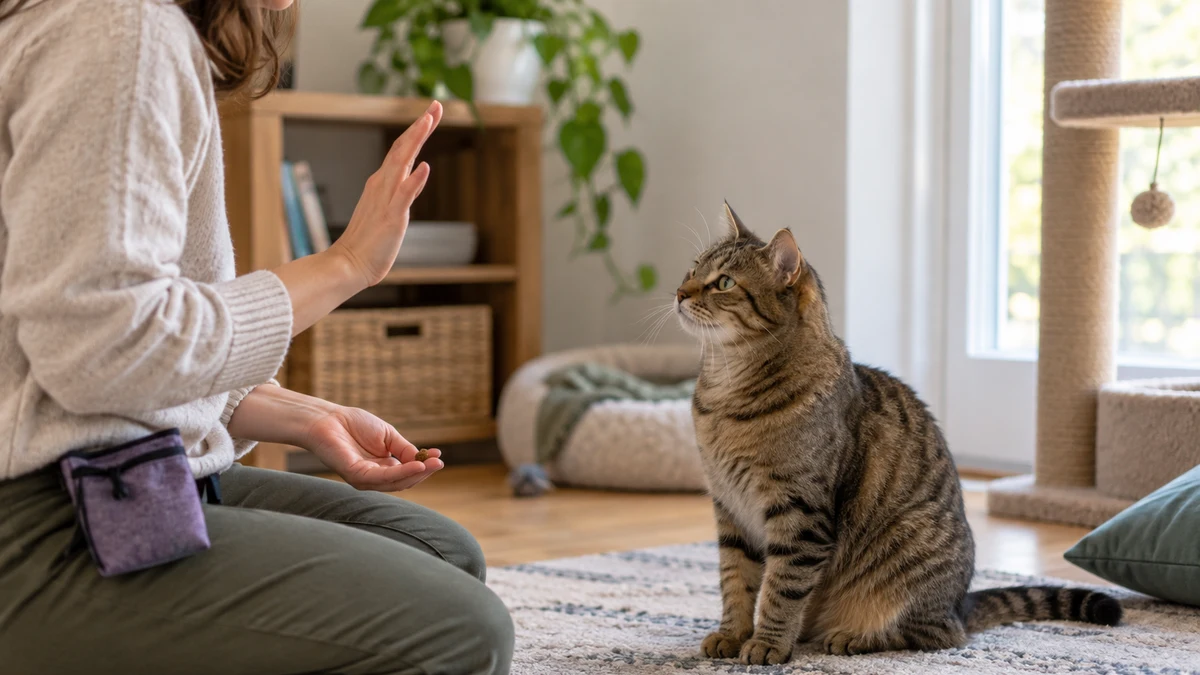
A target can be a commercial stick, a capped pen, a chopstick with a smooth rounded end, or a hand if the cat does not grab or nip. It must have no sharp edge or loose part. Hold it a short distance from the nose rather than pushing it toward the face.
Many cats will look at or sniff a new object. Mark the smallest useful approximation the cat offers:
- Click for looking toward the target.
- Then click for leaning or stepping toward it.
- Then click for bringing the nose very close.
- Finally, click the instant the nose gently touches the target.
This is shaping: reinforcing successive approximations rather than placing the body in position. Do not tap the nose, hold the head, crowd the cat into a corner, or smear food on the target and count licking as a learned touch. If the cat offers a paw instead, simply reset; do not scold. Make the target easier to investigate and reward the next nose-oriented attempt.
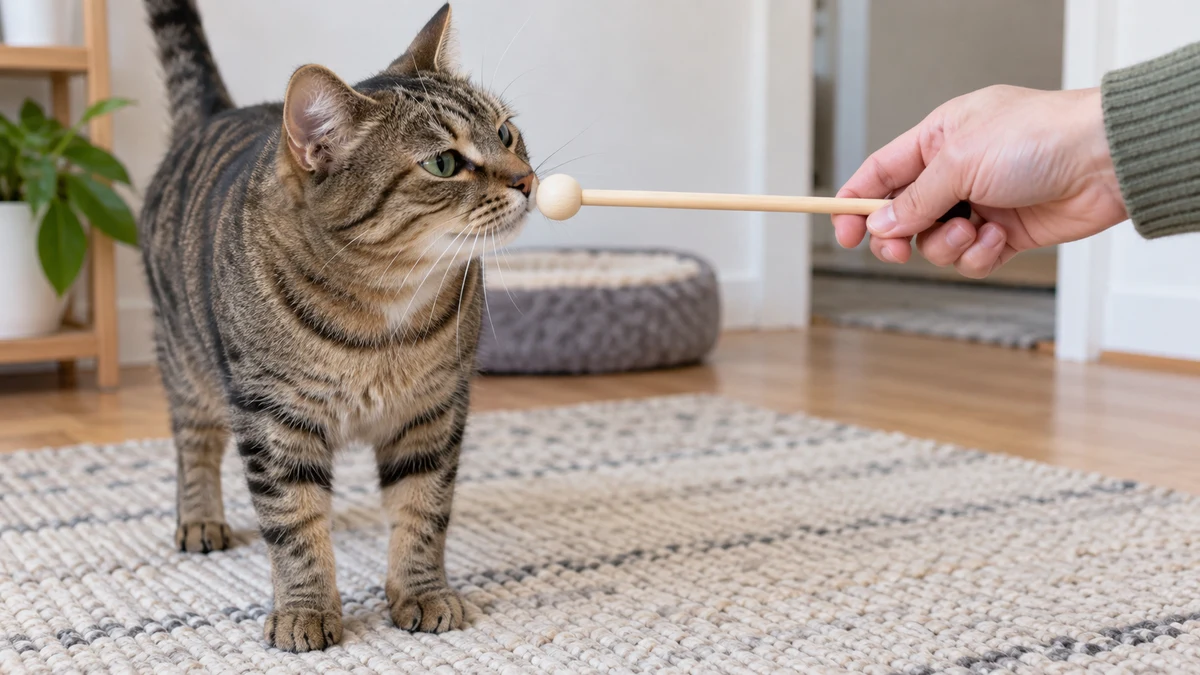
At first, every successful touch earns a click and reward. Present the target, wait, click the contact, then move the reward away from the target so the cat naturally resets for another repetition. Once the cat repeatedly touches a stationary target with a loose body, move on. A single accidental bump is not mastery.
Stage 3: follow the target one easy step
Present the familiar target close enough for an easy touch. After the cat touches and receives the reward, place the target only a small step to one side. Mark the next touch. Gradually ask for one step, then two, then a short straight path.
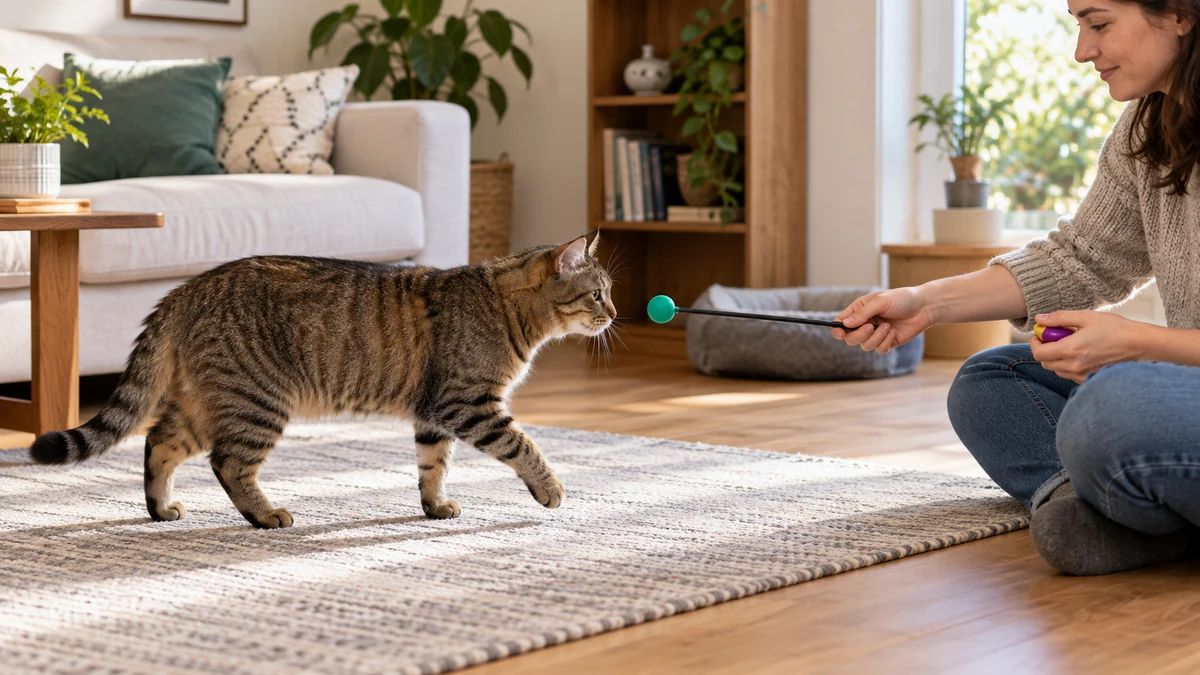
Change only one variable at a time. If distance increases, keep direction, floor, room, and distractions familiar. If you introduce a turn, shorten the distance. Do not raise the target so high that the cat must strain, rear up, or jump. The stick indicates a destination; it must never push, drag, prod, or trap the cat.
A practical working rule is to make the exercise slightly harder only when at least four of the last five repetitions looked prompt and comfortable. This 4-of-5 rule is a training aid, not a biological threshold. If the cat misses twice, wanders off, or needs repeated prompting, lower one criterion immediately: shorten the distance, return to a stationary target, reduce distraction, or end the session.
Stage 4: move to a mat, then add a cue
Use a thin, stable, nonslip mat large enough for the cat to stand or sit without balancing. Place it on the established short target path. Break the goal into choices the cat can offer:
| Step | What to mark | When to make it harder |
|---|---|---|
| Notice the mat | Looking or orienting toward it | The cat readily notices it without tension |
| Approach | One step toward the mat | Approaches repeatedly without needing the target at the nose |
| Contact | One front paw, then two front paws on the mat | Places paws comfortably and does not rush away |
| Arrive | All four paws on the mat | Stands loosely and can leave normally |
| Remain briefly | A tiny pause before the click | The pause is easy; increase only by a moment |
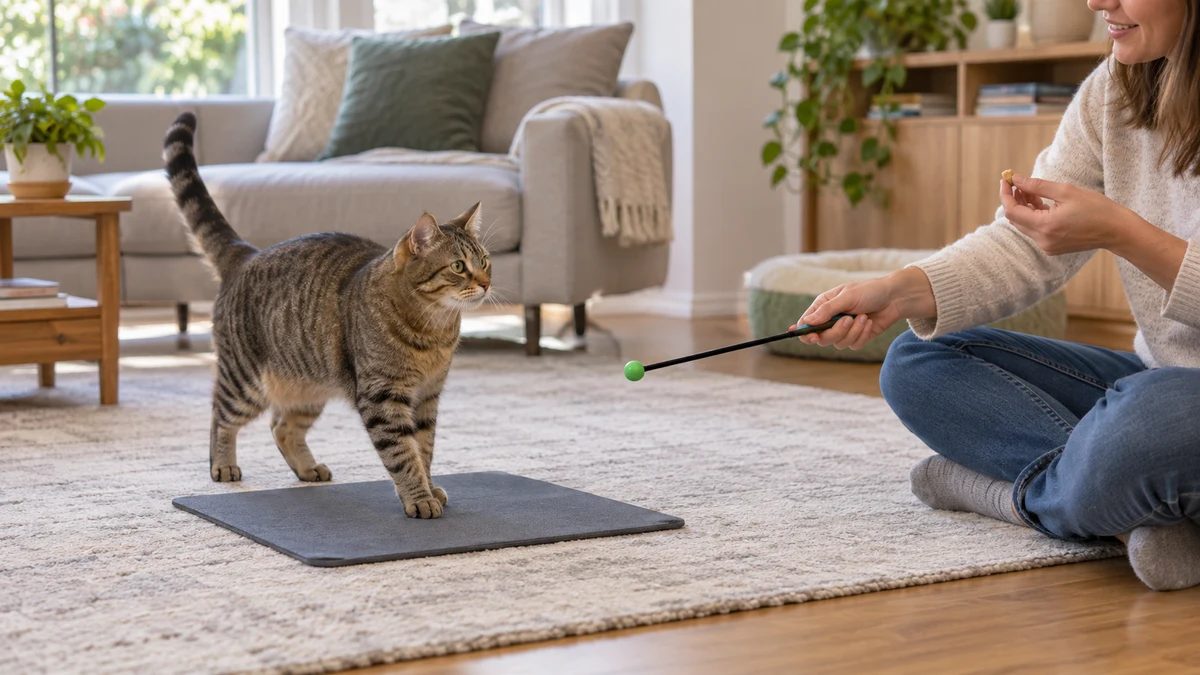
Deliver the reward on or just above the mat when safe, then toss or place the next reward a short distance away so the cat resets by leaving voluntarily. Never block the exit to manufacture duration. A mat behavior can later support calm household routines or carrier training, but it is not a way to immobilize a cat for handling.
Add the word or hand cue only when the behavior is already predictable. Say “mat” once just before presenting the target. After many easy repetitions, begin making the target movement smaller: full target, shorter movement, target shown briefly, then cue without the target. If the cat does not go, bring back the last successful prompt instead of repeating the word louder.
Fade the tool without breaking the promise
The goal is not to carry a clicker forever for every mastered behavior. Once the cue reliably produces the behavior in that familiar setting, stop using the clicker on some easy repetitions and reinforce with the reward the cat values. Gradually vary reinforcement only after the behavior is well learned; new or difficult versions still need frequent reinforcement.
Two promises remain important:
- If you click, pay it. Deliver a reward even when you clicked late or marked the wrong movement. The timing error belongs to the trainer.
- Do not fade everything at once. Removing the target, changing rooms, adding visitors, increasing distance, and reducing rewards together creates a new, much harder task.
Skills do not automatically transfer everywhere. A cat who goes to a mat in the living room may need easier practice on the same mat in the kitchen. Return to a high success rate whenever the surface, person, distance, sound level, or location changes.
Read the cat before changing the plan
One sign alone does not diagnose fear, pain, or illness. A cat may lick the lips after eating, leave because something else is interesting, or decline food because it is full. Look for a change from that cat’s baseline, several signals together, and whether the cat returns to normal quickly.
| Signal during training | Immediate response |
|---|---|
| Turns the head or whole body away repeatedly | Pause the presentation and increase distance |
| Walks away, hides, or stays near an exit | Let the cat leave; do not follow |
| Refuses a normally valued reward | End or simplify; review appetite and health context |
| Repeated lip licking or swallowing unrelated to eating | Stop and observe for other tension or nausea signs |
| Body lowers, crouches, or freezes | Remove the demand and restore an open retreat |
| Ears rotate sideways/back or flatten | Reduce sound, proximity, movement, or difficulty |
| Tail wraps tightly, tucks, or begins sharp flicking | Pause before arousal escalates |
| Pupils enlarge with scanning or repeated startle | Reduce light/sound change and create more distance |
| Growling, hissing, swatting, or frantic escape | End the session; do not punish or re-present the tool |
| Rapid, labored, or open-mouth breathing | Stop immediately and seek prompt veterinary guidance |
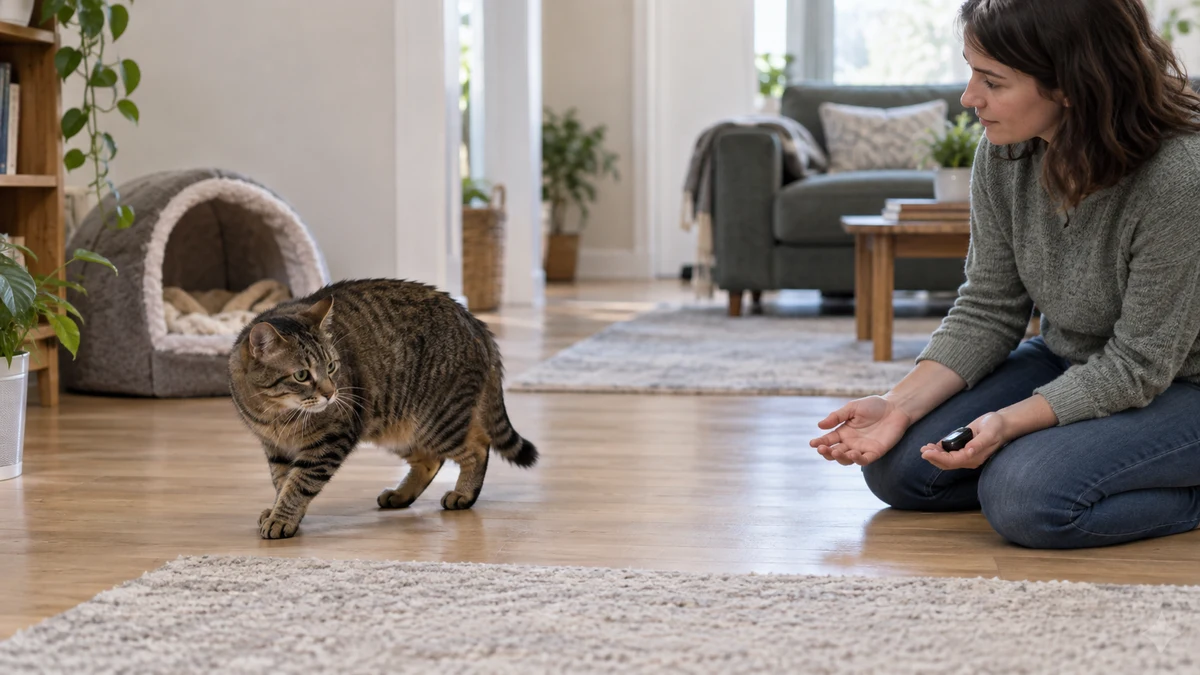
International Cat Care includes crouching, flattened ears, lip licking, scanning, escape attempts, and changes in activity among context-dependent signs of protective emotion. FelineVMA guidance says not to train a cat who is hiding, crouching, growling, hissing, ill, or painful. For a broader baseline checklist, see signs of stress in cats.
Seven boundaries that keep training voluntary
- Do not starve or delay necessary meals. Motivation does not justify hunger.
- Do not force a pose. Never press the hips, hold paws, restrain the head, or block retreat to obtain a repetition.
- Do not use the clicker as a startle or deterrent. It marks a behavior and predicts a reward.
- Do not punish errors. No yelling, spraying, hitting, chasing, or intimidating body posture. FelineVMA warns that punishment can increase fear and interfere with learning; the guide to why hitting a cat is harmful covers safer alternatives.
- Do not repeat a cue until it becomes background noise. Ask once, then make the setup easier.
- Do not promise a deadline. A shelter study showed that cats as a group improved on four trained behaviors after fifteen five-minute sessions, but individuals differed and the shelter setting does not create a timetable for a pet cat.
- Do not train through pain, illness, or fear. Change the goal and involve the appropriate professional.
Adapt the goal to health and mobility
Training should fit the cat’s body, not require the body to fit a trick. Use a low target and flat nonslip mat for a senior cat or a cat with limited mobility. Keep paths short, eliminate jumps and tight turns, and allow any comfortable standing or sitting position. A deaf cat can learn a visual marker; a sound-sensitive cat may prefer a quiet word or softened click.
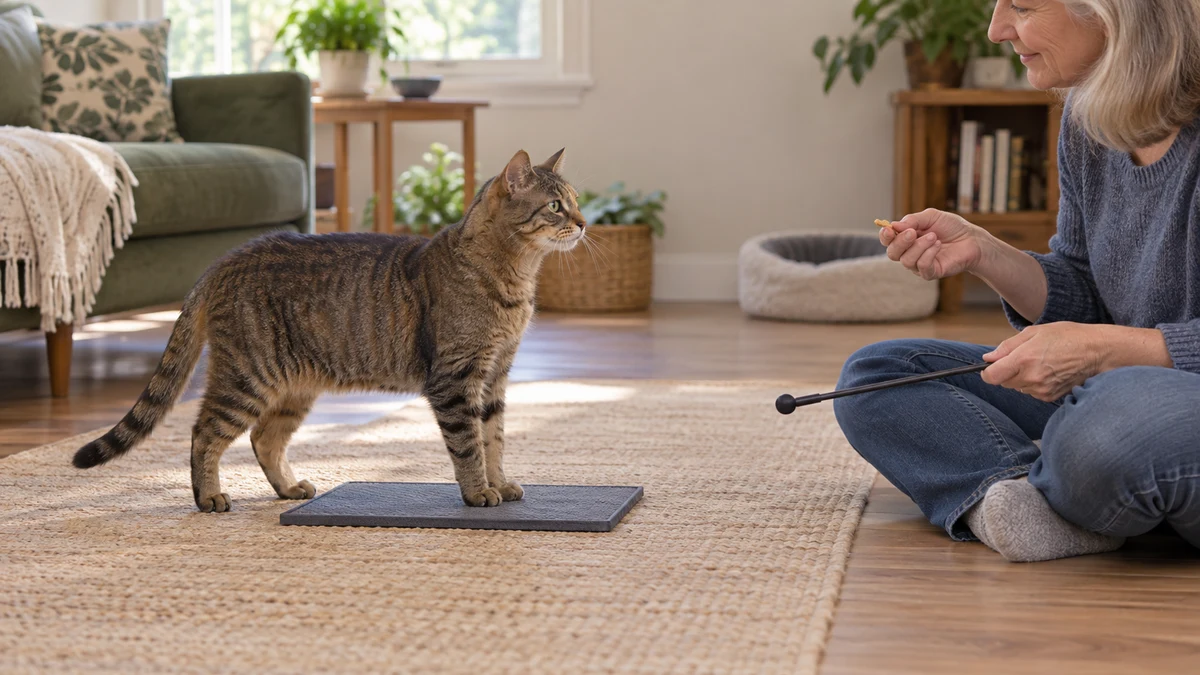
If a cat that previously participated now avoids movement, hesitates to step, changes appetite, reacts to touch, or appears stiff or painful, pause training and talk with a veterinarian. Do not use rewards to push through suspected pain. A veterinarian can assess health and help define safe movement; a qualified reward-based behavior professional can help when fear or aggression persists. Neither replaces urgent care for breathing difficulty, collapse, injury, or other acute signs.
A simple session record prevents guesswork
Write down the date, location, reward, goal, easiest successful step, and first sign that the task became difficult. Record five repetitions as easy, hesitant, missed, or stopped. This turns “the cat is stubborn” into usable information: perhaps the target moved too far, the floor was slippery, the click was loud, the reward had lost value, or the cat was not comfortable that day.
End with an easy success when the cat remains comfortable, but do not lure a worried cat back merely to create a tidy ending. Sometimes the correct final repetition is no repetition at all. Choice, recovery, and health matter more than completing a plan.
FAQ
Can I use a word instead of a clicker? Yes. A short, consistent word or gentle visual signal can become a marker if it is repeatedly followed by the chosen reward. Use it only as a marker, keep the timing precise, and avoid a common word that is heard all day without reinforcement.
How long should a clicker-training session last? There is no universal duration. Stop before attention or comfort declines; for some beginners that may be only a handful of repetitions. Several very short, easy sessions are preferable to one long session that ends in avoidance.
What if I click at the wrong time? Give the reward anyway, reset, and simplify your next attempt. Withholding the reward weakens the click–reward relationship, while one timing error does not require punishment or physically correcting the cat.
When can I stop using treats? First make the behavior reliable in an easy setting. Then reduce the clicker and vary rewards gradually while preserving reinforcement. If you click, still give a valued reward. Increase reinforcement again for a new location, longer distance, distraction, or harder version.
Why does my cat leave as soon as the target appears? The sound, target distance, session length, floor, reward, or health may have changed. Let the cat leave. At another calm time, try a quieter marker, greater distance, an easier approximation, or a different reward. Repeated avoidance, appetite change, pain signs, or sudden loss of a learned skill belongs in a veterinary conversation.