How Many Treats Can a Cat Have Per Day? Build a Calorie Budget
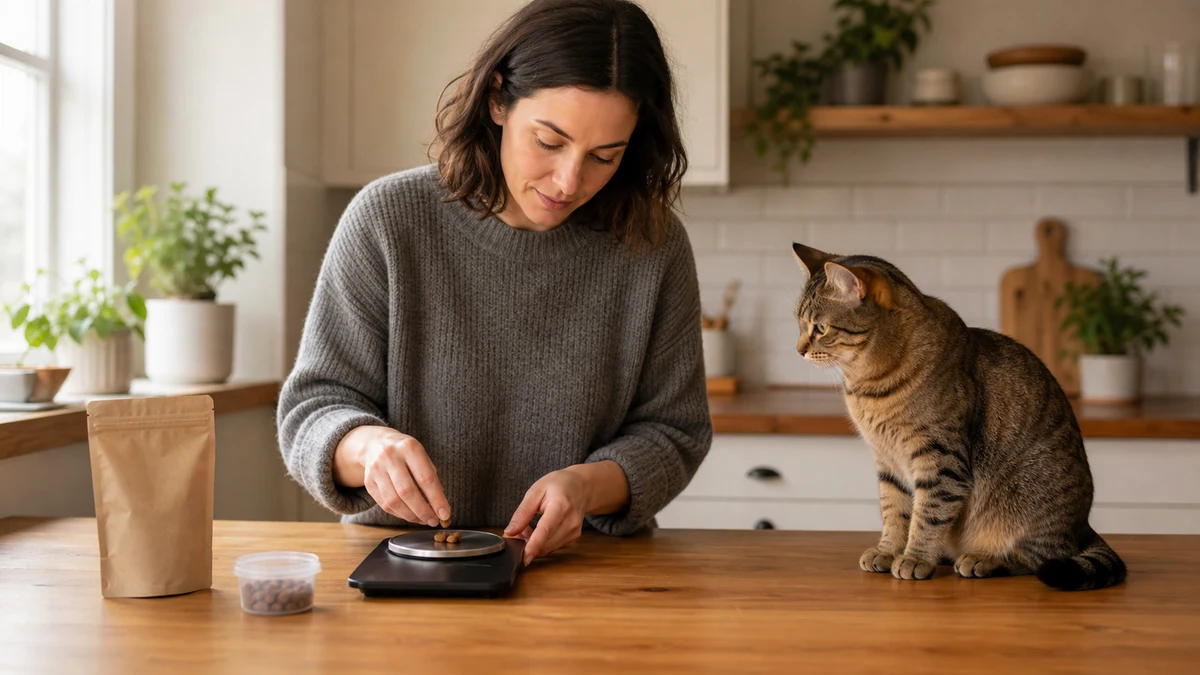
For a generally healthy adult cat, keep all treats and other edible extras together below 10% of that cat’s total daily calories. This is a ceiling, not a target and not a way to calculate the cat’s daily energy need. The other roughly 90% should come from the cat’s appropriate complete and balanced main diet. Count crunchy treats, lickable purées, human food, training rewards, food used with medication, and calorie-containing supplements in the same allowance. If the cat has a weight plan, food allergy, chronic condition, is a kitten, or eats a prescribed diet, ask the veterinary team before applying this general rule.
Why the answer is a calorie budget, not a number of treats
“Three treats” can mean three one-kilocalorie morsels or three large pieces that use most of a small cat’s allowance. Shape, weight, moisture, and fat content change energy density. A package name such as “natural,” “freeze-dried,” “lickable,” or “dental” does not tell you how many calories are in a piece or whether it suits a particular cat.
The World Small Animal Veterinary Association (WSAVA) advises keeping treats under 10% of a cat’s daily calorie intake. American Animal Hospital Association (AAHA) guidance uses the same general ceiling to reduce the chance that extras dilute the nutrition of the primary diet. The U.S. Food and Drug Administration (FDA) explains why that distinction matters: treats, snacks, and supplements are often not intended to provide complete and balanced nutrition.
That does not make every cat entitled to exactly 10%. A cat can receive less or none. Individual daily energy needs vary with body condition, muscle condition, age, reproductive status, activity, environment, health, and the purpose of the diet. Use a calorie goal already established from the cat’s current intake and veterinary assessment; do not copy another cat’s number or turn an online equation into a medical feeding plan.
Count every edible extra in one place
The easiest calories to miss are the ones that do not look like a conventional treat.
| Calorie source | What belongs in the count | Common blind spot |
|---|---|---|
| Commercial treats | Crunchy, soft, freeze-dried, jerky-style, or dental pieces | “Tiny” or “natural” is mistaken for calorie-free |
| Lickable food | Purée tubes, meat paste, toppers, broth-like snacks | One pouch is spread across several moments and counted as zero |
| Human food | Table scraps, meat, fish, dairy, food dropped during cooking | Several people each give “just one bite” |
| Training and care rewards | Rewards for carrier work, grooming, nail care, medication, or puzzle play | Repetition turns a small reward into many portions |
| Edible supplements | Oils, soft chews, chewable tablets, pastes, or other edible products | A health purpose is mistaken for no calories |

Make one household list. Include who feeds what, the product, the amount, and the calories. Food stolen from another pet, leftovers licked from a plate, and rewards from visitors still enter the same total. This accounting is especially useful in a multi-person home because no single serving looks excessive on its own.
Find calories on the package before choosing the portion
Our cat-food label guide explains where to find calorie and nutritional-adequacy information. For a treat calculation, look in this order:
- Find kilocalories per familiar unit: per piece, biscuit, pouch, tube, scoop, or serving.
- If the label gives kilocalories per gram, multiply by the grams actually offered.
- If it gives only
kcal/kg, divide by1,000to obtainkcal/g, then multiply by the portion weight in grams. - If the calorie content is missing, ask the manufacturer for kilocalories per gram and per piece or package. Do not infer calories from the ingredient list or marketing name.
AAFCO explains that calorie statements in the United States are commonly expressed as kcal/kg plus a familiar household unit such as a can, cup, or biscuit. Label requirements differ by market and product category, and AAFCO notes that some exempt treat products may not display calorie content. That is a reason to contact the responsible company, not a reason to guess.
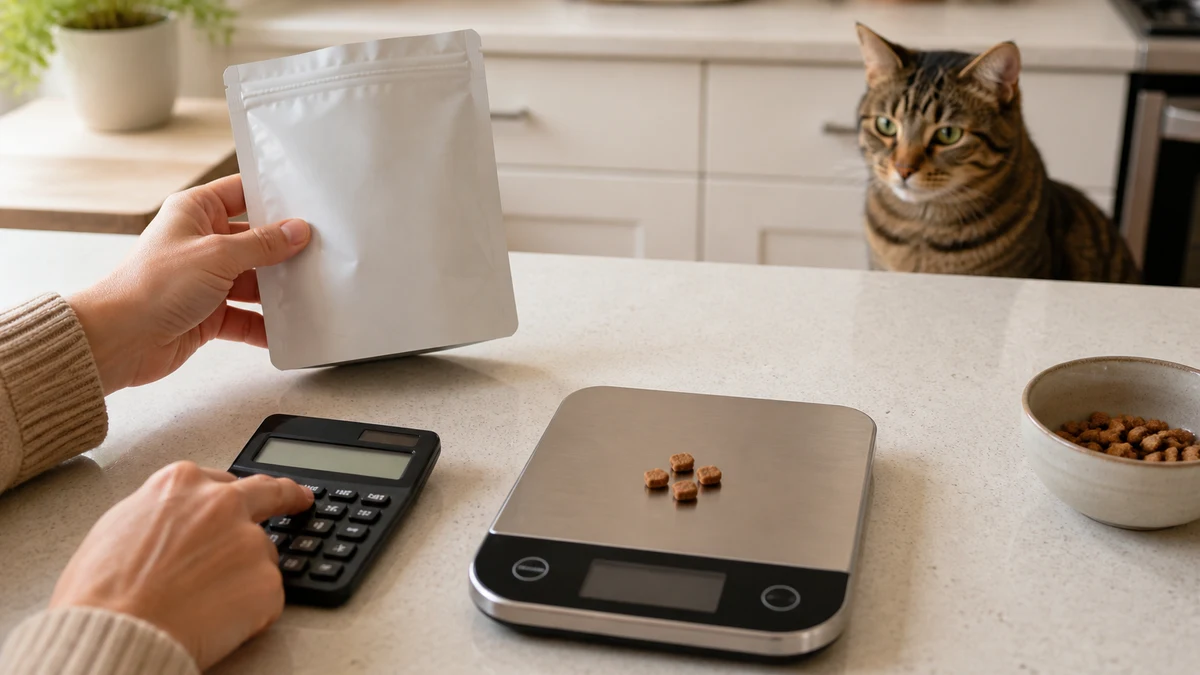
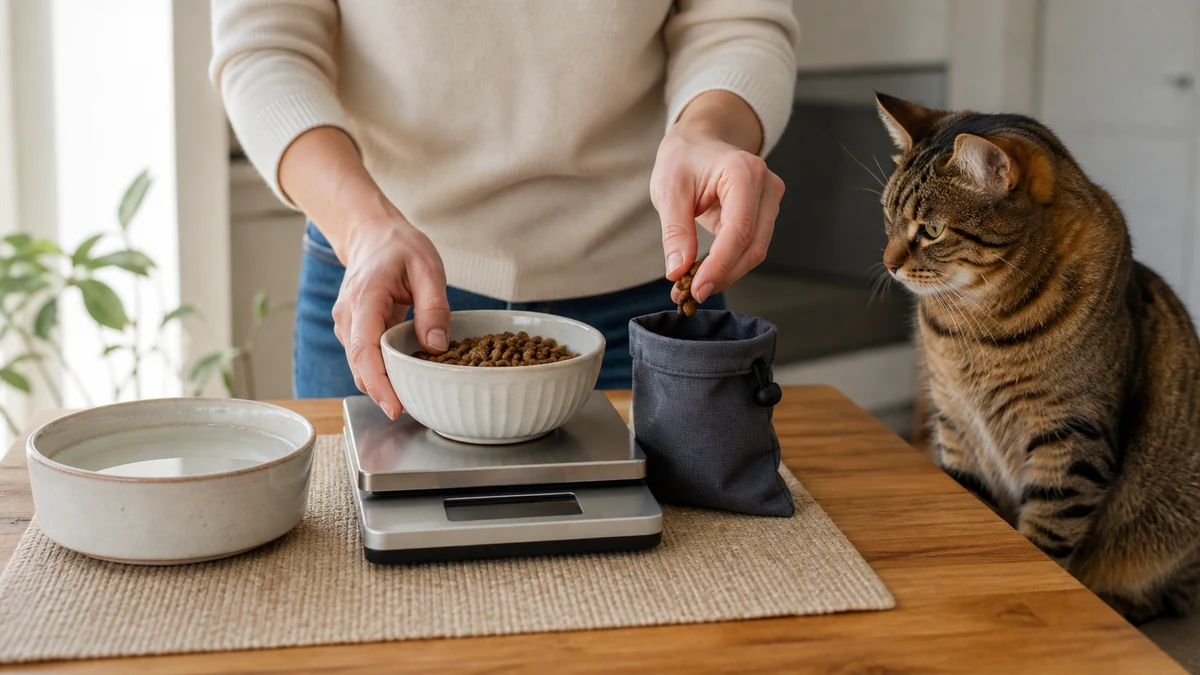
Use a gram scale for portions that are difficult to count or irregular in size. If a strip or chunk is meant to be broken, weigh the amount offered rather than assuming every fragment is identical.
A four-step calculation that prevents double feeding
Start with a daily calorie plan appropriate for the individual cat. Then:
- Calculate the general treat ceiling:
daily calorie plan × 0.10. - Add the calories from every extra already planned for the day.
- Subtract that sum from the treat ceiling.
- Convert the remainder into pieces, pouches, or grams using the label.
The full day’s equation is:
complete main food calories + all edible-extra calories = planned total daily calories
Do not serve the full planned main-food amount and then stack the treat budget on top. If the plan is 200 kcal and extras supply 20 kcal, a 200-kcal main ration plus those extras produces 220 kcal, not 200 kcal. The precise amount of main food to adjust depends on the diet and the cat; medically important changes belong with the veterinary team.
Example 1: pieces plus a lickable treat and supplement
Assume a veterinary team has confirmed a 200 kcal/day plan for an adult cat. This is an arithmetic example, not a recommendation for cats of a certain weight.
- General treat ceiling:
200 × 0.10 = 20 kcal. - One lickable pouch contributes
6 kcal. - One edible supplement contributes
4 kcal. - Calories left for dry treats:
20 − 6 − 4 = 10 kcal. - The dry treats contain
2 kcal/piece, so10 ÷ 2 = 5 pieces.
If all 20 extra calories are used, the complete main food accounts for the remaining 180 kcal, so the day still totals 200 kcal. It would be equally valid to use fewer extras and leave more of the plan to the complete diet.
Example 2: convert kcal per 100 g into grams
Assume a different cat has an individually established 240 kcal/day plan.
- General treat ceiling:
240 × 0.10 = 24 kcal. - A previously approved food reward contributes
6 kcal, leaving18 kcal. - A plain meat treat is labeled
360 kcal/100 g, which equals3.6 kcal/g. - Maximum amount within the remainder:
18 ÷ 3.6 = 5 g.
If the full allowance is used, the complete main diet provides 216 kcal and extras provide 24 kcal. Do not copy the 240-kcal total, the food choice, or the 5-g portion for another cat. The method transfers; the individual calorie plan does not.
Protect the complete diet rather than simply shrinking it
Keeping extras limited protects space for a main food formulated for the cat’s species and life stage. “Complete and balanced” has a defined nutritional purpose; a typical treat does not automatically meet it. Replacing more and more of the meal with treats can lower the intake of essential nutrients even when the scale does not immediately change.
There is another trap: repeatedly cutting an ordinary maintenance food far below its intended amount to force weight loss may also reduce vitamins, minerals, protein, and other nutrients. Therapeutic weight-reduction diets are designed differently from simply feeding much less of a regular food. A weight-loss calorie target and diet choice should therefore come from the veterinary team, not from subtracting an arbitrary number at home.
When wet and dry main foods are combined, calculate their joint calories first, then place every extra in the same daily ledger. Our wet-versus-dry guide explains why format alone does not determine nutritional adequacy or the correct portion.
Calories are only one safety check
A treat can fit the arithmetic and still be unsuitable.
| Concern | Why the name on the front is not enough | Safer decision |
|---|---|---|
| High energy density | Small freeze-dried, fatty, or concentrated pieces may deliver many calories | Use label calories and weigh irregular pieces |
| Salt, fat, or seasoning | Human foods and rich products may conflict with an individual health plan | Use only ingredients and portions already suitable for that cat |
| Unknown ingredients | Mixed dishes and unpackaged treats hide ingredients and preparation | Skip the item when its contents are uncertain |
| Choking, trauma, or obstruction | A chew or hard piece can be the wrong size or shape | Choose an appropriate size, supervise, and avoid bones |
| Raw animal products | Raw or non-sterilized animal treats can transmit pathogens | Do not assume “raw” or “freeze-dried” means safer |
| Prescribed or elimination diet | A conventional treat can introduce unplanned nutrients or proteins | Ask the prescribing veterinary team before any extra |
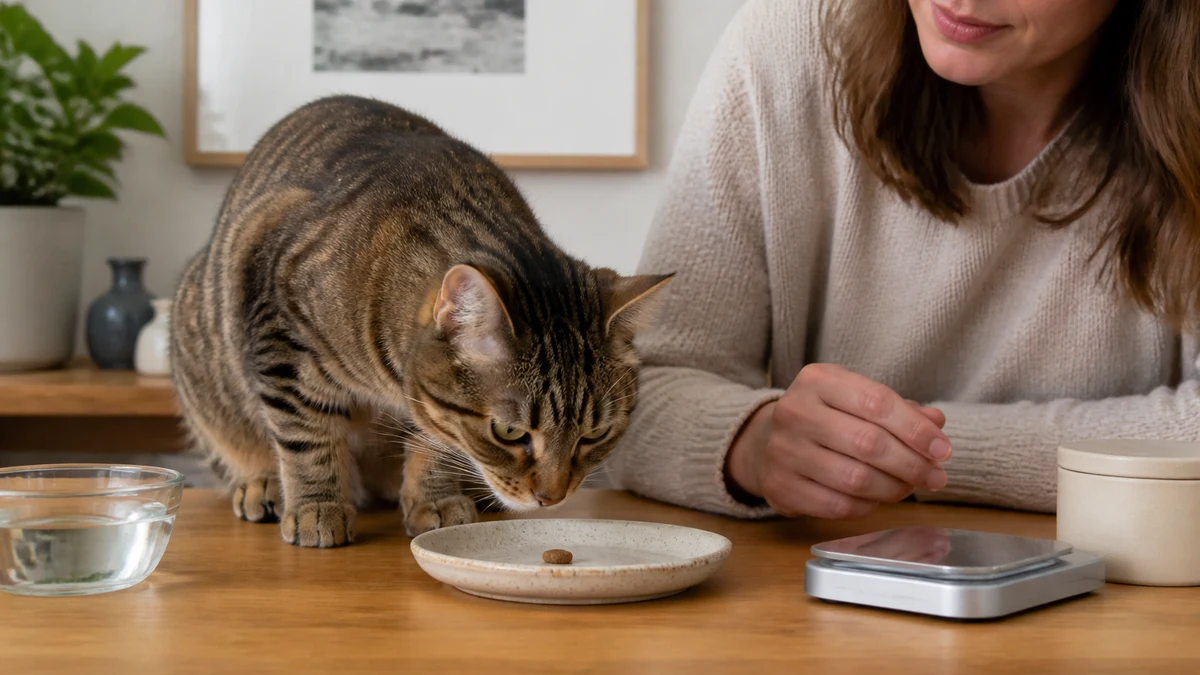
WSAVA specifically advises choosing an appropriate treat size and shape, supervising treats and chews, and getting veterinary advice for cats with medical conditions, dietary sensitivities, or veterinary-prescribed diets. AAHA and AAFP feline guidelines do not endorse raw or dehydrated non-sterilized animal foods, including treats. For human-food hazards and accidental exposure, use our separate human-food safety guide rather than treating the calorie calculation as a safety clearance.
“Dental” also describes a proposed use, not an exemption from the daily total. Count the calories and check whether the product, size, chewing behavior, and feeding directions fit the cat. A dental name does not replace professional dental care or make an unsuitable chew safe.
Eight ways to keep rewards without continually adding calories
- Pre-portion the entire day. Put the day’s measured extras in one small jar. Everyone feeds from it; when it is empty, food rewards are finished.
- Reserve unavoidable extras first. Enter a calorie-containing supplement or food used for medication before allocating optional treats.
- Use part of the complete main ration. Remove a measured amount from the day’s food and use those pieces for training or puzzle feeding.
- Make each reward smaller. Break a suitable treat into several tiny rewards when the product can be divided safely; count the total weight or calories, not the number of hand movements.
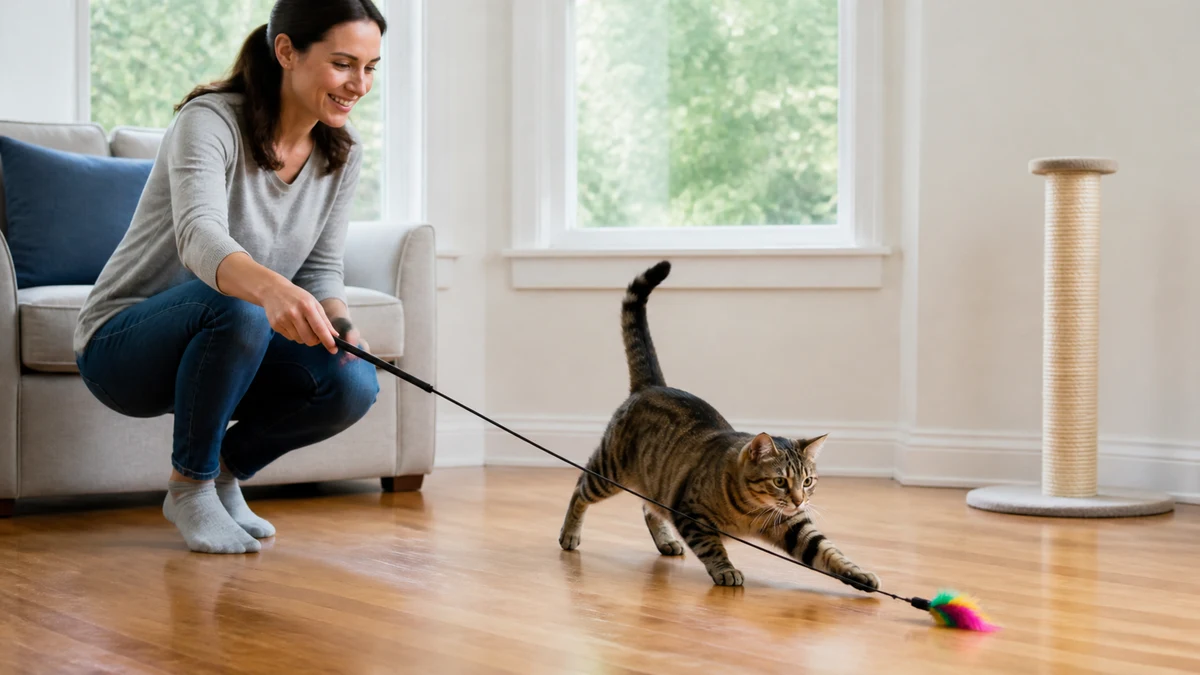
- Alternate food and interaction. Use play, access to a favored perch, brushing the cat enjoys, praise, or calm social attention when these are genuinely rewarding to that cat.
- Assign one shared record. A note on the feeding station prevents several caregivers from each supplying a full allowance.
- Measure before the session. Do not train from an open bag. Place the planned amount in a pouch and return unused pieces to the daily container.
- Use the schedule, not begging, as the cue. A measured feeding schedule makes it easier to see what remains and prevents an extra snack from silently becoming a meal.
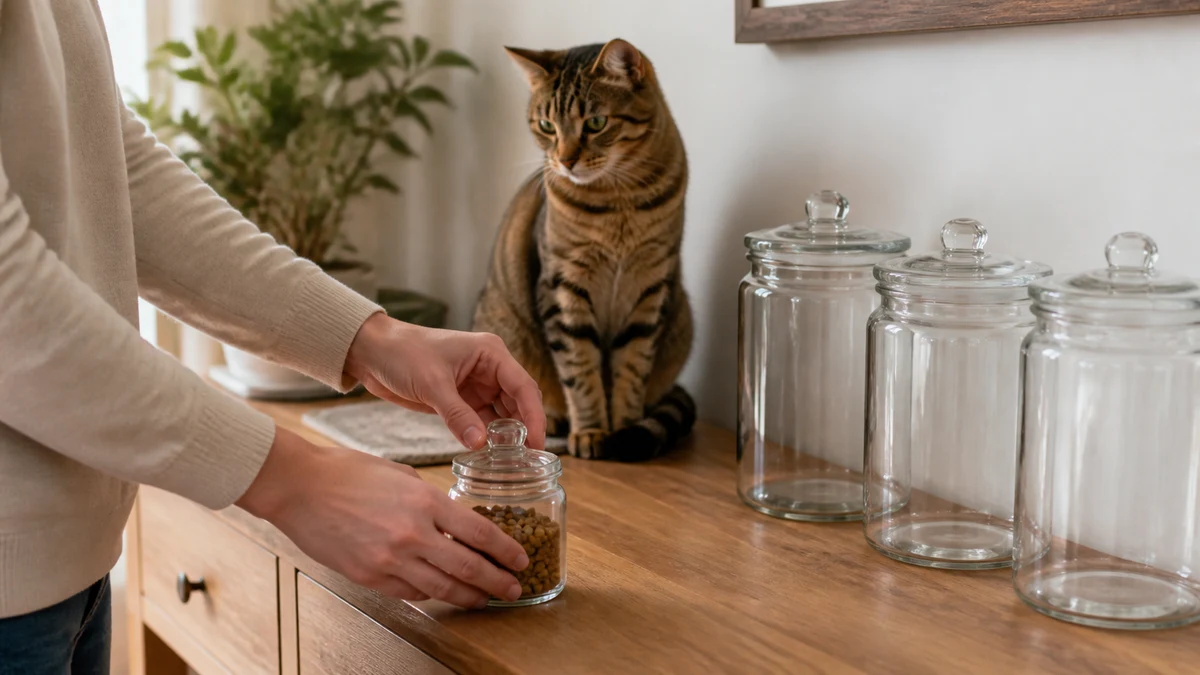
Using part of the main ration is especially useful for food-motivated training because it changes the delivery method without automatically increasing the day’s total. It only works if the training pieces are removed from the meal first.
Non-food rewards do not mean forcing play or touch. Watch the cat’s response. For one cat, a short wand-toy hunt may be valuable; another may choose access to a window perch or a quiet social routine.
When the general 10% ceiling should not be used alone
Ask the cat’s original veterinary team before changing extras when any of these apply:
- Weight control: the calorie target, rate of change, main diet, and monitoring need to work together. Cats should not be placed on an aggressive home-designed restriction.
- Food allergy or elimination trial: an unapproved flavor, protein, capsule coating, or shared spoon can undermine the controlled diet.
- Chronic health problem: kidney, urinary, gastrointestinal, endocrine, cardiac, dental, and other plans may limit ingredients or alter feeding priorities.
- Veterinary-prescribed diet: conventional treats, dental chews, toppers, and supplements may not be compatible even if their calories are low.
- Kitten, pregnancy, or lactation: growth and reproduction have different nutrient and energy needs; protecting complete life-stage nutrition is more important than applying an adult shortcut.
- Poor appetite or unintended weight change: do not use treats to conceal a persistent intake problem. A reduced appetite or unexplained trend needs veterinary assessment.
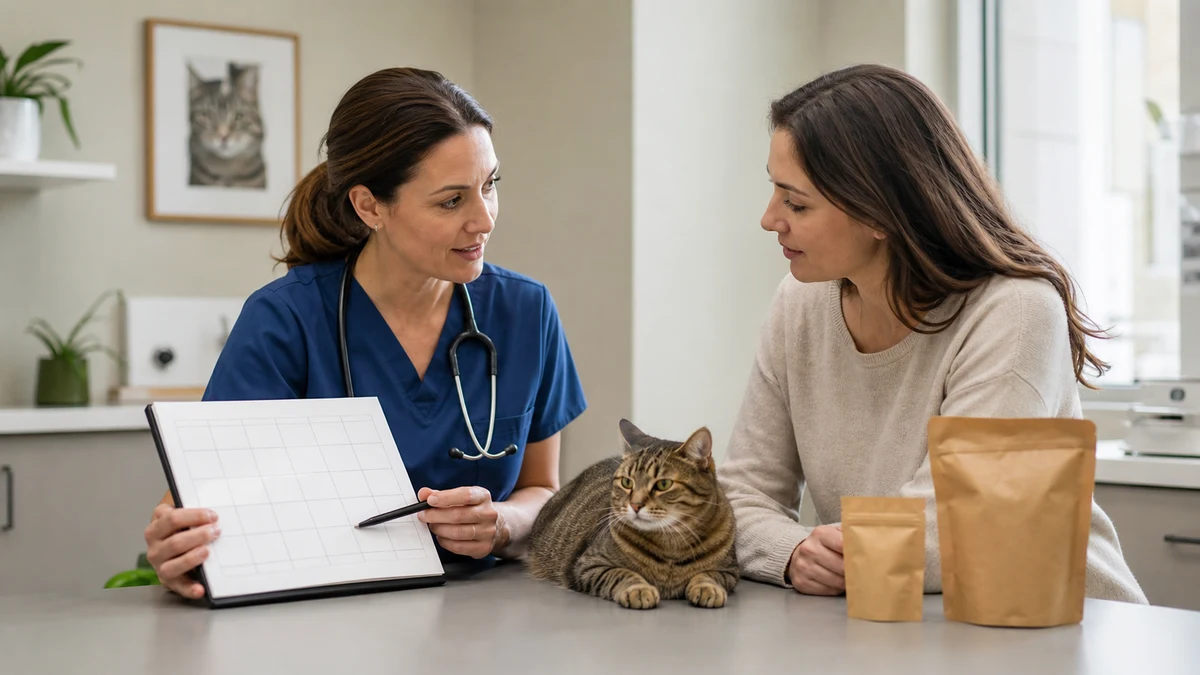
Bring package photos, calorie statements, actual amounts, all supplements, and a short feeding record. That turns “she barely gets treats” into information the team can evaluate.
A practical daily check
Before the first reward, ask:
- Is the cat’s total daily calorie plan individualized and current?
- Have all five categories of extras been listed?
- Are calories known per piece, pouch, or gram?
- Do extras stay below the agreed ceiling without being added on top of the main ration?
- Is the item safe in ingredient, size, shape, and preparation?
- Does it fit any allergy, chronic-disease, weight, kitten, or prescribed-diet plan?
- Has the whole household seen the same allowance?
The useful answer to “how many treats?” is therefore a small, measured remainder in a complete daily plan—not a universal piece count. Use fewer calories when that is enough to reward the cat, and let play or other valued interaction carry part of the relationship.
FAQ
Is 10% a target every cat should receive?
No. It is a general maximum for all treats and edible extras combined. A cat may receive less or none. The cat’s total daily calorie need and any medical limits are individual decisions.
Do lickable treats, toppers, and supplements count?
Yes when they contain calories. Count the entire amount actually fed, including purées, food used with medication, oils, soft chews, and edible pastes. Ask the manufacturer or veterinary team when calorie information is unavailable.
Can I just subtract treat calories from the cat’s usual meal?
The full total must stay within the plan, but a large or medically important reduction should not be improvised. Repeatedly cutting a complete maintenance food too far can reduce essential nutrient intake. Ask the veterinary team to design weight-loss or therapeutic adjustments.
Are freeze-dried or dental treats automatically low-calorie?
No. Those words describe processing or intended use, not calorie content. Read the label, weigh or count the actual portion, check ingredient and physical safety, and include it in the same daily allowance.
What is the easiest way to stop different people from over-treating?
Pre-portion the day’s allowance into one small container and keep one shared record. Every caregiver uses that supply, including for training and medication, so “one treat each” does not multiply unnoticed.