How to Store Cat Food After Opening: Dry, Wet, Fresh, and Frozen
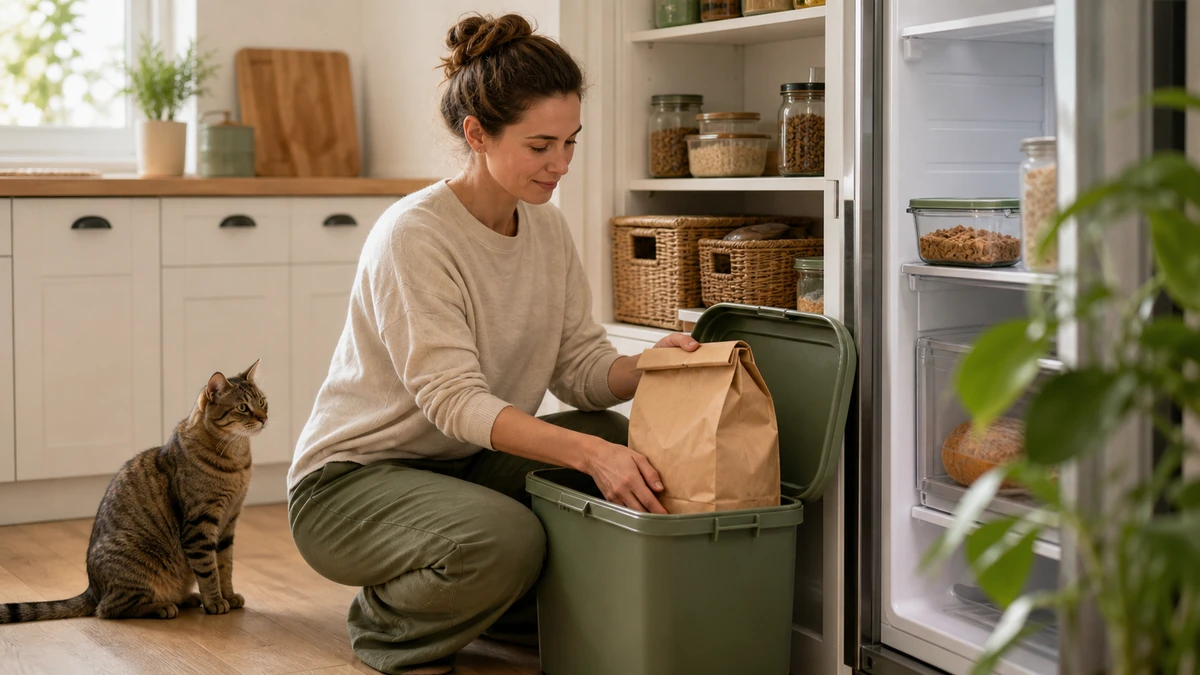
After opening cat food, keep dry food in its resealed original bag, preferably inside a clean, dry lidded bin; cover and promptly refrigerate unused wet or fresh food at 40°F (4.4°C) or below; keep products labeled frozen at 0°F (-18°C) or below and thaw them in the refrigerator. Follow the package’s after-opening instructions whenever they are stricter. Clear bowl leftovers promptly. Discard food exposed beyond its safe time or temperature, recalled food, damp or moldy food, and food from swollen, leaking, or damaged packaging. Reheating, mixing it with a new batch, or tasting it cannot make suspect food safe.
The label, temperature, and opening time work together
“Cat food” is not one storage category. Dry kibble has little available moisture, an unopened can is commercially sealed, opened wet food is perishable, refrigerated fresh food depends on an uninterrupted cold chain, and frozen or raw products need still stricter separation and handling. A clock copied from one formula cannot be transferred to all of the others.
Start with three pieces of information:
- The product label: Find “refrigerate after opening,” “use within,” thawing, freezer, and bowl-disposal instructions. A stricter label wins over a general article.
- The actual temperature: Use appliance thermometers. “The refrigerator feels cold” and “the ice pack is still cool” are not measurements.
- The opening record: Write the opening date and time where the household can see it. Refrigeration slows change; it does not restart the product’s clock every time the food returns to the refrigerator.
Our cat-food label guide explains how to find the responsible company, product identity, lot information, calorie statement, and nutritional-adequacy claim. For storage, the same habit applies: read the complete panel rather than inferring a rule from “wet,” “dry,” “fresh,” or a marketing phrase on the front.
As of September 1, 2026, U.S. FDA pet-food guidance says to store dry and unopened canned food in a cool, dry place below 80°F (about 27°C), and to refrigerate or discard unused opened canned or pouched food promptly at 40°F (4.4°C) or below. Those are storage conditions, not a universal promise that every opened product remains usable for the same number of days.
A storage table for six common situations
| Food situation | Container | Temperature and place | Label and time decision | Discard when |
|---|---|---|---|---|
| Opened dry kibble | Resealed original bag; place the whole bag in a clean, dry, snug-lidded outer bin if extra protection is needed | Cool, dry, indoors, away from sun, heat, humidity, pests, cleaners, and pet access; FDA says below 80°F (27°C) | Keep the best-by date, lot number, and the maker’s after-opening window; record the opening date | It is wet, moldy, unusually oily or clumped, has an off odor or color, contains pests or a foreign object, is recalled, or exceeded the label conditions |
| Unopened can or pouch | Intact original package | Cool and dry; do not use a hot car, damp garage, sunny sill, or flood-prone floor | Use by the marked date and under package conditions; rotate older stock forward | Swollen, leaking, punctured, badly dented at a seam, deeply rusted, spurting, or recalled |
| Opened canned food or pouch | Clean fitted can cover or clean shallow airtight food container; close a pouch and place it upright in a container | Refrigerate promptly at 40°F (4.4°C) or below | Start the product’s after-opening clock immediately; use the label or manufacturer instruction, not another brand’s longest window | The label window ends, cold control is lost, appearance or odor changes, mold develops, or the package was contaminated |
| Refrigerated fresh food | Original tub or clean shallow sealed container, separate from ready-to-eat human food | Maintain 40°F (4.4°C) or below from purchase to serving | Follow the product’s use-by and after-opening directions; general perishable-food rules are only an outer limit | It exceeds the label limit, has been above safe refrigeration too long, the seal failed, or any contamination or spoilage is suspected |
| Frozen food, including products sold raw | Sealed package inside a leak-catching tray or secondary container, separated from other food | Freezer at 0°F (-18°C) or below; thaw in the refrigerator when the label permits | Follow the product’s frozen shelf life, thawing method, and after-thaw window; do not freeze an ordinary unopened can or refreeze contrary to the label | The package leaks, the cold chain is unknown, it thawed under unsafe conditions, or the label’s thawed-use window ends |
| Food served in a bowl | Clean, dry bowl; serve only the measured meal | Use the label’s serving conditions; keep wet and fresh food out only for the instructed period | Start timing when food leaves safe storage. A feeder is refrigerated only if it verifiably holds the required temperature | The label’s bowl limit ends, the room is hotter than the stated condition, insects or dirt reach it, another animal contaminates it, or safety is uncertain |
This table deliberately does not assign one day count to every opened wet food. The WSAVA Global Nutrition Committee’s FAQ says uneaten canned food should be refrigerated and fed within 48–72 hours, while a Wellness manufacturer FAQ checked on September 1, 2026, says its well-covered canned food may last up to 3–4 days, with refrigerator hygiene and prior room exposure affecting that period. These are general or manufacturer-specific instructions—not interchangeable limits for every can, pouch, fresh diet, or feeder. The shorter instruction on the food in your hand is the one that matters.
Dry food: protect the bag instead of throwing it away
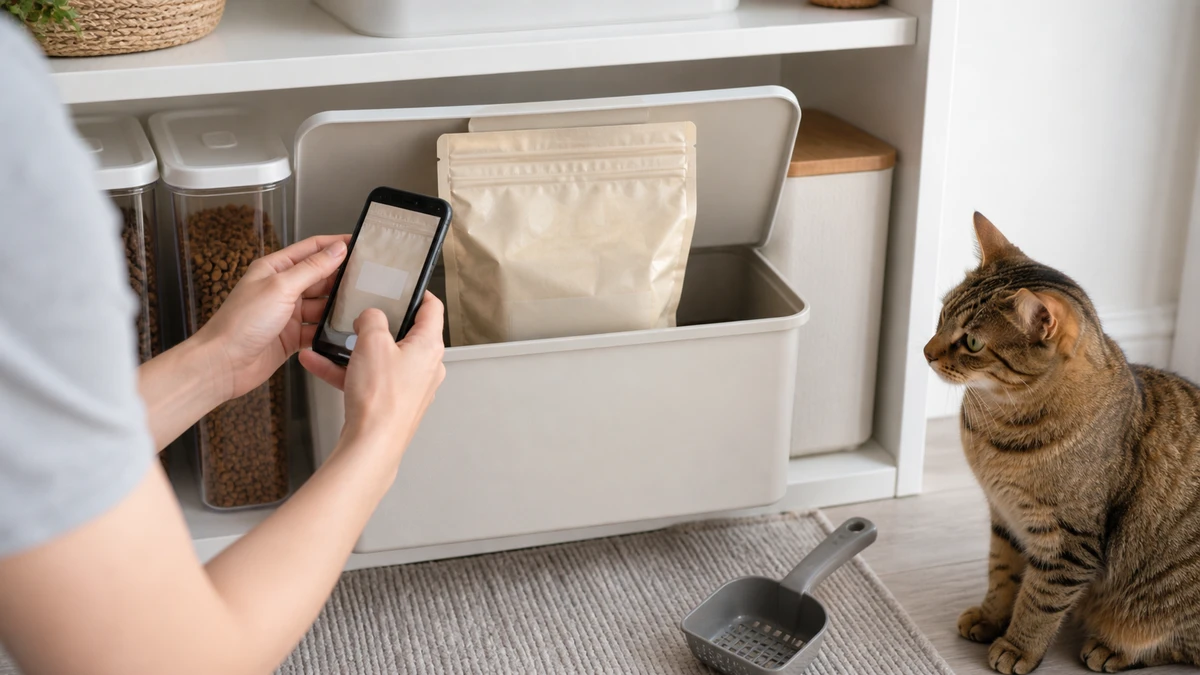
The original bag does more than display marketing. It keeps the product name, UPC, manufacturer, best-by date, and lot number together. FDA explains that the lot number can identify where and when a food was produced, which is useful in a complaint or recall. Photograph the complete panel before it becomes creased, and keep the package until the food is finished.
For an outer bin, place the entire bag inside whenever practical. Roll or fold the top tightly and close both bag and bin after every use. This keeps the food in contact with the packaging designed for it and gives another barrier against humidity, pests, and a determined cat. A lidded bin is not a substitute for a cool, dry location; a sunny balcony, hot car, humid laundry area, or garage with insects remains a poor storage place.
If food must be poured into another container, FDA advises using one that is clean, completely dry, and tightly lidded, while saving the full package information. Do not continually pour a new bag over old crumbs. Residual fats, dust, moisture, and a previous lot remain on the surfaces, and mixing batches makes traceability harder. Finish one batch, empty the container, wash it, dry every seam and corner, and only then add the next batch.
Choose a bag size the household can use within the maker’s stated after-opening quality window. “Best by” on the unopened package does not erase the effects of months of air, heat, or humidity after opening. If kibble becomes damp or visibly moldy, discard the affected batch; do not remove only the obvious pieces or mix the remainder with fresh food.
Opened cans, pouches, and refrigerated fresh food
Use a clean utensil to portion the meal, then cover and refrigerate the unused portion before the feeding session ends. This separates the clean reserve from food that has contacted the bowl, the room, and the cat’s mouth. Do not scrape served leftovers back into the can or pouch.
If you are still choosing between formats, our wet-versus-dry cat-food guide compares nutrition, hydration, cost, measuring, and storage without treating either format as universally better. The safest format is partly the one the household can store and serve correctly every day.
Use a fitted can cover or a clean, shallow airtight container to reduce drying and odor transfer. For a pouch, close it as the maker directs and stand it in a secondary container so a weak seal cannot leak across the shelf. Mark the opening date and time. Place the food where the refrigerator reliably stays at or below 40°F, not in a warm door shelf if the appliance manual advises otherwise.
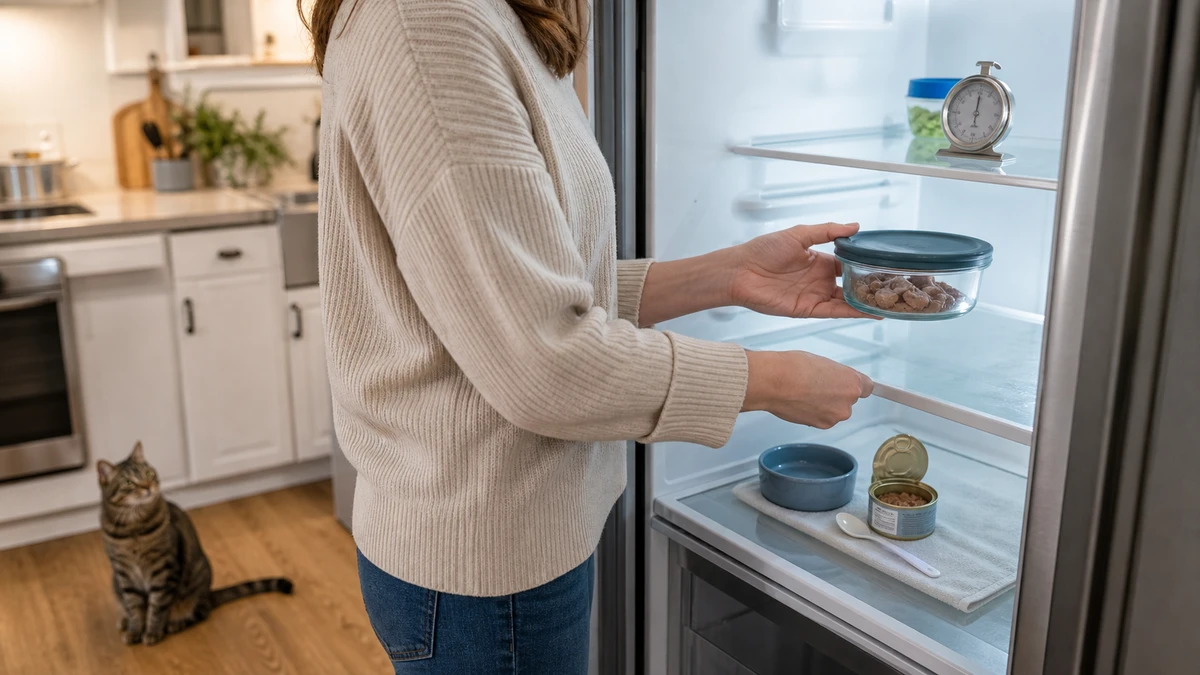
The Pet Food Institute advises covering wet or fresh pet food and refrigerating it according to its label. That makes the product’s use-by date and after-opening instruction essential. “Fresh” is not permission to improvise a longer life, and moving food in and out of the refrigerator does not create a new storage period.
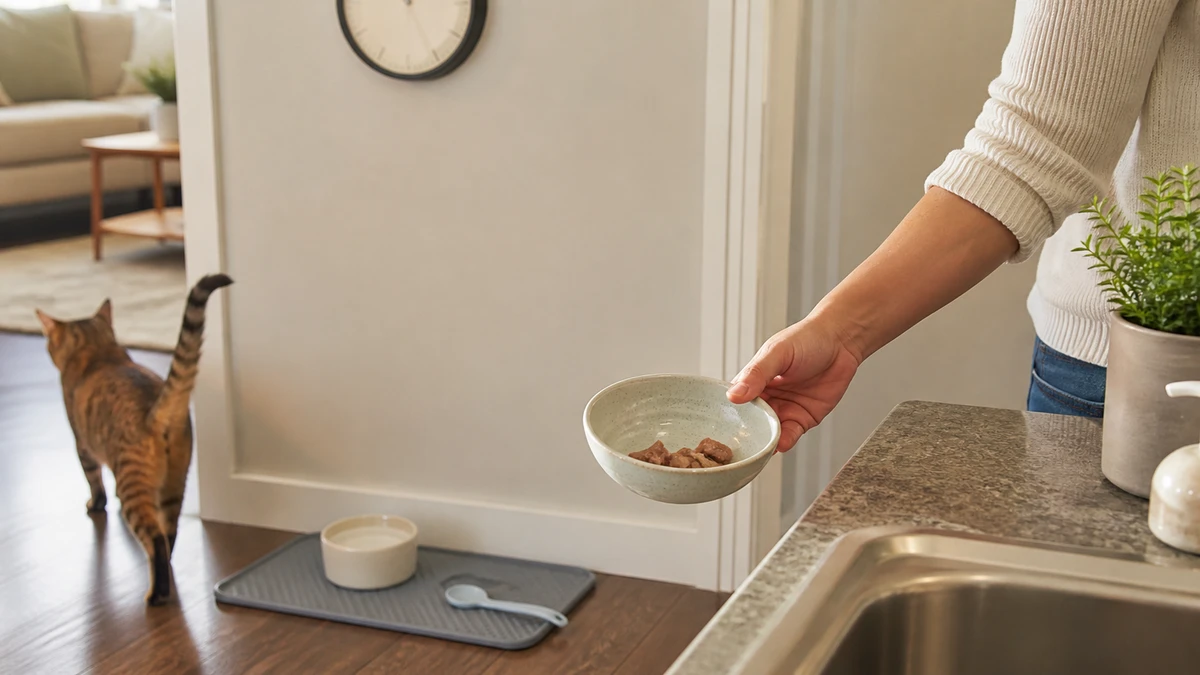
If there is no pet-food-specific bowl instruction, the USDA’s U.S. general rule for perishable leftovers offers an outer safety limit: refrigerate within two hours, or within one hour when exposed to temperatures above 90°F (32°C). It is not permission to leave every cat food out for two hours. A manufacturer may require twenty minutes, thirty minutes, one hour, or another shorter period; warm rooms, direct sun, a warming feeder, raw food, and medically vulnerable household members can all call for more caution.
A measured scheduled or controlled free-feeding plan can make bowl timing and leftovers visible. “Free feeding” never turns ordinary opened wet food into a shelf-stable product.
Refrigerated and frozen food need measured cold control
Keep a refrigerator thermometer where it can be read without guessing. FDA food-safety guidance uses 40°F (4.4°C) or below for the refrigerator and 0°F (-18°C) or below for the freezer. A numerical setting on the appliance is not necessarily the compartment temperature, and a decorative lid or timed feeder is not refrigeration.
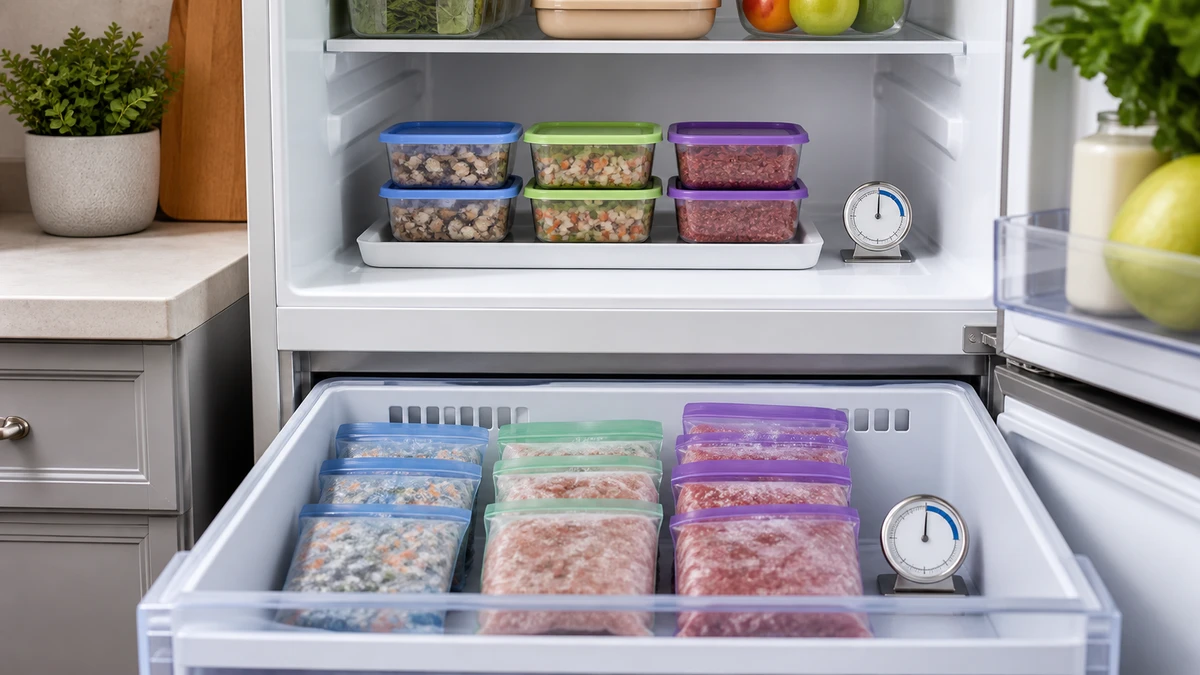
Freeze food only when the package permits it. Freezing an ordinary sealed can can damage its seam or change the contents as they expand, and freezing an opened wet product may change texture even when a manufacturer allows it. If portion-freezing is allowed, use clean, sealed, meal-sized containers, label the freeze date, and keep batches separate.
Thaw frozen products by the label’s method. FDA’s general food-safety guidance lists the refrigerator—not the counter—as a safe thawing method. Keep a pet-food package sealed in a leak-catching tray and separate from other food. WSAVA’s raw-meat diet resource summarizes contamination risks to pets and people; freezing or freeze-drying should not be treated as sterilization. If a household chooses a raw product after veterinary discussion, the cold-chain, separation, handwashing, and surface-cleaning rules become more important, not less.
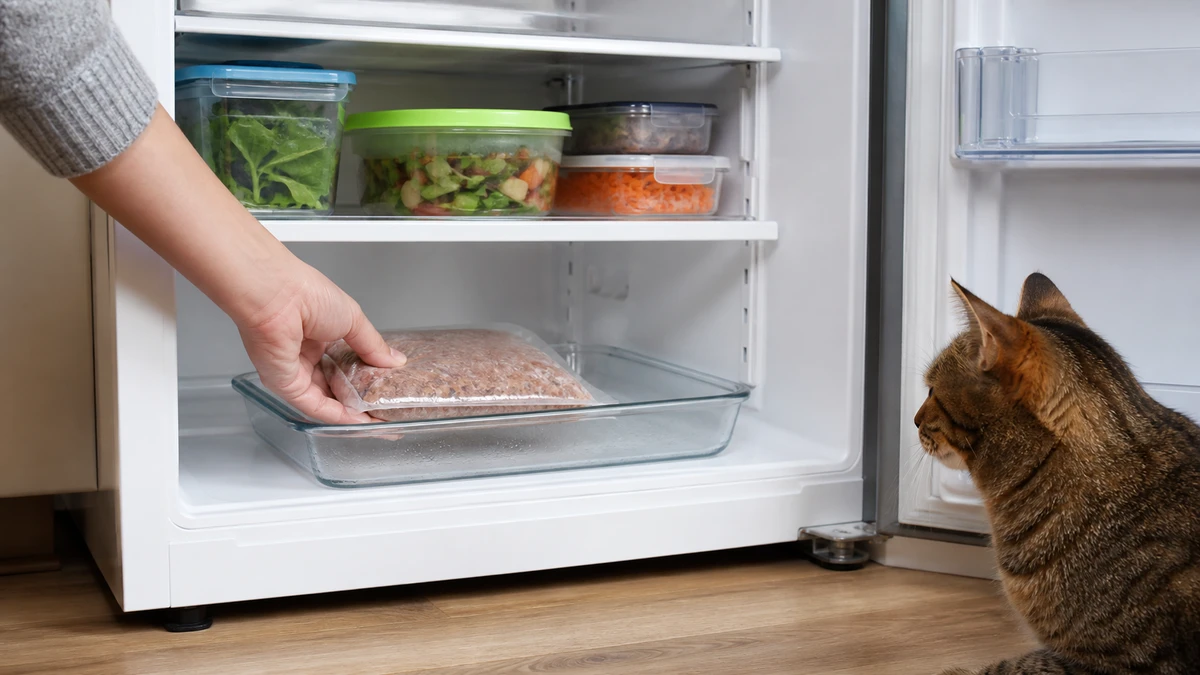
During a power outage, keep appliance doors closed and use actual time and temperature. FDA says a closed refrigerator generally keeps food cold for about four hours, then directs people to evaluate perishable food by measured temperature and exposure. If the history is unknown, do not use normal smell or appearance as proof of safety. Contact the product manufacturer when its instructions do not cover the event.
Twelve hygiene and inventory habits that prevent avoidable mistakes
- Wash hands before and after handling food or treats. Soap and water protect both the food and the people handling it.
- Use a dedicated scoop and measuring tools. Do not use the cat’s bowl as a scoop or return a food-contact scoop to a dirty counter.
- Wash and completely dry food bowls after each use. FDA separately advises washing water bowls daily.
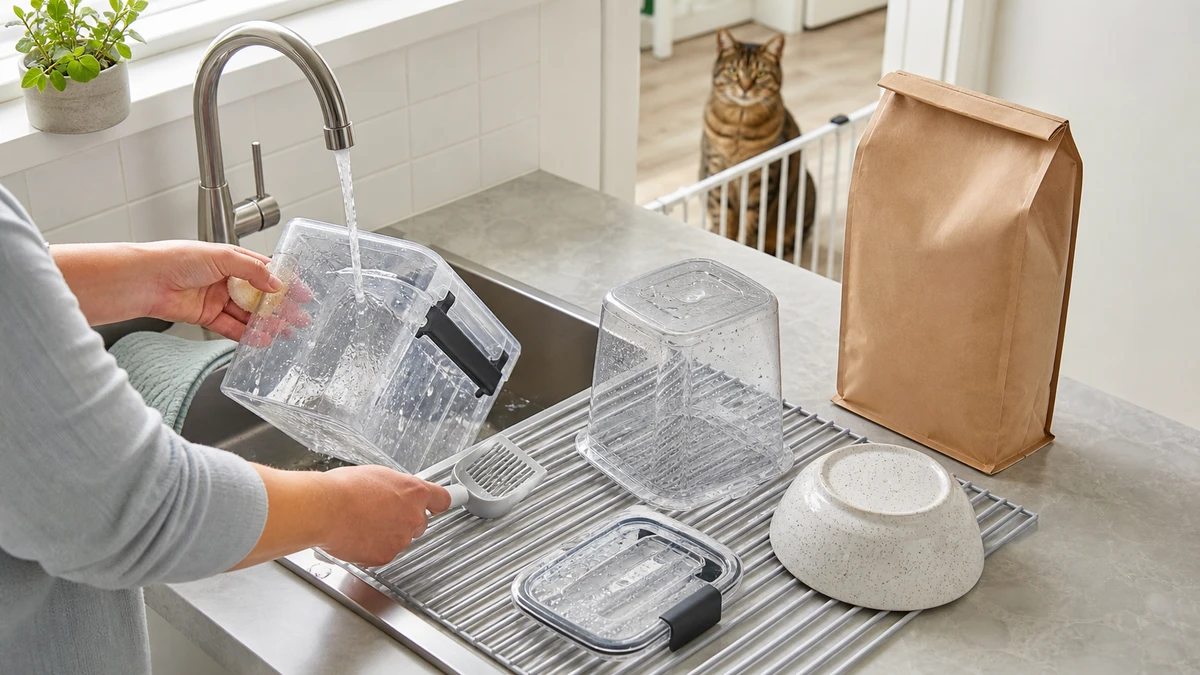
- Wash and dry storage bins between bags. Pay attention to the lid gasket, corners, scoop holder, and crumb-catching seams.
- Keep the original package and record. Photograph the product name, UPC, lot number, best-by date, and manufacturer contact information.
- Write the opening date and time. Put it on a removable household label or feeding log, not over the package’s permanent information.
- Practice first-in, first-out without combining lots. Move older intact packages forward, but never top new food onto old crumbs.
- Portion the clean reserve first. Refrigerate unused wet food with a clean tool; do not return bowl leftovers to it.
- Use appliance thermometers. Check trends and investigate a warm reading instead of trusting a dial setting.
- Separate leak risks. Put fresh, frozen, and especially raw products in sealed secondary trays away from ready-to-eat food.
- Plan for heat, travel, and power loss. Use an insulated cold system that can be measured, or choose a shelf-stable unopened portion for the journey; never leave food in a hot vehicle.
- Check recalls before salvaging a suspect batch. Stop feeding, isolate the package from children and animals, and follow the regulator or manufacturer’s disposal instructions.
When food must not be served
Discard or isolate food when any of these applies:
- Unsafe time or temperature: the label window ended, a chilled product warmed beyond its supported condition, or the history is unknown.
- Moisture where it does not belong: dry food is damp, stuck together, or has condensation inside the package.
- Visible mold or pest activity: do not remove only the affected area and keep feeding the rest.
- Foul or unfamiliar odor, off color, or unexpected texture: these warrant stopping, but the absence of a bad smell does not prove safety.
- Swollen, leaking, punctured, badly damaged, or spurting package: do not open it to investigate with a taste.
- Broken seal, deep seam dent, or heavy rust: package integrity is part of the product’s protection.
- Foreign material or obvious contamination: isolate the package and preserve its identifying information for a complaint.
- Recall match: follow the exact product, size, lot, and date information in the recall notice.
- Cross-contamination: raw juices, cleaning chemicals, floodwater, pests, or an unknown substance reached the food.
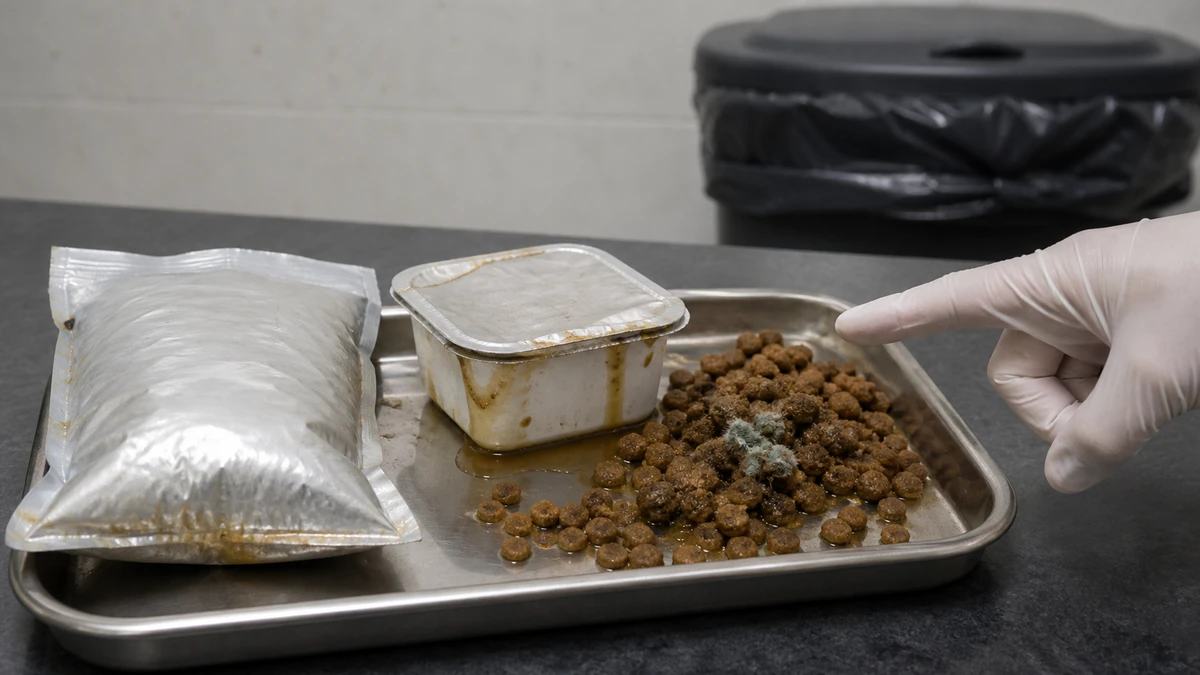
Do not rely on tasting, feeding one piece “to see,” reheating, rinsing, freezing, or blending the suspect food into a new bag. Heat may not correct every toxin or packaging problem, and dilution does not undo contamination. When safety is uncertain, disposal costs less than gambling with the cat’s health or spreading a contaminated product around the kitchen.
If the cat becomes unwell after eating
Stop feeding the suspected product and contact the cat’s veterinarian. Persistent vomiting or diarrhea, lethargy, weakness, reduced appetite, blood, or signs of dehydration deserve prompt veterinary guidance. Cornell notes that vomiting accompanied by lethargy, weakness, reduced appetite, blood, thirst or urination changes, or diarrhea should be evaluated promptly; diarrhea that persists and occurs with poor appetite, lethargy, or vomiting also needs timely care. These signs have many possible causes, so storage history cannot diagnose food poisoning.
Keep the original package, lot and date photographs, receipt if available, opening time, storage temperatures, amount served, and the cat’s timeline. Ask the clinic or regulator how to preserve any remaining sample without exposing people or animals. Do not induce vomiting, give human anti-diarrheal medicine, use leftover medication, or invent a home treatment.
In the United States, FDA accepts pet-food complaints and asks for details such as the product, lot, dates, purchase location, storage and handling, amount eaten, clinical signs, and veterinary records. Other countries have their own regulator and reporting route. Reporting is not a declaration that the food caused the illness; it gives investigators traceable facts.
A one-minute routine after every opening
Before putting the food away, ask:
- Is the original package and lot information preserved?
- Is the clean reserve sealed before the bowl is served?
- Is the pantry cool and dry, or the refrigerator at or below 40°F?
- Is the opening date and time recorded?
- Does the product label give a shorter use or bowl window?
- Are the scoop, bowl, lid, and storage container clean and fully dry?
- Is the food protected from pets, pests, raw-food leaks, cleaners, heat, and sunlight?
- Would everyone in the household know when this batch must be discarded?
Safe storage is not one magic container. It is a chain: keep the traceable package, control moisture and measured temperature, start the correct clock, separate the clean reserve from the used bowl, and discard food when any link is lost.
FAQ
Should dry cat food be poured into an airtight container?
Prefer placing the entire resealed original bag inside a clean, dry lidded bin. This preserves the lot number, best-by date, and packaging barrier. If you must pour it out, save all identifying information and wash and completely dry the container between batches.
How many days can opened canned cat food stay refrigerated?
There is no safe universal number. FDA says to refrigerate or discard it promptly at 40°F or below, while each product sets its own after-opening window. Published examples range from 48–72 hours in a WSAVA nutrition FAQ to 3–4 days in one manufacturer’s FAQ, with conditions attached. Use the instruction on your product; never borrow the longest number.
Can wet food from the cat’s bowl go back into the refrigerator?
Do not return served leftovers to the clean reserve. Portion with a clean utensil and refrigerate the unused portion before feeding. Clear the bowl according to the label and room conditions, then wash and dry it.
Can frozen cat food thaw on the counter?
Follow the label. FDA’s general food-safety guidance lists refrigerator thawing rather than counter thawing; keep the sealed package in a leak-catching tray away from other food. WSAVA’s raw-meat resource explains why freezing should not be treated as making raw food germ-free.
If the food smells normal, is it safe?
Not necessarily. Odor, color, mold, leakage, or swelling can reveal an obvious problem, but unsafe food may look and smell normal. Use the product’s time, measured temperature, package integrity, recall status, and contamination history. When that history is unknown, discard rather than taste-test.