Scheduled Feeding vs Free Feeding Cats: Pros, Cons, and Middle Ground
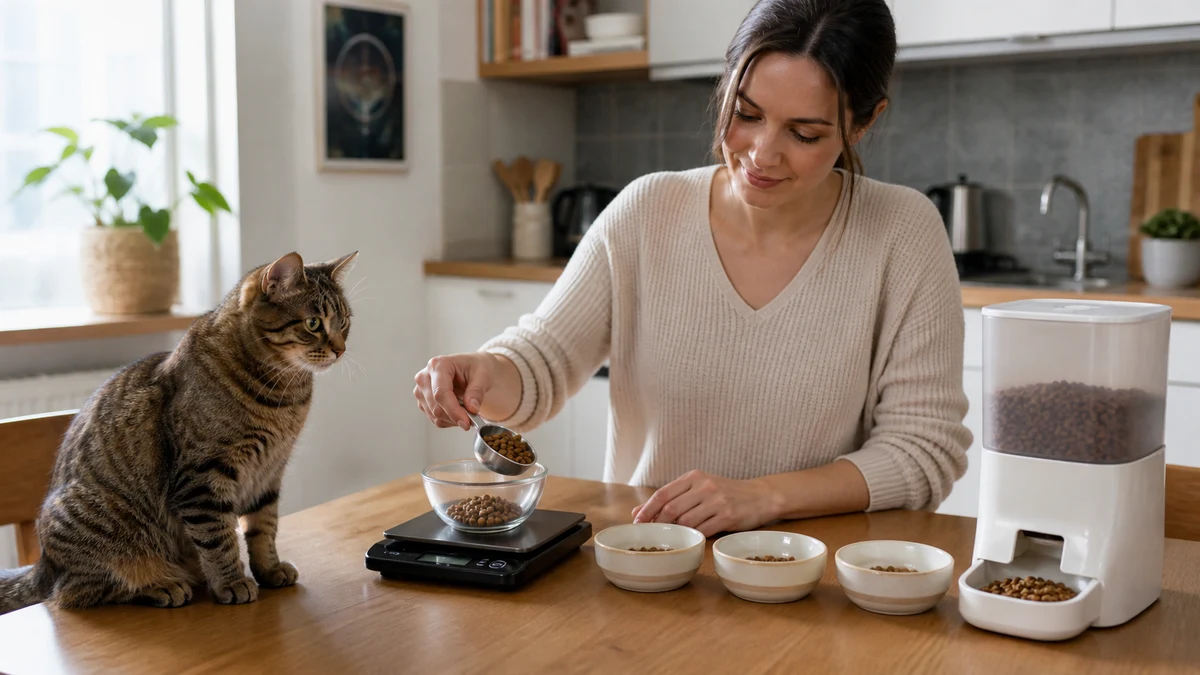
Neither scheduled meals nor free feeding is best for every cat. The most dependable approach is to set and measure a daily total first, then choose when and how to offer it based on body condition, appetite, food safety, relationships between cats, and the caregiver’s schedule. Meals make individual intake easier to see. Free access can be convenient, but it is controlled only when the full-day ration is measurable, leftovers are tracked, and the cat maintains an appropriate body condition. Free feeding does not mean endlessly topping up a bowl, and scheduled feeding does not mean serving the whole day at once.
Keep the daily budget separate from the delivery method. A complete and balanced main diet, package calories, treats, training rewards, and every other food all contribute to total intake. The schedule only determines when, where, and how that food becomes available. A growing kitten, a cat recovering from illness, a cat whose appetite must be closely monitored, or one eating a therapeutic diet needs a plan made with the veterinary team rather than a generic adult-cat schedule from the internet.
Four feeding arrangements that are often confused
Scheduled and free-choice feeding are not the only two settings. Four common arrangements can be used alone or combined:
- Portion-controlled meals: A measured portion is offered at a regular time, then the bowl is removed after the planned meal window. Both the meal amount and daily total are known.
- Divided meals: The daily total is split into several smaller meals. This is still portion control. More meals do not create extra food.
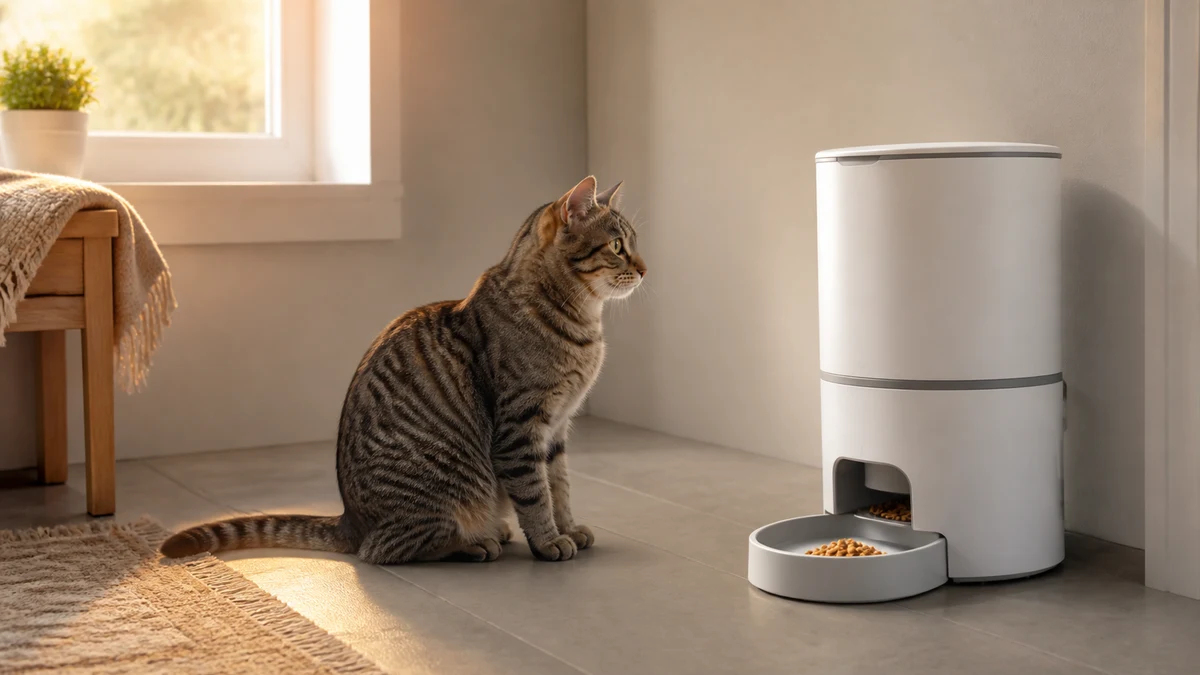
- Automatic feeding: A device opens or dispenses food on a schedule. It is a delivery tool, not a nutrition plan. Someone still has to verify how much goes into the unit and how much it actually releases.
- Free-choice feeding: Food remains available over a long period so the cat can choose when to eat. Controlled free feeding begins with a measured daily ration and a record of top-ups and leftovers; an empty-looking bowl is not permission for an unlimited refill.
A hybrid can work well too. Wet food may be served when a person can handle leftovers safely, while part of the remaining dry-food allowance goes into a timed feeder or food puzzle. That is a mixed schedule, not two complete package feeding amounts added together. For the different tradeoffs between food formats, see our wet versus dry cat food comparison.
Scheduled feeding and free feeding across nine practical dimensions
| Dimension | Scheduled or divided meals | Controlled free feeding | The deciding question |
|---|---|---|---|
| Daily amount | Each meal is measured, so the portions are easier to add | The full-day ration must be measured and leftovers subtracted | Are treats, training rewards, and food from other people included? |
| Appetite changes | A partly eaten or missed meal is usually conspicuous | A decline may be noticed later when food is always present | Does this cat need precise individual appetite records? |
| Body weight and condition | The plan is easy to adjust against trends | It may suit a cat that self-regulates within a measured allowance | Do weight, body condition, and muscle condition confirm that intake is working? |
| Small-meal behavior | The ration can be divided manually or with a feeder | The cat chooses timing, but intake may not be evenly distributed | Are small meals being created without adding calories? |
| Enrichment | Part of a meal can go into safe foraging devices | A bowl in one place may require little activity | Is puzzle food deducted from the daily ration? |
| Wet-food safety | Leftovers can be handled after each meal | Ordinary opened wet food should not sit unrefrigerated all day | Do the label, room conditions, and equipment support safe holding? |
| Individual intake in multi-cat homes | Separate rooms or stations make each cat easier to monitor | A shared bowl cannot show which cat ate what | Can every cat reach its own food without competition? |
| Convenience | It requires a repeatable serving and cleanup routine | It offers more timing flexibility | Can automation help without replacing observation and cleaning? |
| Equipment risk | People can forget or accidentally serve twice | Feeders can jam, lose power, drift in timing, or admit the wrong cat | Has the real output been tested, and is there a backup? |
No row makes one method the universal winner. Measured free access may work for a single healthy cat that regulates intake, maintains an appropriate body condition, and eats food that can be held safely. Scheduled meals usually produce better information when a household needs to monitor appetite, handle wet food, separate therapeutic diets, or prevent one cat from taking another’s share.
Measure the daily total before choosing the clock
Under the U.S. AAFCO model rules, calorie statements use kilocalories per kilogram and a familiar unit such as per cup, can, or pouch. Readers elsewhere should use the equivalent information required on their local labels. As of August 2026, the package feeding directions and calorie statement are useful starting points, not a fixed prescription for every cat. Cornell and WSAVA guidance emphasize that age, activity, body and muscle condition, health, and observed trends affect the amount an individual ultimately needs.
A simple “daily food account” keeps the arithmetic visible:
- Start with the current veterinary plan or the feeding information for an appropriate main food to establish what the cat is expected to receive that day.
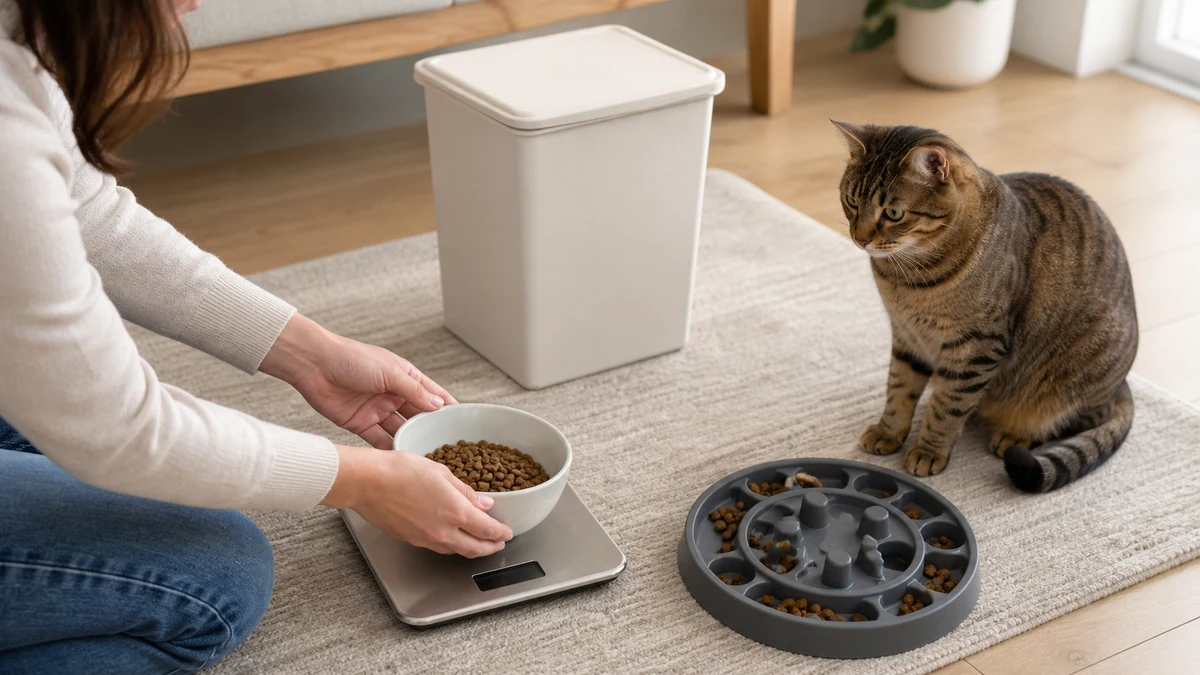
- Use the package’s kcal per gram, cup, can, or pouch to convert that plan into an amount. A kitchen scale often makes dry-food portions more repeatable than a scoop filled to different levels.
- Add treats, training rewards, food used for medication, puzzle-feeder food, and portions supplied by other family members to the same account.
- Measure the entire dry allowance into one container in the morning. Fill bowls, automatic feeders, and puzzles only from that container. When it is empty, the day’s dry allocation has already been distributed.
- Follow weight, body condition, muscle condition, appetite, and leftovers over time. Ask the veterinary team to adjust the plan when those trends change instead of making a large cut or increase alone.
If the planned total is C, while wet food, treats, and other foods contribute W, T, and O, the dry-food remainder is C − W − T − O. That is bookkeeping, not a recommendation for any cat to eat a particular number of calories. Our guide to reading cat-food labels explains where to find nutritional adequacy and calorie information.
The real advantage of meals is data, not discipline
Scheduled meals create repeatable observation points: when food was offered, how much was served, how long the cat ate, and what remained. If a cat normally follows a consistent pattern, eating only part of a meal, avoiding the bowl, or failing to arrive is easier to notice. One leftover meal cannot diagnose a disease. Changes in food, the environment, stress, and health can all alter appetite, so the pattern and the cat’s overall condition matter.
Do not turn “scheduled” into one oversized daily sitting. The Feline Veterinary Medical Association consensus statement describes feline needs that include searching for food, eating frequent small meals, and eating in a safe, private location. A caregiver can keep predictable meal times while splitting the total into smaller servings. A timed feeder can cover dawn, late evening, or working hours. Whenever the number of meals rises, the size of each meal must fall.
A schedule also does not justify waiting out a cat that is not eating. A cat that refuses food, continues to eat less, loses weight, or shows a meaningful break from its normal pattern should be discussed with a veterinarian. Do not assume hunger at the next meal will solve a potentially important appetite change, and do not force an abrupt schedule change on a cat that has not learned the new routine.
Free feeding can be controlled, but a bottomless bowl cannot
Controlled free feeding is not automatically wrong. Cornell notes that some cats may regulate their intake, while free access can lead other cats to overeat and gain inappropriate weight. The management problem grows when the bowl is always present and several people refill it: no one can reconstruct how much was offered, and a multi-cat household cannot tell how much each cat ate.
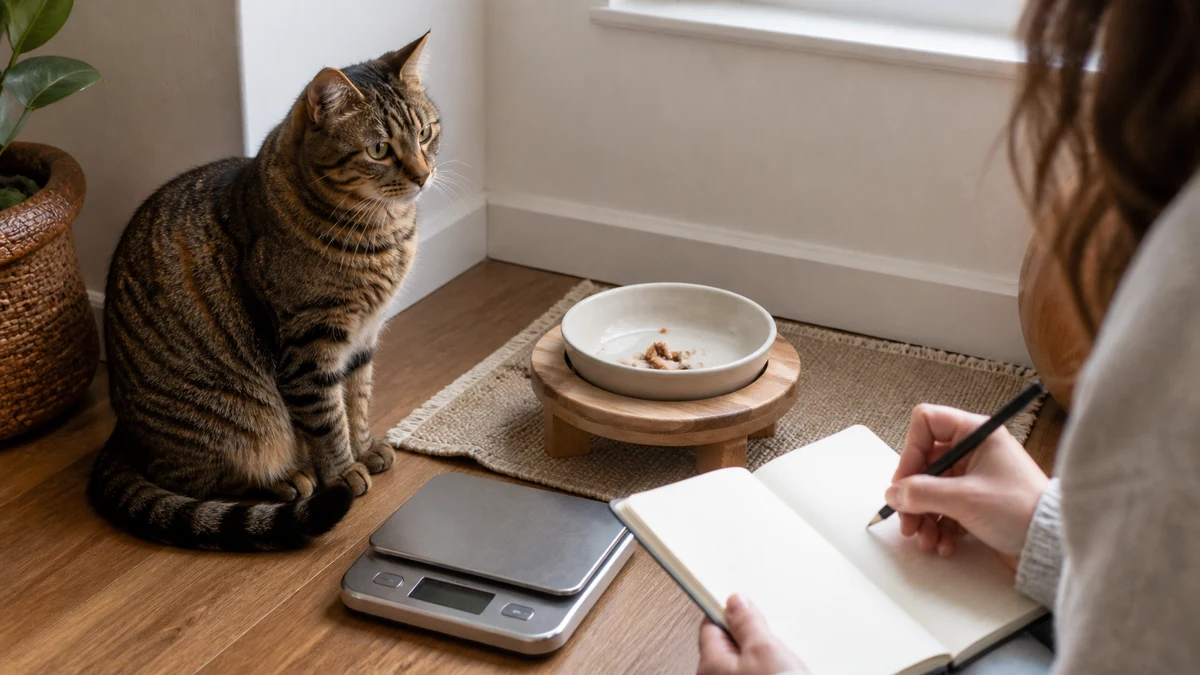
At minimum, a useful free-feeding trial needs four pieces of information: the weight offered each day, the weight left at the end, weight and body-condition trends at consistent intervals, and confidence that the ration belongs to the intended cat. If the daily amount cannot be reconstructed, condition moves in the wrong direction, appetite changes disappear into a shared bowl, or competition changes access, the arrangement is no longer controlled.
The urge to keep a bowl looking full can quietly turn a measured plan into unlimited top-ups. Instead, place the day’s premeasured allowance in a dedicated container at a regular time. Every refill comes only from that supply. At the next reset, weigh the remainder, wash the bowl, and begin a new record. Dry food still needs the storage conditions on its label; “dry” does not mean it can remain indefinitely in a warm, humid, contaminated, or pest-accessible bowl.
Small meals and foraging work with either schedule
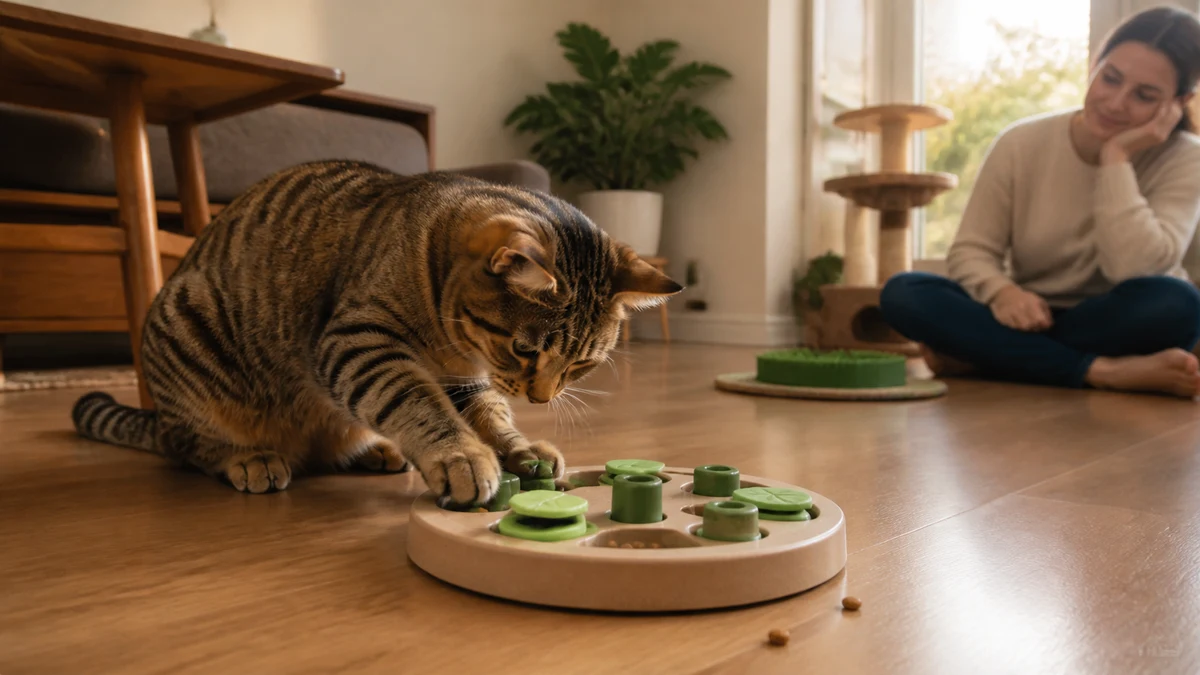
The FelineVMA feeding consensus does not require every household to leave one large bowl out. It encourages opportunities to search, manipulate food, and eat small meals while the daily total remains controlled. Put part of the main diet in an easy stationary puzzle, hide tiny measured portions in safe and countable locations, or use a timer to release small meals. Begin with a device that is easy for the cat to solve, and confirm that the cat can actually obtain the food rather than counting inaccessible food as eaten.
Choose puzzles without loose pieces that could be swallowed, openings that trap a paw, or a design that creates prolonged frustration. Multi-cat homes need more than one resource so a confident cat cannot control the only puzzle. Food enrichment also does not replace social and object play that uses no extra calories; see how to play with your cat through a complete hunting sequence.
Wet-food safety can decide the schedule
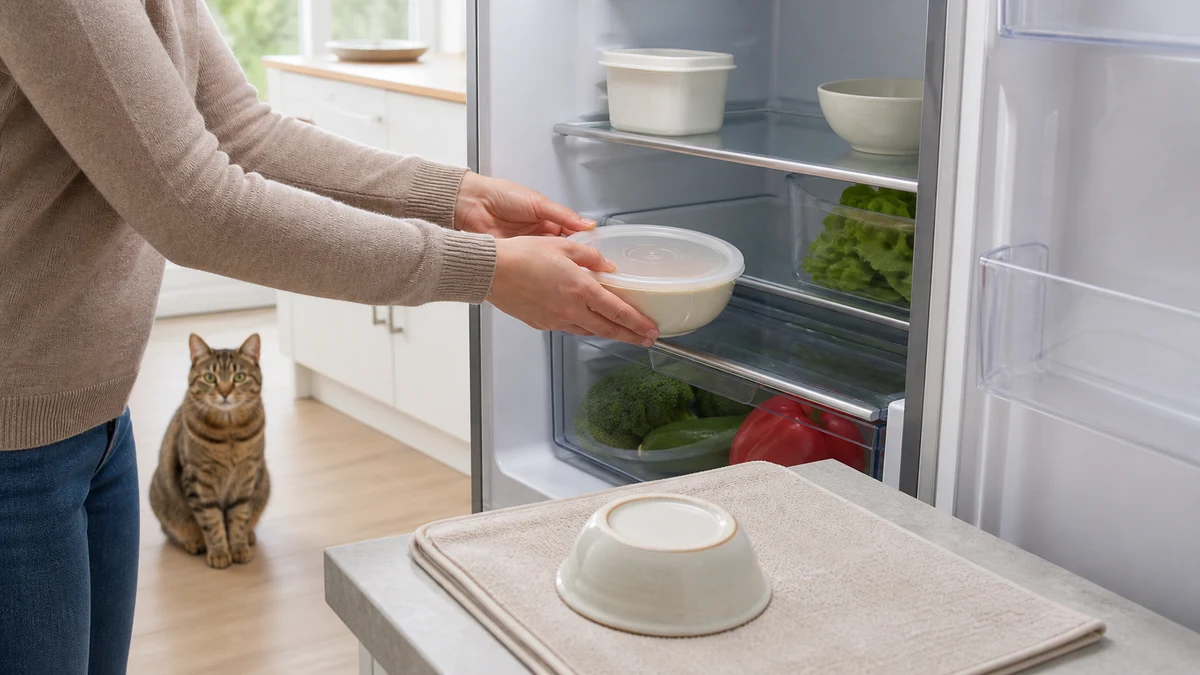
The FDA’s U.S. pet-food safety guidance says to promptly refrigerate or discard unused and leftover canned or pouched food and to keep the refrigerator at 40°F (about 4.4°C) or below. It also advises washing and drying bowls, scoops, and measuring utensils after use. Follow a product label when it is more restrictive. This is why ordinary opened wet food is a poor candidate for unrefrigerated all-day access.
Do not treat one internet rule about a fixed number of hours as a guarantee for every formula, room, and feeder. Ambient temperature, time since opening, ingredients, and the device’s actual cooling performance differ. If a feeder claims refrigerated or cooled storage, follow its instructions, test and clean it, and plan for power loss or a warming ice pack. Without dependable temperature control, reserve wet food for meals that a person can clear promptly.
Dry food needs storage management too. The FDA advises keeping the original package and lot information. If an outer bin is used, placing the whole bag inside preserves that information and limits contact with the bin. Store it somewhere cool, dry, and inaccessible to the cat. Wash and completely dry a container between bags rather than continually mixing new kibble with old crumbs and residual oils.
In a multi-cat home, manage who eats—not just how many bowls exist
One communal bowl is convenient but cannot answer “which cat ate how much?” Obvious stealing is not the only problem. A cat may guard a route or stare from a distance, causing a cautious housemate to wait until late or avoid eating enough. FelineVMA materials advise giving each cat individual food and water resources in separate locations, ideally with visual separation, and checking that no cat controls access.
Several middle-ground options fit different homes:
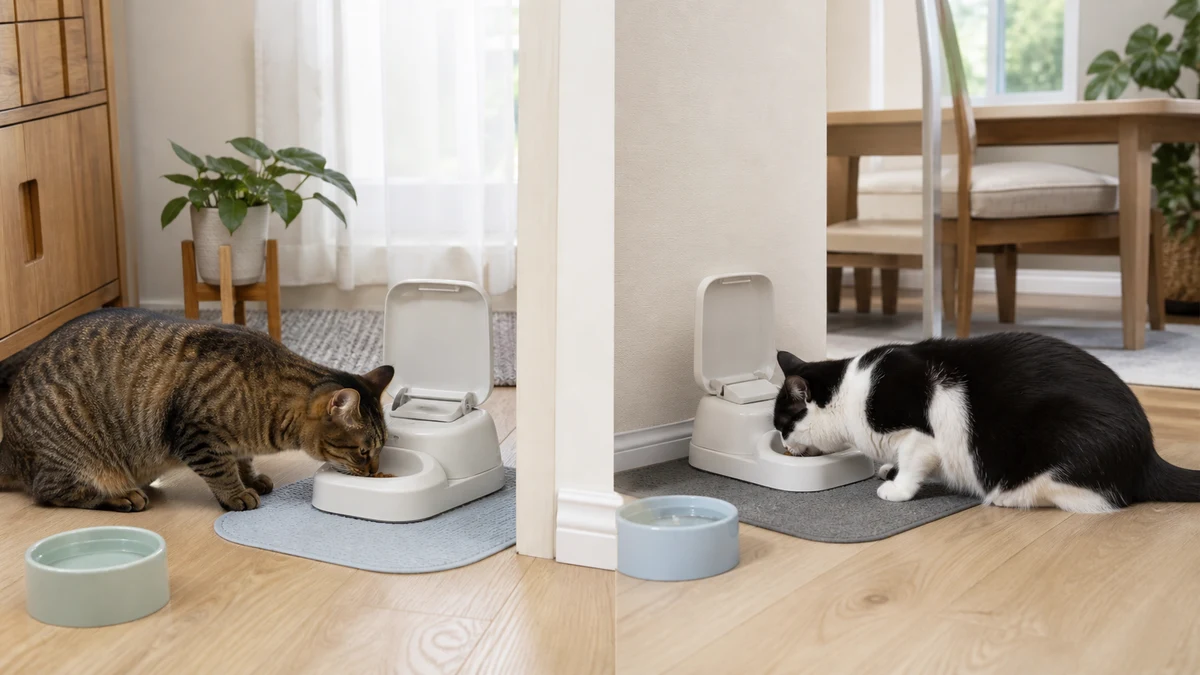
- Feed measured meals in separate rooms, closing doors until each cat finishes and then collecting the bowls. This produces the clearest direct observations.
- Increase distance and use furniture or a screen as a visual barrier when separate rooms are unavailable. Give each cat an open retreat route.
- Use a feeder that recognizes an individual microchip or collar tag for a therapeutic or otherwise protected diet. Watch for a second cat slipping in while the lid is open.
- Serve wet meals by hand morning and evening, then divide the calorie-adjusted dry remainder among individual timed feeders or foraging stations.
- If only one cat needs time to graze, allow that cat a safe private room with its measured allowance while the others keep regular meal times.
Equipment cannot repair a poor location. A selective feeder placed in a dead end can leave a cautious cat vulnerable to being blocked. Two machines side by side are still one defendable resource area. After arranging stations, watch for relaxed approaches, repeated looking over the shoulder, crouched or hesitant eating, route blocking, and whether the correct cat truly consumes the assigned portion.
Test an automatic feeder’s real output, not just its screen
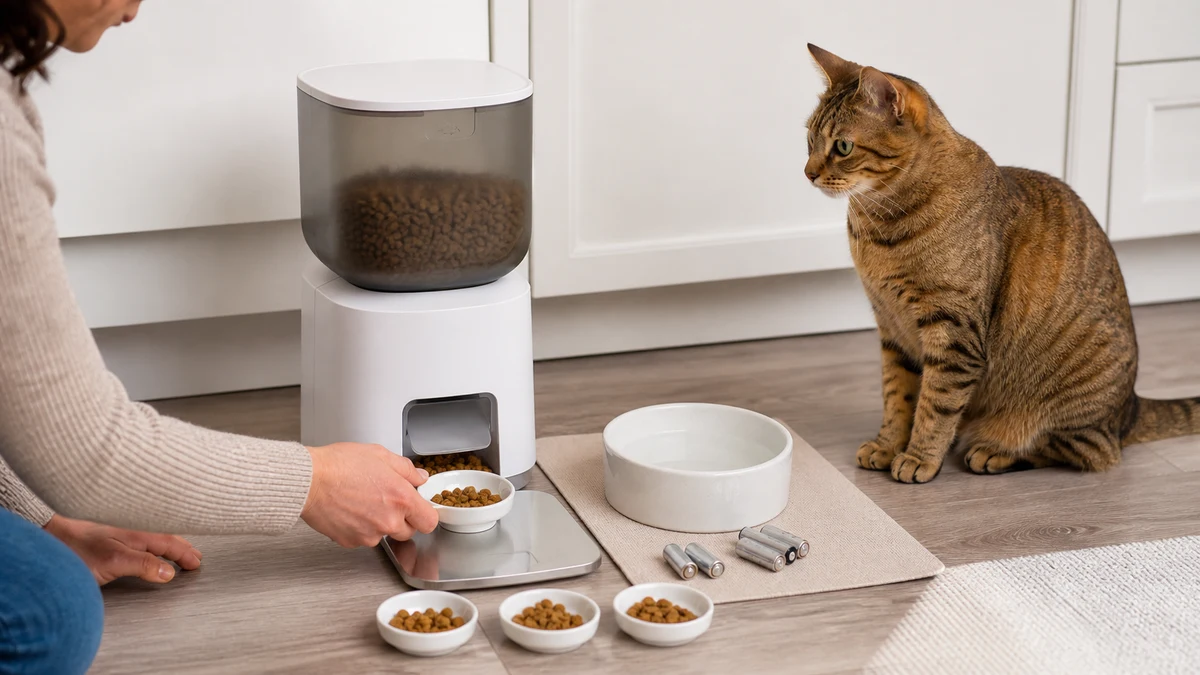
An automatic feeder can cover times when a caregiver is away and can split a daily ration into smaller servings. Failure points include kibble that does not fit the mechanism, portions that differ from the selected setting, a clock or time-zone error, depleted batteries, humidity that makes food clump, and a cat tipping the unit or fishing extra pieces from its chute.
Before depending on it, observe every release for several days and weigh what the machine actually dispenses over a full day. Compare that total with the plan. Retest after changing the food, brand, or kibble shape. Maintain a battery or outage plan, clean all food-contact parts on schedule, and make sure nobody adds a meal because they did not know the machine already served one.
Do not delegate a closely timed therapeutic diet, illness recovery, or precise appetite monitoring to a machine alone. A unit can report a completed cycle even if the cat never approached it, the food jammed, or another cat ate the serving. Ask the veterinary team to design these schedules and to explain what intake change needs a call.
Judge the system by trends, not by a perfect label
A workable feeding method should answer five questions over time: How much was offered today? How much did this cat actually eat? Were leftovers handled safely? What are the weight, body-condition, and muscle-condition trends? Can the people and cats follow the routine consistently? If one answer is repeatedly missing, change the process rather than blaming the cat for having no “self-control” or the caregiver for lacking discipline.
A simple record is enough: date, food weights or container counts, treats, leftovers, unusual appetite, and equipment problems. Use the same scale under similar conditions to follow weight, and ask the veterinary team to confirm body and muscle condition during examinations. One measurement can vary with hydration, timing, and scale error, so respond to a sustained pattern rather than making a large food change after a single reading.
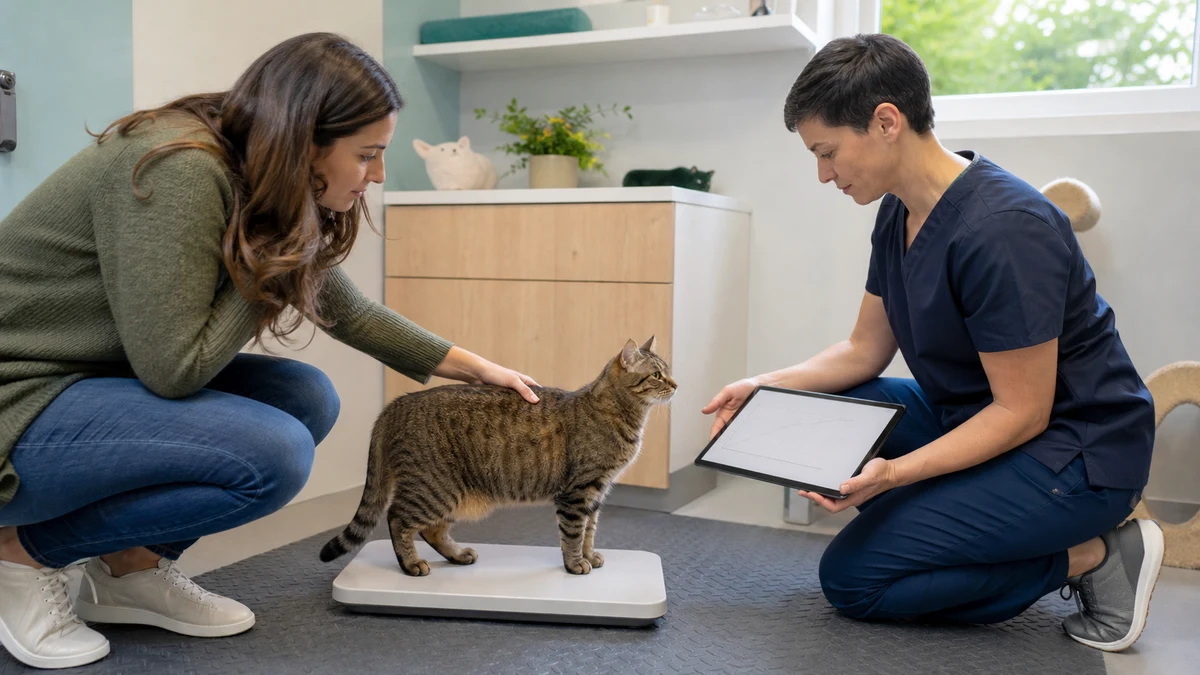
The most practical starting point is often not either extreme but “measure the day, then serve it in parts.” That preserves small-meal behavior and schedule flexibility while keeping total intake visible. A cat doing well with controlled free access, clear individual intake, safe food, and a stable appropriate condition does not need a change merely for the sake of format. When appetite data, multi-cat separation, or wet-food handling matters more, shift more of the allowance into observed meals.
FAQ
Does free feeding always make a cat gain weight?
No. Cornell notes that some cats regulate intake, while others overeat and gain inappropriate weight with free access. The daily ration must be measured, available only to the intended cat, and checked against weight and body-condition trends. A bowl that is refilled without a recorded limit is not controlled free feeding.
How many scheduled meals should a cat have each day?
There is no universal number for every cat. Divide the veterinary-guided daily total into several small meals that the household can deliver consistently; when meal frequency increases, each meal must become smaller. Kittens, recovering cats, cats on therapeutic diets, and cats whose food must coordinate with treatment need a veterinarian-designed schedule.
Can an automatic feeder handle everything while I work long hours?
It can handle some serving times, but a person still has to measure the daily total, verify actual output, clean the unit, inspect leftovers, and confirm which cat ate the food. Test jams, power loss, and unauthorized access while someone is present, and keep a backup for failure.
Can wet food stay in an automatic feeder all day?
Do not assume a lid or ice pack makes that safe. FDA guidance says to refrigerate or discard opened wet-food leftovers promptly. Use the product label and a feeder’s verified temperature-control instructions. Without dependable cooling and a failure plan, serve wet food only when leftovers can be cleared promptly.
How can I tell how much each cat eats in a multi-cat home?
Separate-room meals with recorded leftovers provide the clearest data. Visual barriers, microchip-selective feeders, or individual timed feeders can also help, but observe guarding, tailgating, and route blocking. One shared bowl cannot produce reliable individual-intake records.