Is My Cat Too Fat or Too Thin? Use Body Condition Score to Assess Ideal Weight
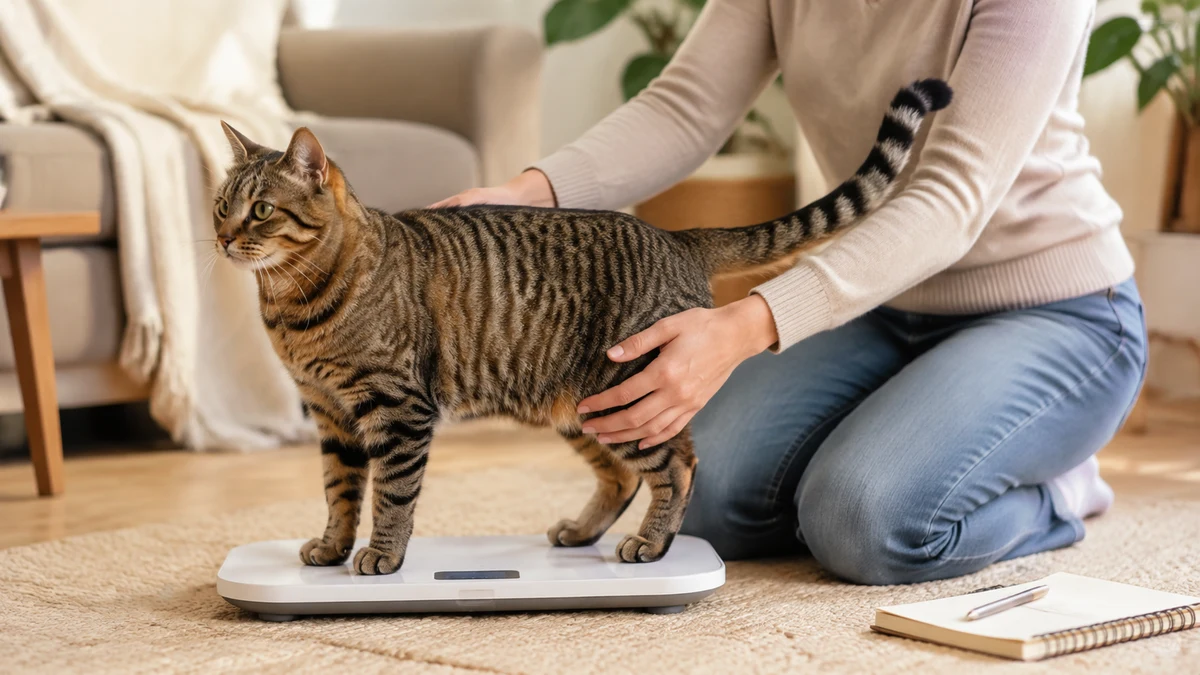
A number on the scale cannot, by itself, tell you whether a cat is too fat, too thin, or at an ideal weight. Combine weight with a standardized body condition score (BCS), a separate muscle condition assessment, the cat’s frame and life stage, and change over time. At home, gently feel the ribs, look for a waist from above, view the abdominal outline from the side, and record what you find on the same scale. Use that record to talk with a veterinarian rather than to diagnose your cat or design a diet alone.
Why body weight is only one part of the answer
Two cats can weigh the same and have very different proportions. One may be a large-framed adult with an appropriate fat covering; another may have a smaller frame and excess fat. A long coat can blur the waist, while a close coat can make contours look sharper. Age and health also matter: an older cat may lose muscle while keeping or gaining fat, so the scale can stay nearly unchanged even as body composition worsens.
This is why the 2021 AAHA nutrition guidelines treat body weight, BCS, and muscle condition score (MCS) as separate findings within a broader nutritional assessment. The history also includes food, treats, activity, environment, and health. BCS estimates fat stores by looking and feeling. MCS evaluates muscle over particular bones. Weight supplies an objective number that becomes most useful as a trend.
Breed labels, coat volume, a broad chest, and a hanging lower-belly flap do not replace those checks. The flap commonly called a primordial pouch can be prominent in a cat at a healthy condition. Judge the rib covering, waist, abdominal contour, and fat distribution together; do not call a cat overweight from the pouch alone.
A calm home body-condition check
Choose a quiet time when the cat is awake and comfortable. Let the cat stand in a natural position on a nonslip surface. Do not hold the cat in a stretched show pose, squeeze the abdomen, or chase a precise score if touch is unwelcome. A partial observation recorded calmly is more useful than a forced examination.
1. Feel the ribs, using light pressure
Place flat fingertips over both sides of the ribcage and move gently through the coat. At an ideal middle score, you should be able to feel individual ribs beneath a light fat covering without digging. Ribs that are sharply visible or prominent with almost no cover point toward a low score. Ribs that are difficult or impossible to find beneath a thicker layer point toward a high score.
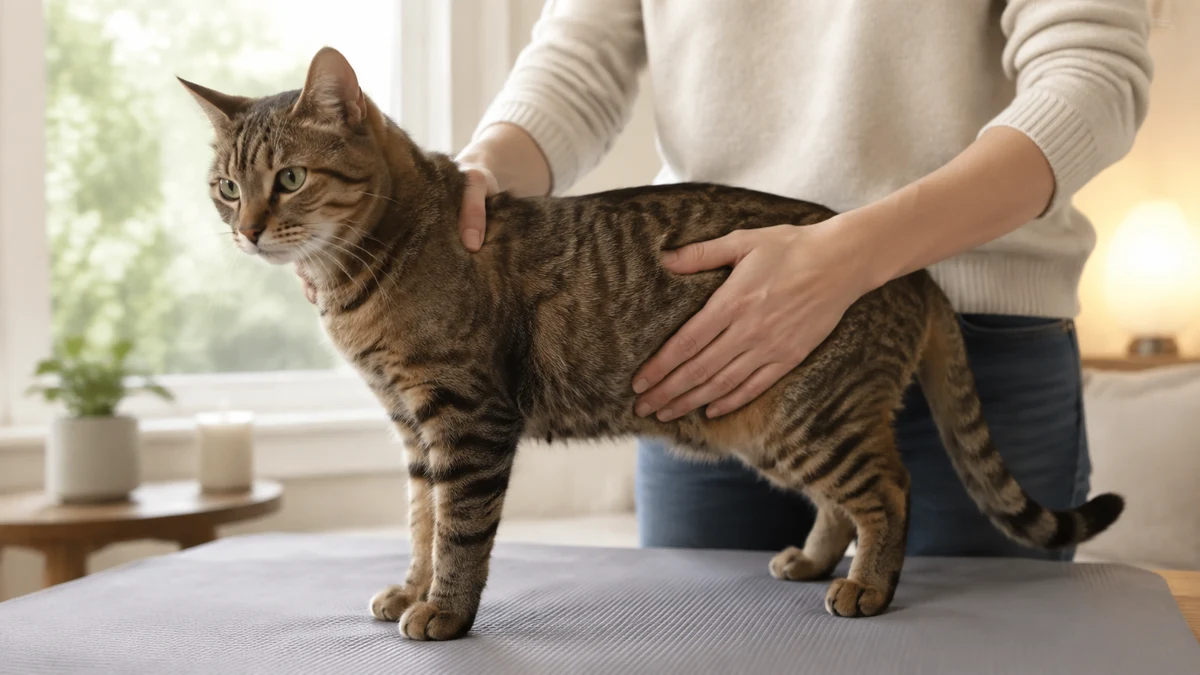
The comparison should be gentle and repeatable, not a pressure test. If the cat flinches, guards an area, seems painful, or resists a touch that was previously accepted, stop and discuss that change with a veterinarian.
2. Look from above for a waist behind the ribs
Stand above the cat only when you can do so safely, or take a level overhead photo while the cat stands naturally. A 5/9 cat usually shows a visible narrowing behind the ribcage. At low scores the waist becomes increasingly pronounced. At high scores the narrowing fades, then disappears as the outline becomes broader or rounder.
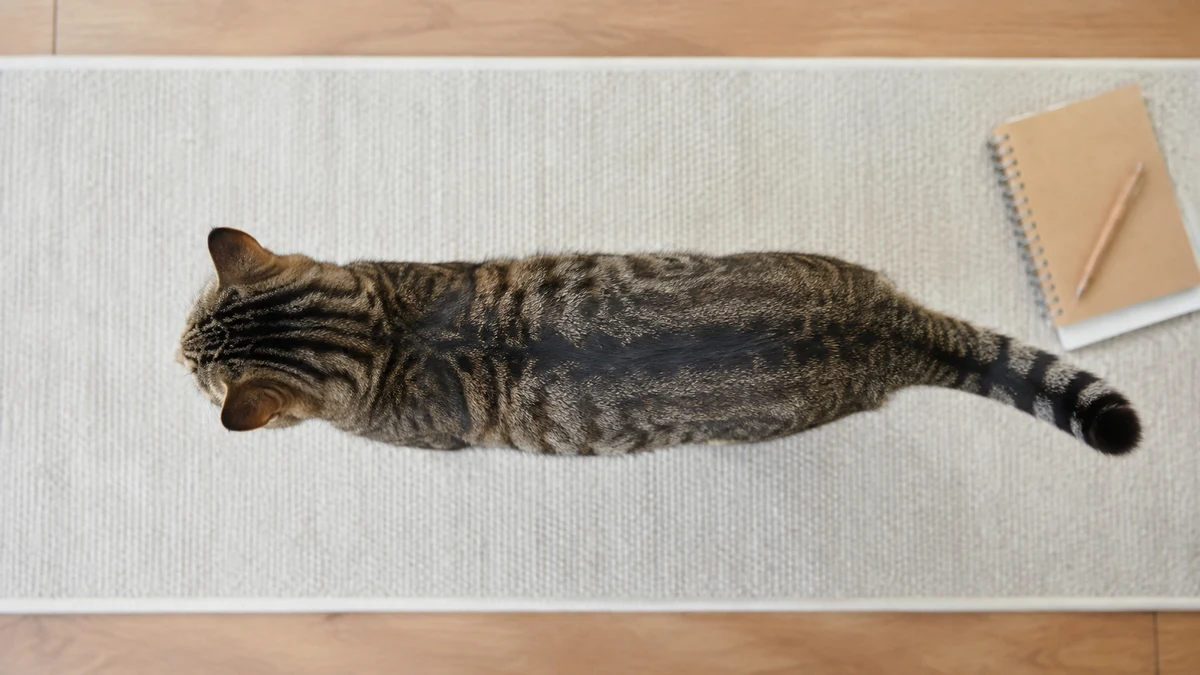
Do not rely on one glance at a curled, crouched, stretched, or fluffy cat. Posture and coat can change the silhouette without changing fat stores. Palpation helps check what the eye cannot see.
3. Look from the side at the abdominal outline
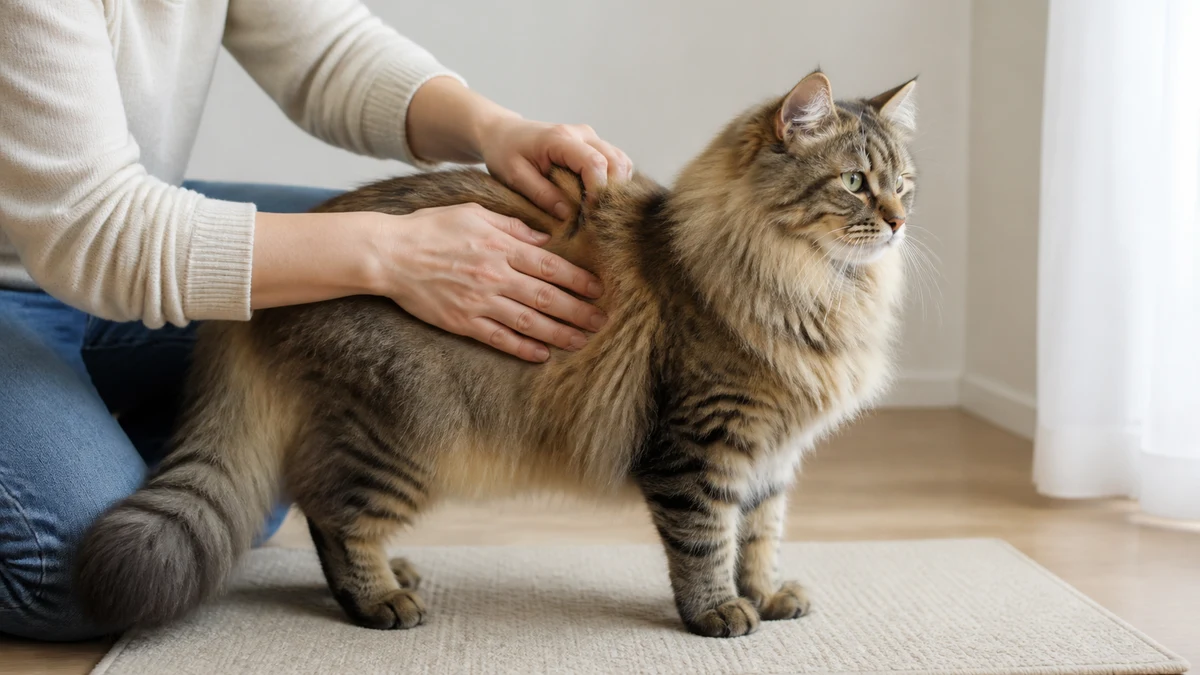
From the side, observe the line from the ribcage toward the hind legs. Lower scores have a stronger upward tuck. Around the middle of the 9-point scale, a modest tuck and only a small abdominal fat pad are expected. Higher scores lose the tuck and develop progressively more rounding and abdominal fat.
The loose primordial pouch may hang or swing independently of the overall outline. Its presence, size, or motion does not assign a BCS. Compare the full abdomen and other scoring sites, then confirm with the rib check.
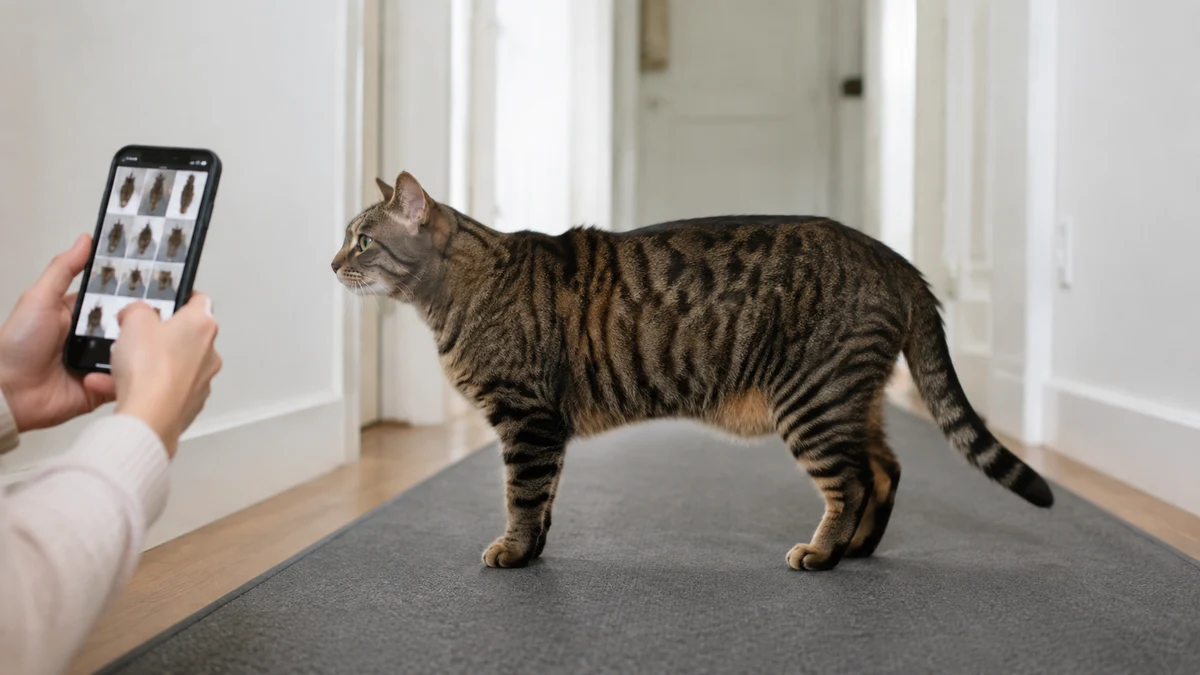
4. Notice fat covering beyond the belly
At higher scores, fat is not limited to the underside. The WSAVA 9-point chart asks the assessor to consider covering over the ribs and deposits around the lower back; at the highest score, deposits may also be evident around the face and limbs. At lower scores, the spine and pelvic landmarks can become increasingly obvious. These findings belong together—one isolated feature should not overrule the rest of the assessment.
5. Assess muscle separately
Body condition scoring is primarily about fat. Muscle condition is assessed by looking and gently feeling over the spine, shoulder blades, skull, and pelvis. AAHA and WSAVA describe muscle as normal or showing mild, moderate, or severe loss. A cat can carry excess fat and still lose muscle, which is why a high BCS does not guarantee good muscle condition.
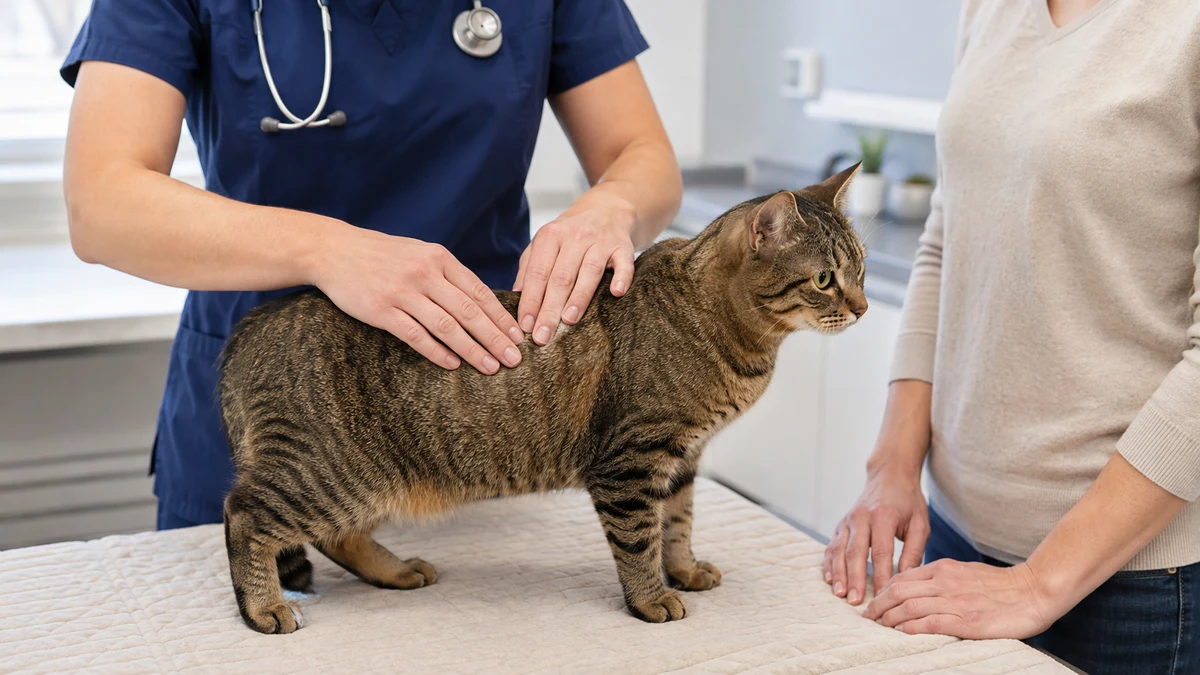
Home observations can flag change, but a veterinarian can teach you where and how to palpate on your own cat. This is especially helpful for a long-coated cat, a senior, a cat with a chronic health problem, or a cat on a supervised weight-management plan.
What the 9-point BCS scale means
Always write the denominator: 5/9, not simply “5.” A score of 3 can mean ideal on a 5-point scale but under ideal on a 9-point scale. AAHA recommends whole-number 1–9 scoring to keep records and conversations consistent. The following is a plain-language guide based on the WSAVA cat chart; it is not a substitute for a hands-on veterinary assessment.
| Score | Rib and bony landmarks | Waist and abdominal outline | Fat-covering interpretation |
|---|---|---|---|
| 1/9 | Ribs may be visible through a short coat; spine and pelvis are very easy to feel | Extreme waist and abdominal tuck | No appreciable fat covering; severely under ideal |
| 2/9 | Ribs and lower-back bones remain obvious | Very pronounced waist and tuck | Little to no palpable fat; markedly under ideal |
| 3/9 | Ribs are easy to feel with only a thin cover; lumbar landmarks are clear | Obvious waist; very little abdominal fat | Lean and under ideal |
| 4/9 | Ribs are easy to feel beneath minimal fat | Noticeable waist and a slight tuck | Near the lean side of ideal |
| 5/9 | Ribs are readily felt beneath a light cover | Proportional waist; small abdominal fat pad | Middle reference point; generally ideal on this chart |
| 6/9 | Ribs are still felt, but extra cover is present | Waist and pad can be found but are less distinct; tuck is absent | Slightly over ideal |
| 7/9 | Ribs take more effort to feel beneath moderate cover | Waist is hard to see; abdomen is rounder with a moderate pad | Clearly over ideal |
| 8/9 | Ribs cannot readily be felt through the heavy cover | Waist is absent; abdomen and pad are prominent | Markedly over ideal; lower-back deposits may be present |
| 9/9 | Ribs are hidden beneath very heavy cover | No waist; extensive abdominal accumulation | Highest score, with broad fat deposits that may extend beyond the trunk |
Low scores: 1–3/9
Low scores reflect too little fat covering, with the ribs, spine, pelvis, waist, and abdominal tuck becoming more conspicuous as the score falls. Do not assume the answer is simply to put out unlimited food. Unplanned weight loss, reduced intake, digestive signs, pain, dental difficulty, stress, and many medical problems require different responses. Arrange veterinary assessment, especially when the change is new or progressing.
Middle scores: 4–5/9
These scores balance ribs that are easy to feel with a visible waist and modest abdominal contour. The exact healthy target for an individual cat is a veterinary decision informed by body frame, age, muscle, health, and history. The useful goal at home is to recognize and preserve the cat’s established healthy pattern—not to make every cat look identical.
High scores: 6–9/9
As the score rises, rib covering thickens, the waist fades, the abdominal tuck disappears, and fat pads or deposits become more evident. AAHA’s feline life-stage guidance classifies 6/9 and 7/9 as overweight and 8/9 or above as obese. That classification calls for a veterinary plan, not shame and not sudden food restriction. Confirm the score and muscle condition before changing the diet.
BCS and MCS answer different questions
A useful record keeps three columns rather than collapsing everything into “weight”:
| Measure | Main question | What it can miss on its own |
|---|---|---|
| Body weight | Is the number changing? | Whether change is fat, muscle, fluid, growth, or measurement variation |
| BCS | How much fat covering is present? | Muscle loss hidden beneath fat or coat |
| MCS | Is muscle over the spine, shoulder blades, skull, and pelvis being maintained? | Total body fat and the objective weight trend |
A senior cat illustrates why this matters. Aging and chronic illness can be associated with muscle loss. A stable reading on the scale may hide a shift from muscle toward fat, while weight loss can include valuable lean tissue rather than only excess fat. AAHA’s senior guidance therefore recommends evaluating body and muscle condition together. A caregiver should not pursue a falling number at the expense of muscle.
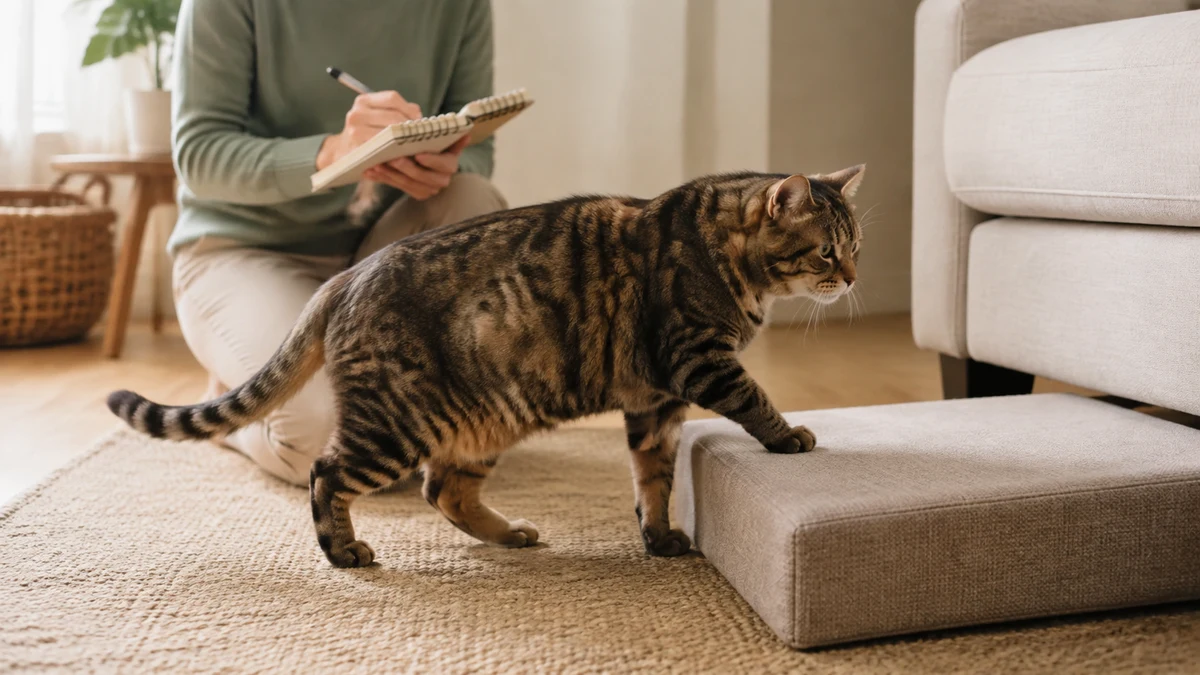
Build a record that can reveal a trend
One home score is subjective; a consistent series is much more informative. These principles make comparisons fair:
- Use the same scale and write the scale name. Record BCS as a fraction, such as 5/9, and keep using the same 9-point reference unless your veterinarian changes it.
- Keep the observer consistent. When possible, have the same person perform the rib check and assign the score; different hands may judge covering differently.
- Use the same weighing setup. Place the same scale on the same hard, level surface, check that it reads zero, and use the same unit.
- Choose a similar time and context. Compare at roughly the same relation to meals and routine bathroom use rather than mixing random conditions.
- Take matching views. Photograph from directly above and from the side, in the same place, lighting, distance, and natural standing posture.
- Record weight, BCS, and MCS together. Add appetite, activity, mobility, medications or diet changes, and anything else that may explain a shift.
- Follow a veterinarian-agreed interval. More frequent measuring is not automatically better; use a schedule appropriate to the cat and the purpose of monitoring.
- Compare the trend, not one odd reading. Repeat a surprising measurement before reacting, then contact the veterinary team if the direction persists or other signs appear.
- Protect the cat’s comfort. Stop if weighing or touching causes fear, pain, or conflict. Ask the clinic for a lower-stress alternative.
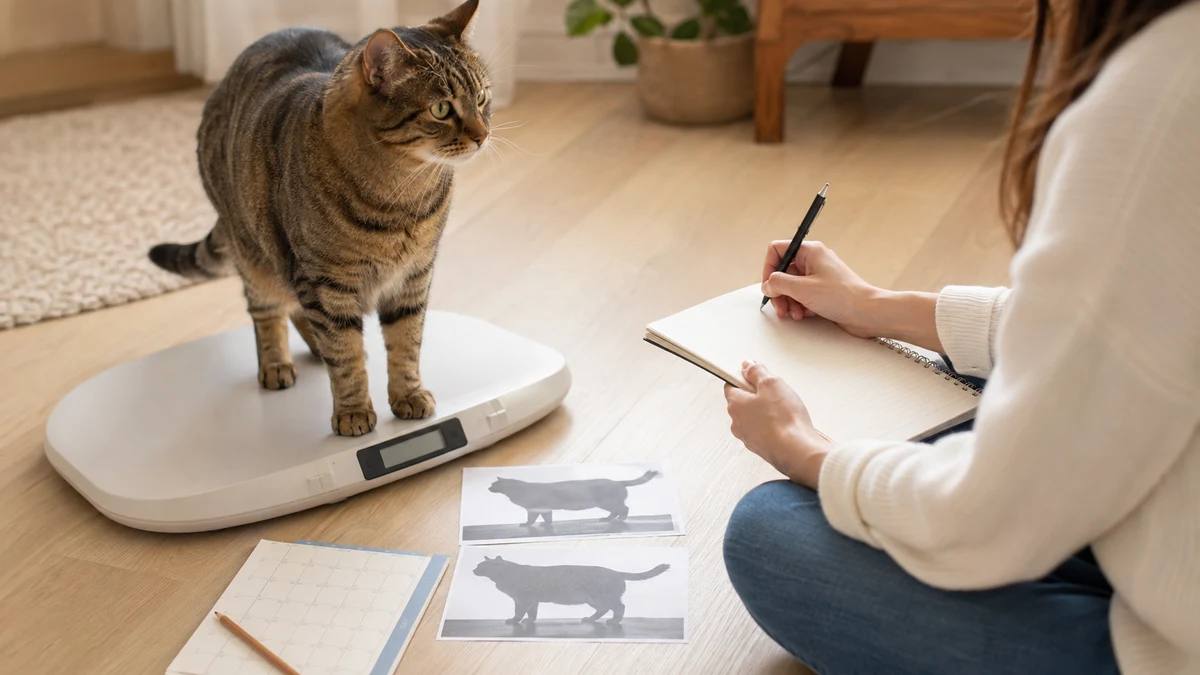
For routine monitoring, the aim is not to collect perfect data every day. It is to produce comparable observations that a veterinarian can interpret. If you are already following a clinical plan, use that team’s interval and thresholds rather than replacing them with a general online schedule.
Changes that deserve veterinary advice
Contact a veterinarian when you see a meaningful change from the cat’s baseline, even if you cannot assign an exact BCS. Useful reasons to call include:
- sudden or unexplained weight loss;
- sudden or unexplained weight gain, abdominal enlargement, or swelling;
- persistent decrease, increase, or other change in appetite, and especially refusal to eat;
- lower energy or activity, withdrawal, weakness, or a marked change in normal behavior;
- new trouble jumping, walking, using stairs, grooming, or entering the litter box;
- visible or palpable muscle loss, particularly over the spine, shoulders, skull, or pelvis, even if weight is stable;
- repeated vomiting, diarrhea, or another digestive change alongside a weight or appetite shift;
- coughing, rapid or labored breathing, open-mouth breathing, or reduced exercise tolerance.
Breathing difficulty, collapse, blue-grey or very pale gums, severe weakness, or a rapidly worsening condition needs urgent veterinary guidance. Do not delay an emergency call in order to finish weighing, photographing, or scoring the cat.
Veterinary guidance treats unexpected weight or appetite changes as reasons for evaluation. Cornell notes that a cat refusing food while losing weight should be examined. These patterns can have many possible explanations; the list above is a triage guide, not a diagnosis.
If the score is high, do not improvise a crash diet
An overweight cat benefits from an individualized plan that accounts for current diet, all treats and extras, health conditions, activity, target condition, and muscle preservation. The number of calories and rate of change belong to that plan. This article deliberately does not calculate a personal calorie allowance.
Avoid five unsafe shortcuts:
- do not pursue rapid weight loss;
- do not starve a cat or abruptly slash the usual ration;
- do not copy a calorie target from another cat or a generic calculator without veterinary review;
- do not use human weight-loss products, supplements, or medications;
- do not stop, swap, or reduce a prescription diet without the prescribing veterinary team’s guidance.
Rapid weight loss can be dangerous in cats, and Cornell specifically warns against sudden starvation diets because of hepatic lipidosis risk. Simply feeding much less of an ordinary maintenance food can also unbalance nutrient intake. A veterinarian may recommend a purpose-formulated food, measured portions, activity changes, or other steps after assessing the individual cat.
If treats or unmeasured access are part of the history, start by writing down the complete picture rather than guessing. Our same-language guides to daily cat treats and scheduled versus free feeding can help you prepare questions, but neither replaces a veterinary weight plan. If activity is appropriate for the cat, interactive play can support enrichment without turning food restriction into the only tool.
If the score is low, do not assume “more food” solves it
A low score or downward trend needs context. Confirm the measurement and note how much the cat is actually eating, but do not force-feed, abruptly change a prescription diet, or delay assessment while experimenting. Appetite, swallowing, dental comfort, digestion, pain, medication effects, chronic disease, competition with another animal, and access to food are examples of information a veterinarian may need to sort through.
If the cat has stopped eating or intake has fallen, use our cat not eating triage guide to organize immediate observations and contact a veterinarian. It is not safe to wait for a visibly dramatic change in body condition before asking for help.
What to bring to the veterinary visit
Bring the log, the scale model or a photo of it, top and side images, the exact food names and labels, measured amounts offered and left, treats, supplements, feeding access, and relevant behavior changes. Include the dates of any diet, medication, household, or activity changes. The veterinarian can repeat BCS and MCS, compare your scale with the clinic scale, examine the cat, and decide whether further evaluation is needed.
Useful questions include:
- Which scoring scale are we using, and what BCS and MCS did you record today?
- What range is appropriate for this cat’s frame, life stage, and health?
- Is the change mainly fat, muscle, or something that needs further investigation?
- How often should I weigh, photograph, and reassess this cat?
- Which specific change should make me call sooner?
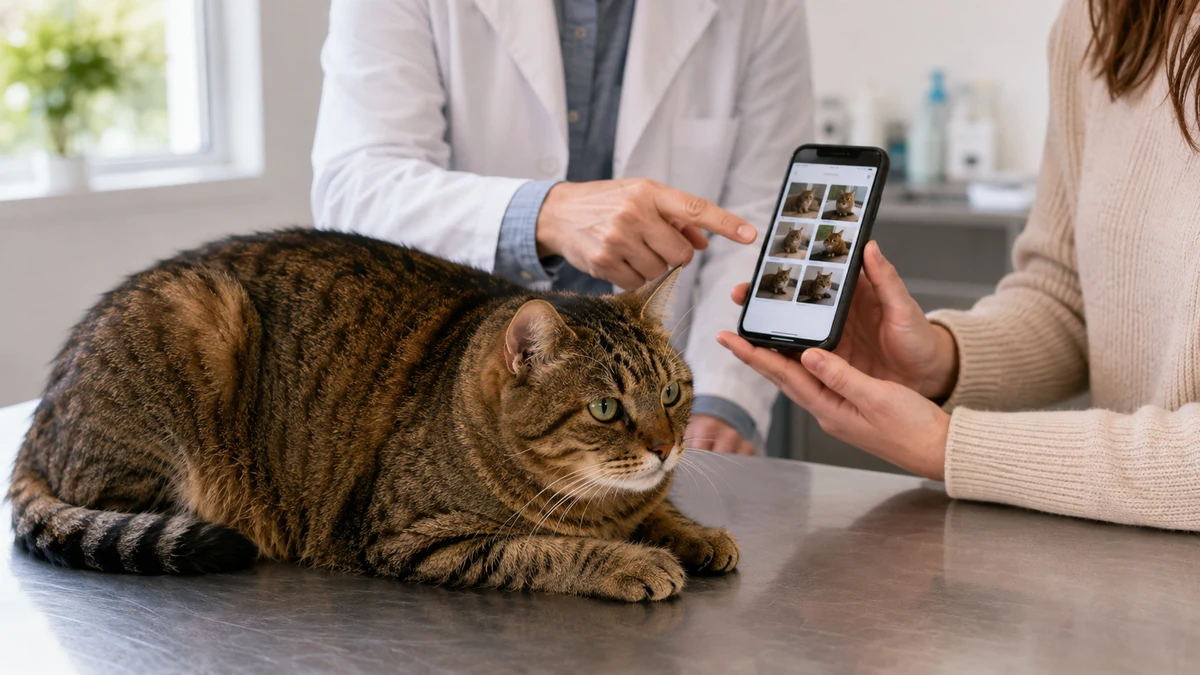
The most useful “ideal weight” is not a universal breed number. It is a veterinarian-supported target tied to this cat’s body and muscle condition, health, and repeatable trend.
Frequently asked questions
Can I tell whether my cat is overweight just by weighing them?
No. Weight is an objective measurement, but it must be interpreted with body frame, BCS, MCS, life stage, health, and previous measurements. Two cats at the same weight can have different fat and muscle proportions.
What BCS is considered ideal on a 9-point cat scale?
The WSAVA chart uses 5/9 as its central ideal description, with ribs easy to feel under a light covering, a visible waist, and minimal abdominal fat. An individual target should still be confirmed with a veterinarian, especially for a senior or a cat with a health condition.
Does a hanging primordial pouch mean my cat is fat?
No. A primordial pouch is a normal lower-abdominal flap and can be noticeable in a cat at a healthy condition. Do not score the pouch by itself; assess ribs, waist, overall abdominal outline, fat distribution, and muscle.
Can an overweight cat also be losing muscle?
Yes. BCS estimates fat while MCS evaluates muscle, and AAHA states that the two should be assessed separately. Excess fat or a long coat can conceal muscle loss.
How often should I weigh and score my cat?
Use the interval your veterinarian recommends for the cat and the reason for monitoring. Keep the scale, timing, observer, scoring system, photos, and recording method as consistent as practical. Contact the clinic sooner if a meaningful change or another concerning sign appears.
Should I reduce food immediately if my cat scores above ideal?
Do not start a crash diet or apply a generic calorie target. Confirm the score and muscle condition with a veterinarian, provide a complete diet history, and follow an individualized plan that protects nutrient intake and muscle while avoiding rapid loss.