Why Do Cats Knock Things Off Tables? Exploration, Play, and Attention
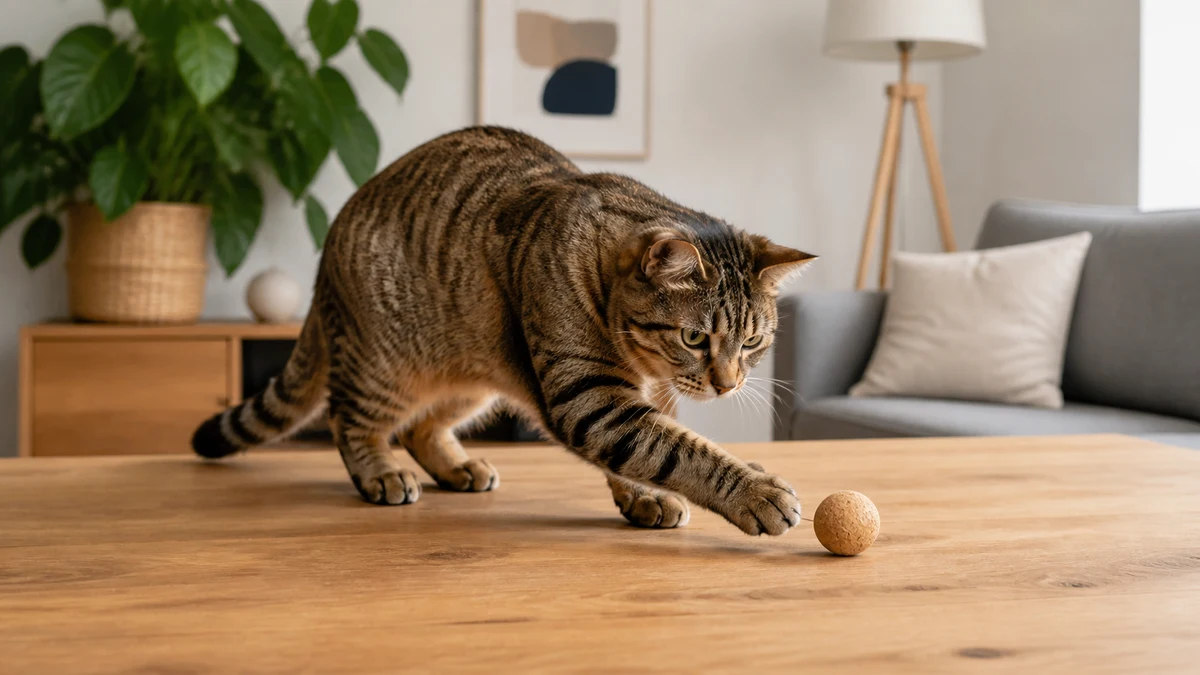
Cats usually knock things off tables because a pawed object gives them something interesting to investigate, chase, or make happen—and sometimes because the human response that follows has become predictable. One episode cannot reveal a cat’s motive. The useful question is not “Is my cat testing gravity or getting revenge?” but “What happened before the paw reached out, what changed when the object moved, and what happened next?” Once you identify that pattern, you can protect hazards, provide a safer outlet, and stop accidentally making the tabletop performance rewarding.
A cat who taps a pen once and walks away may be investigating. A cat who crouches, tracks the rolling pen, and pounces after it drops may be playing. A cat who looks at a sleeping person, pushes an object, then runs toward the food area may have learned a sequence. The same visible action can therefore serve different functions on different days.
Start with the behavior you can actually see
Describe the sequence without adding a story. The cat approaches a surface, sniffs or looks at an object, reaches with one paw, and touches it. The object shifts, rolls, makes a sound, or falls out of sight. The cat may watch it, follow it, repeat the tap, look toward a person, or leave.
That description is already informative. It tells you whether movement itself held the cat’s attention, whether a particular material or sound mattered, and whether a human consequence followed. It does not prove the cat understands gravity as a scientific concept, wants to punish anyone, or planned to break the object.
VCA’s veterinary-authored guide to play and investigation describes kittens swiping, batting, and propelling movable objects with a paw. Object play is believed to help develop eye–paw coordination and hunting skills. Adults also retain play and exploration needs, although individuals differ greatly in what they find interesting and how often they play.
Five possible functions or contexts
These explanations can overlap. Treat them as hypotheses to test against a record, not personality labels.
1. Investigating an object
Cats explore new objects and changes in their environment. A light item responds immediately to a cautious paw: it changes position, texture, sound, and sometimes disappears beyond the edge. A cat may tap once, sniff the new position, and move on. This fits investigation better than a long pursuit.
The attraction may be specific. A cork rolls differently from a key ring; a crinkly wrapper sounds different from a wooden block. Avoid claiming that every tap has one sensory purpose. Observe which materials receive attention and whether novelty fades after a few exposures.
2. Creating prey-like movement and object play
Small movable objects can invite parts of the feline play sequence: orienting, stalking, pawing, chasing, pouncing, and biting. VCA notes that cats are attracted to objects they can bat or propel, while the FelineVMA environmental guidelines recommend regular opportunities for play and predatory behavior.
The drop itself can extend the event. An object rolls, bounces, vanishes, or becomes available to chase on the floor. That does not mean the cat planned a physics experiment. It means movement created another play opportunity.
3. Producing an interesting effect
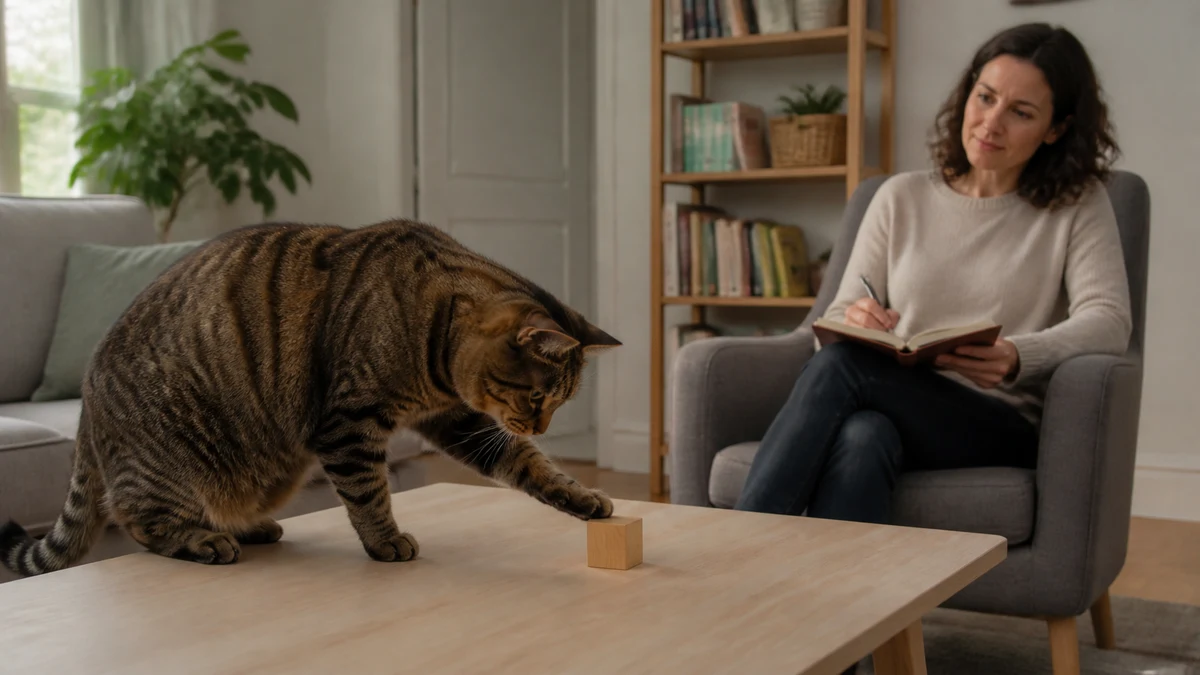
Some objects give immediate feedback even when the cat does not chase: a hollow cup resonates, paper rustles, and a pen changes direction with each touch. Repetition may be maintained by the effect itself. This is a cautious behavioral description, not proof that the cat feels boredom, mischief, or satisfaction in a human sense.
4. Reaching a learned human outcome
Attention is not always the original reason, but it can become part of the pattern. If every push makes a person speak, jump up, chase the cat, refill a bowl, open a door, or start a game, the consequence may increase the chance of repetition. FelineVMA’s training materials specifically include knocking items from dressers or shelves among behaviors that can wake caregivers, and explain how feeding afterward can inadvertently teach the sequence.
“Attention-seeking” should therefore mean a consequence-supported pattern, not mind reading. Look for the cat checking your location before the push, performing mainly when you are available, or moving toward a predictable resource afterward.
5. An easy activity in an under-supplied routine
A bare routine can make whatever moves on a table unusually valuable. This does not prove that every cat who knocks an object is under-stimulated. It does suggest a practical test: add predictable interactive play, safe object play, food searches, climbing, perching, scratching, and toy rotation, then see whether the pattern changes.
If the behavior appears around dawn, before a normal meal, after a long quiet period, or only in one room, timing and access may matter as much as the object.
It is not automatically revenge—or “testing gravity”
Revenge assigns a moral intention that the sequence cannot demonstrate. The cat may have learned that one action changes the environment or mobilizes a person, but learning a consequence is not the same as plotting to upset someone. Shouting “you know better” adds emotion without identifying the trigger or teaching a safer action.
“Testing gravity” is a memorable internet joke, not a universal scientific conclusion. Gravity makes the object fall, of course; the unsupported leap is claiming that every cat pushes objects in order to study that law. Exploration, object play, sensory feedback, and learned consequences explain the observations more directly while leaving room for individual variation.
Use a five-field log instead of guessing
The Merck Veterinary Manual recommends considering the ABCs of a behavior: what happened before it, the behavior itself, and what happened immediately afterward. For tabletop pushing, expand that into five fields for seven to fourteen days.
| Field | What to record | Useful example |
|---|---|---|
| Object | Material, size, weight, whether it rolls or makes sound | Empty plastic cap; light; rolls; not safe to leave out |
| Time | Clock time and relation to meals, sleep, or play | 5:45 a.m.; 20 minutes before breakfast |
| Location | Exact surface and nearby resources | Bedroom dresser beside the bed |
| Antecedent | What happened in the minute before the paw movement | Caregiver asleep; cat had vocalized twice |
| Consequence | Object movement plus every cat and human response | Cap fell; caregiver stood up; cat ran to kitchen; food followed |
Record neutral facts, including days when the opportunity existed but the behavior did not occur. A short video that includes the object, cat’s whole body, and human response can reveal more than a close-up of the falling item.
Patterns guide different tests. Repeated chase after a rolling object supports a play outlet. One careful tap of every newly placed item fits investigation. Early-morning pushing followed by food suggests changing the feeding sequence. Frantic repetition with pacing or other stress signals deserves a wider look at the environment and health.
Make the surface safe before training anything
Management is not surrender; it prevents one repetition from becoming an injury or poisoning emergency.
- Put breakables away. Move glass, ceramics, framed photos, hot drinks, candles, and sharp tools into closed storage or beyond access. Do not rely on learning after an object shatters.
- Lock up medicines and chemicals. Cornell warns that cats may eat pills found on tables or floors and advises prompt veterinary contact after a suspected toxic exposure.
- Secure batteries and swallowable pieces. Button batteries, earplugs, jewelry, rubber bands, hair ties, pins, and craft parts do not belong on an accessible surface.
- Control strings and cables. Cats Protection warns that swallowed string can cause life-threatening intestinal problems. Use cable covers or clips, and store ribbon, thread, yarn, and wand toys after supervised use.
- Stabilize heavy objects. Anchor a monitor, lamp, speaker, plant pot, or freestanding shelf if a collision could pull it down. Keep climbing routes away from hot appliances and unstable stacks.
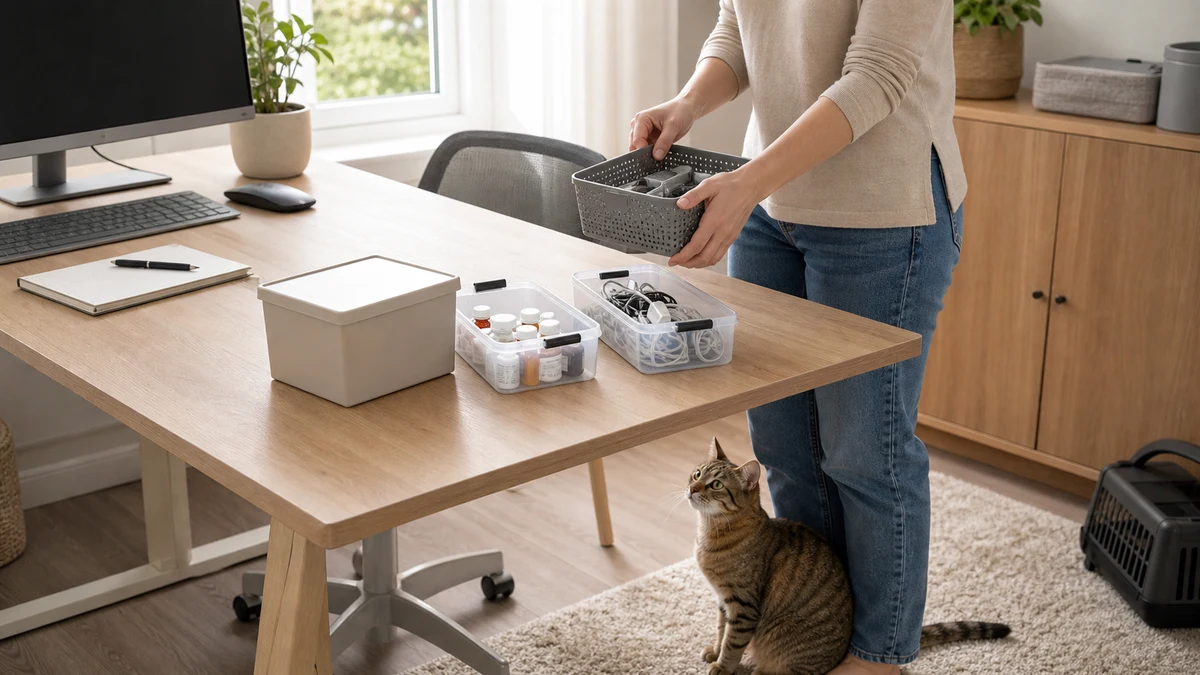
If a cat may have swallowed a battery, medication, string, sharp item, or unknown substance, contact a veterinarian or animal poison service promptly. Do not induce vomiting unless a veterinary professional specifically directs you to do so.
Provide legal ways to bat, chase, and investigate
Removing objects works better when the environment still offers choices.
Create a safe batting station
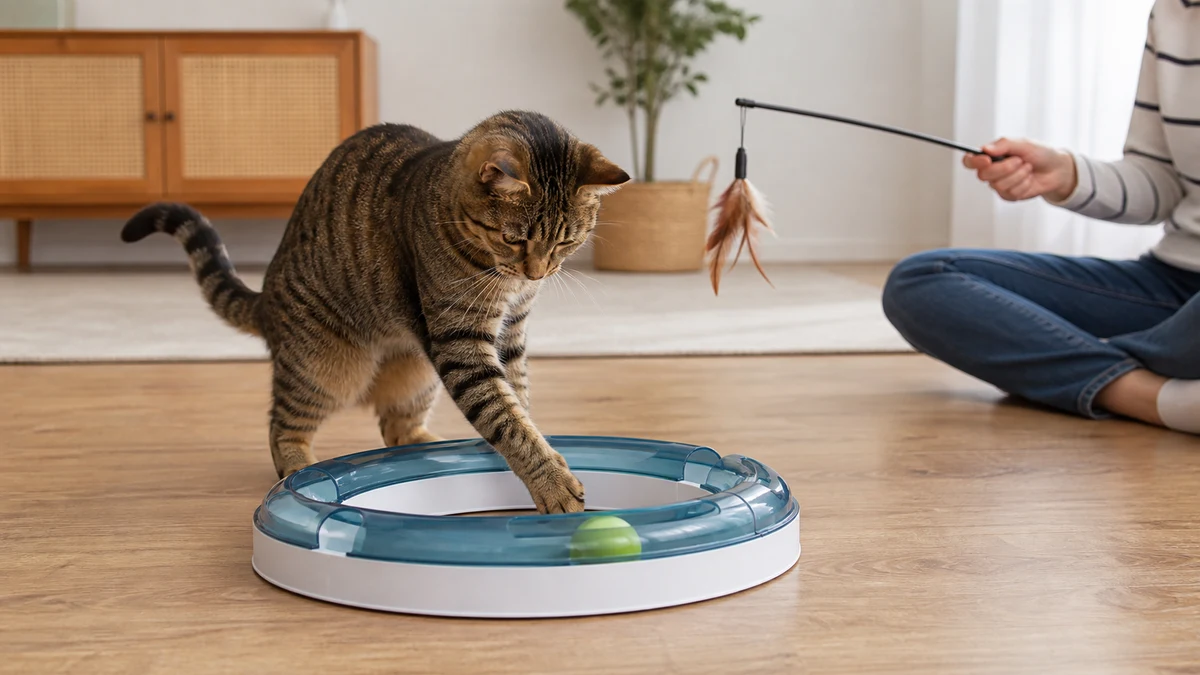
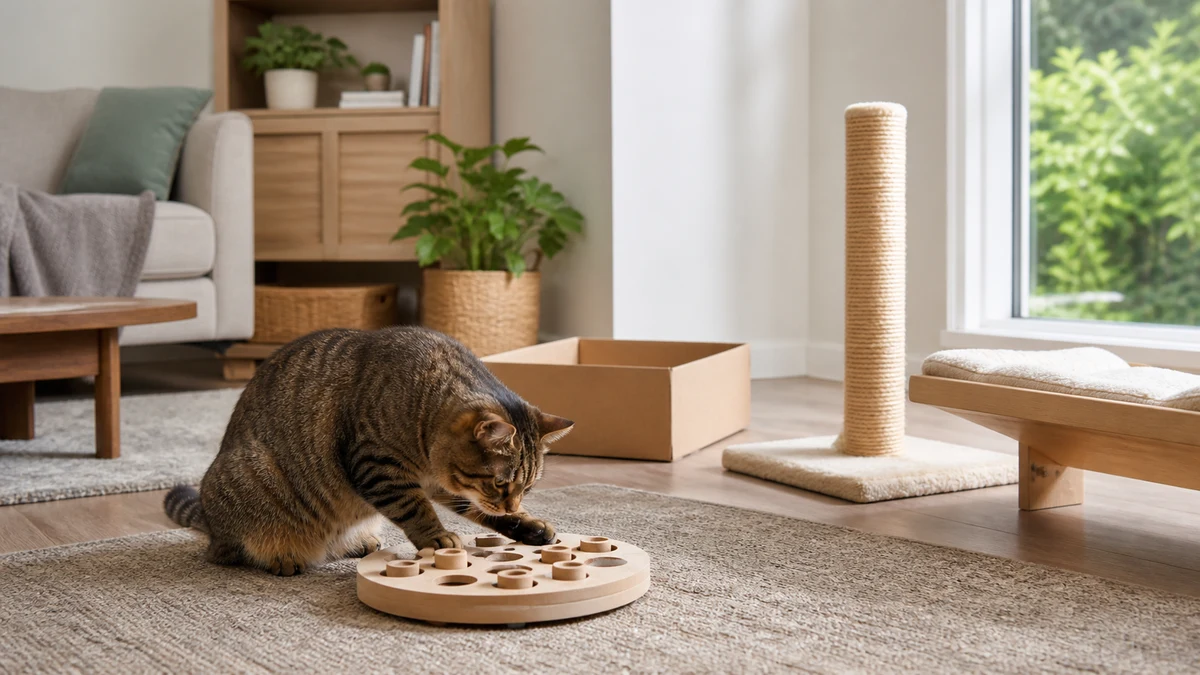
Use a sturdy track toy with a captured ball, a large lightweight toy that cannot be swallowed, or crumpled paper large enough for supervised chase. Put it on the floor or another approved surface away from stairs, glass, and cables. Inspect toys for loose parts and wear.
Schedule interactive play and allow capture
Move a wand toy away from the cat like prey, vary speed, pause behind cover, and let the cat catch it intermittently. Feline environmental guidelines emphasize opportunities for pseudo-predatory play and capture. Several brief, predictable sessions are usually more useful than waiting for the cat to create a crisis before play begins. Hands and feet should never be the prey; see the guide to cats attacking feet for a fuller redirection plan.
Rotate rather than pile up toys
Keep only a few safe options available and exchange them regularly. Add cardboard boxes without staples, a stable perch, a tall scratching surface, and an appropriate food puzzle using part of the cat’s normal daily food. Cats who like manipulating objects may find a puzzle feeder especially relevant.
Reinforce a preferred place and action
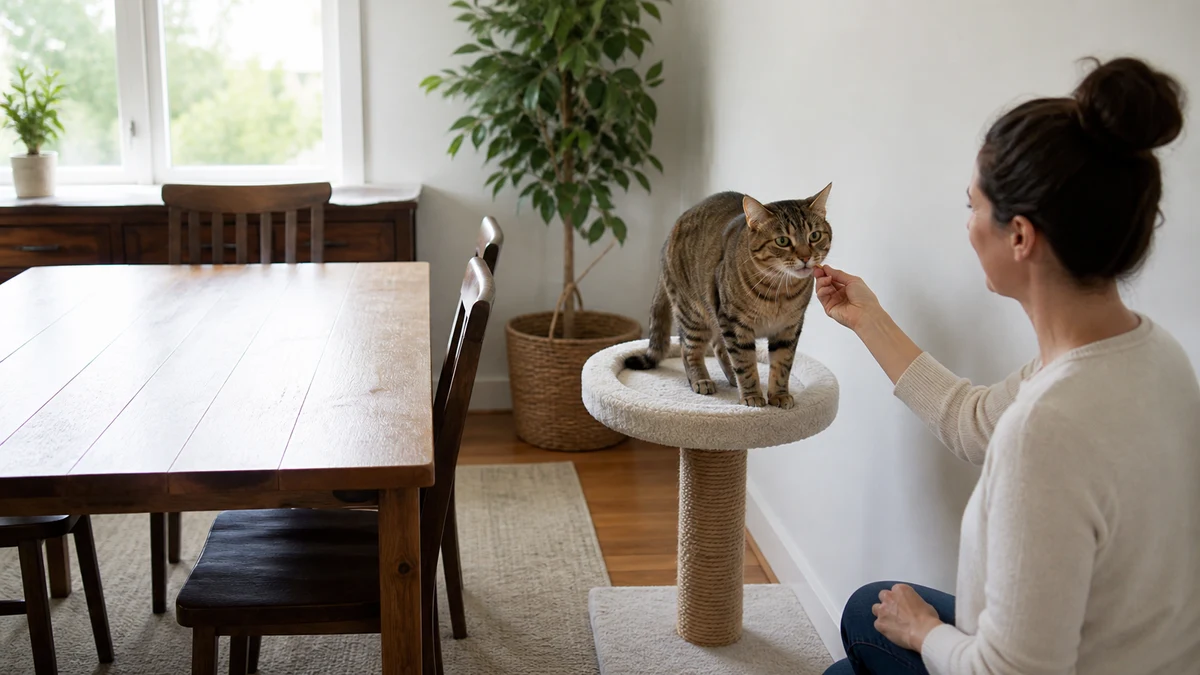
Teach a mat, stool, cat tree, or perch beside the activity area. Reward the cat after four paws reach that location or after the cat engages with the approved toy. Do not wave a treat immediately after an object falls; that risks creating “push, then collect payment.” Rewarding the alternative creates a clearer route.
For repeated pre-breakfast episodes, a timed feeder can separate food from the sleeping person’s reaction. Schedule it just before the established wake-up pattern, while keeping the daily amount appropriate for the cat’s veterinary nutrition plan.
What to do in the moment
First protect immediate safety. If the cat is approaching a hot drink, medicine, or breakable object, calmly block access with a barrier or move the hazard without grabbing at an aroused cat. Once the area is safe, keep your response brief and low-key.
Avoid shouting, spraying water, rushing into a chase, or physically punishing the cat. FelineVMA states that punishment can increase fear and stress, interfere with learning, and damage the relationship; verbal attention may also inadvertently reward an unwanted behavior. The goal is not to become perfectly motionless during danger. It is to prevent danger, then arrange the next repetition differently.
After a pause, cue the preferred perch or begin an already scheduled activity. If the cat is too activated to respond, create distance and wait. Protect the table between sessions. The same principle used for furniture scratching applies here: block the risky option, provide a functional alternative, and reward the location or action you want.
When a sudden increase belongs on the veterinary track
Occasional, context-specific object pushing can be normal exploration or play. Contact a veterinarian when it suddenly becomes much more frequent or intense, appears alongside ingestion attempts, restless pacing, sleep disruption, appetite or thirst changes, vomiting, altered elimination, pain signs, disorientation, or other behavior that is unusual for that cat.
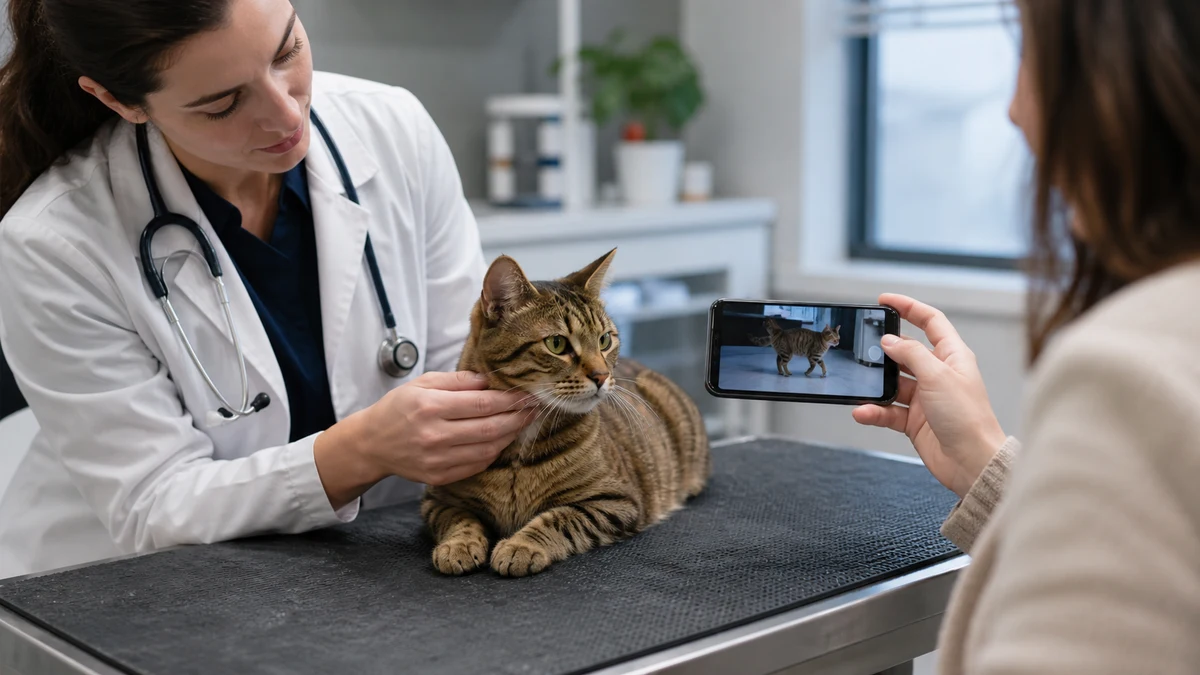
Merck advises ruling out medical contributors before diagnosing a behavior problem and recommends documenting onset, frequency, duration, changes in intensity, daily schedule, antecedents, and consequences. Bring the log and a safe video. A veterinarian can evaluate the whole cat; an article cannot decide whether a sudden change is behavioral, environmental, or medical.
Seek prompt veterinary advice after a possible swallowed object or toxin, even if the cat initially looks well. Do not prescribe medication, induce vomiting, pull visible string from the mouth or anus, or wait for an internet behavior plan to solve a potential emergency.
FAQ
Why does my cat look at me before pushing something off the table? Your presence may be part of a learned sequence, especially if pushing has reliably produced speech, movement, food, a door opening, or play. It may also be a brief check of the room. Use the log to see whether the behavior changes when no one reacts or when the desired resource follows a different cue.
Is my cat bored? Possibly, but one pushed object cannot prove boredom. Add predictable play, food-search opportunities, climbing, scratching, boxes, and rotated toys, then track whether the frequency changes. Also check timing, object properties, and human consequences.
Should I let my cat knock over one safe object? A designated batting station can be a useful outlet if the objects are too large to swallow, cannot splinter, and are used away from edges and hazards. A captured-ball track is easier to control than teaching that every household surface is a toy box.
Will ignoring the behavior make it stop? Only if human attention is what maintains it, and only after safety and other needs are addressed. Extinction can also produce a temporary increase, and you must never ignore access to a toxin, breakable item, or dangerous edge. Management plus reinforcement of an alternative is more complete than “just ignore it.”
How long should I keep the behavior log? Seven to fourteen days often captures weekday, weekend, meal, sleep, and play differences. Continue longer if episodes are rare. Contact a veterinarian sooner rather than waiting out the log when the increase is sudden or other abnormal signs appear.
Is knocking things down a sign my cat is angry with me? The action alone cannot establish anger or revenge. Describe the trigger, object, body language, and consequence. A neutral record gives you something you can change; a moral label usually does not.