Why Is My Cat Afraid of Visitors? A Choice-Based Plan for a Safer Home
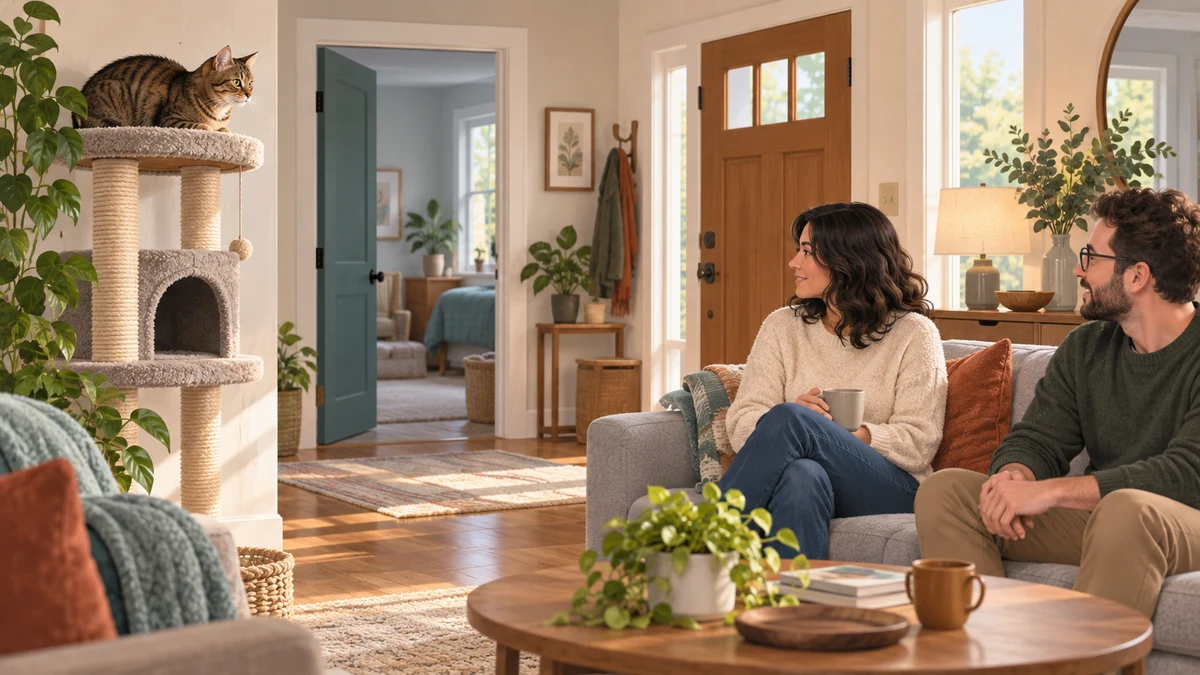
A cat who hides, watches from far away, or declines contact when visitors arrive does not need to be carried out and made to “socialize.” Give the cat a secure place with essential resources, prevent door escapes, ask visitors to be quiet and ignore the cat at first, and let the cat choose whether to approach. Success can mean eating, toileting, resting, and recovering normally while remaining hidden. If the fear appeared suddenly, spreads to familiar people or ordinary sounds, or comes with appetite, toileting, pain, aggression, or escape concerns, contact a veterinarian before starting a home training plan.
The goal is not to turn every cat into a greeter. It is to make visitors predictable enough that the cat can stay safe, keep access to normal resources, and regain ordinary behavior without being chased, cornered, or touched. Some cats may eventually investigate one calm guest. Others may always prefer a protected room during busy visits. Both outcomes can protect welfare.
Hiding can be a reasonable choice
Hiding is part of normal feline behavior. It can provide rest, concealment, or a way to cope when something feels uncertain. Cats Protection specifically advises leaving a shy cat alone when the cat hides from a stranger and asking friends and family not to seek the cat out. More hiding than usual can also accompany stress or illness, however, so the meaning comes from the change from that cat’s baseline and from other signs.
The AAFP/ISFM environmental guidelines organize feline needs around a safe place; multiple, separated resources; opportunities for play and predatory behavior; positive and predictable human interaction; and respect for feline sensory needs. A visitor plan should preserve those needs rather than make access to food, water, litter, rest, or escape depend on greeting a stranger.
The 2022 AAFP/ISFM interaction guidelines were written for veterinary settings, but the behavioral principles are useful at home: cats need control, safety, choice, and familiarity; hiding can help them cope in a novel or stressful situation; and interaction is more appropriate when the cat can initiate it instead of being picked up or restrained. That is why “the cat stayed under the bed and the visit ended without escalating” can be a successful first step.
Why a familiar home changes when the doorbell rings
A visitor is not just one new person. The event may combine a doorbell, footsteps in the hall, an exterior door opening, unfamiliar voice and scent, bags or coats, moved furniture, direct eye contact, and changes to the household routine. We cannot know from one posture which element matters most. Early experience, previous frightening events, health, individual temperament, and the exact setting may all contribute; none should be presented as a certain explanation for one cat.
Watch the sequence instead. Does the cat disappear at the intercom, only after the door opens, when a person stands, or when someone follows? Does recovery begin as soon as voices stop, or does the cat remain withdrawn through the next meal? A simple timeline identifies a workable starting point without assigning a diagnosis.
Our guide to signs of stress in cats explains why body language must be read as a pattern. A single tail movement or wide pupil is not a score. Light, sound, distance, movement, and the cat’s usual behavior all matter.
Before visitors arrive: build safety first
Prepare before the bell rather than trying to reorganize the house around a hiding cat. The list below contains more than eight practical arrangements; use the ones that fit the home and the individual cat.
- Choose a quiet base. Use a room away from the entry and main gathering area. It should be familiar before it is needed for visitors, not a strange place used only when frightening things happen.
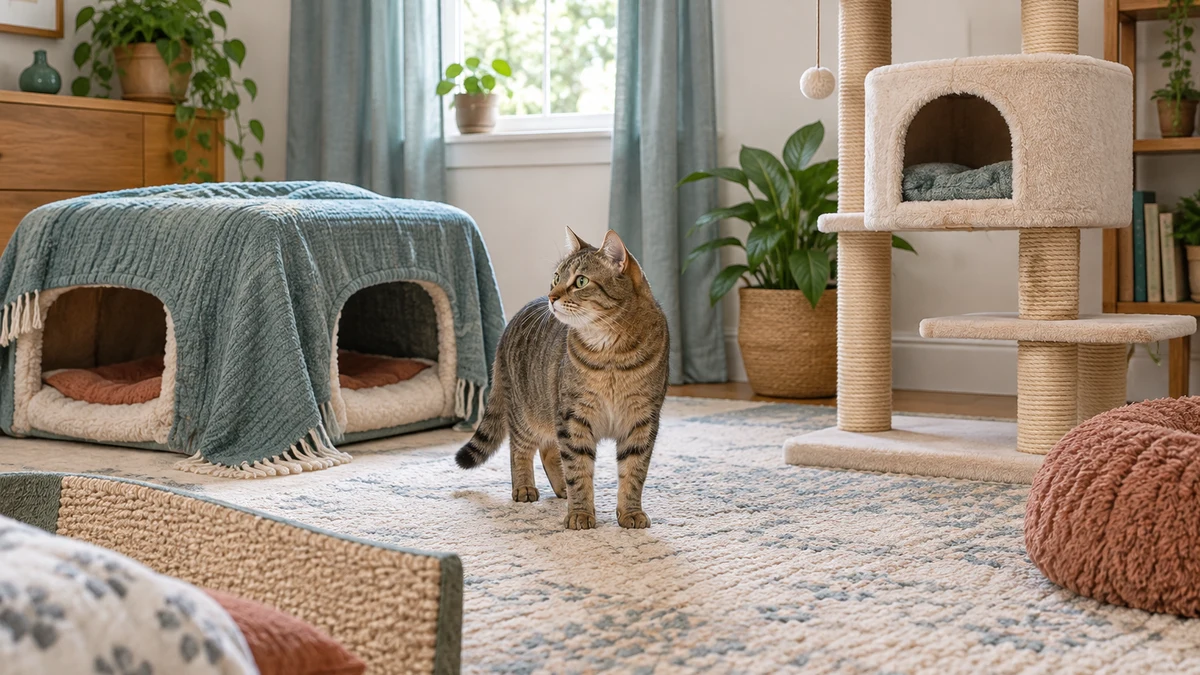
- Offer more than one refuge. A covered bed, stable box, open carrier, space under suitable furniture, and a secure elevated perch give different choices. Never use a refuge as the place where people reach in and grab the cat.
- Provide essential resources. Place fresh water, appropriate food, a clean litter box, resting space, and a scratching surface where the cat can use them without crossing the party. Separate food, water, and litter as space permits.
- Preserve familiar scent. Keep the cat’s usual bedding and avoid deep-cleaning every familiar item just before guests arrive. New coats and bags can remain near the entrance rather than filling the safe room with unfamiliar scents.
- Protect the exit. Decide which interior door will be closed before the exterior door opens. Check screens, windows, cat flaps, balcony access, and other escape routes. Do not rely on someone remembering at the last second.
- Brief every person. Tell visitors that the cat may never appear, the hide is off-limits, and no one should follow, stare, call repeatedly, reach, or offer a hand into a confined space.
- Keep routine anchors. Feed, scoop litter, play, and provide quiet time on the usual schedule where possible. A visit should not require withholding a meal to make treats more powerful.
- Reduce stacked surprises. Lower music, move noisy greetings away from the cat’s area, supervise children closely, and avoid adding a vacuum, renovation, unfamiliar animal, or large crowd to an early practice visit.
- Make a human safety plan. If the cat has scratched, bitten, charged, or redirected aggression before, use physical separation and ask a veterinarian or qualified behavior professional for an individualized plan. Guests should not test the threshold.
- Prepare a low-key end. Plan how coats, bags, goodbyes, and the exterior door will be handled without opening the cat’s protected area during the busiest moment.
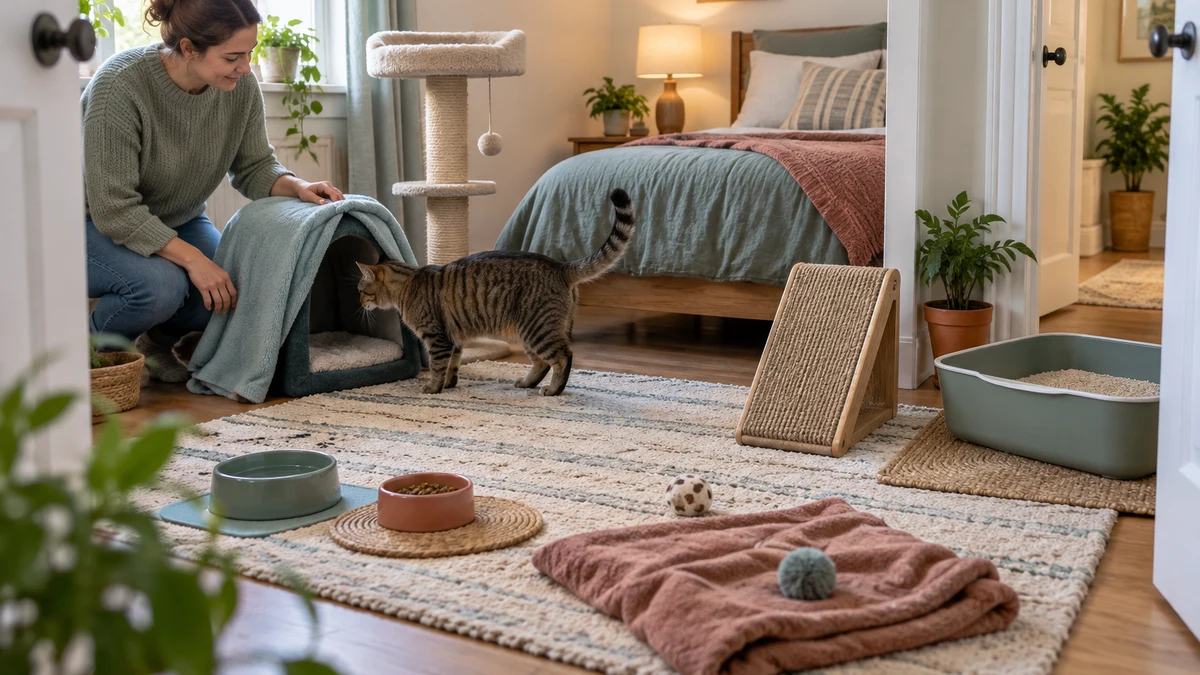
If a protected room is used, move the cat only while the house is still calm and by a familiar routine the cat already accepts. Better yet, make the room rewarding in ordinary life so the cat voluntarily uses it. Do not chase a cat through the home after the first guest is at the door.
For the rest of the house, use the same entry checks as the lost-cat prevention guide: assign one person to the door, confirm the cat’s location before opening it, and use a real barrier rather than a verbal warning alone.
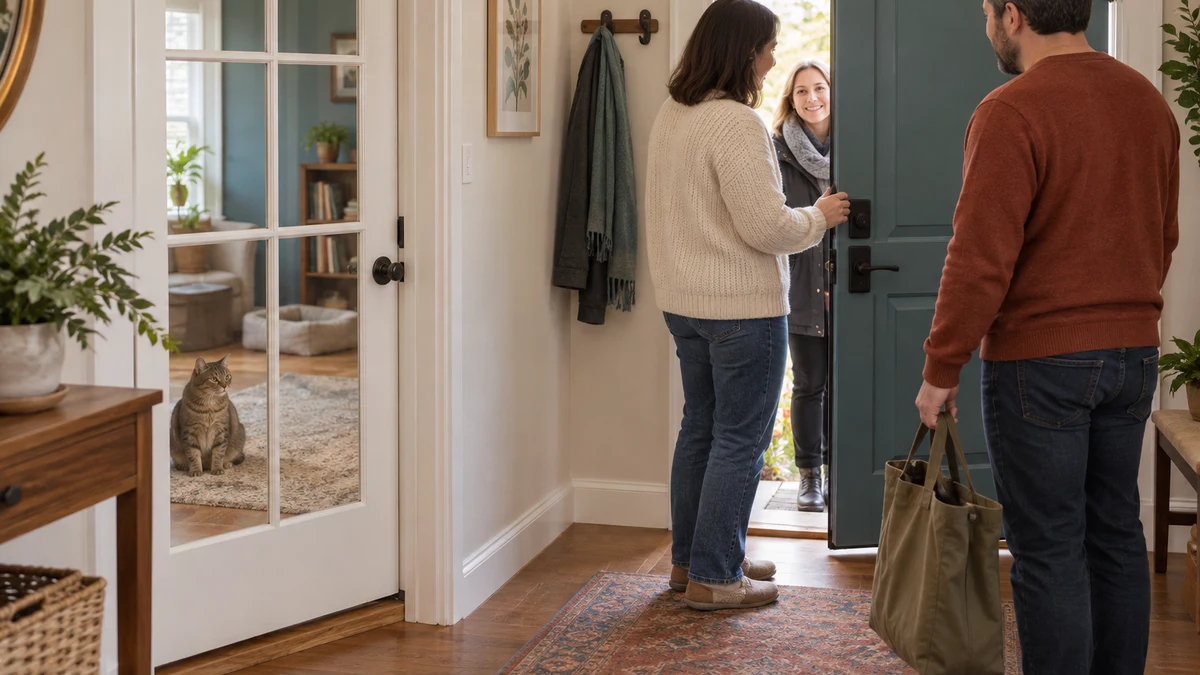
During the visit: the guest script is simple
Start with one quiet adult, not a roomful of people. Cats Protection recommends introducing people one at a time, letting the cat make the first move, keeping voices calm, preserving an escape route or high hiding place, and avoiding handling. Put those points into a short visitor script:
- Enter calmly and move away from the doorway.
- Sit rather than stand over the cat; turn the body slightly sideways.
- Speak softly and keep sudden laughter, calls, and movements down.
- Do not stare, lean over, point, clap, photograph at close range, or keep calling the cat’s name.
- Do not reach into a hide or block the route to it.
- If the cat approaches, keep hands still at first and allow sniffing or cheek rubbing without turning it into immediate petting.
- Stop contact when the cat turns away, stiffens, moves off, or stops returning. An approach is not consent to be picked up.
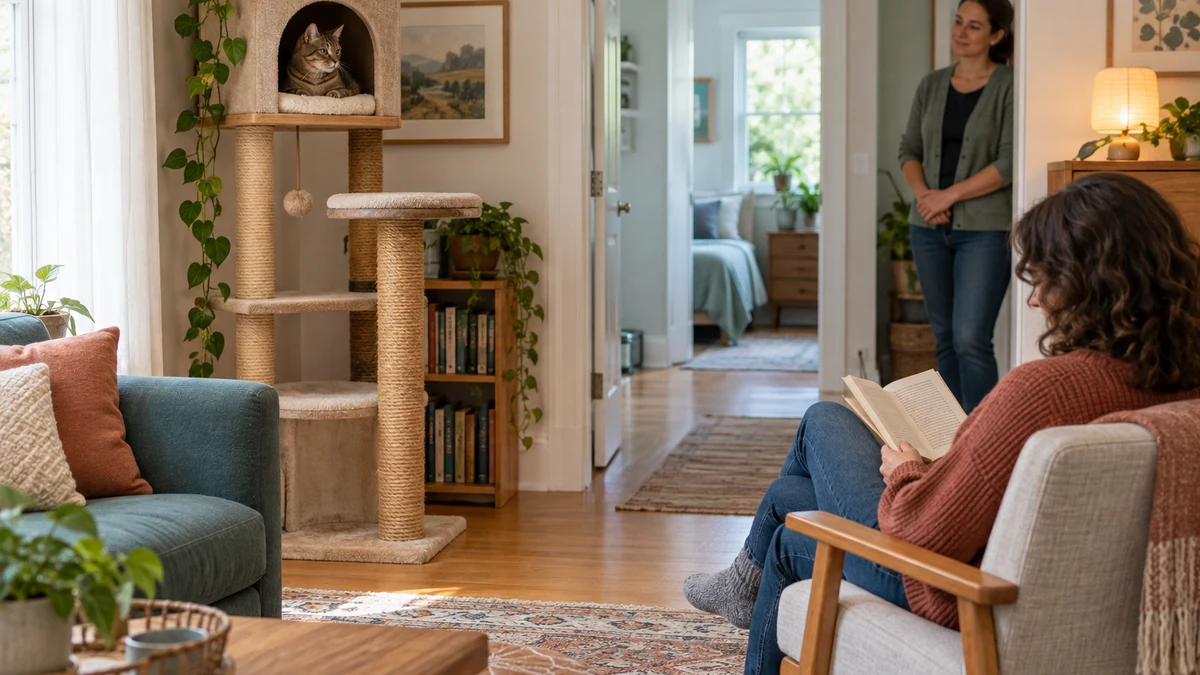
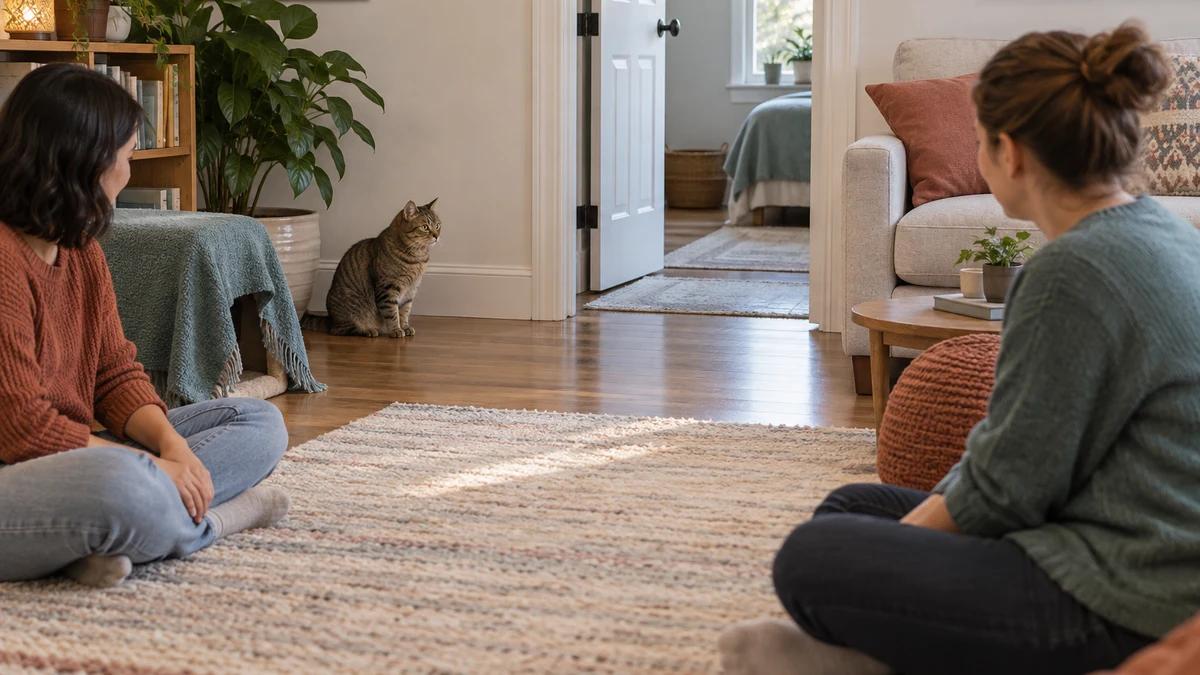
If the cat already eats normally and stays loose at that distance, the caregiver may use a tiny portion of the cat’s normal food or an appropriate treat as a positive pairing. The visitor can toss it away from their body, allowing the cat to eat and retreat rather than luring the cat closer. Food is optional, and refusal is information—not a reason to withhold meals, move the bowl nearer, or reduce distance. Ask the veterinarian about food choices when the cat has a prescribed diet, appetite change, or medical condition.
Play can also add distance. A long wand toy may be suitable if the cat already plays normally in the setup and the visitor can move it gently without directing it into the cat’s face or refuge. A cat that will not eat or play may simply be too tense, not stubborn.
The cat trust guide explains why voluntary return and comfortable disengagement matter more than one slow blink, purr, or approach. Let leaving work every time.
After visitors leave: recovery is part of the plan
Do not pull the cat out for a “you see, they are gone” check. Close the exterior door, restore the familiar layout, lower household activity, refresh resources if needed, and let the cat emerge on its own. Ask family members to leave the hiding place alone.
Record when ordinary behavior returns: eating, drinking, toileting, grooming, stretching, scratching, playing, resting in a usual place, or seeking familiar people. Recovery is not a race. The useful comparison is with this cat after similar events, not with another cat online.
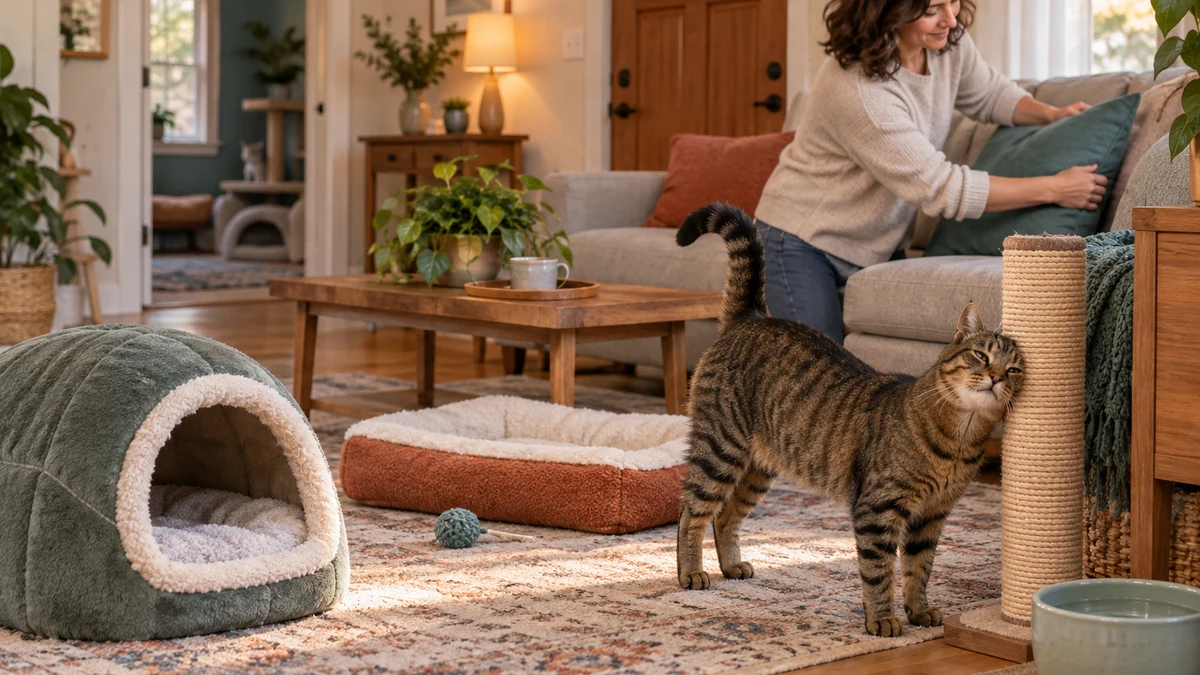
If the cat remains hidden, confirm safe access to water, food, and litter without placing them inside the hide. Cats Protection advises providing nearby access while avoiding repeated coaxing and checking, which may increase pressure. Contact a veterinarian when eating, drinking, toileting, movement, breathing, or general behavior changes, or when hiding is unusually prolonged for that cat.
Let behavior decide whether to repeat, advance, or stop
No single signal proves comfort or fear. Look for clusters, direction of change, and recovery. Remaining in the room is not automatically success; a rigid, silent cat may be freezing. Eating is useful only when it resembles the cat’s normal eating, not frantic grabbing followed by escape.
| Usually supports maintaining or repeating the same easy step | Increase distance, lower intensity, pause, or end |
|---|---|
| Chooses to remain or returns after moving away | Hides sooner, keeps increasing distance, or will not use an available route |
| Body remains loose; movement is fluid rather than crouched | Freezes, crouches tightly, crawls, trembles, or becomes rigid |
| Explores, sniffs, looks away, or resumes ordinary grooming | Scans continuously, fixes on the person or door, or cannot disengage |
| Eats a normally valued item in an ordinary way | Refuses usual food along with other tension signs, or snatches and flees |
| Plays normally and can stop without agitation | Stops normal play, startles repeatedly, or redirects intensely onto the toy |
| Recovers to normal rest, grooming, play, or social behavior soon afterward | Ears flatten, tail tucks or lashes, fur raises, growling, hissing, swatting, biting, panting, frantic escape, or very slow recovery |
Five or more comfortable observations do not create a pass that overrides one serious safety signal. A frantic escape, bite attempt, breathing change, or inability to reach resources ends the session even if the cat accepted food moments earlier.
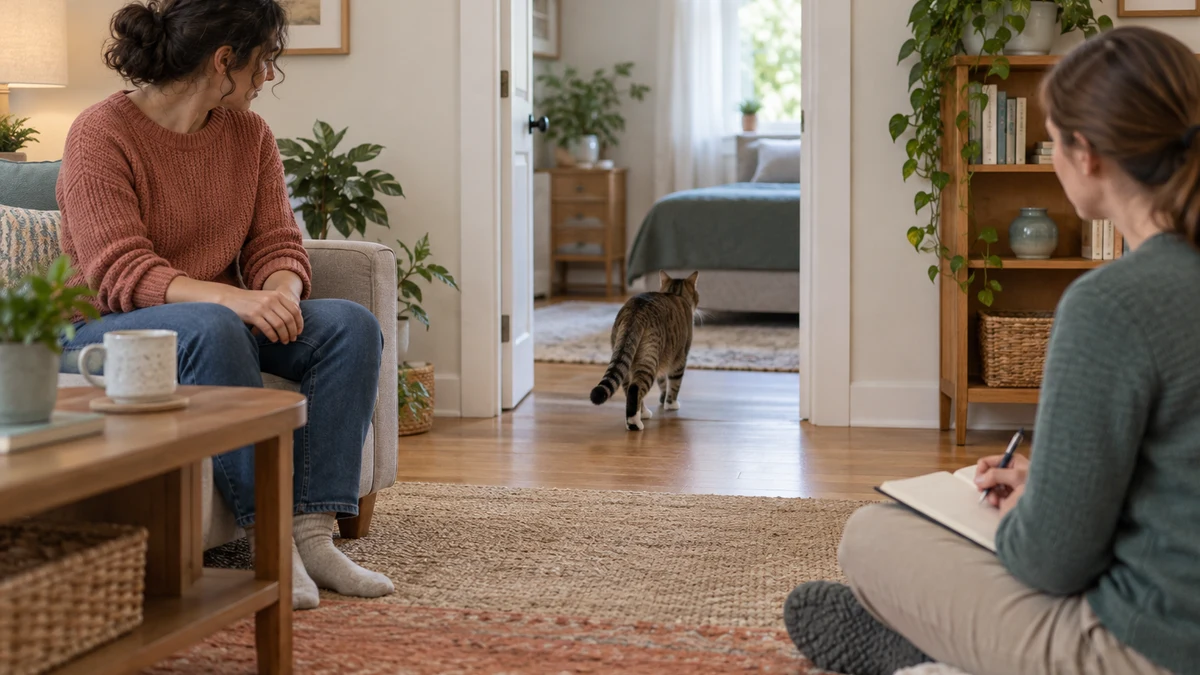
A seven-stage visitor practice plan
Use planned practice only when the cat is medically well enough, the home can be controlled, and there is no immediate aggression or escape risk. Merck Veterinary Manual describes desensitization as small, controlled exposures and emphasizes increasing intensity only while the cat remains calm. It warns that moving too quickly works against progress and that flooding—prolonged, high-intensity exposure until reaction stops—is far more stressful and can make the problem worse.
Treat the stages below as a map, not a calendar. Some cats remain on one stage for many repetitions. Some need an easier step not listed. Change only one variable at a time: volume, distance, duration, movement, number of people, or location.
- Establish the baseline with no visitor. The cat uses the quiet room, hide, perch, food, water, litter, and routes during ordinary life. The exterior door plan works while the house is calm.
- Practise one distant sound. Play a doorbell or quiet voice recording at barely audible volume while the cat is free to play, eat, rest, or leave. Stop if normal behavior changes. Real door activity comes later.
- Separate sight from entry. Let the cat see a known calm person at a great distance through a secure barrier or from an optional perch. No approach, eye contact, or touch.
- One quiet person enters and ignores the cat. The visitor sits in the planned place for a very short period. The cat stays behind the barrier or uses any open retreat route.
- Repeat a short seated visit. Keep the same person, place, and low activity. Advance only after repeated sessions with ordinary behavior and easy recovery.
- Add one small change. The visitor speaks once, shifts position, stands briefly, or walks one predictable path—not all at once. Return to the easier version if tension rises.
- Offer optional interaction only after voluntary approaches. A still hand, a treat tossed away, or gentle distant play may be offered. Petting is optional and brief; picking up is not a graduation requirement.
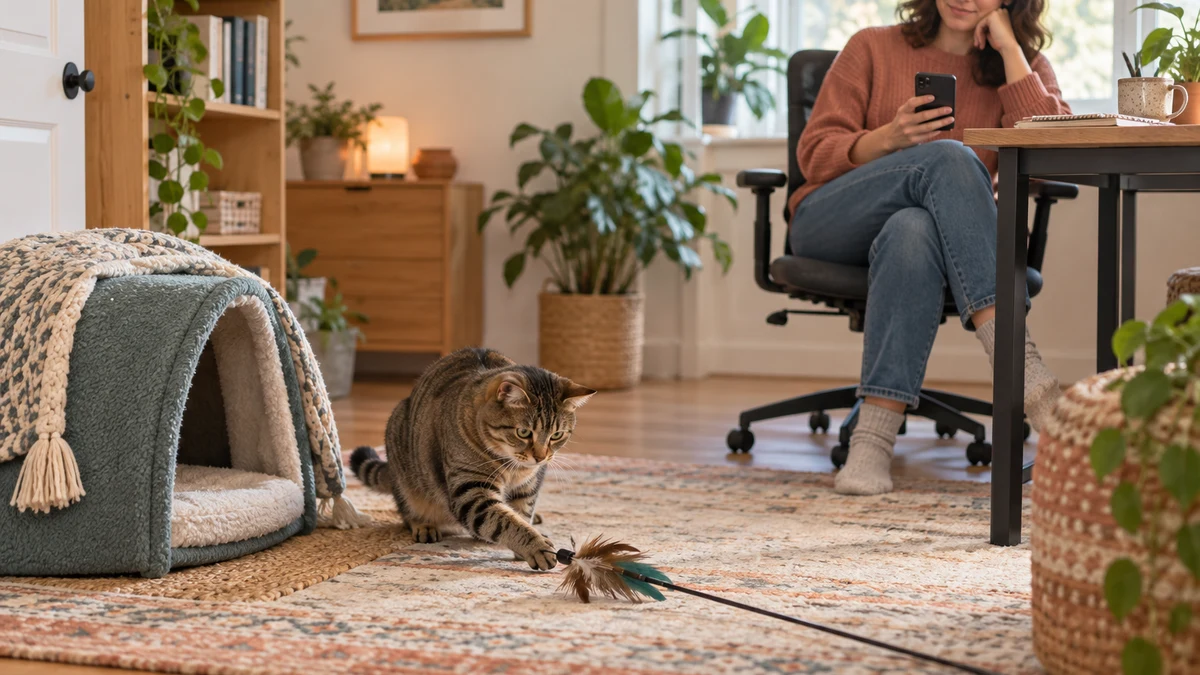
End while the session is still easy. Do not repeat a failed exposure immediately to “erase” it. Restore safety, allow recovery, and begin later with less sound, more distance, shorter duration, less movement, or a more familiar person. The same choice-based structure appears in our kitten socialization guide, but adult cats can also learn; the realistic goal may be tolerance and recovery rather than social contact.
Practices to avoid
- Do not carry or drag the cat to a visitor. Restraint removes the very distance and choice the plan is meant to create.
- Do not close the hide, block the exit, follow the cat, or reach underneath furniture. A refuge must remain a refuge.
- Do not punish hissing, growling, swatting, hiding, or running away. Cornell notes that physical punishment can increase fear or anxiety and worsen aggression.
- Do not use hunger. Keep necessary meals and veterinary diets on schedule; a reward should add value, not make access to food conditional on proximity.
- Do not use flooding. A party, prolonged holding, or trapping the cat in a room with a guest until the cat goes quiet can produce shutdown or escalation, not proof of comfort.
- Do not ask a child or nervous guest to test the cat. Use an adult-controlled barrier and close supervision. Safety is the adults’ responsibility.
- Do not give human medication, leftover pet medication, supplements, or calming products as a substitute for veterinary advice. This article does not provide an individual treatment plan.
When to involve a veterinarian or behavior professional
Contact a veterinarian when fear is new or rapidly worse, appears around familiar people or ordinary events, persists outside visits, or comes with reduced appetite, altered drinking, vomiting, toileting changes, overgrooming, reduced mobility, pain signs, sleep changes, confusion, or other physical or behavioral changes. Cats Protection advises veterinary assessment when a previously confident cat becomes anxious; Cornell likewise recommends ruling out medical contributors before treating aggression as a behavior-only problem.
Use separation and seek prompt guidance when there is charging, biting, repeated swatting, redirected aggression toward another person or animal, frantic door or window escape, injury, or a child or vulnerable adult cannot reliably follow the safety plan. Do not film if recording would create or escalate danger.
After medical contributors and immediate safety have been addressed, ask the veterinarian about a qualified feline behavior professional or veterinary behaviorist. Complex desensitization plans are easier to get wrong when thresholds are hard to read. The professional should use reward-based, low-pressure methods and coordinate with the veterinarian rather than guarantee a personality change.
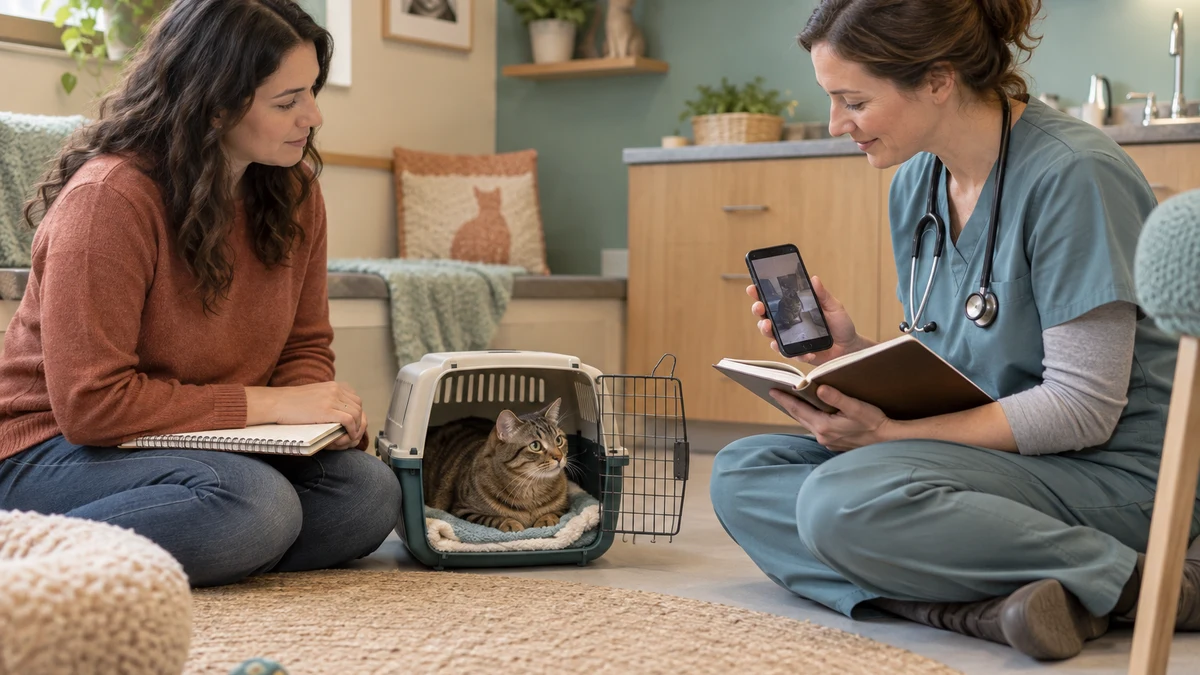
Bring useful observations: the first trigger in the sequence, distance, number of visitors, movements and sounds, the cat’s posture, access to resources, appetite, toileting, what happened next, and recovery time. A short safe video may help, but a written timeline is enough when filming would intrude. If transport itself is difficult, prepare separately with the carrier training guide.
Frequently asked questions
Should I pull my cat out of hiding when visitors arrive?
No. Confirm that the hiding place is safe, keep essential resources accessible, and stop people from reaching in or blocking the exit. Let the cat decide whether to emerge. More-than-usual hiding or hiding with appetite, toileting, pain, or other changes needs veterinary attention.
Is it rude to ask visitors to ignore my cat?
No. Quietly ignoring the cat at first removes social pressure and gives the cat control over distance. Ask visitors to sit, avoid staring and reaching, and let the cat make the first move. A cat who never approaches can still have a successful, safe visit.
Can treats make my cat like strangers?
Treats can form one part of a positive association when the cat is calm enough to eat normally, but they cannot guarantee affection. Use a small appropriate portion without delaying meals, and toss it away from the visitor so the cat can retreat. Stop or increase distance when eating changes or other tension signs appear.
How long should a visitor practice session last?
There is no universal duration. Begin with an exposure easy enough that ordinary behavior continues and stop before tension escalates. Distance, movement, volume, recovery, and the individual cat matter more than a timer. Repeat an easy stage rather than advancing by date.
What counts as progress if my cat still hides?
Progress may mean entering the refuge before panic, eating and toileting normally, emerging sooner after the visit, resting rather than remaining rigid, or tolerating a quiet voice at a greater distance. The cat does not have to accept touch. Welfare, safety, and recovery are the outcomes that matter.