How to Prepare Your Cat for a New Baby: A Gradual Safety Plan
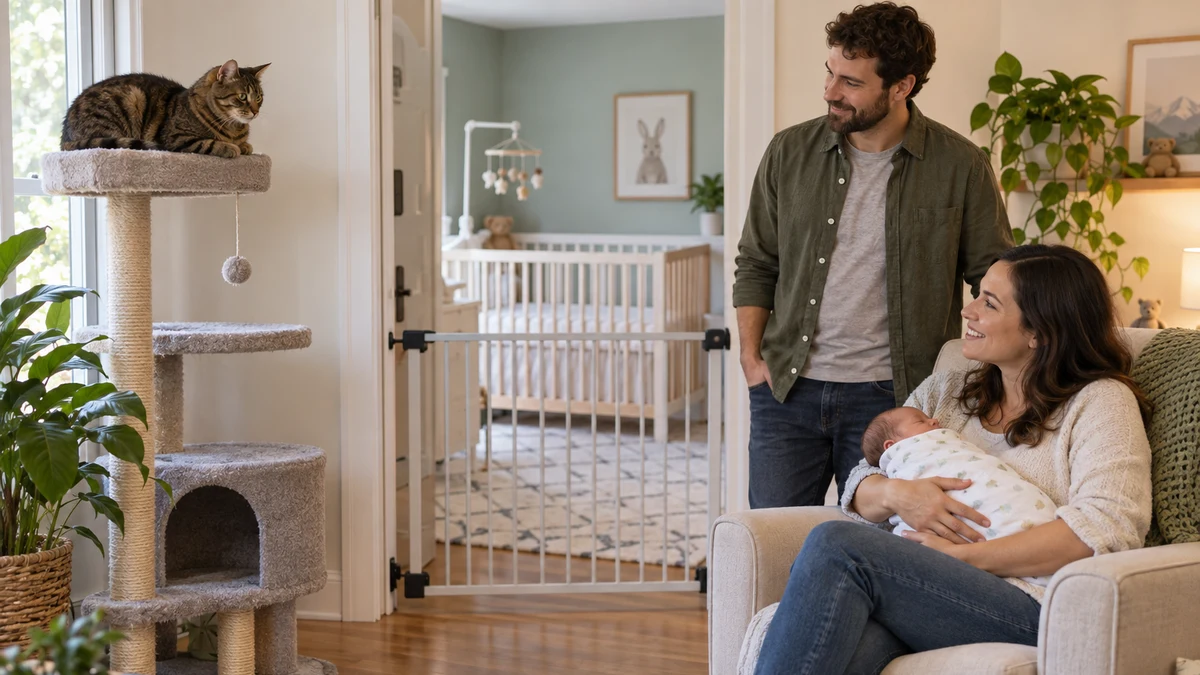
Prepare your cat for a new baby by making household changes early and one at a time—not by waiting until homecoming and suddenly excluding the cat. Set up the baby’s pet-free sleep space, give the cat protected alternatives, shift care routines before the birth, rehearse doors and secure barriers, and introduce baby equipment and sounds at low intensity. After homecoming, let the cat watch from a comfortable distance and leave whenever it chooses. An awake adult must directly supervise every close cat–baby interaction. Calm curiosity and keeping away can both be successful responses; friendship is not required.
Two separate goals: adjustment and safety
A gradual plan can make new sounds, furniture, smells, visitors, and schedules less abrupt for a cat. It cannot prove that unsupervised contact is safe. Even a gentle animal can startle, swat, jump, or seek a warm sleeping place. A newborn cannot reliably move away. Treat these as two parallel jobs:
- Help the cat retain control and predictability. Preserve essential resources, familiar care, hiding places, high resting sites, and routes away from activity.
- Use physical safety boundaries every time. Keep the cat out of every infant sleep space and use direct, awake adult supervision whenever cat and baby are close enough to reach each other.
The American Academy of Pediatrics advises a firm, flat infant sleep surface kept free of objects that can create entrapment, suffocation, or strangulation risk. The NHS also says pets should not share a bed with a baby. Cat welfare and veterinary sources go further for this household situation: prevent access to the cot or crib and the room or protected zone where the baby sleeps. A monitor can help an adult observe a sleeping baby; it does not make a pet-accessible sleep space safe.
Build the home plan before the due date
Do not remove the cat’s current bed, litter tray, or access route on the day the baby arrives. VCA’s veterinary behavior guidance recommends completing household and routine changes beforehand. ASPCA, Texas A&M, and Cats Protection similarly advise using pregnancy as preparation time. The exact lead time depends on the home and cat; behavior, not a countdown, decides how small each step should be.
1. Check health and existing behavior first
Arrange routine veterinary care appropriate to your cat and discuss a new appetite, elimination, mobility, pain, fear, or aggression concern before adding more change. A behavior that may have a medical component needs veterinary assessment, not an online diagnosis. If the cat has previously bitten, scratched, attacked moving children, or panicked around infant sounds, keep cat and baby physically separated and request an individualized plan from a veterinarian or qualified feline behavior professional before any close observation.
2. Make the baby’s sleep zone pet-free
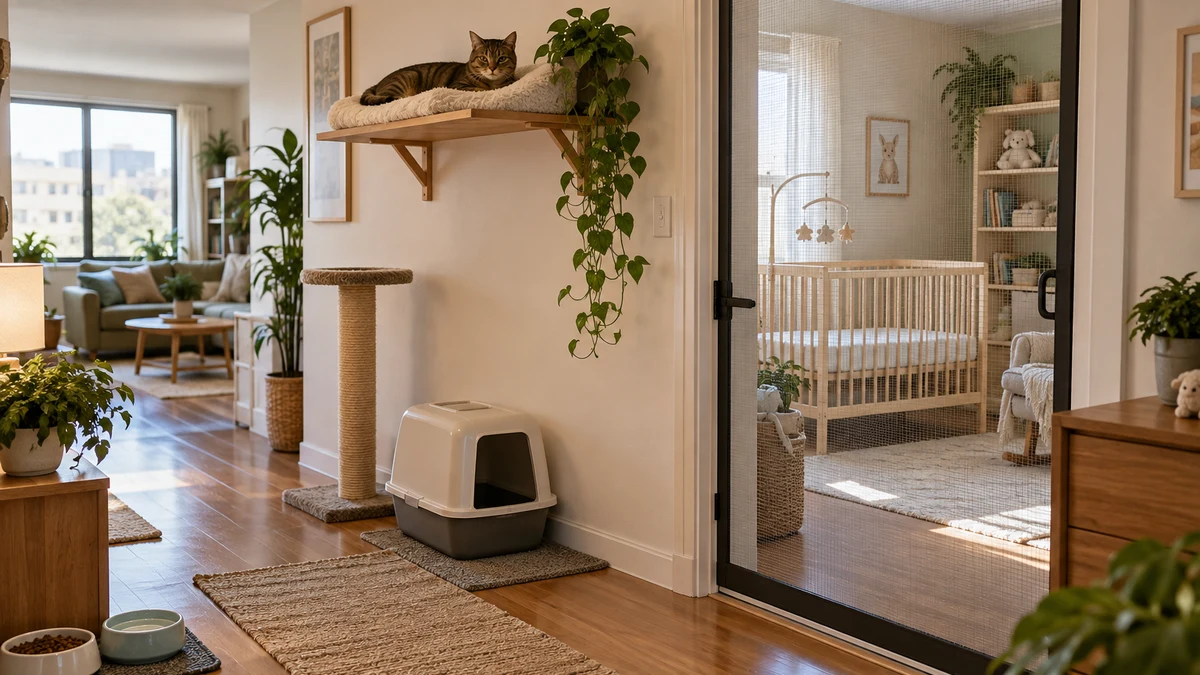
Decide where the baby will sleep and how the boundary will work when tired adults are moving through the house. Depending on the room, that may mean a closed door, a secure full-height screen door, or another robust layout that an adult tests before use. A pressure gate that the cat can jump, squeeze past, or knock loose is not a sleep-space barrier. Never put a deterrent, net, cover, or improvised object in or over a crib unless it is part of sleep guidance from the baby’s pediatric safety professionals.
Practice the boundary while the crib is empty. Close the door for short, ordinary periods and direct the cat toward a better resting site. Do not chase, spray, shout at, or startle the cat away. Punishment can add fear without teaching a safe alternative; see why hitting or frightening a cat is unsafe.
3. Give the cat better alternatives
Create at least one quiet retreat that a crawling child cannot enter, plus a stable high place from which the cat can observe household activity. Put comfortable bedding, a scratcher, water, and suitable enrichment where the cat can reach them without passing the nursery door. Food and litter should remain in appropriate separate locations rather than being crowded together. Senior, disabled, or mobility-limited cats may need low steps and wide platforms instead of a tall jump.
Keep every exit route open. A cat tree becomes a trap if the only way down passes the baby, a visitor, or a closed door. Cat-proof the surrounding room so a startled retreat does not lead to an open window, unstable shelf, cord, or exterior door.
4. Shift care routines gradually
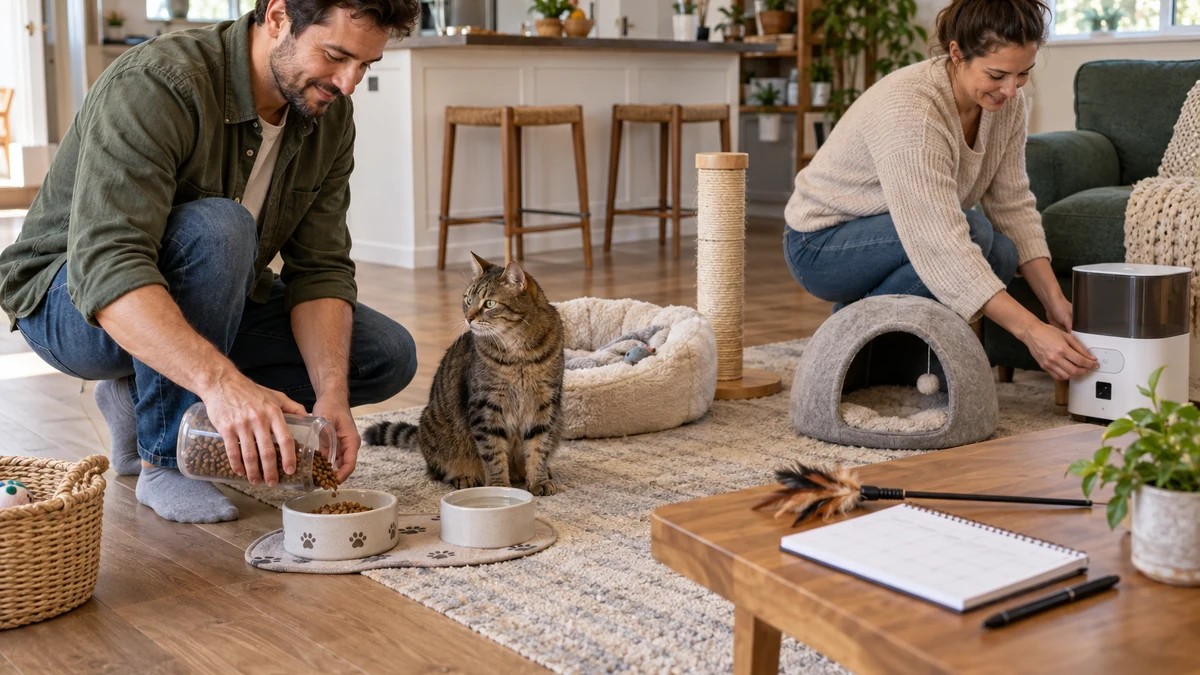
Write down the cat’s current meals, litter cleaning, medication administered under veterinary direction, play, grooming, and social time. Decide which adult can reliably do each task after the birth. If a different person will feed or play with the cat, let that person take over in small steps well before delivery. ASPCA specifically advises moving care responsibilities one to two months ahead when possible.
Aim for a rhythm the household can actually maintain, not a perfect minute-by-minute schedule. A meal can occur within a predictable window; a short interactive play session can replace one long session. Prepare puzzle feeders or toys in advance, but do not use food restriction to force participation. The goal is to prevent every valued activity from disappearing at once.
5. Introduce furniture and equipment without forcing exploration
Set up the empty crib, stroller, changing area, gate, and other large equipment early enough that they become ordinary background objects. Let the cat approach, sniff, rub, or ignore them. Keep the cat’s essentials away from moving stroller wheels and doors. If a previously accessible room will become restricted, start the new access pattern now while also opening a good alternative area.
Do not carry the cat to an object or trap it nearby. Avoid essential oils, concentrated fragrances, and irritating smells as repellents. Products marketed as “natural” are not automatically safe for cats or infants, and a strong odor does not create a dependable physical boundary.
6. Practice baby sounds below the cat’s stress threshold
Play a brief recording of crying, gurgling, or household baby noise at barely audible volume while the cat is free to leave. Pair it with an activity the cat already enjoys, such as play, gentle attention, or a small part of its normal food allowance. Stop while the body remains loose. Across later sessions, change only one variable—slightly longer or slightly louder—after the cat repeatedly eats, plays, rests, or walks away normally.
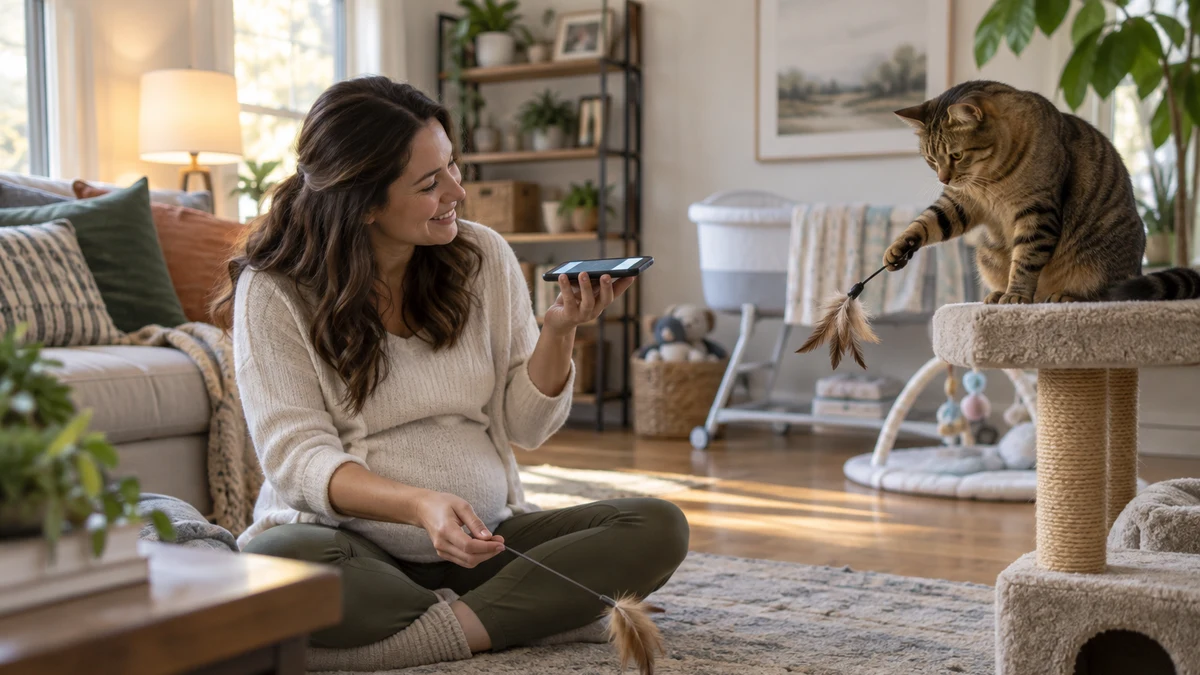
If the cat freezes, flattens its ears, lashes its tail, hides and will not re-emerge, refuses something it normally values, or stays vigilant afterward, the sound was too intense. Turn it off, restore distance and normal routine, and try an easier version another day. Sound practice is familiarization, not a test the cat must endure.
7. Rehearse gates, doors, and adult movement
Adults will often carry the baby, laundry, or feeding supplies with one hand occupied. Rehearse who closes which door, where the cat waits during a transfer, and how visitors enter without creating an escape. Check latches from both directions. If the cat already likes a carrier, keep positive carrier skills fresh for veterinary visits or emergencies; never use the carrier as punishment or routine confinement around the baby.
8. Plan now for the mobile-child stage
The newborn phase is temporary. Decide where cat food, water, litter, medication, string toys, and breakable equipment will go before a child crawls. The cat needs a child-free retreat and uninterrupted access to toileting, rest, and water. Later, teach the child with hands-on adult guidance: no grabbing fur or tail, no chasing, cornering, climbing on, waking, or approaching a cat that is eating, toileting, hiding, or sleeping.
“The baby is gentle” cannot replace supervision. Infants and toddlers move, fall, vocalize, and grab unpredictably; the adult must manage distance before either child or cat is overwhelmed.
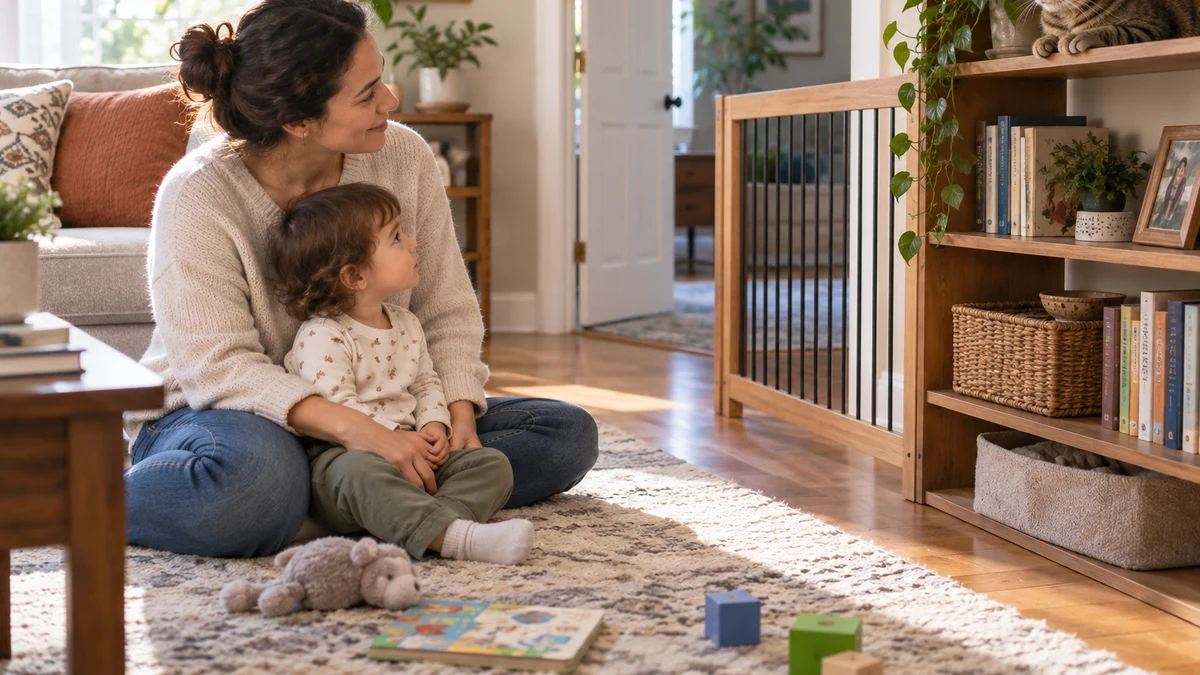
A practical preparation timeline
| Phase | Add gradually | Keep constant | Ready-to-continue signs |
|---|---|---|---|
| Earlier in pregnancy | Veterinary and behavior check; new cat retreat; nursery boundary; furniture | Food, water, litter access, familiar bedding | Cat explores or ignores changes and uses normal resources |
| Following weeks | New caregiver roles; feeding and play windows; doors and gate routines | Daily care and individual attention | Cat eats, rests, plays, grooms, and eliminates normally |
| Later pregnancy | Very low baby sounds; stroller movement; visitors; brief room restrictions | Choice to leave and access to the safe zone | Cat notices and can disengage without prolonged vigilance |
| Before homecoming | Test sleep-space exclusion; assign adult roles; prepare a separate arrival zone | No forced contact | Adults can operate the boundary even while carrying supplies |
| First days home | Distant visual observation; very short calm sessions | Direct supervision and normal cat care | Cat can look away, leave, eat, play, or rest afterward |
| Following months | One small increase in duration or household movement at a time | Pet-free infant sleep and child-free cat retreat | Both remain safe and the cat’s daily functions stay normal |
This is a sequence, not a deadline. Skip an exercise that is not useful in your home, and repeat an easy step when the cat needs more time.
Homecoming: distance first, contact is optional
Before entering with the baby, one adult can quietly greet the cat without a crowd. A worn baby cloth may be placed in open space for optional investigation, away from food, water, litter, beds, and doorways. Do not push it under the cat’s nose or put it in the cat’s bed. Scent exposure is optional; it is not a safety test and does not predict future behavior.
For the first visual introduction, choose a quiet, spacious room that is not the cat’s feeding, toileting, or only sleeping area. One awake adult securely holds the baby; another adult watches the cat and the route between them. Let the cat observe from several feet away, a perch, or a doorway. Do not lift the cat toward the baby, hold it for a sniff, or place the baby on the floor for access.
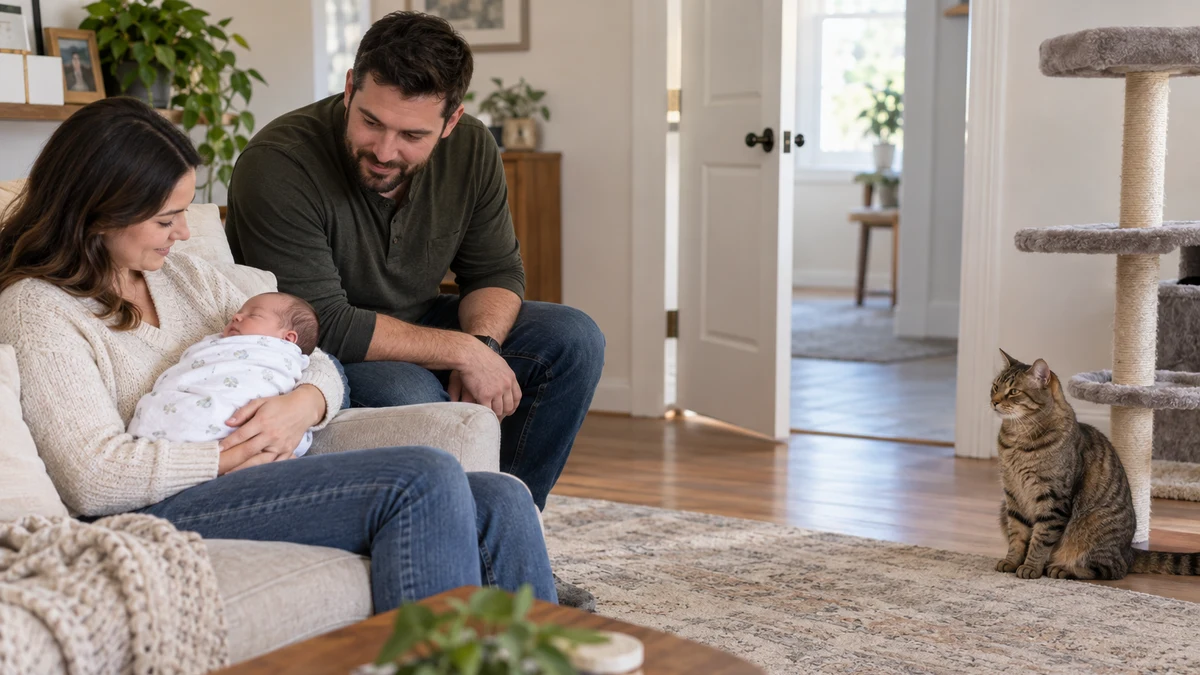
Rewarding calm behavior can mean gentle praise, play, or food at a safe distance if the cat wants it. It does not mean luring the cat closer than it would choose. End the session while everyone is still calm. A cat that leaves, hides briefly, or ignores the baby has made a valid choice; do not call it jealousy or failure.
The first weeks: protect ordinary cat life
Maintain food, water, litter cleaning, rest, play, and quiet social contact. Give the cat attention at times not tied only to the baby’s crying, so the baby’s presence does not become the sole predictor of either rewards or exclusion. Let visitors ignore the cat in its retreat. Keep baby bottles, feeding items, cat dishes, litter tools, and toys separate.
Close supervision means an awake adult is close enough, attentive enough, and physically able to prevent contact. Being elsewhere in the room, looking at a phone, cooking, showering, or sleeping does not qualify. When attention must move elsewhere, separate cat and baby with a reliable door or barrier.
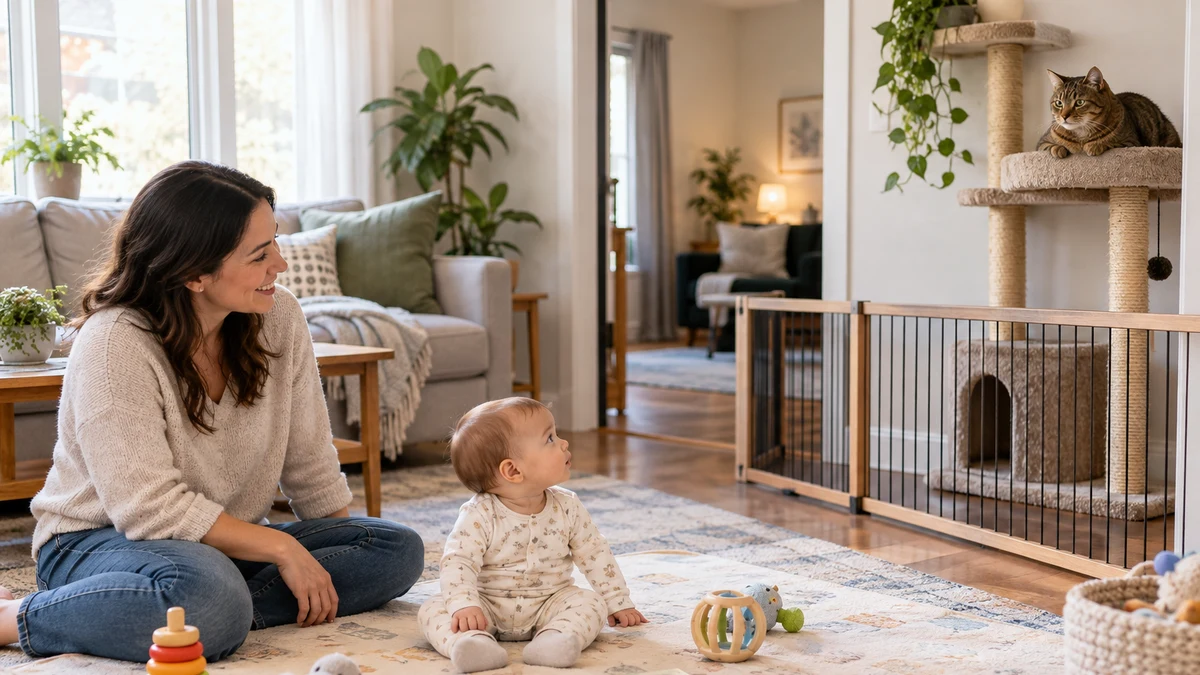
As of September 2026, American Academy of Pediatrics guidance says never to leave a young child alone with an animal and not to allow tail pulling, grabbing an animal’s things, or rough play. If a scratch or bite occurs, separate safely, give the child appropriate first aid, and contact the child’s health professional for individualized advice; contact a veterinarian for an injured or newly reactive cat.
What adjustment can look like—and when to stop
Brief observation, choosing a higher perch, keeping a wider distance, leaving a noisy room, or temporarily resting in a familiar hide can be normal ways to gather information or reduce stimulation. Do not interpret proximity as love or distance as rejection. Look instead at whether the cat can disengage and maintain its usual daily functions.
Stop the interaction, create physical separation, and seek appropriate professional guidance if any of these patterns appear:
- persistent refusal of normal food or water;
- prolonged hiding with reduced normal activity or inability to reach resources;
- new urination, defecation, spraying, or avoidance of the litter area;
- repeated swatting, lunging, biting, stalking, guarding, or attempts to enter the baby’s protected space;
- escalating agitation such as sustained growling, yowling, frantic escape, or inability to settle after sessions;
- a sudden behavior change, apparent pain, excessive grooming, injury, or other health concern;
- any situation in which the cat and baby can reach each other without an attentive adult;
- any scratch, bite, contact near the baby’s face, blocked breathing, or other immediate infant safety concern.
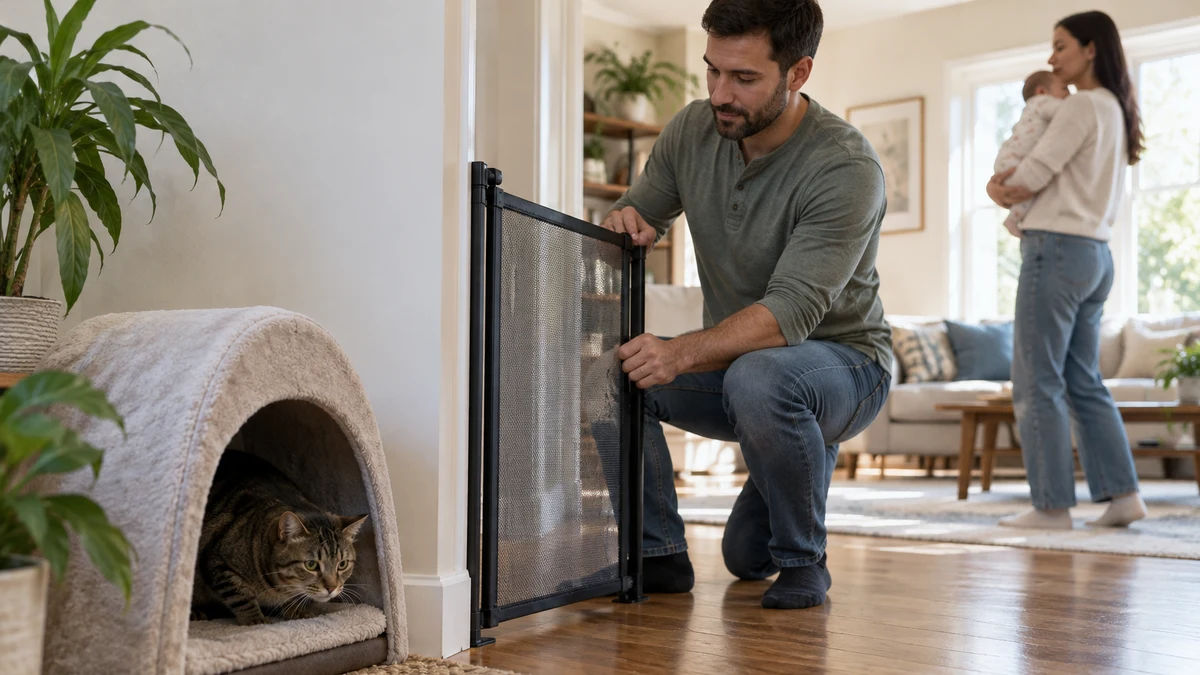
For an immediate baby safety concern, separate first and use the family’s local pediatric or emergency pathway. For cat health or abrupt behavior change, contact a veterinarian. A veterinarian can assess health contributors and, when needed, refer to a credentialed behavior professional. Until risks are assessed, use full physical separation rather than repeating the trigger to “see if it happens again.”
Pregnancy and hygiene without infection panic
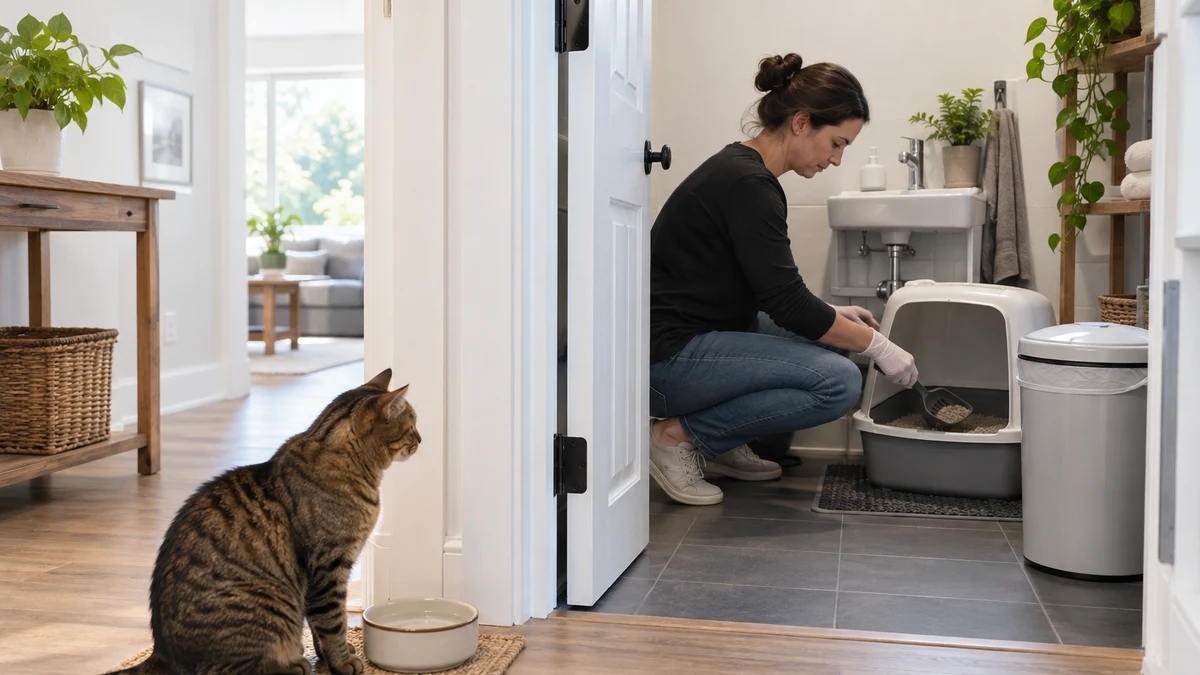
Living with a cat does not automatically require rehoming during pregnancy. Toxoplasmosis can be acquired through infected cat feces, contaminated soil, or raw and undercooked food—not simply by stroking a cat or having one at home. NHS pregnancy guidance says to avoid emptying litter trays while pregnant; if nobody else can do it, wear disposable gloves, clean the tray daily, and wash hands thoroughly. Keep litter away from children and food preparation, reduce hunting opportunities, and do not feed raw or undercooked meat.
Wash hands after contact with litter, feces, saliva, cat supplies, or before eating. Keep the child’s hands away from litter and cat food. These are practical hygiene controls, not a reason to frighten or punish the cat. Pregnancy and infant-health questions belong with the family’s obstetric or pediatric professional; veterinary prevention and cat-health questions belong with the cat’s veterinarian. Guidance can vary by country and individual health status.
Five shortcuts to avoid
- Do not wait until homecoming to change every rule. Sudden loss of rooms, routines, and attention stacks multiple stressors together.
- Do not hold the cat up to smell the baby. Restraint removes the cat’s exit and puts hands near a startled animal.
- Do not punish curiosity or warning signals. Increase distance and improve the boundary instead. Warnings tell you the setup is too difficult.
- Do not use essential oils or harsh fragrances as repellents. They are not reliable barriers and may create additional exposure or welfare concerns.
- Do not treat one calm meeting as permission for unsupervised access. Sleep-space exclusion and direct supervision remain rules, not stages to graduate from.
Frequently asked questions
Should I let my cat sniff the newborn?
There is no need to arrange contact. Let the cat observe from a comfortable distance. If it voluntarily approaches during a directly supervised session and everyone remains relaxed, the adults can preserve distance and a clear exit; never carry, hold, or lure the cat to the baby. Contact near the baby’s face is not appropriate.
Is it normal if my cat hides or ignores the baby?
Choosing distance or a brief retreat can be a useful coping response. It becomes concerning when hiding is prolonged, the cat cannot reach resources, appetite or elimination changes, or fear persists outside the interaction. Track the pattern and contact a veterinarian for a marked or sudden change. Our cat stress guide explains additional observable signs.
Can the cat sleep in the same room as the baby?
The infant’s sleep space must remain inaccessible to the cat. Cat welfare guidance commonly recommends excluding the cat from the room or protected sleep zone while the baby sleeps. Use a reliable door or professionally appropriate room layout and provide the cat with a comfortable alternative; do not rely on an adult waking in time or on an improvised crib cover.
Do I need to rehome my cat because someone is pregnant?
Not routinely. Follow current public-health precautions for litter, food, hand hygiene, and hunting risk, and ask the household’s health professional about individual circumstances. Ask the veterinarian about the cat’s preventive care. Rehoming is not a substitute for understanding the actual routes of exposure.
When can a cat and child be left alone together?
This guide does not set an age at which unsupervised access becomes safe. A newborn needs complete protection; toddlers and young children remain unpredictable and need active adult guidance. Continue separation whenever an adult cannot directly supervise, and adjust the plan with pediatric, veterinary, or qualified behavior professionals for the individuals involved.