Redirected Aggression in Cats: What to Do After a Trigger
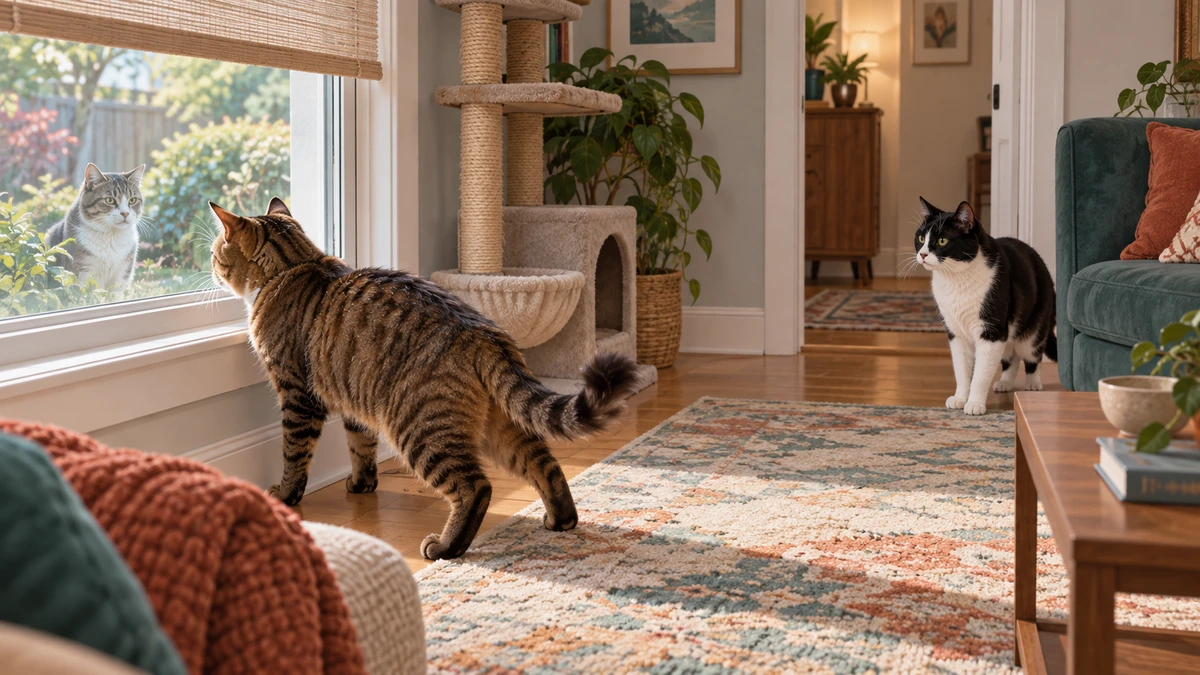
A cat who sees an outdoor animal, hears a startling sound, or detects another intense stimulus may become highly aroused but unable to reach that trigger. The cat can then swat, chase, scratch, or bite a nearby person or animal instead. This observable sequence is called redirected aggression. Do not reach in, pick the cat up, punish the cat, or force the household cats together. Create distance, use doors or a solid visual barrier, let everyone recover separately, and seek veterinary help for injury, repeated episodes, sudden behavior change, or a situation you cannot manage safely.
One event does not prove a diagnosis. Pain, illness, fear, play, petting-related irritation, resource conflict, and other contexts can look similar or occur at the same time. This guide helps you recognize a possible event chain and protect everyone while a veterinarian and, when needed, a qualified behavior professional assess the individual cat.
The event chain matters more than the label
Cornell describes redirected aggression as a cat becoming excited by a stimulus but being unable to respond to it directly, then directing aggression toward a person or another cat. MSD Veterinary Manual likewise describes intense aggression when an aroused cat is approached while the original stimulus is inaccessible. The useful home question is therefore not “Which cat is the aggressor?” but “What happened before attention narrowed, who or what came close next, and when did ordinary behavior return?”
The sequence often looks like this:
- Trigger: the cat sees, hears, smells, or experiences something important.
- Access is blocked or the response cannot resolve: glass, a door, distance, restraint by the environment, or a rapidly disappearing event prevents direct engagement or escape.
- Arousal remains high: staring, rigid posture, tail movement, vocalizing, scanning, or inability to disengage continues.
- A nearby target appears: a housemate, dog, caregiver, visitor, or moving hand enters the cat’s immediate space.
- The response shifts: the cat lunges, swats, chases, scratches, or bites that nearby target.
- The aftermath changes the next encounter: fear, avoidance, defensive behavior, or renewed chasing may persist between household cats even after the original trigger has gone.
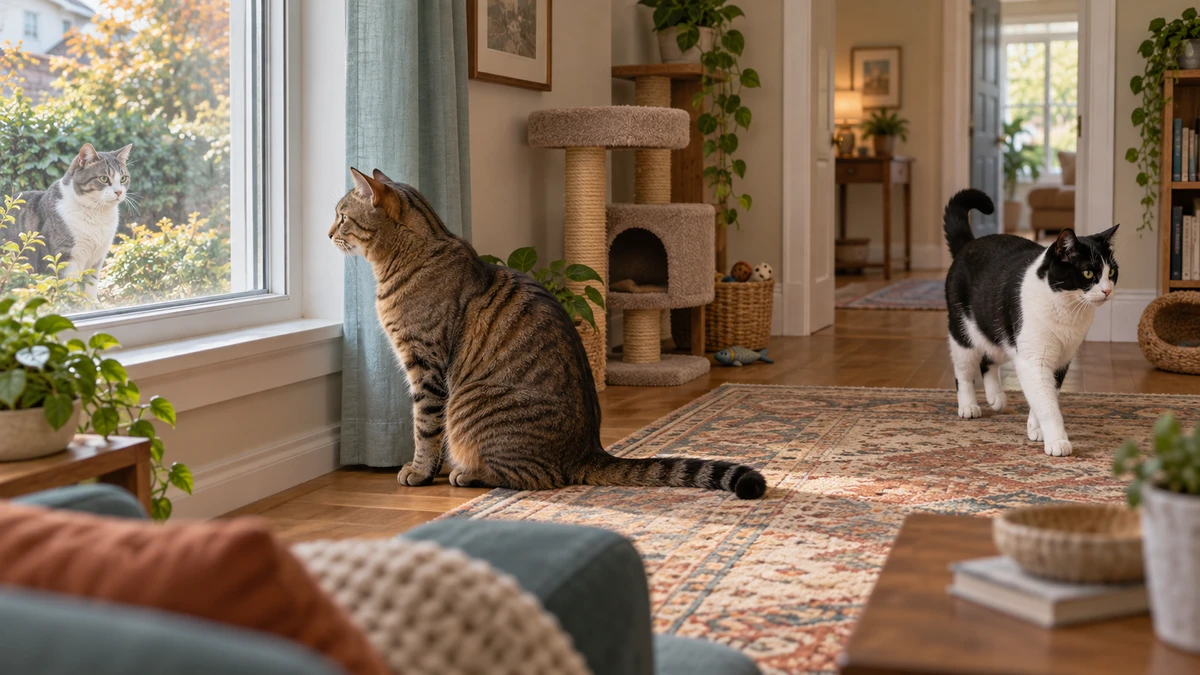
ASPCA notes that the trigger may have occurred earlier, so the attack can appear to come “out of the blue” when nobody noticed the outdoor cat, noise, or odor. This does not mean every unexplained bite is redirected aggression. It means the preceding environment deserves careful reconstruction rather than a confident online diagnosis.
At least seven kinds of stimulus can start the sequence
The original stimulus is not always another cat. Reliable veterinary and welfare sources describe several possibilities:
- An outdoor or unfamiliar cat visible through a closed window, glass door, screen, or patio barrier.
- Birds, squirrels, or other moving animals that hold attention but cannot be reached.
- A sudden, loud, high-pitched, or unfamiliar sound, including an alarm, dropped object, construction noise, or an animal vocalization.
- An unfamiliar animal odor carried on a visitor, clothing, equipment, carrier, or a housemate returning from a veterinary visit.
- An altercation or tense stare between household cats, especially when one cat cannot retreat or the interaction is interrupted at close range.
- A frightening person, dog, novel object, or abrupt household event that produces fear or frustration.
- Pain or physical discomfort. Pain-related aggression is a separate category, but discomfort can also increase irritability and arousal. A sudden change needs veterinary assessment rather than an assumption that a window trigger explains everything.
The same sight or sound will not affect every cat in the same way, and it may not affect the same cat on every day. Distance, escape options, previous learning, health, competing household tension, and the intensity or duration of the stimulus can all change the observable response.
Read a cluster of warning signs, not one body part
No single pupil size, tail position, or ear angle proves redirected aggression. Light changes pupils; play moves tails; fear and pain can share postures. Look for several changes together, compare them with this cat’s baseline, and pay attention to whether the cat can look away and resume ordinary activity.
Possible high-arousal warnings include:
- a fixed stare or repeated return to the window, doorway, sound source, or another cat;
- a suddenly rigid body, crouched body, forward weight shift, or legs held ready to move;
- ears turned sideways or flattened back, sometimes changing rapidly with the source of sound;
- a stiff, lowered, puffed, or forcefully lashing tail;
- pupils that appear unusually wide or narrow for the light, with wide eyes or a tense face;
- whiskers pushed forward or pulled tight, raised fur, or a tightly closed mouth;
- growling, hissing, spitting, yowling, or an abrupt stop in ordinary vocal behavior;
- pacing, blocking, stalking, striking, or an inability to eat, play, groom, rest, or disengage normally.
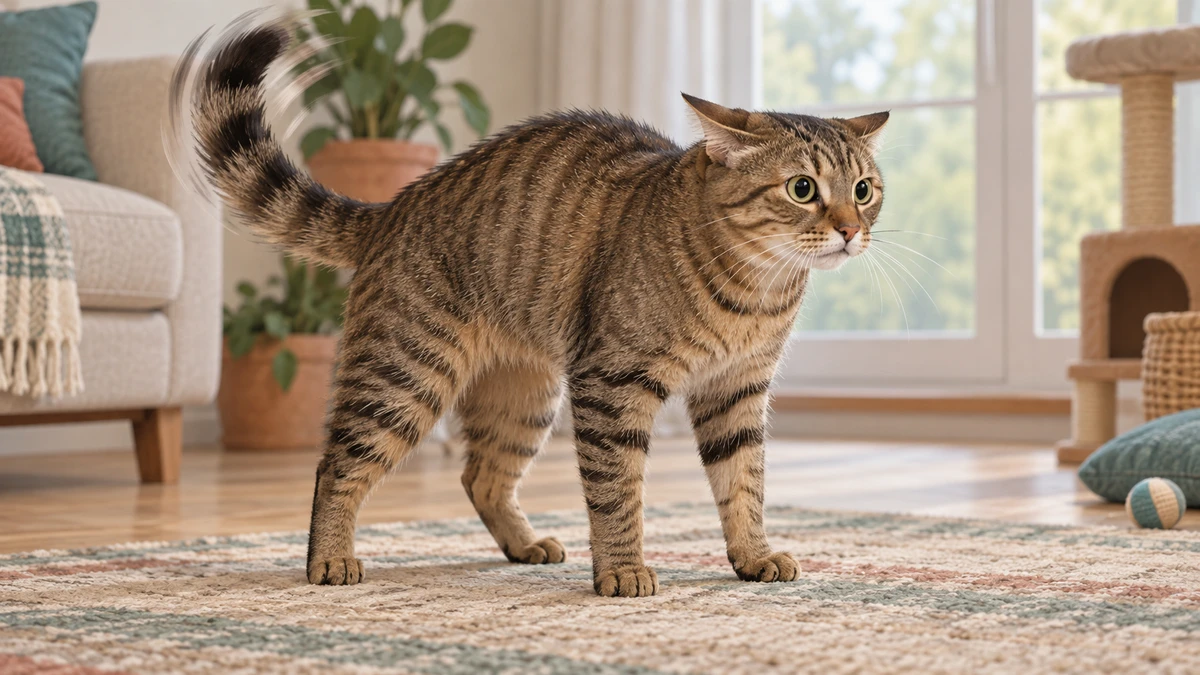
Our guide to signs of stress in cats explains why context, combinations, and recovery are more informative than a checklist score. Treat a tense, staring, growling cat as needing space even if you cannot name the emotion.
How it differs from several look-alikes
These categories can overlap, and a veterinarian may need to rule out pain or illness. The table is a comparison tool, not a diagnostic test.
| Pattern | What usually comes immediately before | What helps distinguish it |
|---|---|---|
| Possible redirected aggression | An intense external or inaccessible trigger, followed by a nearby person or animal entering range | Reconstruct a trigger → sustained arousal → different nearby target sequence; the original trigger may already be gone |
| Play directed at people or cats | Stalking, chasing, ambushing, pouncing, and batting in a play context | Play may be repeated and bouncy with pauses, but rough play can still injure; review the feet-attack guide |
| Petting-related biting | Touch, repeated stroking, holding, grooming, or handling immediately precedes the response | The response is linked to contact; stop touching at early signs and see the petting-bite guide |
| Ongoing intercat tension | Staring, blocking, guarding, following, chasing, or competition occurs across ordinary routines | The relationship pattern extends beyond one trigger event; quiet avoidance and loss of resource access matter too |
| Fear-, pain-, or illness-associated aggression | Approach, movement, touch, restraint, or an abrupt change in tolerance | A new or escalating pattern, pain signs, or changes in appetite, movement, toileting, sleep, or social behavior require veterinary assessment |
“Redirected” describes where the response went, not why the cat became aroused in the first place. A window incident and underlying intercat tension can coexist. A cat in pain can also react to an ordinary approach. Avoid forcing one label onto every future event.
During the incident: eight safety actions
The immediate goal is to prevent more contact, not to train, test, comfort by touch, or prove which cat started it.
- Stop approaching. Freeze or back away slowly if there is room. Do not lean over, stare at, reach toward, pet, pick up, hold, or grab the aroused cat.
- Move people at risk away. Quietly guide children, visitors, and vulnerable adults behind a solid door. Do not ask them to run past the cat.
- Move uninvolved animals only when this can be done without crossing the aroused cat’s path. Close a door between zones; do not carry one cat through the confrontation.
- Never put hands, feet, or your body between fighting or fixated cats. AAFP guidance warns about redirected frustration and human injury during intervention.
- Block visual contact from a safe position. If it can be placed without entering striking range, use a large piece of cardboard, an opaque panel, a cushion, or another solid object to interrupt the sightline and open separate retreat routes.
- Reduce the trigger without closing distance. Lower a blind, close an interior door, or switch off a sound only if the control is safely reachable. Do not walk up to the cat at the window to move the cat yourself.
- Do not punish or startle. No yelling, hitting, spraying, chasing, forced restraint, or “fight it out.” Discipline can add fear and intensify the association between the cats, person, and frightening event.
- Use secure separation and quiet time. Once cats are in different rooms, keep the solid doors closed and provide each with water, litter, bedding, a hiding option, and appropriate food. Avoid repeated check-ins that require close contact.
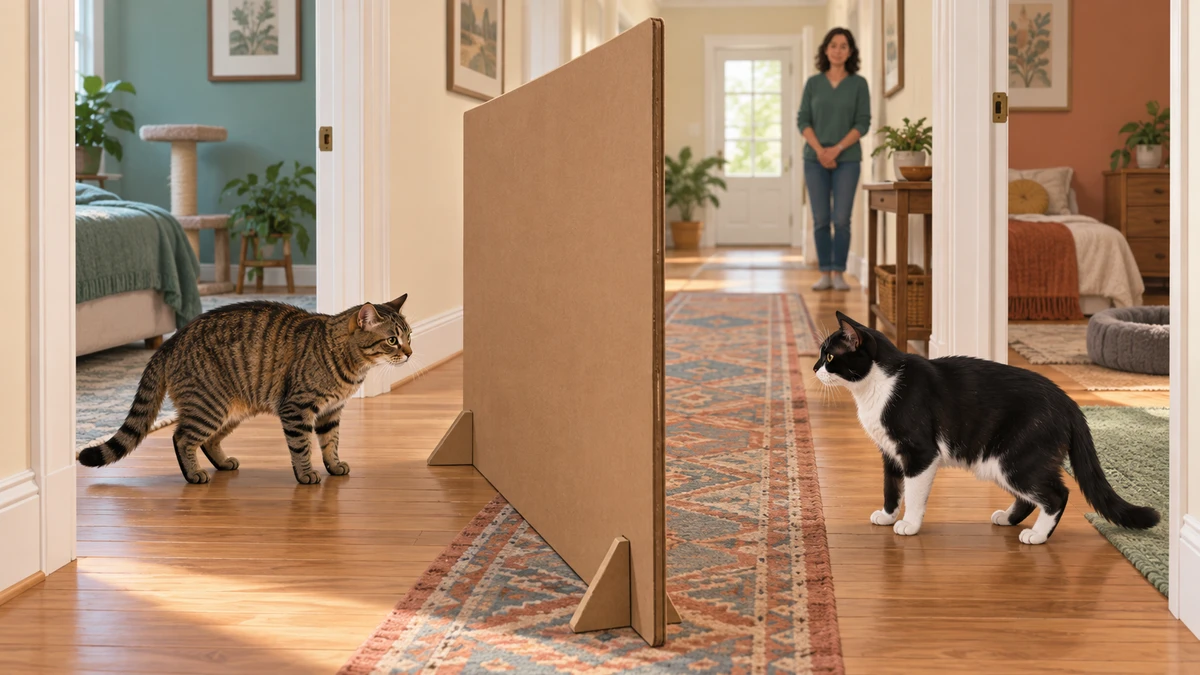
If safe separation cannot be created, people are being charged, a child or vulnerable person is present, or an animal is trapped without an exit, call a veterinarian, emergency veterinary service, or local emergency resource for situation-specific guidance. Generic internet steps cannot make an unsafe room safe.
Recovery is a behavior check, not a timer
Veterinary sources describe recovery periods ranging from minutes to hours and sometimes longer. That range is a warning against using a universal countdown. Opening the door at a preset time can restart the event if either cat is still rigid, scanning, growling, hiding in distress, guarding the door, or rushing the barrier.
Look instead for a return toward each cat’s usual pattern:
- muscles and movement are loose rather than frozen or ready to lunge;
- the cat can look away from the door, window, or housemate;
- ears and tail return to the individual’s ordinary resting positions;
- eating, drinking, toileting, grooming, stretching, play, and rest look normal;
- the cat can hear a small household sound without immediately re-fixating;
- neither cat camps at, strikes, or attempts to rush the separating door;
- the person can observe from a safe distance without the cat escalating.
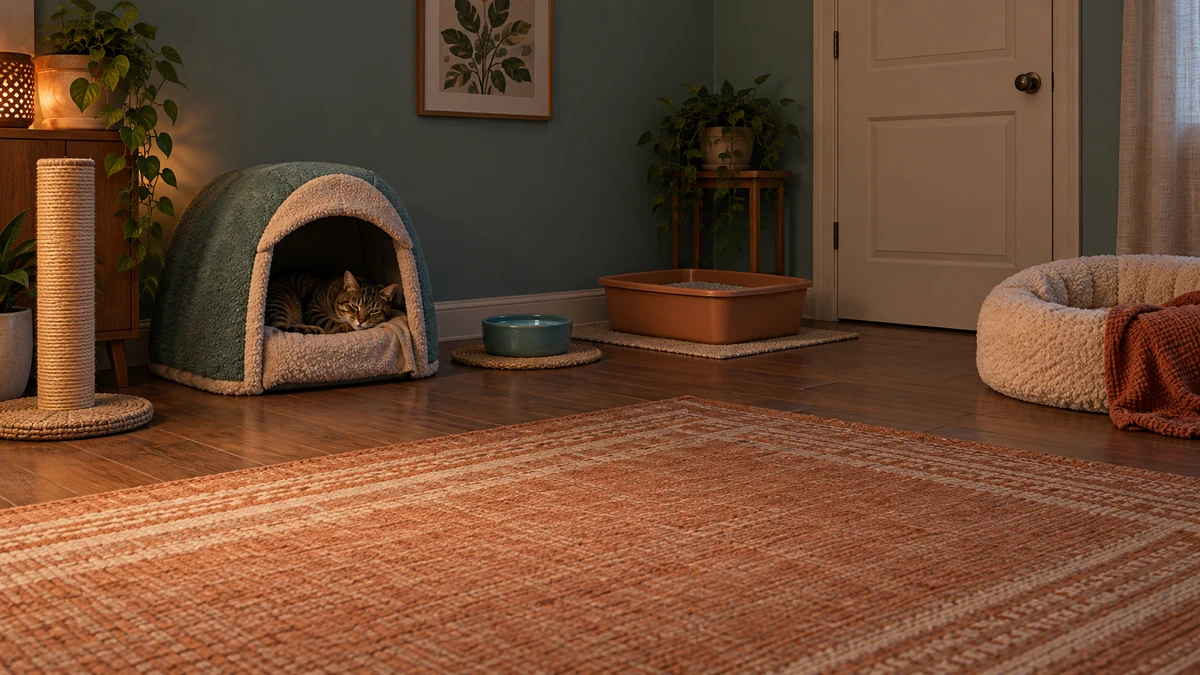
Do not enter to “test” a cat that is still hissing or tail-lashing. Check through a camera, window, or brief distant view when possible. If normal appetite, toileting, movement, or behavior does not return, contact a veterinarian. Persistent refusal to eat is not a reintroduction problem to solve with treats.
Build a factual incident record
A short record can reveal a preventable pattern and give a veterinarian or behavior professional useful evidence. It should preserve observations, not argue for a diagnosis.
Record:
- date, time, room, people, and animals present;
- sights, sounds, smells, handling, conflict, deliveries, outdoor activity, or veterinary visits in the preceding period;
- the first body-language change you noticed and the distance from the possible trigger;
- the first target of staring or vocalizing and the later target of swatting, chasing, scratching, or biting;
- barriers, exits, and resources that were available or blocked;
- what people did, including whether anyone approached, touched, shouted, sprayed, or attempted to separate;
- injuries or possible bites for every person and animal;
- when each cat resumed ordinary eating, drinking, toileting, grooming, movement, play, and rest.

A distant video can help only when recording does not delay separation or put anyone closer to danger. Never recreate the trigger to get better footage.
Reduce repeat exposure without shrinking the cat’s whole life
Match the environmental change to the observed trigger. For a recurring outdoor-cat sightline, cover the lower part of the window with privacy film, lower a blind during predictable visits, move a perch away from the direct view, or use humane outdoor deterrence on your own property. Keep windows and screens secure. Do not punish the indoor cat for looking outside, and do not use devices that can harm, trap, or terrify animals.

For noise triggers, increase distance, provide a familiar quiet refuge, and prevent multiple stressors from stacking. For odor-related episodes after one cat returns from a clinic, use temporary separation and let familiar household scent normalize before close contact. For multi-cat tension, distribute food, water, litter, resting places, scratching surfaces, height, and hiding options so one cat cannot control all access. MSD and AAFP guidance emphasize physical, visual, and sometimes odor separation plus adequate three-dimensional space and separated resources.
Preserve normal play and choice. Arousal management is not permanent confinement or removing every window. The aim is to prevent a repeatable high-risk setup while maintaining routes, height, resting places, and activities that support normal feline behavior.
Reintroduce household cats in small, reversible stages
If aggression was directed at a housemate, do not open the door merely because the original outdoor cat has left. VCA notes that fear and defensiveness after the attack can change the cats’ relationship. AAFP guidance recommends separation until both have returned to normal routines, followed by gradual reintegration.
- Keep solid separation. Give each cat a complete safe zone. Resolve injuries and health concerns first. Wait for normal behavior on both sides of the door.
- Restore predictable routines. Feed, play, scoop litter, and offer human interaction separately. Neither cat should lose access to essentials because of the incident.
- Exchange scent only when both are calm. Swap bedding or a soft item without pushing it toward the cat. If sniffing leads to prolonged staring, marking, hiding, or vocalizing, remove it and add time and distance.
- Add brief, distant visual access. Use a tall secure mesh gate, screen, or glass door. Begin partly covered or at enough distance that both cats can look away, move normally, and leave. End before tension rises.
- Pair calm presence with separate positive activities. Use individual food portions, play, or attention only when each cat participates normally. Refusal, freezing, fixed staring, growling, tail lashing, or door striking means the setup is too difficult.
- Try short supervised proximity last. Use a large room with multiple exits, high places, hiding options, and passive barriers ready. Do not hold cats nose-to-nose. Increase time only across repeated calm sessions; return immediately to the previous stage if either cat cannot disengage.

The full cat introduction guide gives a more detailed scent, site-swap, visual, and supervised-contact plan. Peaceful distance is a valid outcome. The cats do not need to sleep together or become friends.
When professional help is the safest next step
Arrange veterinary assessment when aggression is new, sudden, repeated, escalating, or associated with pain signs, reduced appetite, changed drinking, vomiting, altered toileting, reduced mobility, confusion, sleep changes, or another departure from baseline. Cornell and AAFP both emphasize ruling out medical contributors. Do not give human medication, leftover veterinary medication, supplements, or sedatives based on a general article.
Seek prompt veterinary care for an animal with a wound, possible bite, limping, swelling, pain, breathing change, collapse, or marked withdrawal. Cat punctures can hide under fur; do not handle an aroused cat to search for them. Wait for safe handling or follow the clinic’s instructions.

For a person who is bitten or scratched, move to safety and wash the wound with warm soapy water. CDC advises medical attention when a wound is serious, becomes red, painful, warm, or swollen, when rabies vaccination status is uncertain, when the cat appears ill, or when tetanus protection may be out of date. Local rabies and bite-reporting rules vary, so contact a healthcare professional or local public-health service for guidance rather than relying on this behavior article.
Ask the veterinarian for a board-certified veterinary behaviorist or another appropriately qualified feline behavior professional when you cannot isolate safely, attacks recur, the trigger cannot be managed, housemates cannot progress through reintroduction, or people are afraid to use the home. The plan should be reward-based and coordinated with veterinary care. Hitting, yelling, and spraying do not teach a safe alternative.
Frequently asked questions
Will my cats be safe together as soon as the outdoor cat leaves?
Not necessarily. Arousal can remain after the trigger disappears, and the attacked cat may now respond defensively to the housemate. Keep solid separation until both cats have returned to normal routines, then use gradual reintroduction rather than an immediate test.
Should I pick up the cat and carry them to a quiet room?
No—not while the cat is rigid, staring, hissing, growling, tail-lashing, striking, or otherwise highly aroused. Touching and lifting put your face and hands within reach and remove the cat’s escape choices. Move other people and animals away, open a safe retreat route if possible, and use doors or a passive visual barrier without entering striking range.
How long should I keep the cats separated?
There is no universal number of hours. Use behavior: both cats should resume ordinary eating, toileting, grooming, movement, rest, and ability to disengage. If tension remains, normal behavior does not return, or you cannot assess safely, contact a veterinarian.
Is a tail flick enough to identify redirected aggression?
No. Tail movement can occur in several emotional and activity contexts. Look for a sequence, a cluster of body-language changes, a possible inaccessible trigger, a different nearby target, and the recovery pattern. A veterinarian should assess new or concerning aggression.
Can punishment stop this from happening again?
No. Punishment can add fear and worsen the relationship or the association with the event. Prevent access to repeatable triggers, provide space and separated resources, reinforce calm behavior at safe distances, and get qualified help when risk remains.