Why Do Cats Hiss? Treat the Warning as a Request for Space
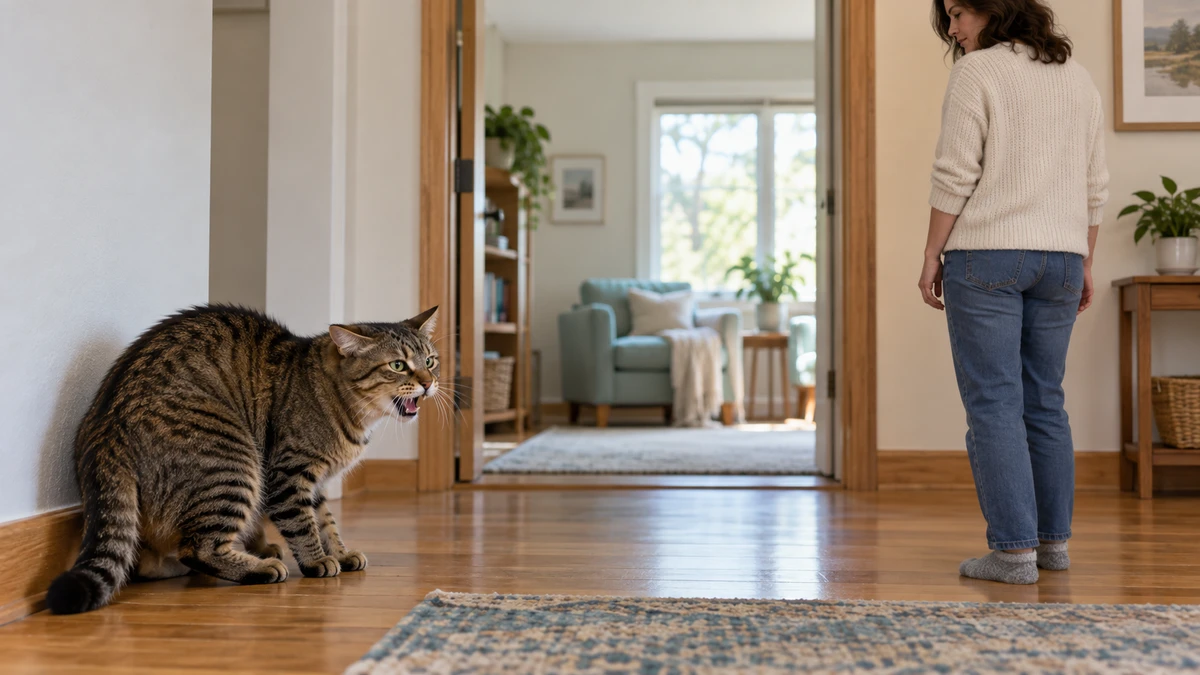
Cats usually hiss as a defensive, distance-increasing warning: something feels too close, too intense, painful, frustrating, or unsafe, and the cat needs the pressure to stop. A hiss is useful information, not proof of a “bad” personality and not a one-word translation of anger. Stop approaching or touching, avert your gaze, leave an open retreat, reduce the trigger, and keep children and other animals back. Then read the cat’s whole body, the setting, and what changed before deciding what help comes next.
A hiss may prevent a bite because it gives everyone a chance to disengage. It does not guarantee that a cat will attack, but it also should not be tested. A quiet cat is not automatically a comfortable cat, either: freezing, hiding, or being unable to escape can occur without a sound. Treat the hiss as a boundary now; investigate the reason only after safety and calm return.
A hiss is a signal, not a diagnosis
The 2022 AAFP/ISFM Cat Friendly Veterinary Interaction Guidelines describe growling, hissing, striking, and biting as ways a cat may try to repel a perceived threat when inhibition or escape is not working. Relevant protective emotions can include fear-anxiety, pain, and frustration. This makes “please create distance” a practical response to a hiss, but it does not reveal which emotion is active or what caused it.
A clinical review of feline emotions explains why interpretation must stay cautious: cats have a limited set of visible behaviors, so the same behavior can occur under different emotional systems. More than one emotion may also be active at once. A cat blocked by a stranger may be frightened and frustrated; a cat with a sore area may fear a familiar hand because touch predicts discomfort.
Do not diagnose from sound alone. Describe the sequence instead: what approached, how close it came, whether the cat could leave, what the ears, eyes, whiskers, body, and tail did, and how long recovery took.
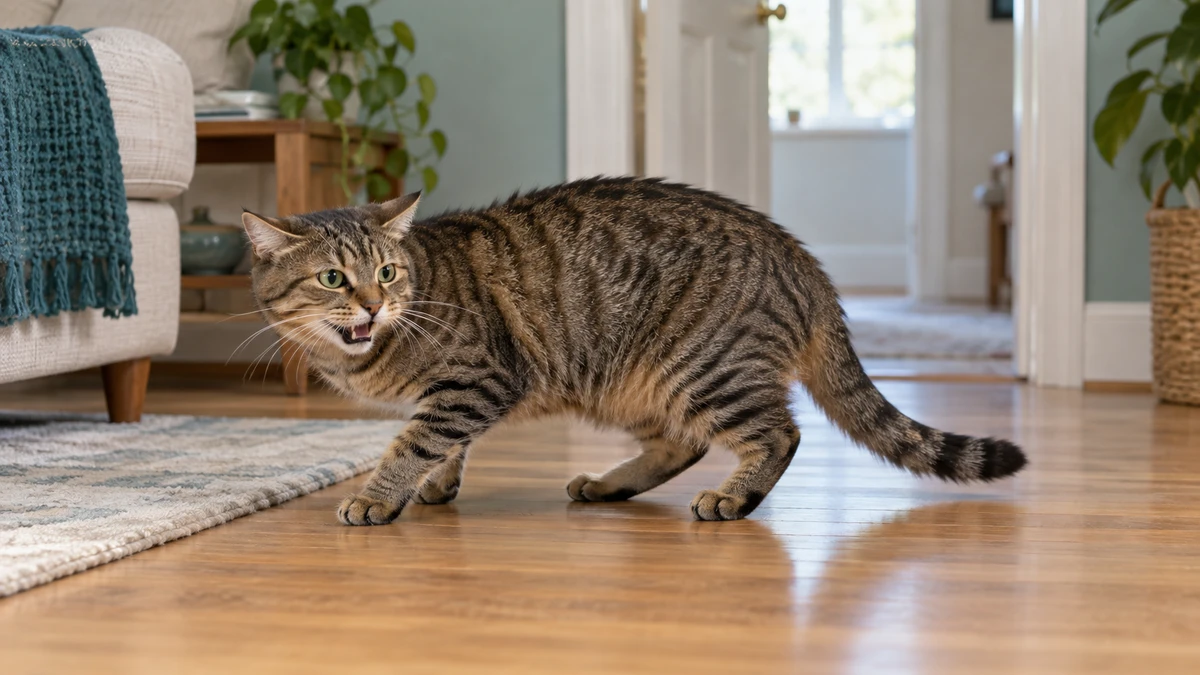
Read at least ten body and environment clues together
The 2021 AAHA/AAFP life stage guidelines list hissing among vocalizations that may indicate defensiveness. They also describe changes in posture, ears, pupils, whiskers, movement, and tail as parts of a fearful or distressed pattern. None of those signs is a standalone emotion meter. Pupil size changes with light; a moving tail has several meanings; ears can rotate toward a sound. Compare a cluster with this cat’s normal behavior and the immediate context.
| Clue | What to observe | Why it matters without becoming a verdict |
|---|---|---|
| Ears | Forward, turned sideways, rotated back, or flattened | Increasing rotation or flattening can accompany arousal, but sound direction also affects the ears |
| Eyes and gaze | Pupil size, squinting, scanning, fixed staring, or looking away | Light changes pupils; a hard stare, repeated scanning, or reduced blinking adds context |
| Whiskers and muzzle | Loose curve, pulled back, splayed or forward whiskers, tense muzzle | Facial tension can accompany protective emotions or pain and should be read with posture |
| Body height and tension | Soft posture, crouching, flattening, arching, freezing, or rigid muscles | Low or frozen does not mean calm; it may show inhibition or preparation to escape |
| Weight direction | Leaning away, backing up, turning aside, or shifting forward | Weight moving away supports a request for distance; forward weight raises immediate risk |
| Tail and coat | Low or tucked tail, fast flicking, lashing, puffed fur, or a still rigid tail | The change from that cat’s baseline and the speed of movement matter more than one snapshot |
| Paws and movement | Paw lift, retreat, escape attempt, swat, or inability to move | A cat that can leave may choose retreat; a trapped cat has fewer safe options |
| Exit and barriers | Open route, corner, carrier, lap, doorway, furniture gap, or blocked hall | The same approach can feel very different when escape is available versus blocked |
| Trigger | Person, animal, touch, sound, object, odor, pain, or an inaccessible outdoor cat | Identify what changed immediately before the hiss rather than guessing a personality trait |
| Recovery | Return to resting, eating, grooming, play, or social behavior | Recovery time helps show whether this was a brief startle or a larger continuing problem |
The direction of change matters. Ears moving farther back, muscles tightening, weight shifting forward, repeated hissing, growling, swatting, or pursuit indicate escalation. Looking away, taking a route out, loosening the body, and returning to ordinary activities indicate de-escalation. Do not move closer to “check” either pattern.
Seven common contexts for hissing
These contexts are prompts for observation, not labels to apply remotely.
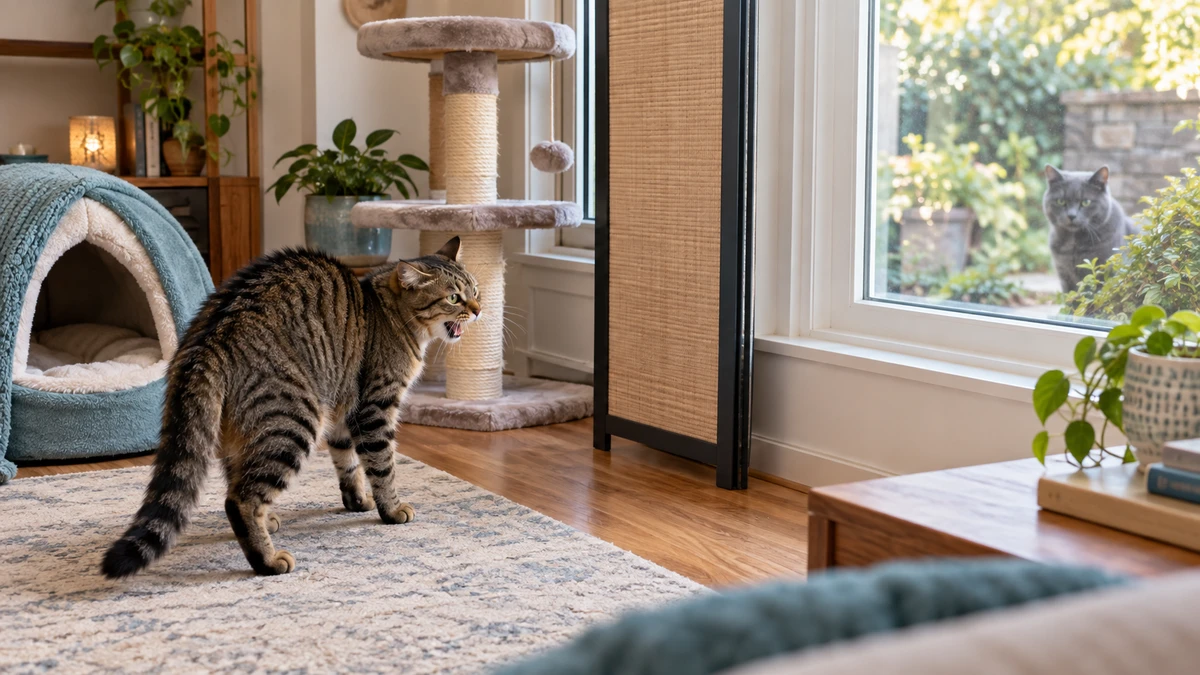
- An unfamiliar person or animal appears. A visitor, dog, new cat, veterinary staff member, or animal outside a window can feel uncertain or threatening. The cat may hiss while retreating, hiding, or trying to make the newcomer stop.
- Someone approaches or blocks the route out. Direct walking, leaning over, staring, reaching into a hide, cornering, or standing in a doorway can remove the cat’s preferred option to leave.
- Handling continues past the cat’s tolerance. Petting, brushing, nail care, lifting, restraint, medication routines, or carrier loading may trigger a hiss when earlier signals were missed or the task became too intense.
- Touch or movement may hurt. The ISFM acute pain guidelines include hissing, hiding, reluctance to move, reduced appetite or grooming, defensive behavior, and a reaction to touch among observations that can accompany pain. A hiss over one body area is a reason to stop touching and call a veterinarian, not a home pain test.
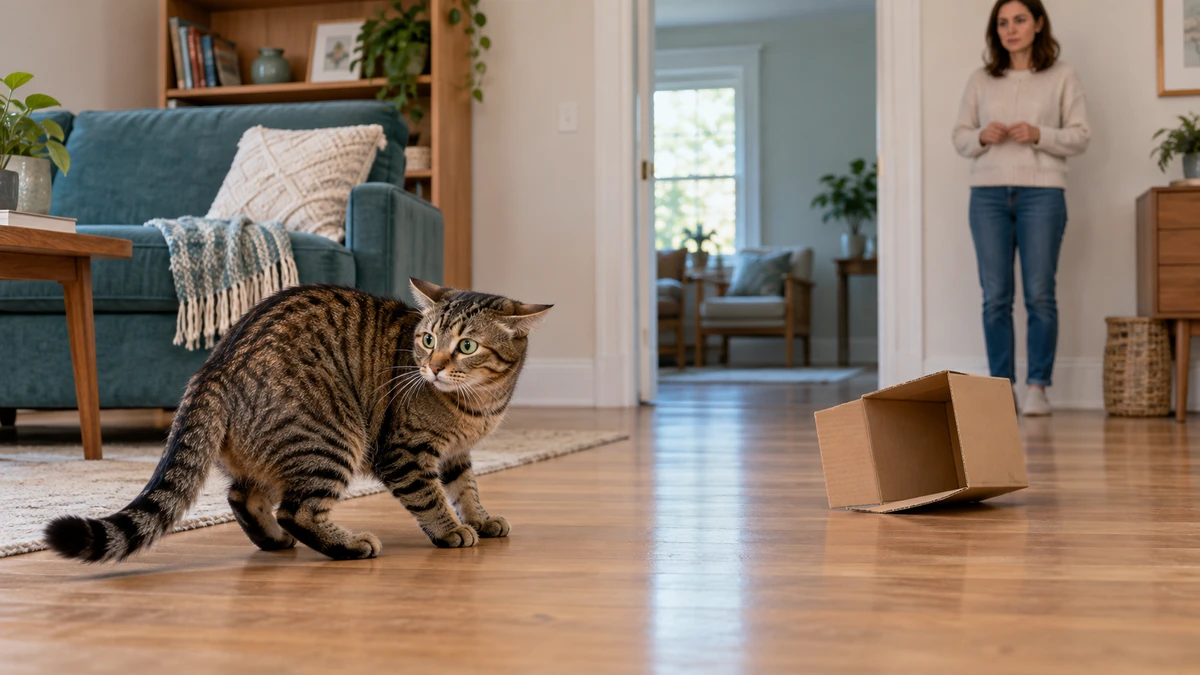
- A sudden event startles the cat. A dropped object, appliance, shout, door, unfamiliar odor, waking touch, or fast movement can produce a brief defensive response before the cat understands what happened.
- Space or resources are under pressure. In a multi-cat home, staring, stalking, blocking a hall or litter route, guarding a perch, or crowding food, water, and resting locations may accompany hissing. The 2024 AAFP intercat tension guidelines stress dispersed resources, visual barriers, and safe places with more than one route.
- High arousal is redirected. A cat activated by an outdoor cat, noise, or conflict may hiss at a nearby person or animal that was not the original trigger. Do not touch or pick up a highly aroused cat. The redirected aggression guide explains how to use distance and solid barriers.
Hissing can also appear in rough social encounters, but the sound alone does not tell you whether two cats can safely continue. Balanced play usually includes pauses and role changes, while persistent pursuit, blocking, one-sided retreat, growling, screaming, or injury requires intervention. Use the play-versus-fighting checklist and separate safely when in doubt.
What to do in the moment: eight safety steps
- Stop the approach and stop touching. Freeze your own advance. If your hand is already near the cat, withdraw it slowly without reaching over the cat.
- Turn slightly sideways and soften your gaze. Do not stare, lean over, put your face near the cat, or demand eye contact. Keep your hands low and movements small.
- Open a retreat instead of directing the cat. Step out of the doorway, clear people and objects from the route, and allow access to a familiar room, high perch, open carrier, or covered hide. Never pull the cat from hiding.
- Lower the stimulus. Reduce sound and movement. Stop the vacuum or grooming task, close a curtain if an outdoor animal is the trigger, or ask a visitor to sit and ignore the cat.
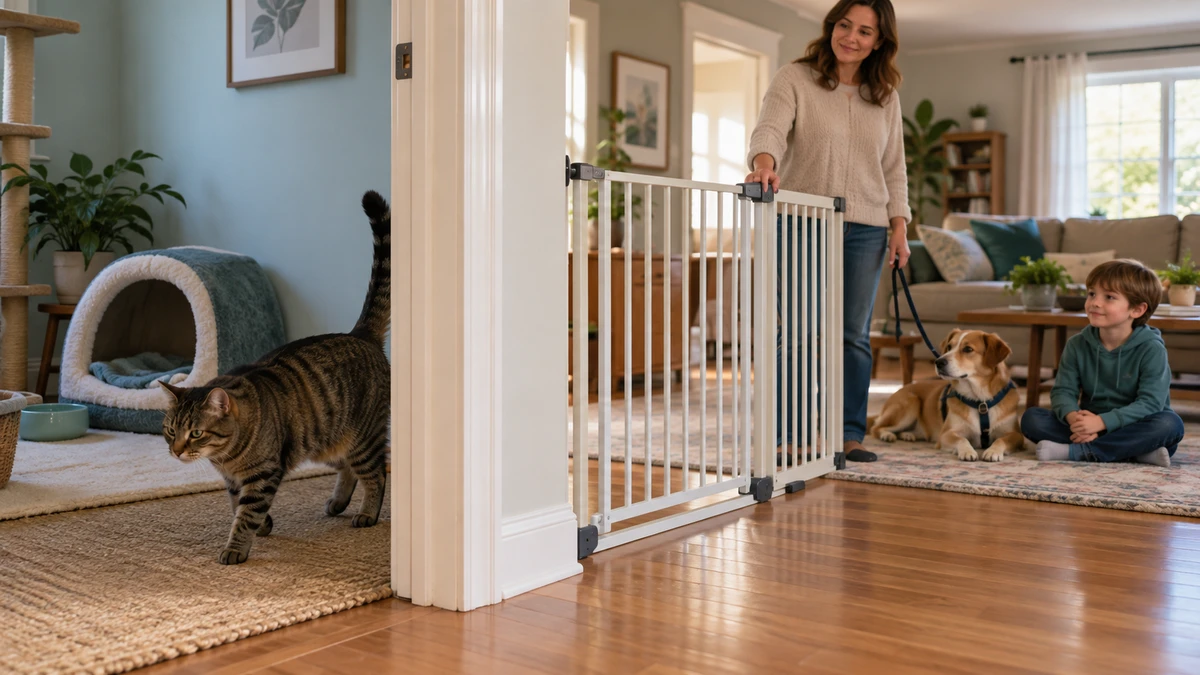
- Move children and other animals away. An adult should use a closed door, secure gate, or solid visual barrier. Do not ask a child to test whether the cat is “friendly now,” and do not carry the hissing cat past a dog or another cat.
- Do not grab, pick up, restrain, or chase. High arousal raises the risk of scratches, bites, and redirected behavior. In a tense cat-to-cat scene, place a large opaque object between sight lines from a safe distance; never put hands between the cats.
- Do not punish or answer the hiss. Do not yell, hit, spray water, clap near the cat, blow at the face, imitate a hiss, or force continued exposure. FelineVMA notes that punishment can increase fear and fear-related aggression; Merck likewise warns that confrontational methods can increase fear, avoidance, and aggression.
- Allow a real recovery period. Do not restart the interaction as soon as the mouth closes. Wait for the cat to move freely and resume ordinary behavior. Depending on the event, recovery may take minutes, hours, or longer.
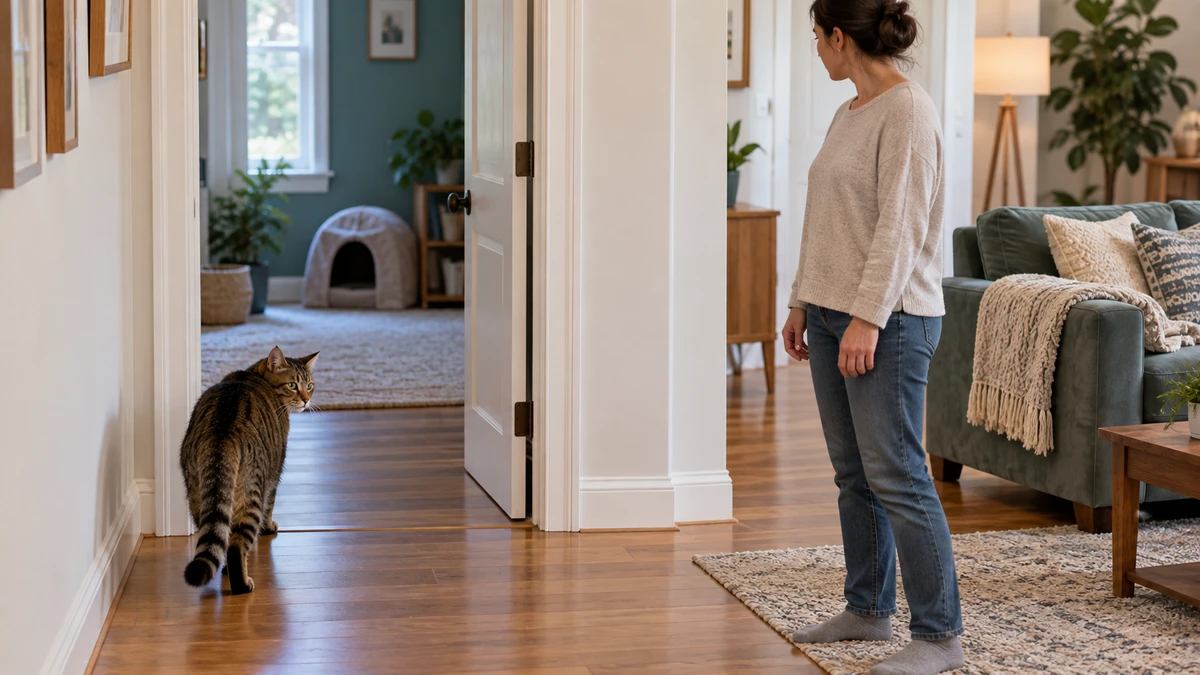
If a cat is loose near an exterior door, close the exterior route before increasing indoor space. If anyone is injured, separate the animals safely and seek appropriate medical or veterinary advice. Safety management is not punishment; it prevents another intense rehearsal while the cause is assessed.
If hissing happens during touch or care
A hiss during brushing, petting, lifting, nail care, or carrier work means the current version of the interaction should stop. It does not grant permission for “one last paw” or a firmer hold. Note the body area, tool, duration, posture, and earlier signals. Do not repeatedly press the spot to prove it hurts.
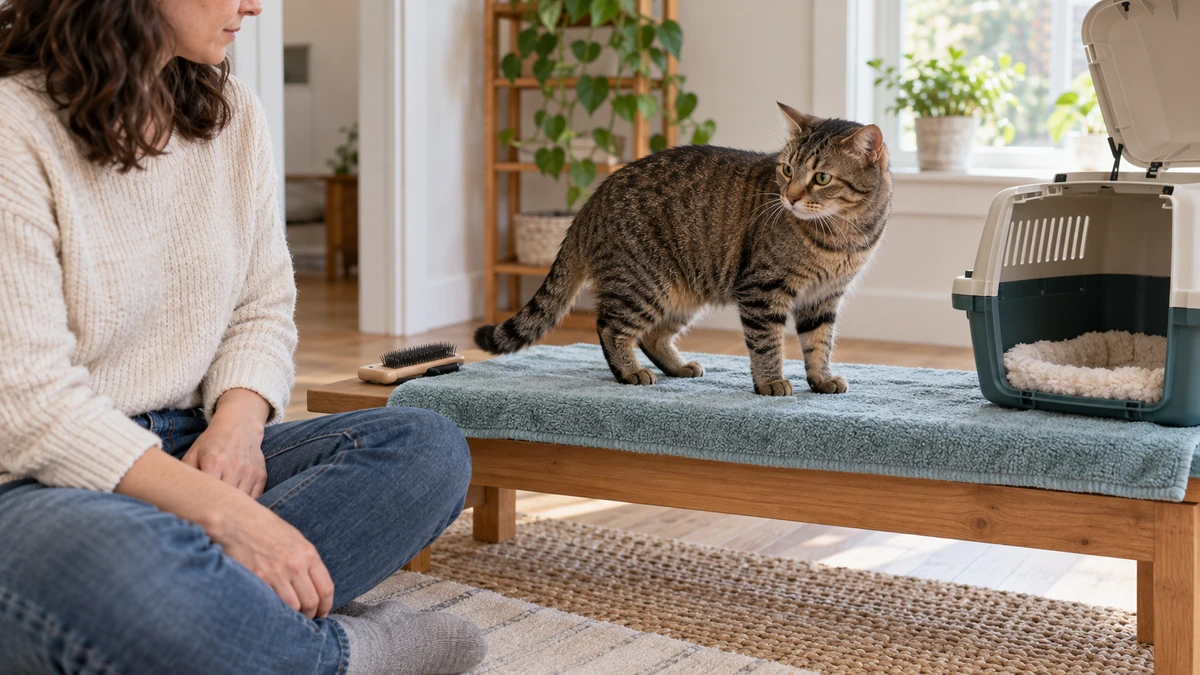
If the pattern is new, limited to one area, or paired with movement, appetite, grooming, sleep, or litter changes, contact a veterinarian. For routine care after medical issues are addressed, rebuild with shorter voluntary steps. The carrier-training guide shows how an open carrier can become a familiar choice rather than an emergency trap.
Protect children and other animals without blaming the cat
Cats Protection describes hissing, ruffled fur, and a swishing tail as warnings for children to stay away. Adults—not children—must manage space. A child may miss subtle cues, move quickly, or follow a retreating cat. Set a simple household rule: no touching, following, cornering, or reaching into a hide when a cat walks away, freezes, growls, or hisses.
Other animals need management too. Use doors, secure gates, visual barriers, separated resources, and supervised movement. A leash on a calm dog may be useful only when an adult can move the dog away without bringing it closer to the cat. Do not hold the cat in someone’s arms for an “introduction.” For visitor-specific planning, see the cat-afraid-of-visitors guide.
Keep an event record before changing everything
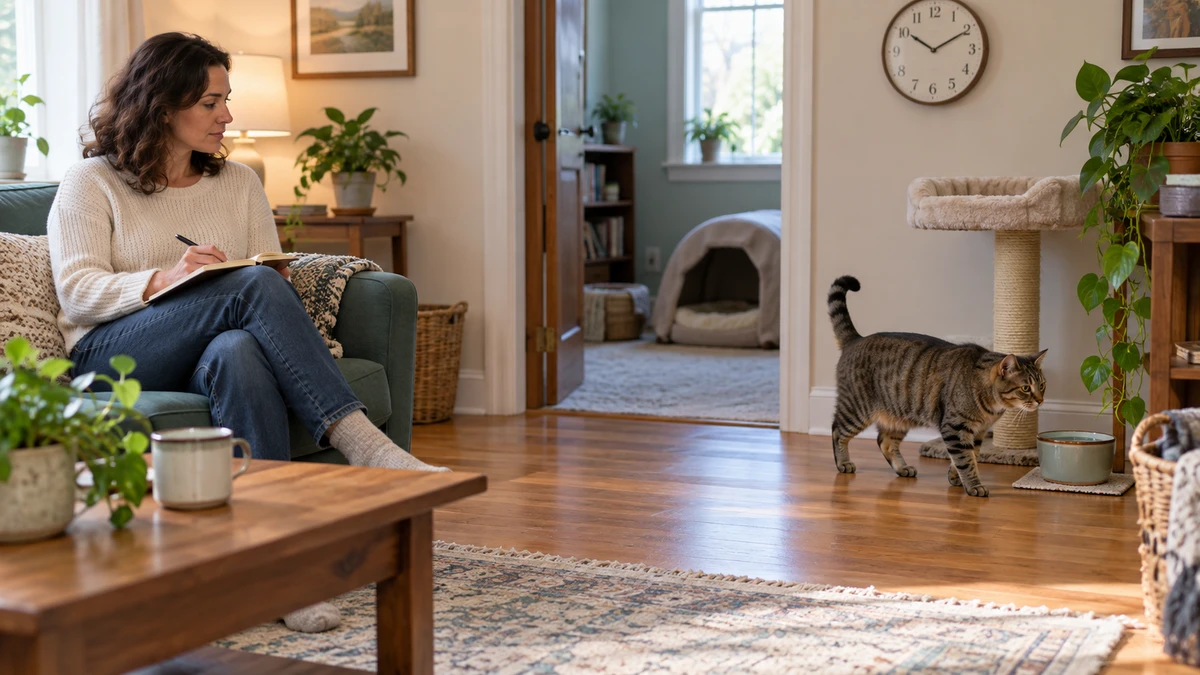
When everyone is safe, write down the event without moral labels:
- date, time, place, and what happened immediately before the hiss;
- people and animals present, their movement, sound, distance, and gaze;
- whether the cat was resting, eating, playing, eliminating, grooming, or being handled;
- ear, eye, whisker, body, weight, tail, and movement changes before and after the sound;
- available exits, hiding places, heights, doors, and any blocking;
- whether there was a growl, spit, swat, chase, bite, or injury;
- appetite, drinking, litter use, grooming, mobility, sleep, and social changes;
- how long it took to resume the cat’s usual activities.
A short video can help a veterinarian or qualified behavior professional if it can be captured from a distance without staging, approaching, or repeating the trigger. Do not provoke a hiss for the camera. The signs-of-stress guide can help organize observations without turning them into a home diagnosis.
Rebuild tolerance only below the cat’s reaction level
First address medical concerns, injury risk, blocked resources, and unavoidable triggers. Planned training is appropriate only when the environment can be controlled and the cat is calm enough to eat, play, explore, rest, or leave in a normal way.
Merck describes desensitization as controlled exposure in small steps and warns that moving too quickly provokes anxiety. Counterconditioning pairs that low-intensity version with something the cat values. In practice:
- define one trigger precisely, such as a brush visible at 2 m—not “grooming” in general;
- begin at a distance, volume, duration, or movement level that does not produce freezing, retreat, hissing, or another marked change;
- offer an individual reward such as food, play, or access to a preferred activity, without luring the cat closer;
- keep the exit open and end while behavior is still relaxed;
- repeat the easy version before changing only one variable;
- if tension rises, stop and make the next session easier rather than waiting for the cat to “get used to it.”
The goal is not to suppress the warning. It is to reduce the need for a warning by increasing safety, predictability, choice, and positive associations. Flooding—holding the cat in a high-intensity situation until it becomes quiet—is not proof of learning and can make the problem worse.
When veterinary or behavior help should come next
Arrange veterinary advice when any of these eight conditions apply:
- hissing is new, suddenly more frequent, or occurring without an identifiable change;
- it begins with touch, lifting, jumping, stairs, grooming, eating, toileting, or movement, especially around one body area;
- appetite drops, the cat refuses food, loses weight, or changes how it chews;
- hiding, sleep, grooming, play, mobility, social contact, drinking, urination, or defecation changes from baseline;
- there is a wound, fall, limp, swelling, breathing change, repeated vomiting, marked weakness, or another physical concern;
- hissing escalates to repeated swatting, chasing, biting, sustained conflict, or injury;
- children, vulnerable adults, or other animals cannot be kept safe with a reliable separation plan;
- careful environmental changes do not improve the pattern, or a gradual plan is too difficult to run below the cat’s reaction level.
The ISFM pain guidelines show why a cluster matters: hissing may occur with pain, but so may hiding, reduced movement, reduced appetite or grooming, and defensiveness. These signs do not identify a disease at home. A veterinarian can assess health and pain, then refer to a qualified feline behavior professional or veterinary behaviorist when needed. Medication, supplements, and pain treatment belong in an individual veterinary plan; do not use human medication or another pet’s prescription.

A hiss is not a character flaw to eliminate. It is an early opportunity to prevent escalation: make space, restore an exit, observe the whole pattern, and respond to sudden or risky change with professional help.
Frequently asked questions
Does a hiss mean my cat will bite?
Not necessarily, but the risk should not be tested. A hiss is a repelling warning that can occur before the cat retreats, freezes, swats, or bites. Stop the interaction, create distance, and protect an exit. Escalating body tension, forward weight, repeated vocalization, pursuit, or striking requires even more caution.
Should I hiss back so my cat understands me?
No. Imitating a hiss, blowing at the face, yelling, spraying, or startling can add threat and damage trust. Human timing and meaning are not a safe feline conversation. Respond by stopping, turning aside, reducing the trigger, and allowing the cat to leave.
Why does my cat hiss at someone they know?
Familiarity does not prevent startle, pain, unwanted touch, changed odor, blocked escape, frustration, or high arousal from another trigger. Record what changed just before the event. A new pattern with familiar people—especially with touch or other daily changes—deserves veterinary advice.
Can I comfort a hissing cat by picking them up?
Do not pick up a hissing or highly aroused cat. Even a cat who usually enjoys being held may bite or scratch when escape feels blocked. Offer space, a safe route, and a quiet environment; let the cat choose whether and when to return.
How long should I leave the cat alone?
There is no universal timer. Wait for more than silence: look for freely chosen movement and a return toward that cat’s normal resting, eating, grooming, play, or social behavior. If the cat cannot settle, the trigger cannot be managed safely, or other health changes appear, contact a veterinarian.